
The United States Department of Agriculture has advised farmers that plant hardiness zones must shift 100 miles north. They expect this shift will become 300 miles by 2050. The areas which are left behind will become unable to grow wheat unless heat-tolerant strains become available. But help is at hand as scientists are well on their way with solutions:
https://www.lancaster.ac.uk/news/scientists-take-a-step-closer-to-heat-tolerant-wheat
New types of weeds and insect pests will also develop in the hotter and drier conditions where wheat was grown when winters were less warm.
Wheat is a staple food, and as such it has a long history since humans began farming it, see:
https://sustainablefoodtrust.org/news-views/a-brief-history-of-wheat
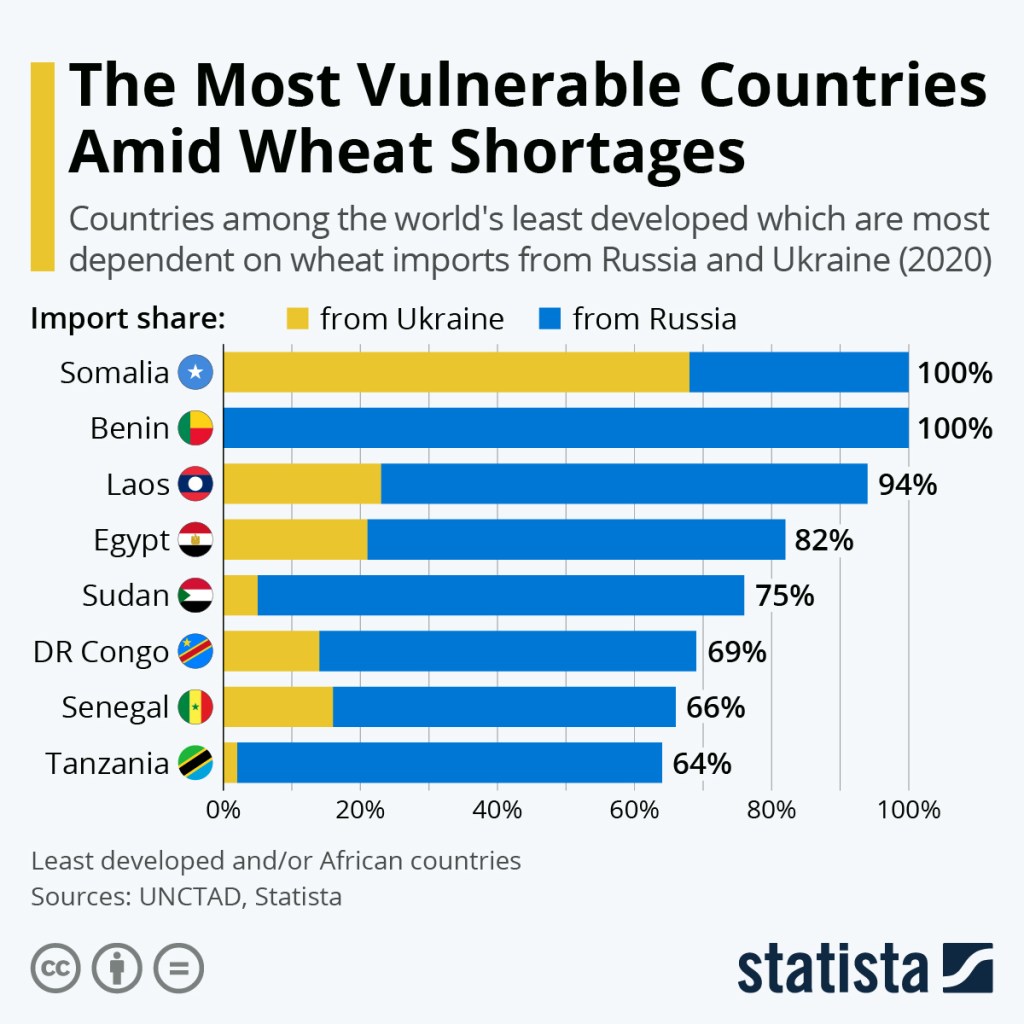
The major producers in the world are China. The most dependent on donations of wheat are countries now suffering years of increasing drought and consequencies of war. Most of these countries are in Africa who have depended on Russian and Ukrainian supplies.
For details of the top ten growers in the world see:
https://www.worldatlas.com/articles/top-wheat-producing-countries.html
And for the full account of global wheat production see:
Although the crop is most successful between the latitudes of 30° and 60°N and 27° and 40°S (Nuttonson, 1955), wheat can be grown beyond these limits, from within the Arctic Circle to higher elevations near the equator. Development research by the International Maize and Wheat Improvement Center (CIMMYT) during the past two decades (Saunders and Hettel, 1994) has shown that wheat production in much warmer areas is technologically feasible. In altitude, the crop is grown from sea level to more than 3 000 masl, and it has been reported at 4 570 masl in Tibet (Percival, 1921).
The 5 biggest wheat exporters (Russia, United States of America, Australia, Canada and Ukraine) provided about three-fifths (59.5%) of the overall value of international shipments for the nourishing cereal food. See:
https://www.worldstopexports.com/wheat-exports-country
Among the top exporters, the fastest-growing wheat suppliers from 2020 to 2021 were: India (up 609%), Australia (up 167.2%), Bulgaria (up 96%), Romania (up 89.2%) and Argentina (up 46.5%).
Such a significant disaster of dead and dying through inadequate rescue supplies is now ongoing, yet even if present supplies eventually arrive this year 2022, what of future years?
Newswise — Wheat is the world’s largest rain-fed crop in terms of harvested area and supplies about 20% of all calories consumed by humans. A new study has found that unless steps are taken to mitigate climate change, up to 60% of current wheat-growing areas worldwide could see simultaneous, severe and prolonged droughts by the end of the century.
See:
https://www.newswise.com/articles/assessing-the-effects-of-climate-change-on-future-wheat-production

 borderslynn
You must be logged in to post a comment.