
Watching the evacuation of people around the world suffering climate change impacts such as flooding, landslides, wildfires – it occurred to me, how do these thousands of people arrive at a safe place and have access to sanitation?
Today, the United States has been so beleaguered by one climate change impact disaster after another, FEMA has had to declare its funds will run out this month as they try to help in the latest disaster, the Lahaina, Maui fireball which consumed the historic town.
Additionally, thousands of asylum seekers have fled to perceived safer areas of the world, but adding an additional burden on sanitation infrastructure. The barge docked in a Dorset, UK, port was found to have legionella infestation in the vital water system. The small number of inmates had to be removed after arriving a few days earlier. Sanitation preparedness is so important as more challenges occur around the world. They cannot be ignored.
Even Fulton Prison, Georgia, USA, in the news in the past week, was reported to be a new build in the 1980s but already rapidly deteriorating. There are twice as many prisoners housed there than it was designed for. Sanitation is primitive and prisoners get ill and die due to unsafe washing and toilet facilities.
https://edition.cnn.com/2023/07/13/us/fulton-county-jail-atlanta-doj-investigation/index.html
The UN had urged us to be prepared for the danger ahead through lack of sanitary facilities for those who have been evacuated due to disasters. But there is a long history of inadequate sanitation for favelas, prisons, even hospital in the UK, and any place where the root cause is neglect and poverty. There are so many places where humans find themselves forced to be, yet in danger from unhygienic conditions:
https://news.un.org/en/story/2022/05/1118722
Climate change threatening access to water and sanitation
Unsplash/Patrick Federi
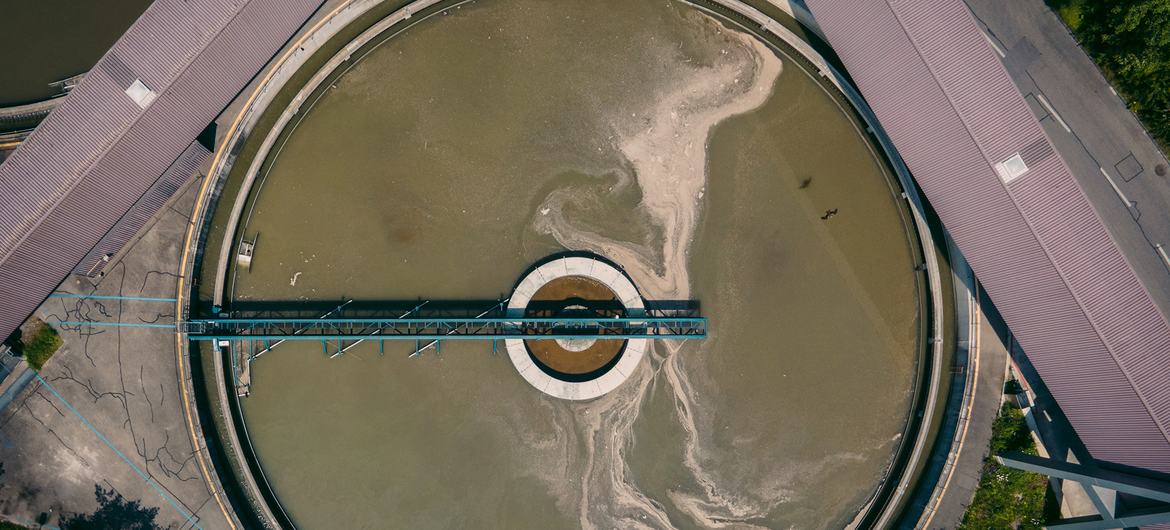
A sewage treatment plant in Zurich, Switzerland.
20 May 2022Climate and Environment
Climate change is set to increase pressure significantly on people’s access to water and sanitation unless governments do more to prepare key infrastructure now, the UN warned on Friday.
“Climate change is already posing serious challenges to water and sanitation systems in countries around the world,” said Thomas Croll-Knight, spokesperson for the UN Economic Commission for Europe (UNECE).
Rising risks
According to UNECE and the World Health Organization’s Regional Office for Europe (WHO/Europe), despite being a priority aligned with the Paris Climate Agreement, plans to make water access possible in the face of climate pressures, “are absent” in the pan-European region.
And “in most cases” throughout the region of 56 countries, there is also a lack of coordination on drinking water, sanitation and health, intergovernmental discussions in Geneva heard this week.
“From reduced water availability and contamination of water supplies to damage to sewerage infrastructure, these risks are set to increase significantly unless countries step up measures to increase resilience now,” warned Mr. Croll-Knight.
It is estimated that more than one third of the European Union will be under “high water stress” by the 2070s, by which time the number of additional people affected (compared to 2007) is expected to surge to 16–44 million.
And globally, each 1°C increase caused by global warming is projected to result in a 20 per cent reduction in renewable water resources, affecting an additional seven per cent of the population.
Dangers are real
Meanwhile, as governments prepare for the next UN climate conference (COP 27) in November and the UN 2023 Water Conference, UNECE painted a potentially grim picture moving forward in parts of Europe.
From water supply and sewerage infrastructure damage to water quality degradation and sewage spillage, impacts are already being felt.
For example, increased energy demand and disruption to treatment plants in Hungary are threatening significant additional operational costs for wastewater treatment.
And challenges in ensuring adequate water supply in the Netherlands have increased, while Spain struggles to maintain a minimum drinking water supply during drought periods.
Resilience
Despite water management adaptation initiatives in many Nationally Determined Contributions (NDCs) and National Action Programmes (NAPs) under the Paris Agreement, governance mechanisms and methods for integrating water and climate are absent, leaving the interface of drinking water, sanitation and health is worryingly unaddressed, in most cases.
Lacking adequate governance mechanisms, stepping up measures under the Protocol on Water and Health – a unique multilateral agreement serviced by UNECE and WHO/Europe – can play a key role
It can support developing more options for the inclusion of water, sanitation, and health in NDCs and NAPs and ensure that national and sub-national drinking water supply and sanitation strategies, integrate a clear rationale towards mitigating climate change, and risk analysis.
Previously, Secretary-General António Guterres had called on all regional countries to accede to the Protocol and fully apply its provisions – a call echoed by Pedro Arrojo-Agudo, Special Rapporteur on the human rights to safe drinking water and sanitation, who referred to the Protocol as a key instrument linking public health and the environment.
UNECE
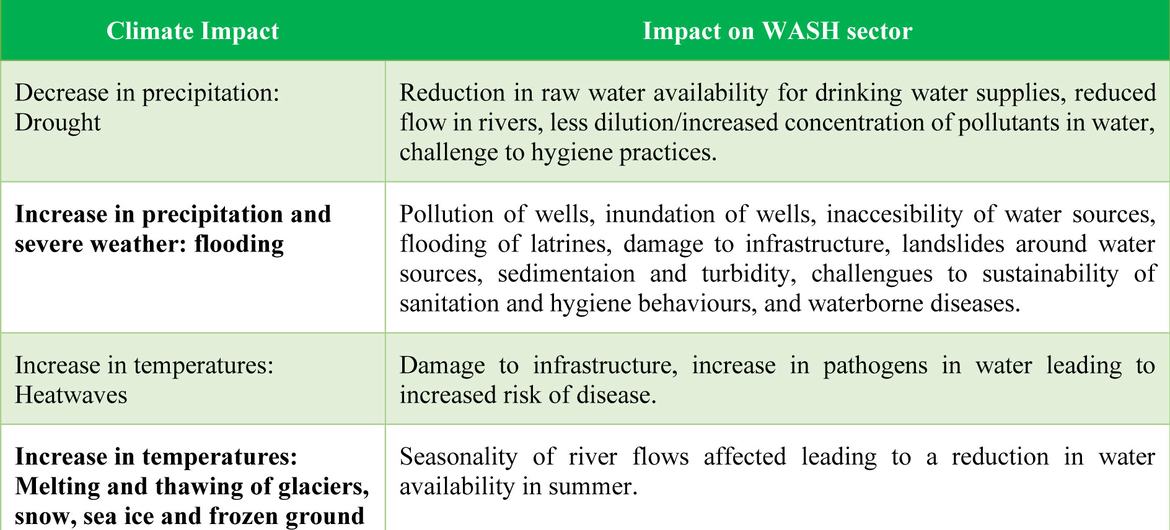
Examples of climate change impacts on the Water, Sanitation and Hygiene (WASH) sector.
♦ Receive daily updates directly in your inbox – Subscribe here to a topic.
♦ Download the UN News app for your iOS or Android devices.
RELATED STORIES

Portuguese beaches lead the way during UN, EU clean-up campaign
WMO warns of frequent heatwaves in decades ahead
Lack of basic water facilities risks millions of lives globally: UN health agency
NEWS TRACKER: PAST STORIES ON THIS ISSUE
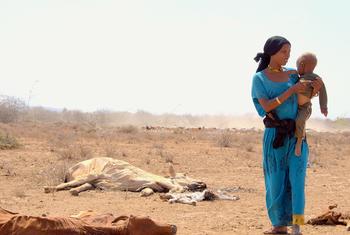
World ‘at a crossroads’ as droughts increase nearly a third in a generation
12 May 2022
Humanity is “at a crossroads” when it comes to managing drought and accelerating ways of slowing it down must happen “urgently, using every tool we can”, said the head of the UN Convention to Combat Desertification (UNCCD) on Thursday, calling for a global commitment to support drought preparedness and resilience.
World Health Day: Take climate action, take care of each other
6 April 2022
An urgent call to protect health and mitigate the climate crisis was issued by the UN health agency on Wednesday, to mark World Health Day on Thursday.
RESOURCES
- Navigate the News
- Information for Broadcasters
- UN System Links
- Media Alert
- UN Journal
- Meetings Coverage
- Audiovisual Library

 borderslynn