
Look back in recorded history and see the financial costs of war. While some are in a position to profit, most are broken nations. The domino effect was summarized neatly for the resulting economic cost to many of WW1 in the book I recommended in my previous blog:
After the First World War, in 1920, the League of Nations was set up to maintain world peace. Though it did initially have some successes, reaching fifty-eight member states in 1934, it is widely regarded as being ultimately unsuccessful due to the international failure to deal with war debts and how states interact, particularly their connections through currency exchange rates. In the aftermath of the war, Britain owed the US substantial sums of money, which it could not repay because it had used the funds to support its allies during the war. These allies could not pay Britain because they were so damaged by the war: thus there was a chain of debts. At the Versailles Peace Conference, the French, British and Americans agreed to make Germany pay these debts. War reparations were set at the equivalent of over US$400 billion in 2017 money. The scale of the reparations was unworkable and ultimately led to serious economic problems for Germany: in the end they were unable to pay. This meant that the long chain of expected financial flows from Germany to France, so it could pay back Britain, which in turn could pay back the US, failed to materialize. In addition there was a speculative boom in the US, so many of the ‘assets’ on bank balance sheets around the world were actually unrecoverable loans In 1929 the US saw the largest stock market crash in its history, with knock-on effects in London. In 1931 the UK crashed out of the ‘gold standard’ for its currency, ending its fixed exchange rate with gold and so devaluing sterling, with fears the US would follow suit. Credit flows dried up, culminating in a widespread banking crisis. While the causality and interactions are hotly debated, the international financial system was weakened and the 1930s saw a worldwide economic depression.
The Human Planet: How we Created the Anthropocene by Lewis and Maslin
Whilst wars rage around us today, as in Ukraine and the Middle East, humans strive to introduce possibilities as to how we might gain more and lose less if we reset our economic compass to save all of us and what remains of life on this precious Earth.
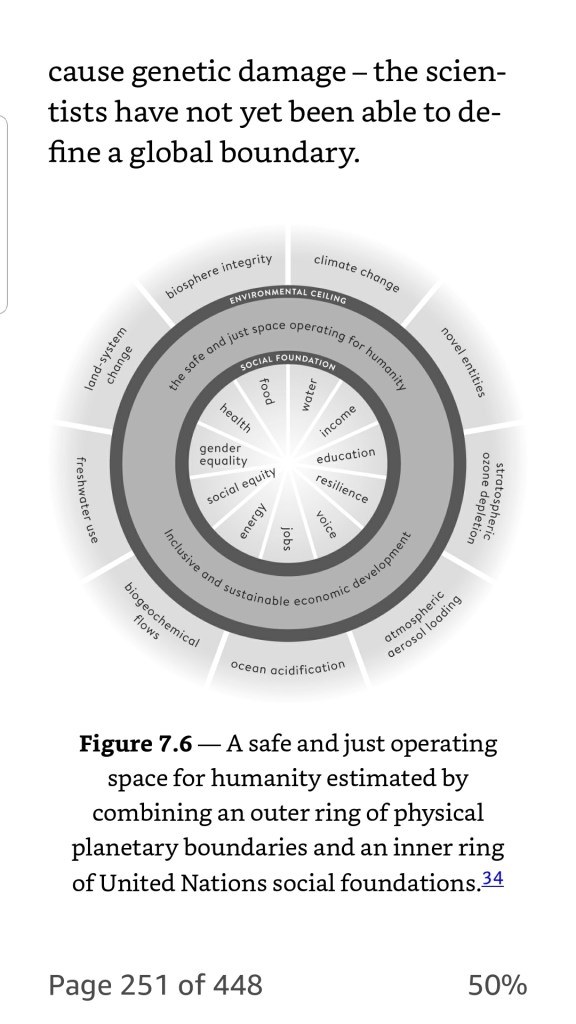
From the above same book, but referring to Kate Raworth’s book, ‘Doughnut Economics’ we should seek a safe operating space for human existence (and thus all living things):
The safe operating space for humanity relates to the physical environment. It has been suggested that an extension is required including health, nutrition and social wellbeing levels that nobody should fall below. Economist and development researcher Kate Raworth incorporates the planetary boundaries, which she refers to as an environmental or ecological ceiling, with key aspects of our ‘social foundation’ as a lower boundary, including water, food, health, income, education, employment and social equality. In between these two rings is the ‘doughnut’, what is called ‘a safe and just operating space for humanity’, seen in Figure 7.6. To live within this space, according to Raworth, requires inclusive, redistributive and sustainable economic development, which is becoming known as ‘doughnut economics’, but which might also be called Anthropocene economics.37
Inspired by:
Let us not forget Maslow’s Hierarchy of Needs:

Wars are a sign of desperation, final grabs for finite resources driven by fear and mental stress.
We must work with empathy to care for ourselves in a more responsible way and stop all bloody and cruel destruction to our fellow humans. Join together for the sake of our precious planet which once teemed with diverse life forms before we arrived.

 borderslynn
You must be logged in to post a comment.