Back in 2010, this article about Sudan explained the different viewpoints of nomadic herders and Arab farmers, their belief systems about land use brought them into conflict.
Of the five mass extinctions we described in Chapter 2, probably the most relevant to our story is the last one, 66 million years ago – the result of a major meteorite strike off the coast of present-day Mexico. The impact ended the 170 million year reign of the dinosaurs, creating the ecological space for mammals to diversify and expand. This mass extinction is the most similar to what is happening today because it was highly selective in which animals and plants were killed off. Large-bodied animals and the fragile ecosystems in the surface waters of the oceans showed particularly high levels of extinction. The impacts of human actions are very similar: the largest animals have gone, coastal dead zones proliferate, oceans are acidifying and coral reefs are dying, with few expected to survive 21st-century warming.28 Our impacts today are so similar to 66 million years ago that they can be said to have been caused by a human meteorite.
The Human Planet: How we Created the Anthropocene
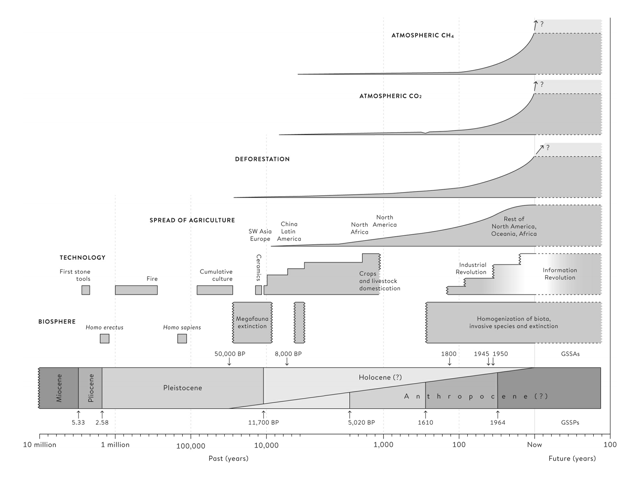
A diagram below, from this book suggests the timescale of the impact of The Anthropocene:
From The Human Planet
If we continue to be a warring people, destroying habitats at such a rapid rate, then the brief time humans have been on the Earth will have been the most harmful impact for the Earth.
One example of an appalling fight for resources is the war torn nation of Sudan, particularly Darfur:
Racial tension between ethnic groups fuels the conflict in Darfur, as many nomadic herdsmen consider themselves to be Arabs while many farmers consider themselves to be African.
By Scott Baldauf Staff writer
April 26, 2010KHARTOUM, SUDAN
Many in Sudan consider racism to be at the root of the Darfur conflict, and those who belong to Sudan’s ruling Arab elite have often been dismissive of those who belong to African tribes far from the capital, Khartoum.
Intermarriage between Arab traders who arrived 800 or 900 years ago has blurred the color line in Darfur, and nearly all Darfuris, even those who consider themselves to be Arabs, are black.
Yet ethnic and cultural identity remains a cause of tensions in Darfur, more often between nomadic herdsmen (many of whom consider themselves to be Arabs) and farmers (who consider themselves to be African) over access to shrinking supplies of water and pasture land
Now, in 2023, with appalling warring atrocities carried out by the RSF, this rebel group have ousted the Sudanese government army from control over the Darfur region. They have fought to control the fertile land for the past 20 years, as such land becomes increasingly hard to find in drought hit areas across Sudan.
Much of the ethnic violence is blamed on militias which are part of – or affiliated to – the Rapid Support Forces (RSF), the paramilitary group fighting the SAF for control of the country.
Retired, living in the Scottish Borders after living most of my life in cities in England. I can now indulge my interest in all aspects of living close to nature in a wild landscape. I live on what was once the Iapetus Ocean which took millions of years to travel from the Southern Hemisphere to here in the Northern Hemisphere. That set me thinking and questioning and seeking answers.
In 1998 I co-wrote Millennium Countdown (US)/ A Business Guide to the Year 2000 (UK) see https://www.abebooks.co.uk/products/isbn/9780749427917



 borderslynn
You must be logged in to post a comment.