In the book, ‘Before It’s Gone’ by Jonathan Vigliotti, I read of the consequences of extensive loss of whole communities in Western States of America, plus the memorable loss of the old community of Lahaina in Hawaii, due to out of control wildfires.
I live in a Scottish Glen, high in the fells of the Scottish Borders. The fells were over grazed by sheep and cattle when we first moved here. In Autumn the grasses yellowed and in sunshine they looked golden. In winter they were often covered in snow, and in Spring and Summer they sprang to life with multitudes of grass types and wildflowers. Wildlife consisted of deer, wild goats, mountain hares, beavers, badgers, rodents of all types. Fish swam in the clean burns and the ecology was as pure and devoid of poisons as could be.
But the landowner of the estate took up a lucrative offer from the Forestry Commission to cover a percentage of his land in mostly Sitka Spruce. These have grown into a dense forest and killed off the natural flora as no light penetrates the forest floor. The process of planting damaged the hydrology so, as we are on the Watershed, rainfall rushes faster down the slopes, especially when an older forest was felled not long after the new forests were in sapling stages. Many wild animals and birds were displaced when the old forest was logged.
Then a new landowner arrived and planted hardwood forest wherever it was still possible to plant trees. These are most welcome and consist of a variety of trees native to Britain, but avoiding Ash, as these were already dying across Britain due to a fungus infection on imported saplings from Asia. These had been planted by the previous landowner as ‘screen’ of the pine forest and have since died.
I looked up related documents to help me understand the threat to Scotland of wildfires:
Climate change is leading to warmer, drier weather conditions in spring and summer, and more frequent, prolonged droughts, which increases the risk of wildfires startingandspreading.
Wildfire risk also increases with disease outbreaks, windthrow damage, and changes to climatic suitability affecting vigour, which increase the level of standing and fallen deadwood and litter. According to the UK Climate Risk CCRA3 Wildfire Briefing, the risk of wildfire could double in a 2 °C global temperature-increase scenario and quadruple in a 4 °C scenario.
Threats to forests and woodland
Wildfires are a semi-natural hazard, with most started accidentally from recreational or land management activities, or deliberately. Wildfires can start within forests or spread in from adjacent areas, such as grassland, heathland or moorland. Wildfires start more frequently in areas with high visitor numbers, near areas of socio-economic deprivation, and in areas close to public rights of way. Potential ignition sources include campfires, BBQs, hot oil or particles from machinery and vehicles, or power lines.
There are two periods of high wildfire risk: late winter-spring when there is dead-dry ground vegetation present (e.g., grass, bracken), overnight-frosts, dry periods with low daytime relative humidity; and summer, with hot and dry weather, including heatwaves and droughts. Wildfires during the latter are usually more intense and more damaging. The changing climate is likely to increase the risk of wildfires in both the late winter-spring and summer periods, and may extend the high-risk season into the autumn.
There are three main types of wildfires: surface fires, ground fires and crown fires. The most common is the surface fire, burning fuels such as heather, grass, bracken and gorse. Surface fires can burn fiercely, spread fast with long flames and at high fire intensity. There can be substantial growth of these fuels along roads and rides, before canopy closure, and after woods have been thinned. Ground fires consume peat and soil organic matter and threaten carbon stores. Smouldering peat fires are hard to extinguish and can re-kindle frequently.
Crown fires occur less frequently, during hot and dry summers, but are the most dangerous. They spread from surface fires, with ladder fuels, including tall shrubs, low tree canopies, standing deadwood and trees in poor health, and leaning windblown trees increase the risk of canopy fires.
Where I live we have ample heather, grass, bracken – and now gorse, imported with the forestry activity. There are large peatlands in these fells.
I deliberately planted hardwood trees in what had been the sheep dowsing area which was attached to a bothy and pens – the bothy had been rebuilt as a well insulated small cottage. All the sheep facilities were made available as potential garden once we arrived to live here.
I love trees. I can’t get enough of them. Over the time we have lived here, I have watched our garden trees mature, along with the surrounding estate forests.
But we have had some serous drought periods over recent years.
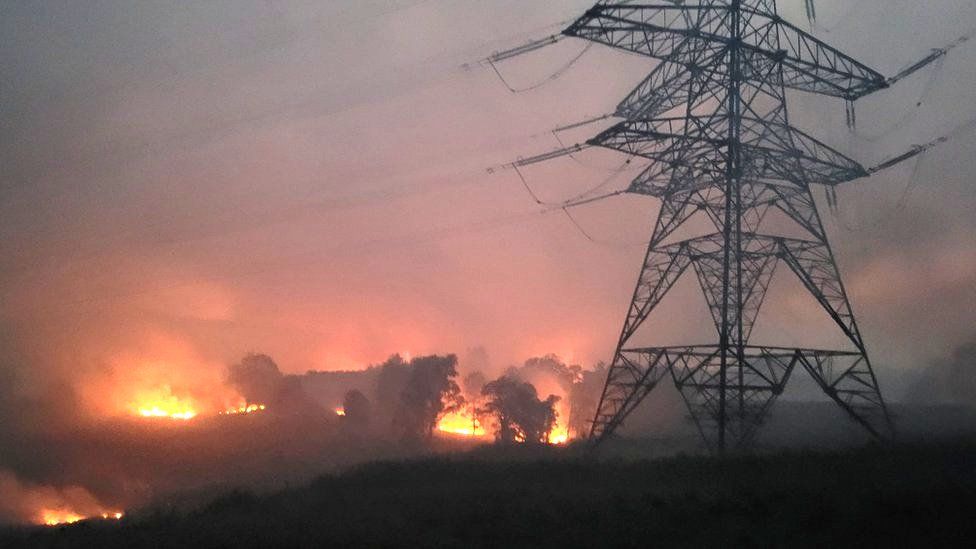
Last year the Scottish government issued a fire warning for all the country. Indeed the BBC ran a shocking piece about a wildfire in the Highlands:
Local councillor Chris Ballance said the community of Cannich had been “traumatised” by the incident and praised the efforts of firefighters.
Image caption,The fire affected a large area of moor and woodland near Cannich
In a letter to the Scottish Fire and Rescue Service, Mr Ballance, said: “Thirty square miles of moor and woodland, 25 years-worth of conservation work destroyed. I smelt the smoke 12 miles away, and it was visible from space.
“On behalf of the City of Inverness area committee, and in particular my ward of Aird and Loch Ness, I have to thank you, and ask you to give our thanks to all your team, for your work in overcoming the fire at Cannich.
“As the earth burns, I can think of no better definition of the word ‘hero’ than ‘firefighter’.”
RSPB Scotland said it was still assessing the full-scale of the fire’s impact on its Corrimony reserve.
A spokeswoman said: “But it is clear that it is extensive and will cost hundreds of thousands of pounds and take many years to restore.”
So many people had invested their money, labour and much of their lives in ecological restoration of this conservation area….see
The need for carbon capture has been the underlying motivation to plant trees, preserve wetlands and peat bogs wherever we can. To conserve and rewild with flora and fauna to regain an ecological balance which supports life on Earth.
It was about hope that we could reduce the impact of carbon emissions and save living things from extinction. But global temperatures have exceeded the limit of 1.5 degrees above recommended levels. Fossil fuels are still being mined and they drive world trade and economic growth, whilst their emissions from use rapidly trap heat creating the greenhouse effect. It is a vicious circle ultimately tipping the balance away from a habitable world.
As fast as we try to conserve land and use the trees to capture carbon, we see our efforts go up in smoke in an even faster moment. As the fire burns, so the trapped carbon is released, adding to the greenhouse effect, especially as these fires have consumed vast acres of land globally over the past few years. Indeed, it is, sadly, the new normal.
The burning of natural vegetation emits huge quantities of released carbon which once were captured by the trees and plant life. Those global fires simply increased the temps past the limit in a vicious circle, intensifying year on year.
Methane, the main ingredient in natural gas, has been shown to produce roughly 80 times the climate-warming power of carbon dioxide over a 20-year period. The gas is released from pipelines, storage tanks and energy facilities. It also wafts from landfills and the cattle industry. Scientists say a substantial reduction in the emissions is among the changes that could make the swiftest impact on climate change.
For those hoping to rebuild their homes in Lahaina, they have been advised to use no combustible building materials. They must create defensible space around their home – so no grass, trees or plant life which could dry out and catch fire.
I don’t know about you, but if my view from inside my home lacked the lush greenery I now see this summer, I could not endure a single day there.
Vigliotti tells us about John Mercer, who, back in 1968 focused on Antarctica, and was first to realise over his lifetime research:
that human activity was driving CO2 levels to rates not seen in millions of years, so fast there was no time for Mother Nature or humanity to adapt to the unintended consequences.
In Vigliotti’s book, ‘Before it’s gone’ he describes looking into the Helheim Glacier, being informed by Dr. Gordon Hamilton* of University of Maine. He was told of the rapid change the data they collected had revealed. “My colleague almost fell out of his chair. It’s that alarming.” The scientist was obviously greatly troubled as they saw a line in a rock where the surface ice used to reach. Helheim had thinned by more than 300ft in just over a decade and the glacier had retreated by more than 4 miles. Trackers showed one part of Greenland’s ice sheet was moving at 8.7 miles a year with insufficient snowfall to rebuild what was lost. Hamilton commented,”Humans have never witnessed this scale of loss before, and not enough people are worried as they should be.”
Vigliotti was also told by Hamilton that warmer air and water were melting the icebergs at both ends. “We’re witnessing the possible collapse of a critical regulator of our planet,”Hamilton told him.
Vigliotti points out the oceans are now 1.5 degree warmer after absorbing 90 percent of excess heat trapped by the greenhouse effect. More heat reduces oxygen for marine life living to a depth of 700 metres. In the Arctic the ocean temperature has increased by 3 degrees.
The arctic is losing control of its rhythm of holding freshwater in a frozen reservoir that helps regulate ocean temperature and salinity. But now the freshwater escapes in a flood, decreasing salinity, reducing the density of the Atlantic, and thus slowing the conveyor belt of underwater currents that circulate colder arctic water and vital nutrients to the warm south. It is estimated this rapid melting of Antarctica and Arctic major icebergs will shut down this critical conveyor belt by 2050.
And politically we are failing:
My second beef is with the epic failure of Green politicians in Germany and elsewhere to target and tax the continent’s Big Bad Polluters – the top 10% – corporations, private jet and superyacht owners included. If the top 10% of global emitters were required to slash their annual carbon emissions to that of the average EU citizen, other things being equal, that would cut global emissions by around 1/3 – and would be FAIR.
Instead, the Greens and other policy-makers imposed the cost and delivery of decarbonisation on to the shoulders of millions of insecure, low-paid Europeans enduring a cost-of-living crisis.
From Substack, Ann Pettifor, on Europe failing to finance cutting emissions, June 2024
*Dr Gordon Stuart Hamilton of Maine University, died in 2016 carrying out his dangerous research which showed us all we have no time to debate the issue, he found the evidence:
Gordon Hamilton was a glaciologist at the University of Maine. (Laure Noualhat)
Retired, living in the Scottish Borders after living most of my life in cities in England. I can now indulge my interest in all aspects of living close to nature in a wild landscape. I live on what was once the Iapetus Ocean which took millions of years to travel from the Southern Hemisphere to here in the Northern Hemisphere. That set me thinking and questioning and seeking answers.
In 1998 I co-wrote Millennium Countdown (US)/ A Business Guide to the Year 2000 (UK) see https://www.abebooks.co.uk/products/isbn/9780749427917




 borderslynn

You must be logged in to post a comment.