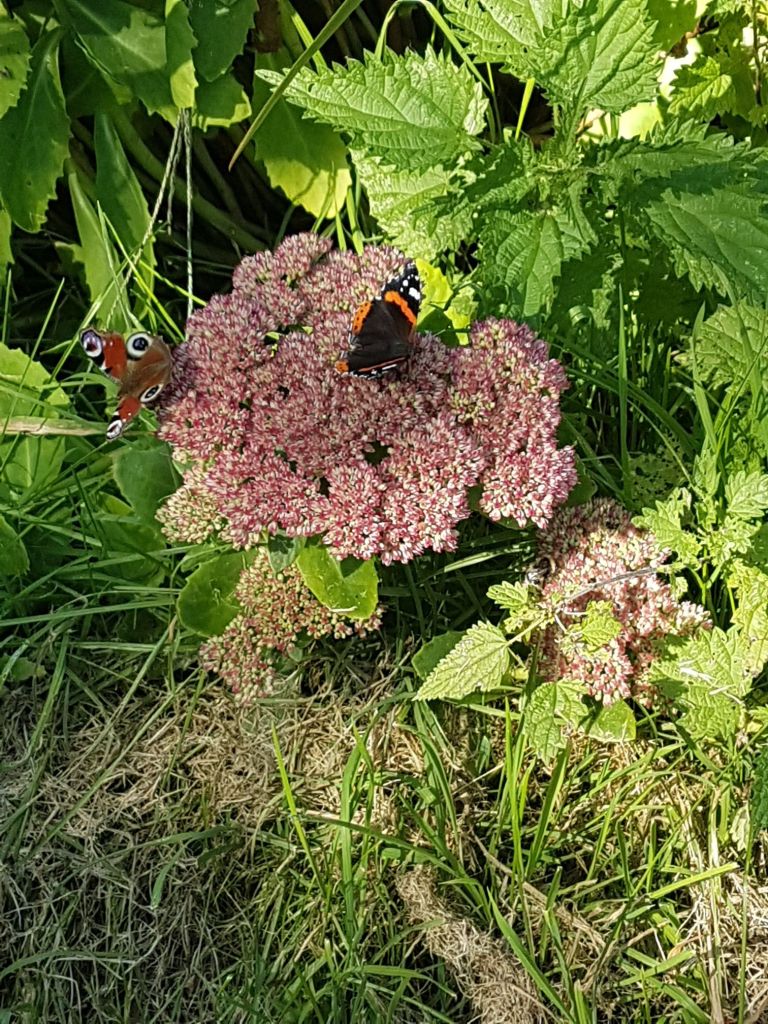
I just photographed a Peacock and a Red Admiral on my Autumn Glory.
19th September 2024
In previous years there could be at least 12 to 20 on this plant. These two are the highest count in a day for this year. I am distraught. Seeing butterflies all my life has always lifted my spirits, no matter what adversity life throws at me.
So I hoped this was something to do with living where I do after unseasonal and turbulent weather all year. But no. I read in my Butterfly Conservation news this reproduced article:
Wondering where all the butterflies have gone? You’re not alone.
In 2024, we’ve seen butterfly numbers fall across the UK. With 80% of butterflies having declined since the 1970s and a third of moth numbers having fallen in that same period, the time has come to tell the Government enough is enough.
Our message to Government
We’re calling on the Government to:
Declare a nature emergency
Implement an immediate and permanent ban on butterfly-harming neonicotinoid pesticides, without exceptions.
If you agree, sign our letter and join leading conservation figures in calling on the Government to take action now.
And we know pesticides are being used extensively in gardens and farmland. But also climate change plays an obvious role. In a link from 2018 National Geographic pointed out the impact of lack of habitat due to climate change disruption which cut the Monarch butterfly population in Mexico drastically:
And activists try in vain to fight against big banks funding these operations:
Mana Pools National Park (219,600 ha) forms part of a natural World Heritage Site (WHS) that was inscribed based on its intact wilderness and beauty in 1984. This 676,600 ha WHS also encompasses the Sapi Safari Area (118,000 ha) and Chewore Safari Area (339,000 ha). Mana Pools is a Key Biodiversity Area, home to remarkable wildlife including iconic species such as elephants, buffalos, and lion in addition to a variety of plans game, leopards and cheetahs, and many resident and migratory birds, with over 450 bird species recorded. Mana Pools National Park was also designated as a wetland of international importance under the Ramsar Convention in 2013. The site’s pristine ecosystem is an important tourist attraction and crucial for Zimbabwe’s tourism industry.
The Mana Pools World Heritage Site, part of the larger Middle Zambezi Biosphere Reserve, is located directly opposite the Lower Zambezi National Park in Zambia. The Lower Zambezi National Park is also currently under serious threat by the development of an open pit copper mine in the middle of the national park. There are grave concerns around the overall effect of large-scale mining in this ecologically sensitive area which would also invariably impact the Mana Pools World Heritage Site.
Growing Threat
Despite its significance, Mana Pools is now under growing threat of damaging developments, particularly oil and gas exploration. In a gazette notice on 28th April 2023, the Zimbabwean Ministry of Mines and Mining Development announced that Shalom Mining Corporation Pvt Ltd had applied for a licence to prospect for oil and natural gas in an area of very high conservation value contiguous to Mana Pools. If allowed to go ahead, this development potentially poses a serious risk to the adjacent World Heritage Site and Ramsar Site, in addition to the damage it might cause within the proposed prospecting area itself.
In response to the oil and gas prospecting threat, BirdLife partners in Southern Africa put together a strong objection to the proposal. BirdLife Zimbabwe (BirdLife partner in Zimbabwe) and BirdWatch Zambia (BirdLife in Zambia) submitted it to the Ministry of Mines and Mining Development of Zimbabwe. The letter was also shared with the UNESCO World Heritage Centre, the IUCN World Heritage Programme, and the Secretariats of the Convention on Migratory Species and Ramsar Convention on Wetlands of International Importance.
“Zimbabwe and Zambia have just signed a Memorandum of Understanding to set up the Lower Zambezi Mana Pools Transfrontier Conservation Area to enhance wildlife conservation. In a report by the Zimbabwe Broadcasting Corporation, “the agreement is set to enhance ecosystem integrity and natural ecological processes by harmonising environmental management procedures” With so much at stake, we implore the Zimbabwe Ministry of Mines and Mining Development to turn down the prospecting application and the Governments of Zimbabwe and Zambia to work together to protect the intact ecosystem of the Zambezi comprising both Mana Pools and Lower Zambezi National Park” , said Julia Pierini, CEO BirdLife Zimbabwe.
“Mana Pools in Zimbabwe holds immense ecological importance, interconnecting with the Lower Zambezi National Park in Zambia. The proposed oil exploration programme by Shalom Mining, threatens this wildlife haven, and would upend the delicate balance of this critical ecosystem” said Daniel Phiri, National Coordinator, BirdWatch Zambia.
“Mana Pools in Zimbabwe holds immense ecological importance, interconnecting with the Lower Zambezi National Park in Zambia. The proposed oil exploration programme by Shalom Mining, threatens this wildlife haven, and would upend the delicate balance of this critical ecosystem”
Daniel Phiri, National Coordinator, BirdWatch Zambia.
We are plundering Africa yet again and the world is on fire, glaciers are melting at great speed, floods are drowning people and displacing millions. Freak weather is impacting the planet so fast resilience measures cannot be laid down fast enough.
Retired, living in the Scottish Borders after living most of my life in cities in England. I can now indulge my interest in all aspects of living close to nature in a wild landscape. I live on what was once the Iapetus Ocean which took millions of years to travel from the Southern Hemisphere to here in the Northern Hemisphere. That set me thinking and questioning and seeking answers.
In 1998 I co-wrote Millennium Countdown (US)/ A Business Guide to the Year 2000 (UK) see https://www.abebooks.co.uk/products/isbn/9780749427917





 borderslynn
You must be logged in to post a comment.