Extract from “Rise and Kill First”, by Ronen Bergman:
1995
THURSDAY, NOVEMBER 2, a senior member of the VIP protection unit of the Shin Bet, responsible for the safety of the prime minister, made an encrypted phone call to a colleague, Yitzhak Ilan, who was in charge of intelligence collection for the agency’s southern region. “The day after tomorrow in the evening,” the caller told Ilan, “there’s going to be a huge rally in Tel Aviv’s Kings of Israel Square, in support of the government and the peace process. Rabin will be speaking. Since the hit on Fathi Shaqaqi, have you got any info on whether Islamic Jihad aims to avenge their leader by trying to kill the prime minister?”
Ilan replied that there was no specific information, but there was a lot of agitation in the area in the wake of the Shaqaqi assassination, and although Israel hadn’t taken responsibility for it, the PIJ had no doubt who was behind it. Ilan’s chief concern was that there might be a car bomb at the rally, and he recommended clearing the whole area around the square of vehicles. After their conversation, the VIP protection unit decided to put on extra precautions.
The peace rally was organized by left-wing groups as a counter to the angry protests the right had been staging, which had become spectacles of vicious incitement against Rabin. Pictures of him were set aflame, he was depicted in the uniform of the Nazi SS, and coffins bearing his name were carried along. At some of these protests, demonstrators had tried, and almost succeeded, to break through the security cordon and attack him. Shin Bet chief Gillon warned that Jewish terrorists might try to harm a government leader, and he even asked Rabin to travel in an armor-plated car and to wear a flak jacket. Rabin, who didn’t take Gillon’s warnings seriously, recoiled at the latter idea, and complied only on rare occasions.
The rally was a great success. Although Rabin had doubted that the supporters of the left would come out and demonstrate, at least a hundred thousand crammed into the square and cheered for him. They saw Rabin, generally a very introverted man, showing rare emotion. “I want to thank each one of you for standing up against violence and for peace,” he began his speech. “This government … has decided to give peace a chance. I’ve been a military man all my life. I fought wars as long as there was no chance for peace. I believe there is now a chance for peace, a great chance, and it must be taken.
“Peace has enemies, who are trying to harm us in order to sabotage peace. I want to say, without any ifs or buts: We have found a partner for peace, even among the Palestinians: the PLO, which was an enemy and has ceased terror. Without partners for peace there can be no peace.”
Afterward, Rabin shook hands with the people on the platform and headed for the armor-plated car waiting nearby, accompanied by his bodyguards. Shin Bet security personnel saw a young, dark-skinned man standing in the prime minister’s path. But because of his Jewish appearance, they did not try to move him out of the way. The young man, Yigal Amir, a law student close to the extremist settlers in Hebron, slipped past Rabin’s bodyguards with astonishing ease and fired three shots at the prime minister, killing him.
In 2015, an article in the Conversation appeared, here is part of it:
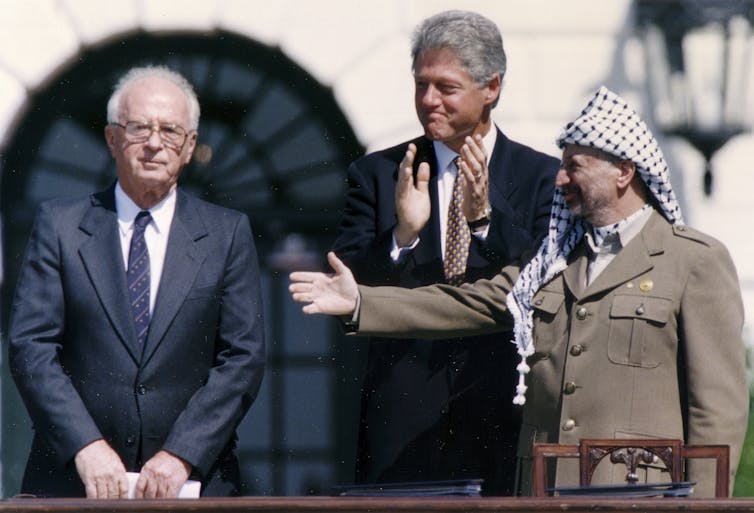
The Oslo process, which culminated with the awkward handshake between Rabin and Yasser Arafat on the White House lawn in September 1993, established limited self-rule for Palestinians and entailed an Israeli redeployment from the West Bank, territory that Amir believed to be the biblical birthright of the Jewish people.
The 1990s – a relatively secure decade
Rabin knew that by the 1990s, Israel was more secure than it had ever been since its establishment in 1948.
By the time he became prime minister (for the second time) in 1992, Israel had a peace treaty with Egypt and a close alliance with the United States. It was the strongest military power in the region, with the most advanced weapons systems and a powerful domestic arms industry, while its most vociferous enemies – Iraq and the Palestine Liberation Organization – had either been defeated (Iraq in the First Gulf War) or were at the nadir of their influence and appeal (the PLO at the end of the First Intifada). It was also in the early 1990s that the country established diplomatic relations with key states in the world, including Russia, China and India. Israel could, Rabin felt, afford a peace process with the Palestinians.
Disinformation is dangerous. We fight it with facts and expertise
That realism also led Rabin to the belief that a Palestinian state was inevitable as a result of Oslo, as he told his close aide Eitan Haber (who in turn told me during an interview).
Yasser Arafat and Yitzhak Rabin on the White House lawn. Gary Hershorn/Reuters
Rabin didn’t like or trust Palestinian leader Yasser Arafat, and it’s not clear whether he had a sense of what such a state would look like. But he knew ruling over another people was no longer viable. And he was already thinking about Iran as the primary strategic threat to the country.
At the same time, however, Rabin was capable of using brute force when he deemed it necessary.
A ‘risk’ for peace?
Rabin’s “break their bones” instructions regarding Palestinian protesters and rioters in the First Intifada helped legitimize a harsh Israeli response to civilian rallies against the occupation.
He used deportation and border closures as he thought necessary. In other words, he did not hesitate to use force and coercion. But he was, at the same time, willing to innovate for the sake of Israeli security, and to adopt nonmilitary means as well.
It’s become a cliché to talk of “risks for peace,” and Rabin used similar language in defending Oslo.
But Rabin didn’t see things as gambles. As a military man, he saw issues as having best solutions, which might still fail. But it was important to try.
Almost all of Israel’s leaders have dismissed this part of his legacy – his willingness to take risks. Even those on the left and in the center worry that the Israeli public doesn’t want to hear about an end to the occupation while Palestinian terrorism continues. Unlike Rabin, they have been unwilling to confront public opinion on the matter.
A golden era for Jewish-Arab relations in Israel
There is another important issue of Yitzhak Rabin’s time in office that has been eclipsed in the past 20 years.
Rabin’s second tenure as prime minister is known as the “golden era” of Jewish-Arab relations in Israel. Rabin paid more attention to Arab citizens of Israel, about 20% of the population, than any other Jewish Israeli leader had before or has since.
In addition to directing more resources to the community, he responded to their concerns by dropping the traditional paternalistic attitude the Zionist parties had long held regarding the Arab minority.
Perhaps more importantly, for the first and only time, Arab political parties played an indirect role in policymaking.
In 1993, as a result of the Oslo accords, Rabin lost his majority in the Knesset, the Israeli parliament. Two Arab parties propped him up from outside his own coalition, voting with the government on no-confidence measures brought by the opposition.
Rabin’s views on Israel’s Arab minority reflected his analysis of Israeli-Palestinian relations more broadly – namely, that coercion was simply untenable as a solution to Israel’s relations with Palestinians inside and outside of Israel.
Since 1995, Arab citizens have either disengaged from the political process or voted for Arab parties in increasing numbers, at the expense of Rabin’s party, Labor. The percentage of Arab citizens’ votes for the top three Arab parties, for example, has climbed from 68.7% in 1999 to 80% in 2015.
Retired, living in the Scottish Borders after living most of my life in cities in England. I can now indulge my interest in all aspects of living close to nature in a wild landscape. I live on what was once the Iapetus Ocean which took millions of years to travel from the Southern Hemisphere to here in the Northern Hemisphere. That set me thinking and questioning and seeking answers.
In 1998 I co-wrote Millennium Countdown (US)/ A Business Guide to the Year 2000 (UK) see https://www.abebooks.co.uk/products/isbn/9780749427917


 borderslynn