
Yesterday, whilst Pope Francis lay in state and his mourners continued their grieving, the media showed clips of his past expressions of love of humanity. This man, who promoted that we each care for one another, died on Easter Monday, April 21st 2025, the next morning after meeting his last visitor at the Vatican on Easter Sunday, (J.D. Vance, US Vice President).
On April 23rd we also shared the sorrow Days of Remembrance for Victims of the Holocaust, whilst the suffering remaining populations in Gaza are herded by Israelis into smaller parcels of land, with no food, water, shelter being supplied. It is said Gaza was a topic raised by Pope Francis as he spoke to the Vice President.
The lack of love and the overflowing of love, that we can both protect and destroy one another is perhaps best expressed by the Taoist ancient wisdom of ‘Yin-Yang’.
The symbol summed up by an AI trawl:
The yin yang symbol, also known as the taijitu, represents the duality of opposing forces in the universe, illustrating how they are interconnected and interdependent. It consists of a circle divided into black (yin) and white (yang) halves, each containing a dot of the opposite color, symbolizing that each force contains the essence of the other.
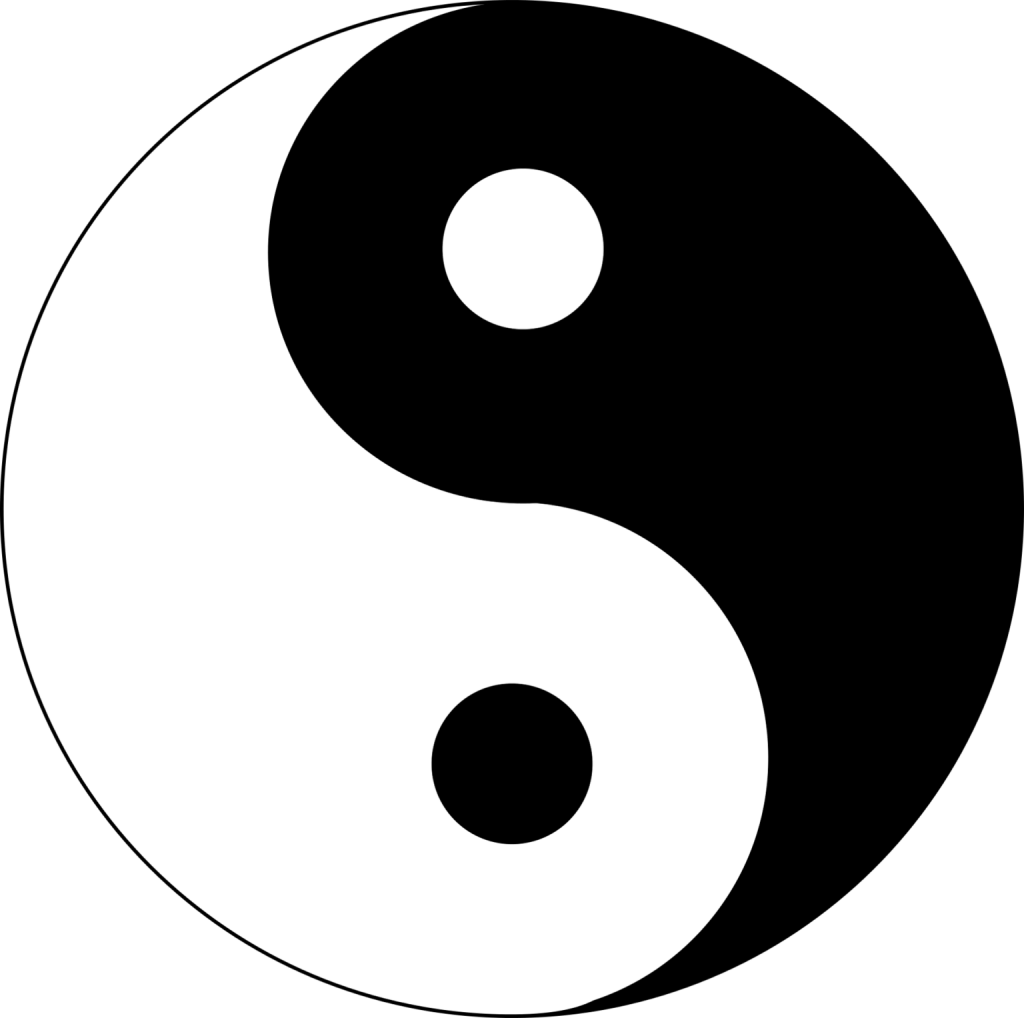
Those opposing forces may explain why we humans can feel so full of love but can also be cruel beyond belief with no ounce of compassion for those we have ‘othered’. Perhaps life is in balance though some of us perceive that we humans are polarised into extreme beliefs which may accelerate our destruction.
We can read of past cruelty or see it daily, expressed verbally and physically. Is this the intensity of life forces at play, where we are so caught up it can feel like a maelstrom?
The Ying-Yang suggests there is an equal amount of positive and negative energy, but the forces work in harmony. If this wisdom is valid, then perhaps the more recent wisdom of Desiderata also holds true:
Go placidly amid the noise and the haste, and remember what peace there may be in silence. As far as possible, without surrender, be on good terms with all persons.
Speak your truth quietly and clearly; and listen to others, even to the dull and the ignorant; they too have their story.
Avoid loud and aggressive persons; they are vexatious to the spirit. If you compare yourself with others, you may become vain or bitter, for always there will be greater and lesser persons than yourself.
Enjoy your achievements as well as your plans. Keep interested in your own career, however humble; it is a real possession in the changing fortunes of time.
Exercise caution in your business affairs, for the world is full of trickery. But let this not blind you to what virtue there is; many persons strive for high ideals, and everywhere life is full of heroism.
Be yourself. Especially do not feign affection. Neither be cynical about love; for in the face of all aridity and disenchantment, it is as perennial as the grass.
Take kindly the counsel of the years, gracefully surrendering the things of youth.
Nurture strength of spirit to shield you in sudden misfortune. But do not distress yourself with dark imaginings. Many fears are born of fatigue and loneliness.
Beyond a wholesome discipline, be gentle with yourself. You are a child of the universe no less than the trees and the stars; you have a right to be here.
And whether or not it is clear to you, no doubt the universe is unfolding as it should. Therefore be at peace with God, whatever you conceive Him to be. And whatever your labors and aspirations, in the noisy confusion of life, keep peace in your soul. With all its sham, drudgery and broken dreams, it is still a beautiful world. Be cheerful. Strive to be happy.
by Max Ehrmann ©1927

This poet was born in the USA.
Max Ehrmann was born in Terre Haute, Indiana on September 16, 1872 to German immigrant parents. In 1894 he graduated from DePauw University in Greencastle. Later Ehrmann studied law and philosophy at Harvard University. He returned to Terre Haute where he practiced law. When he began writing, he devoted every day to his work. Ehrmann wrote many poems, but his most famous poems are “Desiderata” (1927) and “A Prayer (1906)”.
He studied at Harvard and looks to have lived a fulfilling life. But he died in 1942 knowing WW2 was well underway, and he was of German descent.
There is a negative cloud over Harvard now, since 31st March of this year:
https://www.harvardmagazine.com/2025/04/trump-administration-harvard-research-funding-threats

 borderslynn
You must be logged in to post a comment.