
There is a website which provides information for 9752 data centres across the world.
https://www.datacentermap.com/datacenters/
Why are data centres and data transmission networks important?
Demand for digital services is growing rapidly. Since 2010, the number of internet users worldwide has more than doubled, while global internet traffic has expanded 20-fold. The data centres and data transmission networks that underpin digitalisation have led to rising energy use…………….Significant advances in data centre performance have been made in recent years, but additional government and industry efforts on energy efficiency, RD&D, and decarbonisation of electricity supply and supply chains are necessary to curb energy demand and rapidly reduce emissions over the coming decade to get on track with the Net Zero Emissions by 2050 (NZE) Scenario.
https://www.iea.org/energy-system/buildings/data-centres-and-data-transmission-networks
Hyperscalers, such as AWS, don’t declare their energy use.
As AI drives unprecedented growth in data center energy consumption, utilities and hyperscalers are locked in an uneasy, sometimes adversarial partnership to expand capacity.
Data Center Knowledge spoke with technology infrastructure experts about the challenges, opportunities, and unanswered questions facing the industry, as well as the “complex mix” of strategies and technologies required to ensure the grid can meet escalating demand.
Location, Location, Location
As of March this year, half of the 11,000 data centers worldwide were located in the US, according to David Porter, vice president of electrification and sustainable energy strategy at Electric Power Research Institute (EPRI). But Porter, whose research organization advises countries interested in developing new data centers, said the central challenge facing data centers and utilities was the same in the US as in Europe, Asia, or the Middle East: “[That is], whether the location the developer is using has the capacity to serve it in a short time,” he told Data Center Knowledge………….
In Ireland, where Echelon Data Centres received permits for a new data center just this month for the first time in three years, there has been a “quasi-moratorium” on new construction, Echelon’s head of energy systems Cormac Nevins told Data Center Knowledge.
Calling the growth in power demand “extreme,” Nevins sounded optimistic that policy in Ireland was beginning to move at a speed commensurate with how quickly the industry is changing.
“From 2022 through 2032, we’re looking at doubling data center capacity in Dublin,” he said, describing ambitious government targets. “In the same period, we have to bring in 8 GW of solar, 4.5 GW of onshore wind, and 5 GW of offshore wind. And a bonus of another 2 GW of offshore wind to reach hydrogen targets. These are ambitious targets for renewables.”………………..
Discussing a suit filed this month by Google, Amazon, Microsoft, and Meta against an Ohio utility company, AEP Ohio, for its plan to charge hyperscalers increased upfront energy costs for their data centers, Porter said it was not unusual for utilities and large customers to be at odds about who should bear the cost of upgrades.
“The utility regulators for each state have something they think is fair and prudent for all of the customers that utility serves,” he said.
Margarita Patria from Charles River Associates (CRA), a consulting firm that helps utilities such as NIPSCO and FirstEnergy plan for regulation and additional capacity, told Data Center Knowledge: “Whatever entity gets the benefit of the upgrade is the entity that has to pay for it. That’s just and fair to my mind. It becomes a question: who is benefiting?”
In many countries, such as the UK, the building of data centres are thought of as essential to national infrastructure:
Plans to build a huge data centre next to the M25 in Hertsmere have been green lit by councillors. Developer DC01UK say it will be Europe’s largest data centre when it is built and council officers said it could be used by companies such as Google, Amazon or Microsoft.
Data centres are deemed ‘national critical infrastructure’ by the government, and ministers have supported plans for the centre in Hertsmere. It will be located next to South Mimms services, on green belt land that is now seen as ‘grey belt’ by planning officers.
While it is currently agricultural land and is not previously built on, officers judged that it does not “contribute strongly to any of the green belt purposes”. Councillors on Hertsmere Borough Council’s planning committee voted the proposals through by eleven votes to one at their meeting on Thursday (January 23).
https://www.essexlive.news/news/local-news/massive-data-centre-the-largest-9894894
Requirements for building a data centre:
Energy
Servers require extraordinary amounts of electrical power and must be kept at specific temperatures at all times. A site must have access to a power grid that can keep the servers running and the cooling systems working around the clock.
Size
Data centres are huge and, with the increased demand, are only getting larger. New and reconstructed sites must be able to meet the demands for data centre capacity, which is usually measured in three ways:
- Racks: The number of racks indicates the amount of space available for servers
- Square footage: Many new facilities are now larger than 250,000 square feet
- Power capacity in megawatts: Many new facilities have a power capacity between 80 and several hundred megawatts
Reliability
Like the internet itself, data centres need to be on at all times, with no exceptions. Beyond having enough power, most data centres have extensive backup systems that can keep servers and cooling systems functioning, even when local power goes out. This often includes power generators or uninterruptible power supplies, which provide automated backup when the main power source goes down.
https://www.procore.com/en-gb/library/data-centre-construction
Data centres require continual clean water circulating for cooling:
Data centers are significant consumers of natural resources, and while carbon emissions and electricity consumption often capture most attention, water usage is also gaining increased recognition. Water is essential in data center cooling systems to control the heat produced by these massive facilities, ensuring their internal servers run uninterrupted 24 hours a day, 7 days a week.
Data centers use large amounts of water for their cooling systems, which include cooling towers, chillers, pumps, pipes, heat exchangers, condensers, and computer room air handler (CRAH) units. Additionally, data centers need water for their humidification systems and facility maintenance.
Globally, data centers are located in all different types of countries and climates, including many data center facilities in water-stressed regions prone to droughts. According to the United Nations, by 2025, 50% of the world’s population is projected to live in water-stressed areas, making data center water usage a key environmental area to prioritize change.
https://dgtlinfra.com/data-center-water-usage/
Essex in South East England receives low rainfall sometimes:

The UK is suffering a water crisis and solutions (not simply reservoirs) are investigated as described here:
But if we are to see more building of data centres, the experts say they have devised techniques to ensure the water supply system is carefully designed to maximise what is available:
https://datacentrereview.com/2024/03/solving-the-data-centre-water-dilemma/
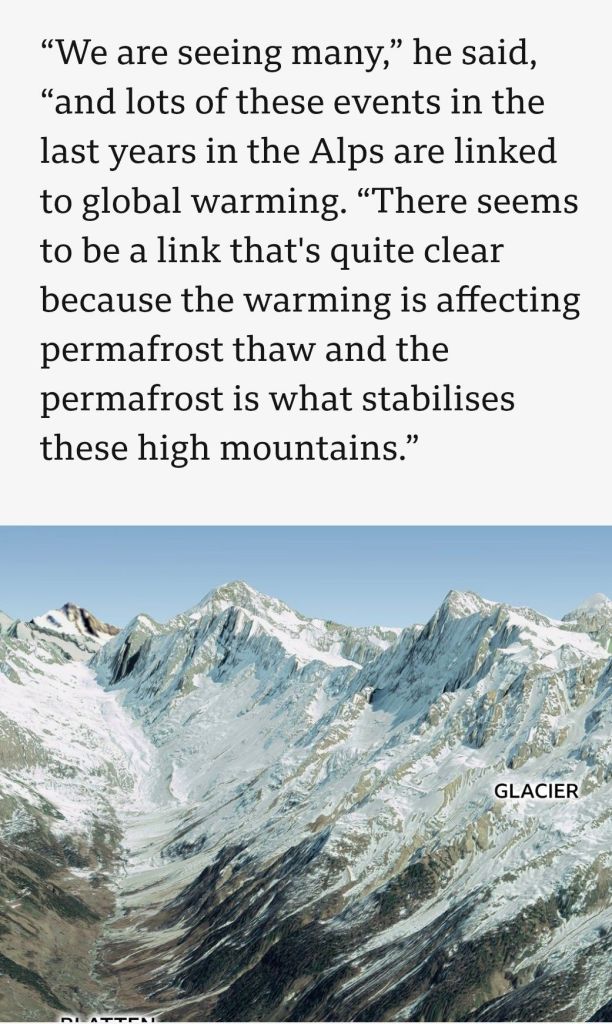
Consequences of increased emissions through energy consuming data centres (and, sadly, now Bitcoin mining centres) have added another fossil fueled human activity to the warming planet. Recently the Blatten glacier collapse was yet another catastrophic symbol of the harm we humans have done to the Planet Earth.

 borderslynn
Pingback: Draining our energy and fresh water capacity | borderslynn