
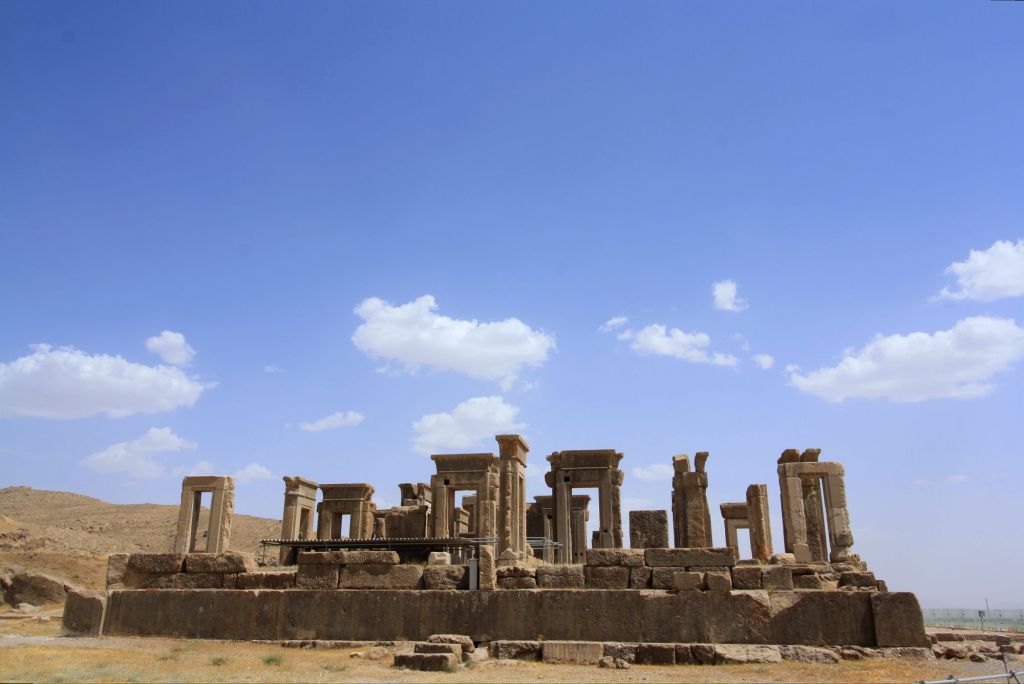
This was the ceremonial and spiritual capital of a vast empire, built by Cyrus, Darius, and Xerxes, titans whose names still echo through history. Giant statues of winged bulls guard the Gate of All Nations, through which princes from vassal states passed once each year to pay homage to their Persian masters. The great Apadana, or Hall of Audience, where these princes knelt together before their dead sovereign, was the length of three football fields. Its roof was supported by thirty-six towering columns, some of which still stand. Two monumental staircases leading up to the hall are decorated with intricately detailed carvings depicting the annual ritual of obedience, which was held on the day of the vernal equinox. Today they offer a vivid picture of how completely Persian emperors once dominated the richest lands on earth.
The carvings show rulers of subject states filing past their supreme leader, each bearing gifts symbolizing the wealth of his province. Archaeologists have managed to identify most of them, and the very names of their cultures evoke the richness of antiquity. The warlike Elamites, who lived east of the Tigris River, bring a lion to symbolize their ferocity. Arachosians from Central Asia offer camels and rich furs, Armenians a horse and a delicately crafted vase, Ethiopians a giraffe and an elephant’s tusk, Somalis an antelope and a chariot, Thracians shields and spears, and Ionians bolts of cloth and ceramic plates. Arabs lead a camel, Assyrians a bull, Indians a donkey laden with woven baskets. All these tributes were laid before the King of Kings, a monarch whose reign spread Persian power to the edges of the known world.
Many countries in the Middle East are artificial creations. European colonialists drew their national borders in the nineteenth or twentieth century, often with little regard for local history and tradition, and their leaders have had to concoct outlandish myths in order to give citizens a sense of nationhood. Just the opposite is true of Iran. This is one of the world’s oldest nations, heir to a tradition that reaches back thousands of years, to periods when great conquerors extended their rule across continents, poets and artists created works of exquisite beauty, and one of the world’s most extraordinary religious traditions took root and flowered. Even in modern times, which have been marked by long periods of anarchy, repression, and suffering, Iranians are passionately inspired by their heritage.
Great themes run through Iranian history and shape it to this day. One is the continuing and often frustrating effort to find a synthesis between Islam, which was imposed on the country by Arab conquerors, and the rich heritage of pre-Islamic times. Another, fueled by the Shiite Muslim tradition to which most Iranians now belong, is the thirst for just leadership, of which they have enjoyed precious little. A third, also sharpened by Shiite beliefs, is a tragic view of life rooted in a sense of martyrdom and communal pain. Finally, Iran has since time immemorial been a target of foreign invaders, victim of a geography that places it astride some of the world’s most important trading routes and atop an ocean of oil, and it has struggled to find a way to live with powerful outsiders. All these strains combined in the middle of the twentieth century to produce and then destroy the towering figure of Mohammad Mossadegh.
From: All the Shah’s Men
Historical Timeline of pre-Shah Iran:
Sorosh Tavakoli from Stockholm, Sverige, CC BY 2.0, via Wikimedia Commons
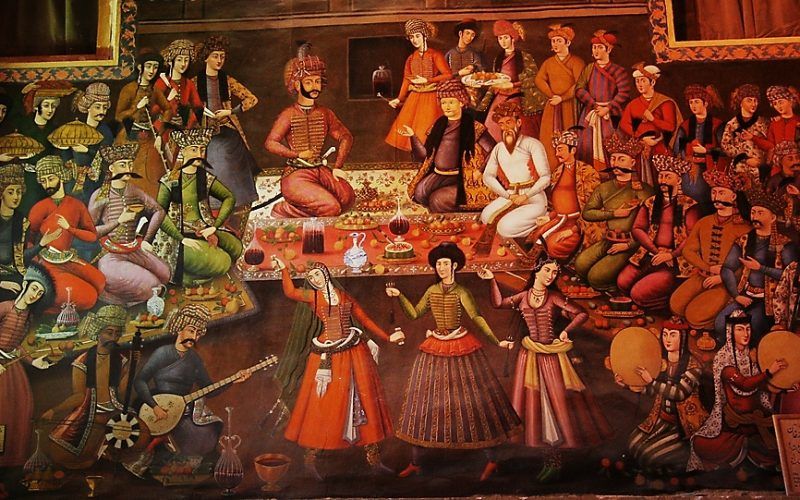
The Safavid Empire stands as one of the most transformative dynasties in Persian history, ruling Iran from 1501 to 1736 and fundamentally reshaping the religious, cultural, and political landscape of the region. This Turkmen dynasty not only reunified Persia after centuries of fragmentation but also established Twelver Shi’a Islam as the state religion, creating a distinct Iranian identity that persists to this day.
…..
The Safavid dynasty emerged from a Sufi religious order founded by Safi-ad-din Ardabili in the 13th century in northwestern Iran. Initially a Sunni mystical brotherhood, the order gradually evolved into a powerful political and military force under the leadership of Safi-ad-din’s descendants. The transformation from a religious order to an imperial dynasty culminated with Ismail I, who proclaimed himself Shah of Iran in 1501 at the age of fourteen.
https://www.ourhistory.org.uk/the-safavid-empire-architects-of-modern-iran/
In the 1920’s, Great Britain was negotiating on an oil deal which Winston Churchill called “a prize from fairyland beyond our wildest dreams.”
Since the early years of the twentieth century a British company, owned mainly by the British government, had enjoyed a fantastically lucrative monopoly on the production and sale of Iranian oil. The wealth that flowed from beneath Iran’s soil played a decisive role in maintaining Britain at the pinnacle of world power while most Iranians lived in poverty. Iranians chafed bitterly under this injustice. Finally, in 1951, they turned to Mossadegh, who more than any other political leader personified their anger at the Anglo-Iranian Oil Company (AIOC). He pledged to throw the company out of Iran, reclaim the country’s vast petroleum reserves, and free Iran from subjection to foreign power.
From Kinzer, All the Shah’s Men

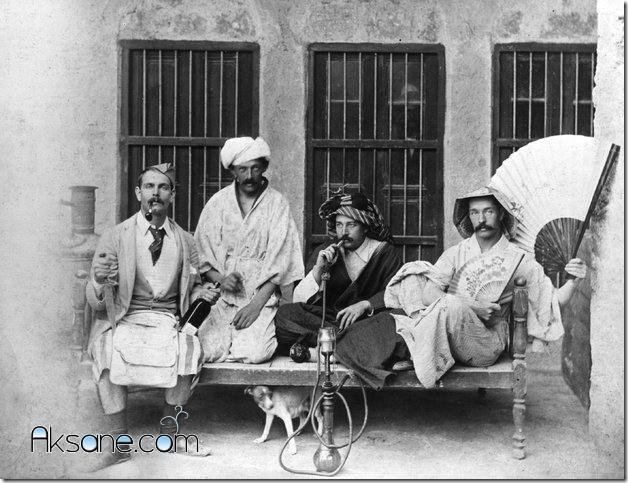
William Knox D’Arcy seen here when involved in oil exploration in Iran:
https://alchetron.com/William-Knox-D’Arcy
See the detailed negotiation coverage from an Iranian historian, but here is an extract from it:
Oil in Iran between the Two World Wars
By: Dr. Mohammad MalekIt was on May 28th, 1901 that Mozafar’od – Din Shah (of Qajar) granted the British subject William K. D’Arcy a 60-year oil concession on all areas of the country except the five northern provinces bordering Russia. The concession provided its holder the exclusive privilege to explore, exploit and export petroleum. Article 2 (of the concession) granted the holder the sole right of transportation of oil the area of the concession. Article 10 stipulated a royalty of 16% of the net profits on all operations to the Iranian government.
Oil was discovered in commercial quantities in the southwest of the country in late May 1908. The Anglo – Persian Oil Company (Anglo- Iranian Oil Company from 1935) was formed in London in April 1909. It was formed with an initial capital of 2 million pounds to assume all the D’Arcy’s rights and responsibilities. The first royalty in 1913.
On 20 May 1914, an agreement was signed between the British government and the APOC by which the British government became the major shareholder of APOC owning 51% of the shares. The agreement gave the British government the right to appoint two directors on the Board who would have the power of veto on any questions relating to British national interests. Also on the same day, a contract was signed between APOC and the British Admiralty by which APOC guaranteed the supply of oil to the Admiralty for 30 years at fixed prices.[1] The contract would really affect the relations between Tehran and APOC in so far as the royalties were concerned. Tehran did not protest until August 25th, 1920 when it ordered its financial advisor (Sydney Armitage-Smith) to negotiate with APOC on royalties.[2] Talks started in London and an agreement was signed on 22 December 1920 as result of which APOC paid one million pounds in settlement of Iran’s claims on royalties.
The Pahlavi dynasty replaced the Qajar dynasty in late 1925 and started talks on the revision of the concession in London in late July 1928. But before the talks started, the new regime strongly attacked the legality of the 1920 agreement on the basis that it had never passed the Majles.[3] In London, the Court Minister Abdol-Hoseyn Teymurtash told Sir John Cadman (the APOC’s chairman) that the Iranian government would grant APOC a new 60- year concession if, in return, APOC would agree -to reduce the area of the concession, -with a complete cancellation of the exclusive right of transportaion, -to give the Iranian government a substantial block of the shares,[4] -to register itself in Tehran as well London, -to be exempted from tax by both governments.[5]
The talks continued in Lausanne in August 1928. In Lausanne, Teymurtash made it clear that his government should be given 25% of the APOC’s total shares. “If this had been a new concession, the Persian Government would have insisted not on 25% but on a 50-50 basis”, he said.[6] He also demanded a minimum guaranteed interest of 12.5% on dividends out of the shares plus 2s for per ton of oil produced. Also he specified that 50 to 60% of the existing area should be relinquished at the time of the ratification of the new concession, and 60% of the remaining area should be reduced in three years. Cadman viewed Teymurtash’s demands as extravagant but promised that he would examine them with his company’s major shareholder, the British government.
In order to consolidate his position in any further talks with the British, Teymurtash took action soon after he returned to Tehran. He decided that Iran needed to demonstrate that it was in absolute control over the southwest where the APOC’s operations and installations had been centered. He also decided that the shah, Prime Minister and the press should criticise D’Arcy concession. So he took the shah, all Cabinet Ministers, along with the Majles deputies accompanied by hundreds of other civil servants, high ranking military officials and journalists to inaugurate the newly constructed road to the southwest and to visit oilfields and the APOC’s installations. In Ahwaz, the capital of the southwest province of Khuzestan, the shah showed his anger towards APOC and the concession by refusing to make a visit to the installations and by sending the following message to Cadman in London:
“the authorities of the company must know that neither the Iranian government nor the Iranian people agree with the D’Arcy concession. … Now, I explicitly notify the authorities of the company that they must rectify the matter and if they do not give it due attention, they will be responsible for any action which might result. No more can Iran tolerate the enormous profits from its oil going into pockets of foreigners while at the same time being dispossessed of its oil wealth”.[7]
Teymurtash himself threatened that if by the following spring he found his demands made in London and Lausanne had not been met, he would then turn against APOC and fight it.[8]
In its meeting of 20 November 1928, the British Cabinet agreed with 20% of the shares for Iran. Cadman, who had attended this meeting, was told of the following principles as the basis for any further talks with Teymurtash.
-Under a new prolonged concession, an extension of the contract between APOC and the British Admiralty should be guaranteed.
-The controlling position of the British government in the shares should be maintained.
-Shares to the Iranian government should be inalienable.Cadman arrived in Tehran on 18 February 1929. To Teymurtash, Cadman specified that APOC would agree with 20% of the shares only. Furthermore, he stated that APOC would not guarantee the interest on the shares being exempted from taxation in London.[9] Having had realised that the British would never agree to his demand for 25% of the shares, Teymurtash stated that in a new 60-year concession, both Iran and APOC should have the right to cancel the concession at the expiry date of the D’Arcy concession. Cadman left Tehran empty-handed with no agreement whatsoever.
From the talks in London, Lausanne and Tehran, it is well understood that Teymurtash had been planning to push APOC to the southwest of the country making it possible for his government to develop any possible oilfields outside southwest by non-British. Also, he had been planning to limit the influence of the British government over APOC as much as possible.
In 1930, Teymurtash adopted a policy to extract more money from APOC, this by levying it on its operation inside Iran. Nothing had been worded in the concession to prevent him from doing so. He submitted a bill to the Majles by which APOC would pay a tax of 4% on its profits earned in Iran, as from 22 March 1930. The bill passed the Majles on the same day, i.e. April 1st, 1930. APOC offered a guaranteed consolidated payment of “145.000 pounds per annum” for 10 years, or “150.000 pounds” for 8 years” in return for immunity from any tax.[10] Teymurtash did not agree. “The Company must show the amount of its profits earned in Persia”.[11]
Tehran was under extreme financial pressure in March 1931. The inflation rate had risen to nearly 45% and the shah needed a huge sum to go further with his railway and the army. In such a situation, APOC requested a new longer concession in return for a royalty of 4s per ton plus 10% of the net profits. Teymurtash was irreconcilable. He was entirely against the idea of a new longer concession. “The D’ Arcy concession is a law … it is a sacred document … [It] resembles an old and sick father who cannot be got rid of. We have to wait until he dies”, he said to Jacks.[12]
https://iranchamber.com/history/articles/oil_iran_between_world_wars.php
In more recent times:

In 1953 the United States was still new to Iran. Many Iranians thought of Americans as friends, supporters of the fragile democracy they had spent half a century trying to build. It was Britain, not the United States, that they demonized as the colonialist oppressor that exploited them……..
From Kinzer, All the Shah’s Men
In 1953, Iran witnessed a moment that would reshape its future and reverberate through global politics. Mohammad Mosaddegh, a leader driven by ideals of independence and democracy, stood at the center of this turning point. His move to nationalize Iran’s oil industry threatened powerful foreign interests, setting the stage for a CIA-backed coup that removed him from power. Understanding the events surrounding Mohammad Mosaddegh and the 1953 Coup in Iran is key to grasping how external interference and internal struggles have shaped modern Iranian history. This story is as much about one man’s vision as it is about the forces determined to crush it.
https://www.historywanderer.com/1953-coup-in-iran/
Soon after President Eisenhower took office on January 20, 1953, John Foster Dulles and Allen Dulles told their British counterparts that they were ready to move against Mossadegh. Their coup would be code-named Operation Ajax, or, in CIA jargon, TPAJAX. To direct it, they chose a CIA officer with considerable experience in the Middle East, Kermit Roosevelt, a grandson of President Theodore Roosevelt.
From Kinzer, All the Shah’s Men
Once the deed was done, Winston Churchill received congratulations, and in 1954 a new oil agreement was made.

Read details of archived messages and deals after Mossadegh coup:

If the United States had not sent agents to depose Prime Minister Mohammad Mossadegh in 1953, Iran would probably have continued along its path toward full democracy. Over the decades that followed, it might have become the first democratic state in the Muslim Middle East, and perhaps even a model for other countries in the region and beyond. That would have profoundly changed the course of history—not simply Iranian or even Middle Eastern history, but the history of the United States and the world. From the perspective of today—the perspective of those who have lived through the September 11 attacks, the Iraq war, and all the attendant threats that have emerged to destabilize the modern world—the 1953 intervention in Iran may be seen as a decisive turning point in twentieth-century history. By placing Mohammad Reza Shah back on his Peacock Throne, the United States brought Iran’s long, slow progress toward democracy to a screeching halt. The Shah ruled with increasing repression for twenty-five years. His repression produced the explosion of the late 1970s, later known as the Islamic Revolution. That revolution brought to power a radical clique of fanatically anti-Western clerics who have worked relentlessly, and often violently, to undermine American interests around the world.
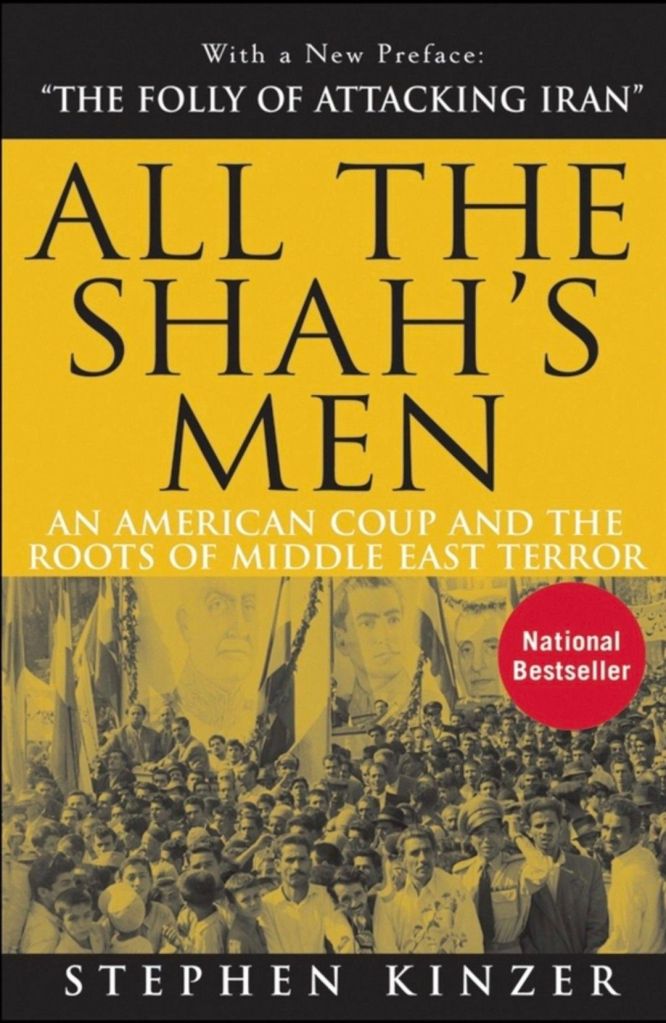
From 2008 book, All the Shah’s Men’ by Stephen Kinzer:
And Kinzer also notes:
That is especially true of the Bush administration, which is more closely allied with the oil industry than any other administration in American history. President Bush and those around him may have other reasons to feel tempted by the idea of invading Iran. Some believe, against all evidence, that the key to victory in Iraq is crushing the regime in Iran. Bush himself has said several times that he expects history to absolve him, an argument that can be used to justify even the craziest presidential decisions. Beneath these arguments lies another, more diffuse impulse.
Later, Kinzer points out how the Blair government seemed to have learned from historical mistakes, by emphasising diplomacy above force:
Now, with the Bush administration eager to find a scapegoat for its failures in Iraq, Lieberman is urging that the United States “take aggressive military action against the Iranians to stop them from killing Americans in Iraq.” This threatening rhetoric might intimidate countries that are small, poor, isolated, and insecure. When directed against a nation as proud as Iran, it has the opposite effect. It stiffens resistance and unites people who, like people everywhere, don’t like being ordered around by those they consider bullies.
Britain, which has been Iran’s enemy for considerably longer than the United States has, seems to have learned this lesson. In 1953, the British secret service worked with the CIA to depose Prime Minister Mossadegh, and over the course of the twentieth century, anti-British fervor has nearly always been more intense than anti-Americanism in Iran. Yet when an Iranian patrol captured nineteen British sailors and marines whom they said entered Iranian waters illegally in the spring of 2007, British leaders responded in a way that was startlingly different from the way American leaders would probably have responded if the captured soldiers had been from the U.S. Army. Prime Minister Tony Blair repeatedly insisted that he would pursue only diplomatic means to free the captives and categorically ruled out the use of force. The Iranian government, evidently impressed, soon released its captives. An incident that might have burgeoned into a long-running and highly destabilizing crisis was resolved through negotiation, without either side losing face.
Kinzer explains how Mossadegh, being a titanic figure in his brief moment in history to bring democracy to Iran, (even featured on the cover of Time magazine in 1951) was brought down by the CIA engineered coup ( President Dwight Eisenhower and Prime Minister Winston Churchill ordered the coup):
Operation Ajax, as the CIA coup against Mossadegh was code-named, was a great trauma for Iran, the Middle East, and the colonial world. This was the first time the CIA overthrew a foreign government. It set a pattern for years to come and shaped the way millions of people view the United States. This book tells a story that explains a great deal about the sources of violent currents now surging through the world. More than just a remarkable adventure story, it is a sobering message from the past and an object lesson for the future.
And in a current book by Chris Unger, you can read for yourself the minute details of the ‘interference’ orchestrated by the Republicans once Khomeini came to power after the Iranian Revolution in 1979.
As a journalist, one tends to move from one story on to the next. But this was different. I had started investigating it in 1991, and to be honest, I had been on and off it ever since. It became the background noise to my life as a journalist—something between a hobby and a part-time obsession. I’ve long thought that much of what we see on the news is merely spectacle and theater, and that we rarely get a glimpse of the unseen ways in which power really works. Behind the curtain. In that regard, the October Surprise was a master class. There were double agents, betrayals, covert operations, cutouts, illegal arms deals, and mysterious deaths. A hall of mirrors designed to obscure the truth, it was a case study in how to hijack American foreign policy, steal the presidency, and get away with it. All with no fingerprints.
The specific allegations dated back to the 1980 presidential election between the Republican ticket of Ronald Reagan and George H. W. Bush versus Jimmy Carter and Walter Mondale. At the time, Iran held fifty-two American hostages who had been incarcerated at the American embassy in Tehran during Iran’s Islamic Revolution. The fate of those hostages became a national obsession and arguably the most important issue of the 1980 election, a crisis unfolding in real time, the resolution of which would determine who held the most powerful office in the world.

Unger sets the scene:
If the hostages were released before the election, the thinking went, the ensuing patriotic fervor would give President Jimmy Carter such a big bounce in the polls that he would beat Reagan. But if the hostages were still incarcerated, voters would see Carter as a weak and impotent president who allowed America to be humiliated. As a result, Reagan-Bush campaign manager William Casey engineered a secret deal whereby Iran agreed to release the hostages, but only after the November elections had taken place.
When I first read about the accusation, the alleged crime was so over the top, it was literally unimaginable. Who could possibly believe that the Republicans—historically, the tough guys in American foreign policy, in the Cold War, in Vietnam, and now, rhetorically at least, in Iran—would secretly arm the Islamic fundamentalists chanting “Death to America!” in return for Khomeini’s people prolonging the incarceration of fifty-two Americans? If these charges were true, the entire Reagan-Bush era—indeed, modern conservatism in the United States—had been born out of a treasonous covert operation. That was the October Surprise.
These covert manoeuvres led to the US Republican win over the Democrats. This use of the situation in Iran to assist the Republican campaign is, and always will be, a shock tactic which helped build the ‘play book’ for Republican manipulation of international interference.
Where there is a country with huge oil reserves, such as Iran, Iraq and Venezuela, where the wealth derived might lift the population forward into a strong and prosperous sovereign state, history tells us the United States has ‘interfered’.
We must hold on to historical evidence in order to comprehend current events. As Truman once said:
There is nothing new in the world except the history you do not know.
Those of us who have only lived a life ‘in the West’ need to try, no matter how hard it may be, to imagine life ‘in the Middle East’ and to put ourselves ‘in their shoes’.
How might we feel about those who think they have a ‘God given right’ to wreck our dreams and plans for future generations?

 borderslynn

You must be logged in to post a comment.