
From Christopher Armitage List of Actions of Trump administration since Jan 2025:
- USDA rescinded 2001 Roadless Area Conservation Rule on June 23, 2025, opening 58 million acres across 39 states to logging and road construction, including 9 million acres of Alaska’s Tongass rainforest, 28 million acres in high wildfire risk areas, and land that provides drinking water for 60 million Americans.
- Interior Department finalized plan on October 24, 2025 opening entire 1.5-million-acre coastal plain of Arctic National Wildlife Refuge to oil and gas leasing.
- Arctic Refuge plan mandates four lease sales over 10 years on sacred Gwich’in Indigenous lands.
- Arctic Refuge drilling threatens Porcupine caribou herd birthing grounds in region experiencing Arctic warming 3-5 times faster than global average.
- Interior Department proposed on June 2, 2025 eliminating safeguards for 13 million acres of “special areas” in National Petroleum Reserve-Alaska.
See Christopher Armitage, Substack
Trump and Putin chose to meet in Alaska, Aug 15th 2025
Looking up the history now as Trump sometimes made it sound like Putin was inviting him to Alaska.
Looking back
Alaska’s modern history is very short; it was not discovered by the developed world until halfway through the 18th century. However, the indigenous peoples of Alaska have been here for quite some time.
The history of Alaska dates back to the Upper Paleolithic period (around 14,000 BC), when Siberian groups crossed the Bering land bridge into what is now western Alaska. At the time of European contact by the Russian explorers, the area was populated by Alaska Native groups. The name “Alaska”derives from the Aleut word Alaxsxaq (also spelled Alyeska), meaning “mainland” (literally, “the object toward which the action of the sea is directed”)
https://www.ereferencedesk.com/resources/state-history-timeline/alaska.html
And
Following decades of exploration, Russia claimed Alaska in 1741. It then founded its first North American settlement there on Aug. 3, 1784. This was established by the Shelikhov-Golikov Co., one of several fur-trading organizations that operated in the area — ostensibly on the empire’s behalf. In 1799, Czar Paul I merged several of these into the Russian-American Co. (RAC). A powerful conglomerate, the RAC was given a trade monopoly on Alaskan resources. It was also tasked with creating new settlements and expanding Russia’s New World presence.
To this end, company manager Alexander Baranov had his men venture all the way down to northern California, where they set up an outpost called Fort Ross on Feb. 2, 1812. The RAC’s grand vision was for this establishment to serve as an agricultural hub, one whose crops would sustain its own settlers and those up in Alaska. With their food supply guaranteed, the colonists in both locations would have an easier time harvesting the Pacific’s most profitable commodity: sea otter pelts. Several times more valuable than the coveted beaver and fur seal pelts, these were the lifeblood of the Russian-American economy.
Unfortunately, Fort Ross’ farming output was grossly inadequate. And to make matters worse, the Russian fur trappers overhunted those sea otters so badly that the animals nearly vanished from the North Pacific. The Russians therefore gave up on Fort Ross, which was sold to an American frontiersman in 1844.
https://history.howstuffworks.com/american-history/why-didnt-russia-sell-alaska-to-canada.htm
Then:
Purchase from Russia
1867 – Financial struggles force Russia to sell Russian-America to the United States. Negotiated by US Secretary of State William Seward, the treaty buys what is now Alaska for $7.2 million, or about 2 cents an acre. Alaska’s value was not appreciated by the American masses at the time, calling it “Seward’s folly.” ; Pribilof Islands placed under jurisdiction of Secretary of Treasury. Fur seal population, stabilized under Russian rule, declines rapidly.
1868 – Alaska designated as the Department of Alaska under Brevet Major General Jeff C. Davis, US Army
Currently, climate change continues to melt major glacier above the capital city, Juneau, of Alaska:
Threat over after Alaska’s capital sees record glacier-related flooding as river tops 16.6 feet
And here is a perspective on the goals likely being secured by Putin in these future meetings, from Lev Parnas, Substack:
Pay attention to who’s coming to Alaska from the Kremlin side. This isn’t a random diplomatic team — it’s Putin’s most loyal, most trusted inner circle. These are not people flying in to negotiate peace. Every single one of them has made it clear, even in the past few days, that Russia’s territorial claims are non-negotiable. Foreign Minister Sergei Lavrov has repeated that “Russia’s borders are defined by the constitution.” Dmitry Kirillov has doubled down on the narrative that occupied regions are “forever Russian.” They are here because this meeting was designed to pull Russia back from isolation, restore its global market access, and solidify Putin’s leverage over Europe’s energy supply — with Ukraine as the ultimate prize
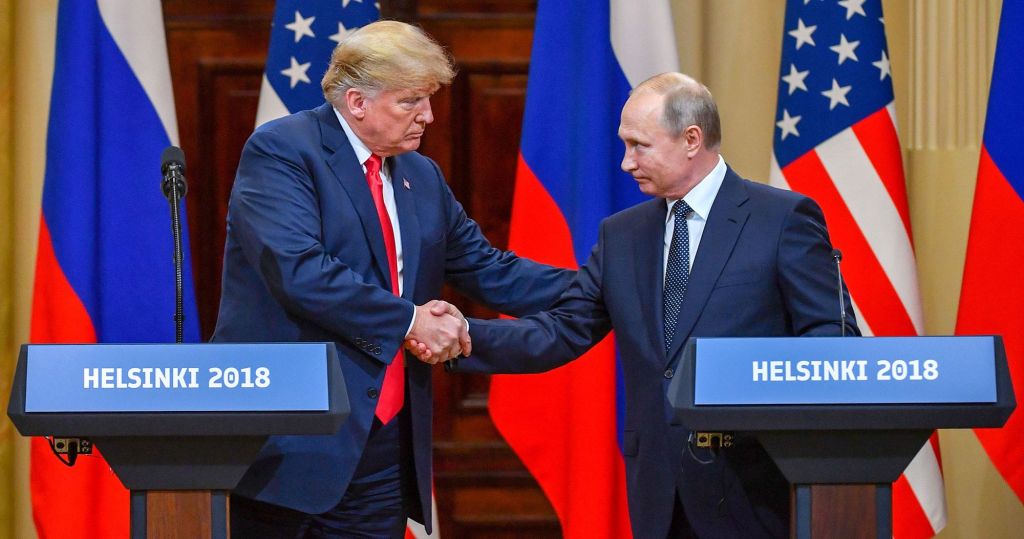
Some people think the Putin in Alaska was a double, here are two photos to compare:

And a comment from the post- “summit” from Jim Acosta, Substack:
If Trump hates being called a Russian asset, he should stop acting like one. His so-called summit with Vladimir Putin, which was obviously intended as a distraction from the Epstein scandal, magnified another malignant issue for Trump – his subservience to the Russian dictator.
A summary of news:
Although Trump rated the summit at “a 10,” the reviews weren’t exactly glowing: The New York Times headline was: “At Trump’s Summit, No Deal on Ukraine, and No Consequence for Putin.” A Fox News reporter said, “It did not seem like things went well. And it seemed like Putin came in and steamrolled, got right into what he wanted to say and got his photo next to the president and then left.”
Here is a comment from Richard Haas:
Last, the most revealing moment of the summit may well have taken place before it started when Foreign Minister Sergei Lavrov walked into the hotel wearing a sweatshirt with “CCCP,” as in “USSR,” across the chest. The informality I took as a sign of contempt for the proceedings; the reference to the Soviet Union a message recalling the Cold War and signaling the United States and Russia were again equals and rivals. It was a hint of what was to come for anyone watching.
And what did Alaskans have to say about this ‘summit’ which excluded Ukraine’s Volodymyr Zelenskyy?

 borderslynn
You must be logged in to post a comment.