We’re hearing a lot of talk about stagflation now, for good reason. Tariffs and mass deportations are both stagflationary: They increase inflation while depressing growth.
It’s becoming increasingly clear that there’s a third major stagflationary force coming into play: Soaring electricity prices, which will also hurt growth while increasing inflation.
Now, during the 2024 campaign Donald Trump boasted a lot about how he would bring down energy prices. He talked very big, and made specific promises. Notably, he declared that he would cut the price of electricity in half within 12 months of taking office:
So how’s that going?
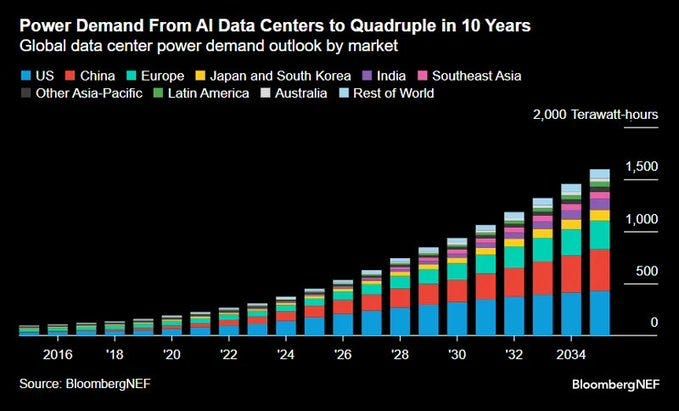
And this is only the start. Many analysts expect further large increases in electricity prices over the next year or more, largely because of surging demand from AI data centers. The electricity outlook is sufficiently scary that Texas — Texas! — has passed a new law giving the grid operator the right to cut off data centers during periods of power shortage.
An aside: In the America I grew up in, people who made big boasts about what they would achieve then completely failed to deliver were considered unserious blowhards. What happened to that country?
But Trump has a scapegoat, which probably won’t surprise you — renewable energy:
It’s unclear what his theory is. How does adding wind and solar generating capacity — increasing electricity supply — lead to higher prices?
To the extent that there is a story here, it involves what I’ve called MAGA brain, “the belief that the only way you can get results is by being tough and nasty, avoiding anything that might be considered woke” — which includes renewable energy.
As it happens, the data overwhelmingly reject Trump’s claims about renewables and prices. The Department of Energy has data on the share of each state’s electricity generated by renewable sources. For example, Iowa gets 80 percent of its utility-scale power from renewables, mostly wind, while New Jersey only gets 4.6 percent from renewables. Yet Iowa’s electricity prices actually fell slightly from May 2024 to May 2025, while NJ prices rose 10 percent.
Trump, however, has his own reality:
Except New Jersey doesn’t have any windmills. There have been proposals for large offshore wind farms, but they have never come to fruition — and Trump has signed executive orders that will effectively ban future offshore wind development.
So why are electricity prices soaring? The main answer is clearly a surge in power consumption by data centers, driven mainly by AI. Crypto is also playing a role, although we don’t know for sure how much — and thanks to the influence of the crypto bros, we may never find out:
Can we blame Trump for rising electricity prices? Not yet. The AI boom began well before Trump won the election, and the grid just wasn’t ready. Trump is, however, doing all he can to make the problem worse — boosting crypto and AI while blocking the expansion of renewable energy, which has accounted for the bulk of recent growth in electric generating capacity:
So the electricity crisis is set to get worse. And it will matter a lot. Households spend a substantial share of their budgets on electricity, but the overall impact of electricity prices goes well beyond your utility bills: electricity is an important cost of doing business, and an increase in that cost will be passed on to consumers. By my estimate, overall spending on electricity — both direct spending by consumers and spending by businesses that ultimately gets passed on to consumers — is about 2 percent of GDP. So large electricity price increases could have a significant effect on the cost of living.
Rising electricity costs will also lead businesses to produce and invest less. In particular, as I wrote the other day, energy shortages could bring the boom in AI spending to a screeching halt — and that spending is currently the only thing keeping the U.S. economy above stall speed, growth so slow that economic weakness becomes self-reinforcing.
Many people, myself included, have drawn parallels between the current AI frenzy and the telecoms boom and bust of the late 1990s — an alarming parallel, because the telecom bust led to years of elevated unemployment. But as Peter Oppenheimer of Goldman Sachs has pointed out, there have been many such boom-bust cycles over the centuries, going back to Britain’s canal mania in the 1790s. And here’s one analogy that has occurred to me: What would have happened if, midway through the 1790s canal-building boom, investors had realized that there wasn’t enough water to fill all those new canals?
So the electricity crisis is serious, adding significantly to the risk of stagflation. Unfortunately, it would be hard to find policymakers I’d trust less to deal with this crisis than the Trump administration, whose energy policy is driven by petty prejudices (Trump is still mad about the windmills he thinks ruin the view from his Scottish golf course), macho posturing (real men burn stuff), and hallucinations (the imaginary windmills of New Jersey.)
Placing tech companies in Pentagon:
On June 13, 2025, the Army will officially swear in four tech leaders.
Det. 201 is an effort to recruit senior tech executives to serve part-time in the Army Reserve as senior advisors. In this role they will work on targeted projects to help guide rapid and scalable tech solutions to complex problems. By bringing private-sector know-how into uniform, Det. 201 is supercharging efforts like the Army Transformation Initiative, which aims to make the force leaner, smarter, and more lethal.
The four new Army Reserve Lt. Cols. are Shyam Sankar, Chief Technology Officer for Palantir; Andrew Bosworth, Chief Technology Officer of Meta; Kevin Weil, Chief Product Officer of OpenAI; and Bob McGrew, advisor at Thinking Machines Lab and former Chief Research Officer for OpenAI.
Retired, living in the Scottish Borders after living most of my life in cities in England. I can now indulge my interest in all aspects of living close to nature in a wild landscape. I live on what was once the Iapetus Ocean which took millions of years to travel from the Southern Hemisphere to here in the Northern Hemisphere. That set me thinking and questioning and seeking answers.
In 1998 I co-wrote Millennium Countdown (US)/ A Business Guide to the Year 2000 (UK) see https://www.abebooks.co.uk/products/isbn/9780749427917



 borderslynn
You must be logged in to post a comment.