
In past blogs I have written about land which sank beneath the oceans after the Ice Age melt began over 10,000 years ago.
Now the world knows the Arctic and Antarctic ice caps are melting and sea levels are rising fast. Land is going beneath the oceans.
Thermal Expansion – As highly reflective ice and snow melt due to climate change induced global warming, the albedo of the earth declines. A lower albedo means warmer overall temperatures which means more snow and this causes water to expand. This is a positive feedback loop because as more ice and snow melts, the earth gets hotter which melts more ice and snow.
Meltwater – When the lower albedo of earth (and other factors such as the intensifying greenhouse climate) melts ice and snow it ends up in the ocean. Meltwater is the leading factor in sea level rise. Meltwater also affects the salinity of ocean water which can disrupt and alter ocean currents
https://storymaps.arcgis.com/stories/2841d4d221c7412fb8b887f7ffcf0c62
There are dramatic changes happening globally, for example Russia:
Siberian pipelines:
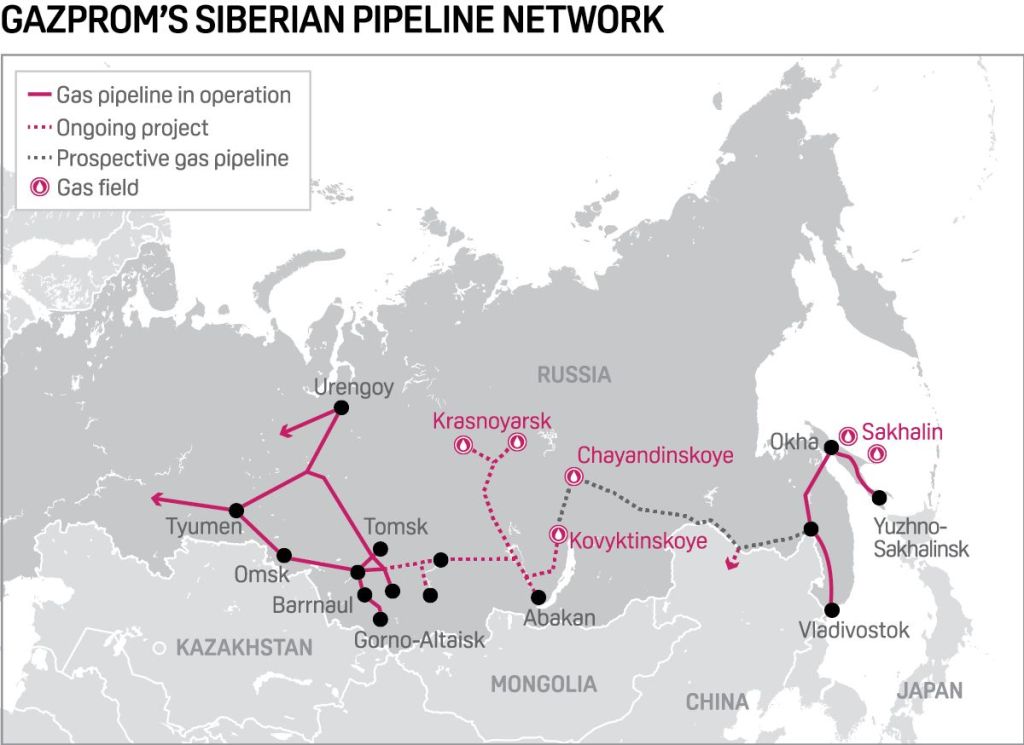
Melting Permafrost in Siberia is Threatening Russia’s Energy Industry
Permafrost and Climate Change
As the world becomes increasingly warmer due to anthropogenic climate change, the effects of climate change grow more apparent. Human activities, such as the burning of fossil fuels, deforestation, and livestock farming, have led to irreparable damage to our climate. One such result is the melting of permafrost. Permafrost is a frozen layer of soil, gravel, and sand bound together by ice that remains at or below 0ºC (32º F) for at least two years, primarily found in the Arctic and sub-Arctic regions of the globe. This ‘permanent frost’ acts as a carbon sink, storing up to 1,500 billion metric tons of organic carbon, almost twice as much as is currently in the atmosphere. These layers contain high concentrations of carbon as the permanently low temperature prevents dead animals and plants from decomposing. Unlike regular frozen ground, permafrost reaches from one meter up to more than 1,000 meters deep. With a heavy reliance on Arctic resources, as rising global temperatures accelerate permafrost thaw, the release of greenhouse gases, infrastructure collapse, and economic instability pose environmental and geopolitical challenges for Russia.
Permafrost and Russia’s Energy Sector
Two-thirds of Russia rests on permafrost, namely in the northern province of Siberia. However, as climate change causes global temperatures to rise, permafrost thaws, releasing stored greenhouse gases (GHGs) like carbon dioxide and methane into the atmosphere. Methane, in particular, is more potent than carbon dioxide at trapping heat in the atmosphere, resulting in higher ground temperatures. The release of GHGs exacerbates global warming, which furthers permafrost thawing—creating a dangerous positive feedback loop. Thus, Russia is warming 2.5 times faster than the rest of the world, contributing to devastating climate disasters in the region.
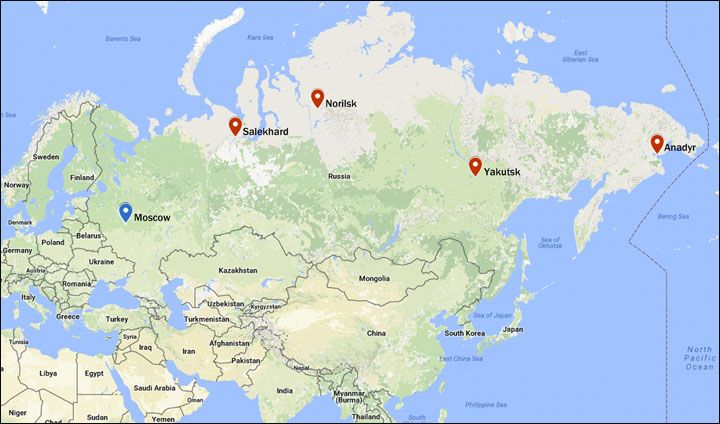
This is a Siberian methane crater:

See the report for accelerated disaster due to climate change in Asia:
https://library.wmo.int/records/item/68890-state-of-the-climate-in-asia-2023
China is famous for its global road building (as were the Romans). The problem for China in its own territory in mountainous areas, is the depletion of permafrost which is now damaging existing roads:
Abstract
Express highways are roads of high speed, large capacity, and transportation flexibility. The network of express highways in China has been developed over the last 30 years to accommodate the needs of a growing population and to facilitate economic development. Part of the network is in permafrost regions, where the construction and maintenance of these roads present significant engineering challenges due to permafrost degradation induced by climate warming and by construction. This paper summarizes the engineering problems encountered in the construction and maintenance of these express highways, and the mitigation techniques used to overcome them on new transportation projects in permafrost regions. Ten types of engineering problems along the Qinghai-Tibet Highway, the oldest and longest highway in the permafrost regions of China are identified. Their main cause is related to permafrost degradation in the subgrade beneath the road subbase. Settlement of the highway embankment due to thaw consolidation of degrading permafrost is the dominant mechanical distress observed. Mitigation techniques, mainly for enhancing heat convection beneath express highways, are discussed along with their effects. Research in China related to transportation projects may provide a reference for future express highway design and construction in permafrost regions around the world
https://onlinelibrary.wiley.com/doi/abs/10.1002/ppp.2053?af=R

And I have written before about the world’s glaciers disappearing, for example, Alaska:
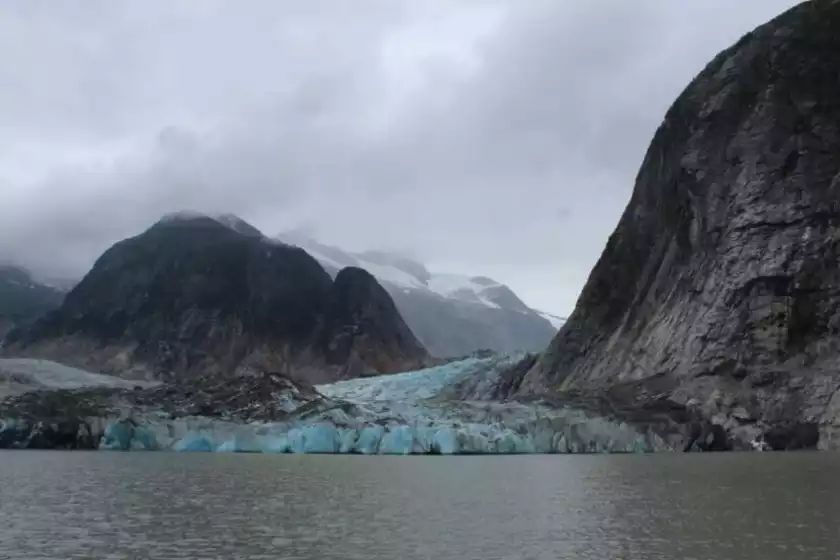
Alaska’s glaciers are melting faster than anywhere else
KHNS | By Avery Ellfeldt
Published February 24, 2025
From the Internet I gathered this list of lands going under now or will do over the next couple of decades.
The island of Tuvalu

The Maldives
Bangkok, Thailand
Jakarta, Indonesia
Jamaica, Caribbean
The island of Kiribati, Pacific Ocean
The Marshall Islands
Bangladesh
Venice, Italy
Netherlands
The Mekong Delta, Vietnam
Gardj Sugdub are the first of 63 communities living along Panama’s Caribbean and Pacific coasts to be relocated due to their island sinking beneath sea levels.
Sunday 2 June 2024 16:51, UK
Solomon Islands
Pilau, South Pacific
Micronesia, Pacific
Fiji, Pacific
Seychelles, off east coast of Africa
Cook Islands, off New Zealand
French Polynesia
Made up of popular tropical retreats like Bora Bora, Tahiti and the Society Islands, French Polynesia
Tangier Island, Virginia
Even the United States is affected by rising sea levels. Tangier Island, about 12 miles off the east coast in Virginia’s Chesapeake Bay
Shishmaref, Alaska
See:
https://www.rd.com/list/islands-will-disappear-80-years/
You can read about some of the above at:
and for the Caribbean:
https://www.my-island-jamaica.com/will_jamaica_sink.html
Macao:
Despite sophisticated flood control infrastructure, large parts of the Zhuhai-Macau area are projected to be below sea level by 2100. Sea level rise of 65 centimeters, together with high tide, would flood 3400 km2 of the Zhuhai region.
https://earth.org/data_visualization/sea-level-rise-by-2100-zhuhai-macau/
And the exponential construction of datacentres and bit mining energy centres will intensify the warming of the planet – whereas we should be dialling back our fossil fueled energy productions:
Climate risks, which are considered at a very high level of concern by the report, include riverine flooding, which risks severe damage to electronics, walls, roofs, and power systems from water ingress, and coastal inundation, which risks buildings being flooded, leading to water damage to cabling.
The report notes that by 2050, major data center hubs such as New Jersey, Hamburg, Shanghai, Tokyo, Hong Kong, Moskva, Bangkok, and Hovestaden are expected to face significant climate risks, with 20 to 64 percent of facilities in these areas likely to be highly vulnerable to physical damage from climate-related events.
The Asia-Pacific region, while leading global data center expansion, is also among the most exposed. In 2025, more than 10 percent of data centers in APAC are considered high risk, a figure projected to rise to more than 12 percent by 2050.
https://www.datacenterdynamics.com/en/news/climate-threats-to-data-centers-set-to-surge-report/
As fires rage around this increasingly hotter world, we know our excessive use of fossil fuels is adding to the continual destruction of our once beautiful world.

nbcnews
Wildfires live and die by the weather, but “the weather” doesn’t mean the same thing it did in 1990, or even a decade ago, and the reason the Fort McMurray Fire trended on newsfeeds around the world in May 2016 was not only because of its terrifying size and ferocity, but also because it was a direct hit—like Hurricane Katrina on New Orleans—on the epicenter of Canada’s multibillion-dollar petroleum industry. That industry and this fire represent supercharged expressions of two trends that have been marching in lockstep for the past century and a half. Together, they embody the spiraling synergy between the headlong rush to exploit hydrocarbons at all costs and the corresponding increase in heat-trapping greenhouse gases that is altering our atmosphere in real time. In the spring of 2016, halfway through the hottest year of the hottest decade in recorded history, a new kind of fire introduced itself to the world.
From the book, Fire Weather by John Vaillant
Here the author describes how human activity (anthropocene) – here petroleum industry within a boreal forest (!!!!) – is an anomaly……
Fort McMurray is an anomaly in North America. Located six hundred miles north of the U.S. border and six hundred miles south of the Arctic Circle, the city is an island of industry in an ocean of trees. Without the lure of petroleum, this part of Alberta would resemble Siberia in even more ways than it already does: sparsely populated; its rivers spun like compass needles toward the Arctic Ocean; its trees low, short-lived, and prone to fire.
At the time of writing, Vaillant pointed out:
Canada is the world’s fourth-largest oil producer and the third-largest exporter. Nearly half of all American oil imports—around 4 million barrels per day, come from there—the equivalent of one ultra large crude carrier ship every twenty-four hours. Of this vast quantity, almost 90 percent originates in Fort McMurray.
Many populations who have survived wildfire damage often get flooding after drought.
Rain on wildfire burn scars can trigger damaging debris flows − a geologist explains how
Published: January 23, 2025 1.47pm GMTUpdated: February 12, 2025 1.42pm GMT

As a consequence of climate change, conditions in previously safe areas to live in the world have become impossible to survive in. So people are on the move to flee to safety. But not all receive open arms and comfort when they reach somewhere which could have been safe.
People fleeing impacts of climate change suffering physical and mental health crises
Issues range from anxiety and depression to addiction and domestic violence.
Press release, 14 December 2022
People migrating to escape climate change-induced drought, floods, sea-level rise and crop failure are suffering a range of physical and mental health impacts as a result, according to new analysis from IIED and the International Centre for Climate Change and Development (ICCCAD).
https://www.iied.org/people-fleeing-impacts-climate-change-suffering-physical-mental-health-crises

 borderslynn
You must be logged in to post a comment.