Elon Musk, a South African white man, may or may not have realised the power he wielded when he discarded the USAID budget in order to fund tax cuts for billionaries like him.
Nearly 15,000 will have died already because of Trump and Musk’s cuts to USAID, advocacy program claims
The President’s Emergency Plan for AIDS Relief has saved more than 25 million lives since it began in 2003
And now we can look at the facts on an hourly death rate basis, from a website using the much acclaimed AI ability to search a wealth of data – although check their disclaimer!
Executive summary
Multiple peer-reviewed forecasts and real-time trackers estimate that USAID funding cuts could already have caused hundreds of thousands of deaths in 2025 and will cause many millions more by 2030 if not reversed. A Lancet modelling paper projects roughly 1.78 million excess all-age deaths in 2025 from per‑capita funding reductions and more than 14 million cumulative excess deaths through 2030 under complete defunding; independent real‑time trackers and commentators put current, already‑occurred deaths in the hundreds of thousands range [1][2][3][4].
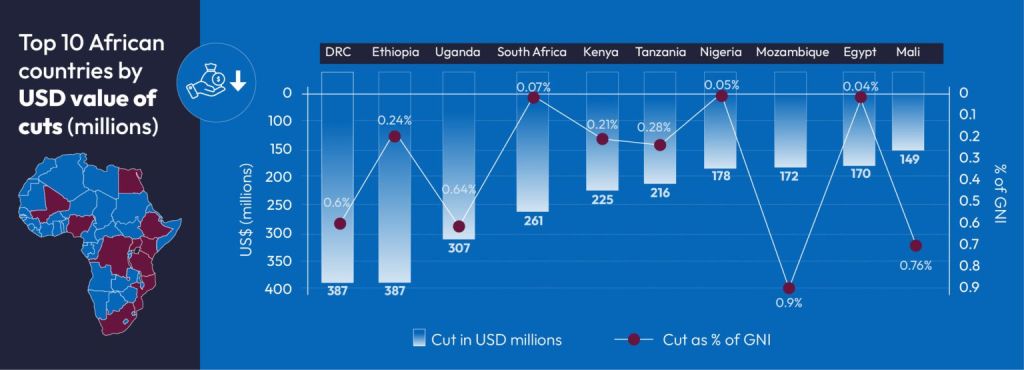
And at a 6 month anniversary since the cuts, this is what Africa experienced:
In dollar terms, the Democratic Republic of Congo (DRC) and Ethiopia have seen the greatest cuts. However, their large populations and economic heft may obscure the true impact of the cuts, which may appear more visible in smaller and less diversified economies such as Mozambique and Mali, where USAID funding accounted for a greater proportion of Gross National Income (GNI).
Fig 2
Reframing the data to examine those countries most affected in terms of USAID funding as a proportion of GNI shows that the impact is most acute in smaller and less diversified economies. This includes Liberia, Somalia – as well as Malawi and Mozambique, highlighted in the first chart.
Take Liberia for example, founded by American slaves, and yet has had a cursed existence, now continuing in its sorrowful path since tariffs and cutting of USAID:
MONROVIA, Liberia — Why is Liberia poor? The answer is long and nuanced, the multifaceted causes are deeply ingrained in the system of governance and socioeconomic ecosystem. However, one of the most widely spread root causes for nation-wide poverty is violent conflict. This is certainly the case for Liberia, the West-African nation originally founded in 1821 by former American slaves under the American Colonization Society.
Founded on pillars of liberty and freedom, its recent history is marred by a coup in the 1980s, which followed with years of civil war, a repressive government under Charles Taylor until 2003 and then a serious outbreak of Ebola in 2014. It is only now that Liberia can begin its road to recovery.
The U.S. is trying to facilitate a total financial support package of up to $40 billion for Argentina, but only $20 billion comes from U.S. government funds.
The deal includes a $20 billion currency swap between the U.S. Treasury and Argentina’s central bank. That was authorized in October and was heavily criticized in both countries, especially after President Donald Trump initially tied support to President Javier Milei’s performance in the October election in Argentina. Critics argue that using financial assistance to influence foreign elections sets a dangerous precedent.
The remaining $20 billion was originally expected to come from private banks and sovereign wealth funds, coordinated by the Treasury Department to invest in Argentine debt. But in November 2025, a group of banks backed out of a plan for the matching $20 billion package, instead opting to explore a smaller, short-term loan deal, according to reports.
Retired, living in the Scottish Borders after living most of my life in cities in England. I can now indulge my interest in all aspects of living close to nature in a wild landscape. I live on what was once the Iapetus Ocean which took millions of years to travel from the Southern Hemisphere to here in the Northern Hemisphere. That set me thinking and questioning and seeking answers.
In 1998 I co-wrote Millennium Countdown (US)/ A Business Guide to the Year 2000 (UK) see https://www.abebooks.co.uk/products/isbn/9780749427917



 borderslynn
You must be logged in to post a comment.