So I thought I would educate myself about Rare Earth Processing:
Rare earth metal processing involves extracting and refining rare earth elements from ores, which are typically found in complex mixtures. The process includes crushing the ore, separating the rare earth elements using various chemical methods, and purifying them into usable forms for applications in electronics, magnets, and other technologies. ameslab.gov sfa-oxford.com
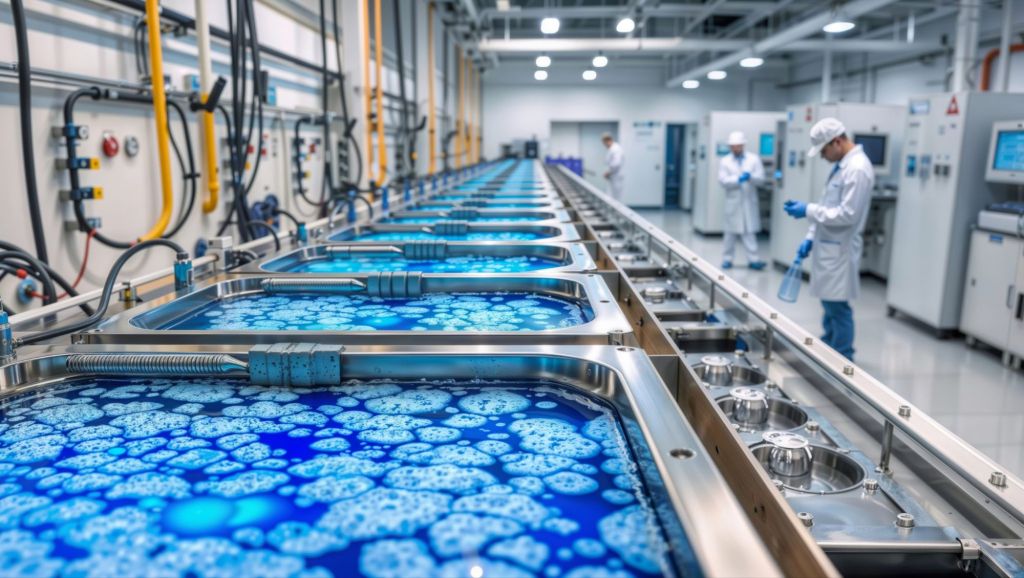
‘Blue solution’:
Rare Earth Metal Processing. Blue solution in tanks at a rare earth metal processing plant, with technicians in the background ensuring quality control and efficient production.
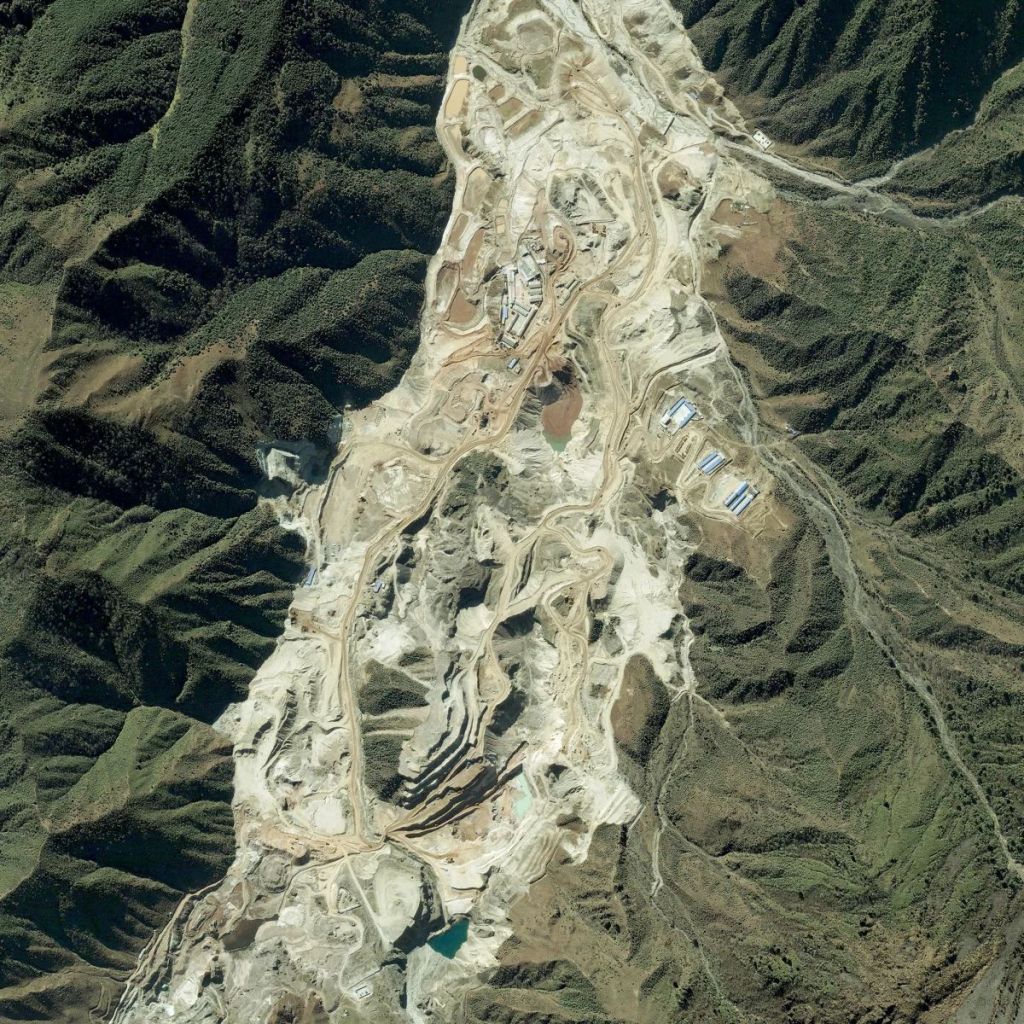
This is a satellite image collected on Nov. 13, 2012, of the Maoniuping Mine, one of China’s largest rare earth elements mines, located near Mianning, Sichuan province, China. DigitalGlobe/Maxar via Getty Images
How China came to rule the world of rare earth elements
It has taken China many decades of trial and error before they could achieve the world dominance in mining THEN PROCESSING rare earth elements. Other countries are trying to catch up, such as Germany and Riyadh.
Human industrial activity always harms the ennvironment. That is why everyone has let China get poisoned first but they are trying to mitigate the harm:
Highlights
•REEs are 17 critical metals essential for green technologies like electric vehicles and wind turbines.
•Conventional mining is energy-intensive, generating hazardous and radioactive wastes.
•In-situ leaching causes severe soil acidification and water contamination.
•EKM offers high efficiency with minimal environmental impact.
•LCA is crucial for evaluating and mitigating environmental impacts of REEs production.
The engine of industry is still coal in many countries, but also oil. The crisis in Iran is said to foresee the likely collapse of the Iranian supply chain of oil to China:
This is the potential unraveling of a 1.8 million bpd oil supply chain that exclusively feeds Chinese refineries at an $8-12 discount to global benchmarks. When that supply chain breaks,and what we are seeing suggest it will, the ripple effects will reshape everything from Brent crude pricing to Beijing’s refining margins to the geopolitical balance of power across the Persian Gulf.
See Giacomo Prandelli, Merchant News, Substack, Jan 14, 2026
He goes on to explain:
After Trump walked away from the nuclear deal in 2018 and reimposed sanctions, Iran’s oil exports cratered from 2.5 million barrels per day to just 350,000-500,000 bpd by 2020.
The regime should have collapsed under that pressure (It didn’t) instead, Tehran found a lifeline… China’s independent refineries in Shandong province, desperate for cheap crude and willing to look the other way on sanctions.
Fast forward to today, and Iran is exporting near-record volumes again—roughly 1.8 to 2.3 million bpd—with 90-95% going exclusively to China. In 2024 alone, Chinese buyers imported 533 million barrels of Iranian crude, representing about 13.6% of China’s total oil purchases. That’s not a marginal source anymore. That’s a structural dependency.
But Iranian crude doesn’t just flow to China because of political alignment. It flows because of the discount. Iranian oil consistently trades $7-12 below Brent benchmark prices. For Chinese refiners operating on low margins, that discount is the difference between profitability and bankruptcy. They’re not buying Iranian crude out of ideology…they’re buying it out of economic necessity.
The sanctions evasion machinery is sophisticated: ship-to-ship transfers in international waters, rebranding Iranian crude as “Oman Blend” or “Malaysian Light,” routing payments through Chinese banks outside the US financial system, and shell companies in the UAE and Malaysia providing plausible deniability. It works because Washington has largely looked the other way during Biden’s presidency, and because China has been careful not to involve state-owned oil majors that need access to Western capital markets.
And the regime appears desperate:
In at least one city, security forces have already refused to fire on protesters. That’s the domino that brings down authoritarian regimes.
So as China contemplates the implications, countries around the world are not in a position to replace China’s sophisticated prowess in rare earth process:
China’s Role and Global Constraints
China’s near-monopoly is not limited to mining but extends to processing and refining, stages that are capital-intensive, environmentally contentious, and politically sensitive in many democracies. This reality constrains how quickly alternatives can be built. Even with strong political will, new mines and processing facilities take years to develop, and environmental and labour standards emphasised by Japan and others add further complexity. As a result, efforts to diversify supply chains are likely to be gradual and uneven, leaving countries exposed in the interim.
The countries of the world are gripped with the crises facing us all just now.
And as Merchant News warns:
Trump wants low oil prices. But oil staying cheap makes Venezuela investment economically not feasible.
And China depends on oil imports:
China imports roughly 10 million barrels of crude oil per day. Domestic production covers only about 3.5 million barrels, leaving a 6.5 million barrel gap that must come from overseas.
We are on the edge of our seats as history unfolds.
Of course, Israel been keen to see Khamenei disappear:
How deeply are Israel’s Mossad spymasters involved in Iran protests?
Story by YONAH JEREMY BOB
• 54m
Protestors burn images of Ayatollah Ali Khamenei during a rally held in Solidarity with Iran
The IDF and Israel in the public sphere are doing all they can to stay out of the current Iran protests crisis to avoid being caught in Tehran’s crosshairs with ballistic-missile fire. But what about the Mossad in the shadows?
Why is US moving USS Abraham Lincoln Carrier Strike Group to Middle East amid Iran tensions?
US carrier deployment to the Middle East is underway as the USS Abraham Lincoln Carrier Strike Group has been redirected to the CENTCOM area of responsibility
Retired, living in the Scottish Borders after living most of my life in cities in England. I can now indulge my interest in all aspects of living close to nature in a wild landscape. I live on what was once the Iapetus Ocean which took millions of years to travel from the Southern Hemisphere to here in the Northern Hemisphere. That set me thinking and questioning and seeking answers.
In 1998 I co-wrote Millennium Countdown (US)/ A Business Guide to the Year 2000 (UK) see https://www.abebooks.co.uk/products/isbn/9780749427917



 borderslynn
You must be logged in to post a comment.