We’ve broken lots of major stories about ICE this month, but we’re just getting started (I have more leaked documents than time to write them up!)
“We have a nice little database and now you’re considered a domestic terrorist,” a masked federal agent taunted a protester filming him in Maine last week.
Department of Homeland Security spokesperson Tricia McLaughlin’s response was firm: “There is NO database of ‘domestic terrorists’ run by DHS.”
There’s just one problem: She’s lying.
Two senior national security officials tell me that there are more than a dozen secret and obscure watchlists that homeland security and the FBI are using to track protesters (both anti-ICE and pro-Palestinian), “Antifa,” and others who are promiscuously labeled “domestic terrorists.”
I can reveal for the first time that some of the secret lists and applications go by codenames like Bluekey, Grapevine, Hummingbird, Reaper, Sandcastle, Sienna, Slipstream, and Sparta (including the ominous sounding HEL-A and HEL-C reports generated by Sparta).
Some of these, like Hummingbird, were created to vet and track immigrants, in this case Afghans seeking to settle in the United States. Slipstream is a classified social media repository. Others are tools used to link people on the streets together, including collecting on friends and families who have nothing to do with any purported lawbreaking.
There’s practically nothing available that further describes what these watchlists do, how large they are, or what they entail.
“We came out of 9/11 with the notion that we would have a single ‘terrorist’ watchlist to eliminate confusion, duplication and avoid bad communications, but ever since January 6, not only have we expanded exponentially into purely domestic watchlisting, but we have also created a highly secretive and compartmented superstructure that few even understand,” says a DHS attorney intimately familiar with the subject. The attorney spoke on the agreement that their identity not be disclosed.
Prior to 9/11, there were nine federal agencies that maintained 12 separate watchlists. Now, officially there are just three: a watchlist of 1.1 million international terrorists, a watchlist of more than 10,000 domestic terrorists maintained by the FBI, and a new watchlist of transnational criminals, built up to more than 85,000 over the past decade.
The new domestic-related watchlists—a set of databases and applications—exist inside and outside the FBI and are used by agencies like ICE and the Border Patrol to organize the Niagara of information in possession of the federal government. Collectively, they create ways to sort, analyze, and search information, a task that even artificial intelligence has failed to conquer (so far).
Among other functions, the new watchlists process tips, situation reports and collected photographs and video submitted by both the public and from agents in the field; they create a “common operating picture” in places like Minneapolis; they allow task forces to target individuals for surveillance and arrest; and they create the capacity for intelligence people to link individuals together through geographic proximity or what is labeled “call chaining” by processing telephone numbers, emails, and other contact information.
Administration officials have alluded to all of this, though contrary to the Hollywood idea of some all-seeing eye, actual government watchlists are more a patchwork system of lists and applications, each of which might have individual justification or even legitimate purpose to aid law enforcement but overall form the basis for massive violations of American civil rights.
“One thing I’m pushing for right now … we’re going to create a database where those people that are arrested for interference, impeding and assault, we’re going to make them famous,” Tom Homan, Trump’s border czar, told Fox News earlier this month.
Watchlists in general fly in the face of the spirit of the Constitution and the protections it’s supposed to embody against unreasonable search and seizure, and relating to the right of privacy.
“The very essence of the ‘list’ is its secrecy and its lack of any opportunity for the listed to be heard,” Supreme Court Justice Felix Frankfurter said of a Justice Department list of subversives during the Red Scare. “It is the shrouding of the process in a veil of secrecy that is the most offensive to our democratic traditions.”
Now, the national security community has developed an interlocking set of lists and applications that are secret not just to the public but opaque to most who toil in the federal agencies themselves. Asked about the watchlists, a Border Patrol agent recounted to me how they punch their data into their own proprietary application, not really knowing what happens after that.
Again, these watchlists aren’t the all-seeing eye of Sauron that many imagine. They’re more like the compound eye of a fly, a fragmented array of lenses (over 3,000 per eye in the common housefly!) that collectively form a mosaic. That mosaic—the ability to unify all the disparate lists into one master picture—doesn’t yet exist, sources tell me. That, however, is the direction we’re going, especially with software packages like Palantir that can be customized to aggregate all that is collected.
“We do of course monitor and investigate and refer all threats, assaults and obstruction of our officers to the appropriate law enforcement,” says McLaughlin. “Obstructing and assaulting law enforcement is a felony and a federal crime.”
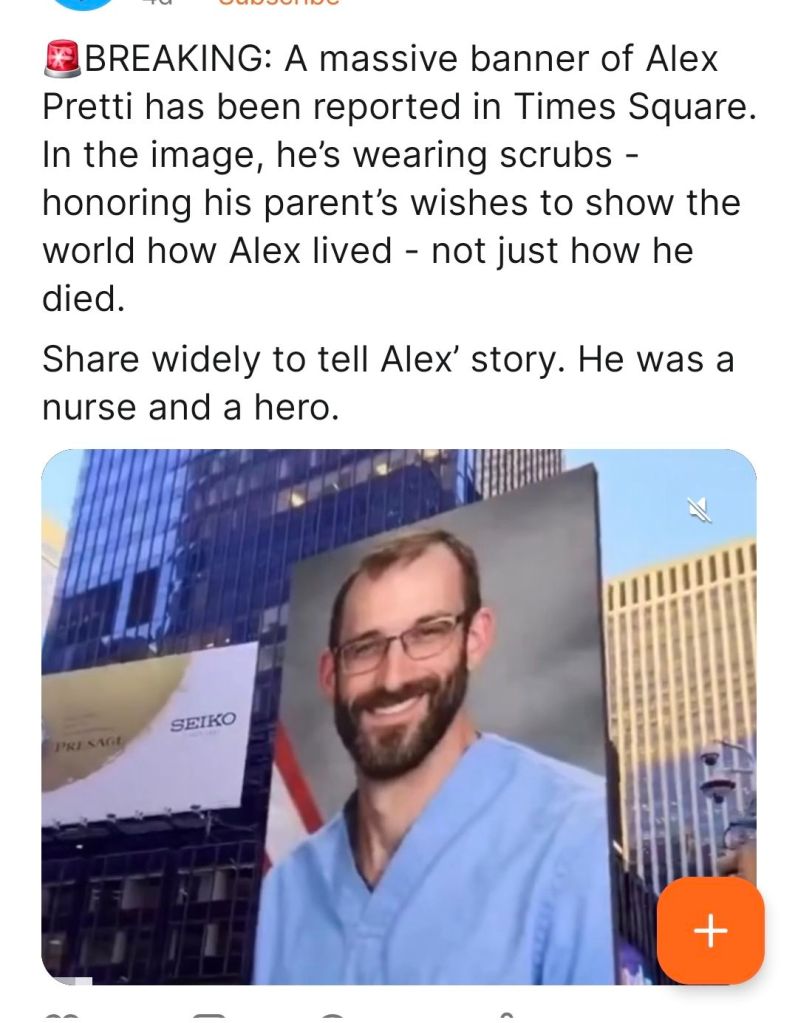
Impeding federal law enforcement has emerged as the Trump administration’s primary justification for actions against people like Renee Good and Alex Pretti.
As part of its new effort to support its operations in places like Minneapolis and Los Angeles, the Homeland Security Department, working with the Justice Department, has started more methodically tracking what it calls “aggressive protesters.” According to one senior official, this is a new designation the agency uses to describe the supposed threat posed by people on the streets.
Both Good and Pretti were considered aggressive protesters; in Good’s case, for criticizing ICE officers while operating a vehicle; and in Pretti’s case, getting up close to immigration officers while filming them.
Bangor plane crash kills 7: Private jet linked to ‘anti‑Trump’ lawyers who defended illegal aliens
Story by TOI World Desk
• 2d
Bangor plane crash kills 7: Private jet linked to ‘anti‑Trump’ lawyers who defended illegal aliens
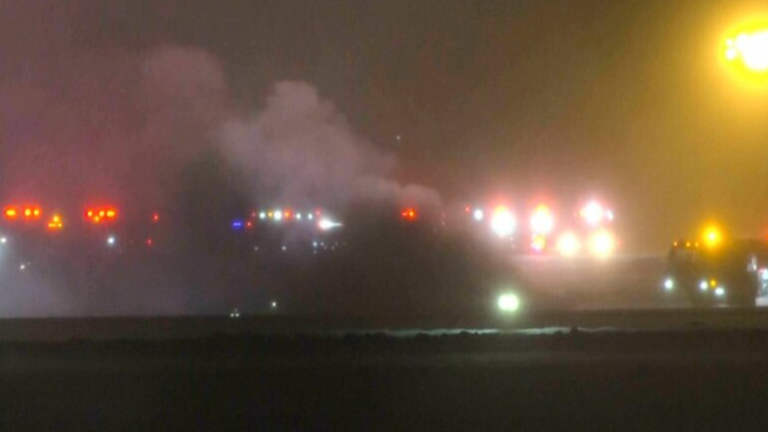
Seven people were killed and one crew member seriously injured when a private jet crashed on takeoff at Bangor International Airport in Maine on Sunday night, officials said.
The Bombardier Challenger 600 went down during a heavy winter storm as it tried to lift off at about 7.45 pm local time. The aircraft was reportedly connected to a Houston law firm.
The Federal Aviation Administration confirmed that the jet, carrying eight people, crashed during takeoff amid freezing snow and icy conditions.
Emergency responders were on the scene for hours as the airport was closed and flights were cancelled in the region.
Here is an extract from Michael D Sellers Substack, January 29, 2026, showing his belief Minnesotans have set the example for America:
They showed how accountability can be built quickly:
A simple neighborhood signal that mobilizes bodies.
A distributed set of cameras that creates an evidentiary wall.
Rapid dissemination that prevents early narrative capture.
A swarm of analysis that makes denial look ridiculous.
A press ecosystem forced—by the thickness of the record—to engage reality rather than press releases.
That’s not just “resistance.” It’s civic competence. It’s the muscle memory of self-government.
And it appears to have mattered on the ground. ICE isn’t gone. The larger machine doesn’t dissolve because one community stands up. But it does seem like something shifted. Peak madness—at least in that place, in that phase—hit a limit. Not because power became kinder, but because citizens made the cost of unchecked lying higher.
Vigilance remains essential; anyone who thinks the story ends neatly is not paying attention. But we should still be able to say, without embarrassment, that ordinary people pushed back—and that pushback changed the weather.
So the question becomes the one you asked implicitly: have we learned enough to repeat this?
Will other cities show the same spirit and resolve?
It’s too soon to promise. Civic courage is not guaranteed, and it is never evenly distributed. But Minnesota has set an example that can’t be unseen. It has reminded the country of something we forget at our peril: institutions are not the only guardians of public truth. Sometimes they are the problem. Sometimes they are late. Sometimes they are compromised. Sometimes they are trapped by access and incentives.
When that happens, the people become the record.
And maybe that is the most hopeful part of this story: not the outrage, not even the exposure, but the quiet competence of a community that remembers how to become a community in a crisis.
A whistle. A door opening. Footsteps in the snow. Phones raised, not for spectacle, but for the simple insistence that what is happening is seen.
In that sense, “The Eyes of Minnesota” is not just a poetic line. It’s a civic achievement.
The eyes prevailed—not because they were perfect, but because they were many. Because they were close. Because they were brave enough to be present. Because they understood, at last, that the first battle is for the story, and that the story belongs to the people who show up.
And for that, Minnesota has shown the rest of the country a standard worth honoring—and worth imitating.
The example has been set.
The Eyes of Minnesota have prevailed.
Over to you America
Another 2 apps which provide an ICE worker with phone details in targetted locations:
How ICE uses phone and internet data to identify and track people
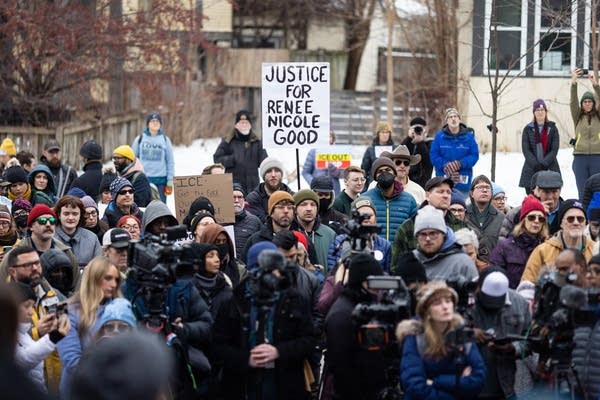
People listen to clergy and faith leaders call for accountability at the site where Renee Good was killed by an ICE agent in Minneapolis on Jan. 8.
Ben Hovland | MPR News
404Media identified these apps:
What acting ICE Director Todd Lyons called the “largest immigration enforcement operation ever” continues to unfold in Minnesota. And we are learning about the tools federal law enforcement agents use to track the people they’re trying to arrest, as well as protesters.
ICE recently purchased two programs called Tangles and Webloc, which are used to track the cell phone activity of entire neighborhoods and monitor people over social media and through internet data, according to reporting by 404 Media. 404 Media journalist Joseph Cox joined MPR News host Nina Moini with insight on those tools and how they’re used to track people.
More ICE software surveillance app, Mobile Fortify:
An ICE agent points a government-issued smartphone at someone’s face, snaps a photo, and within seconds knows whether that person has a deportation order—or at least, whether an algorithm thinks they do. The tool, called Mobile Fortify, went live in June 2025, and it searches more than 200 million photographs stored in federal databases. No warrant required. No reasonable suspicion needed. Point and scan.
Over 1,000 state and local agencies now have access to the companion Mobile Identify app. Driver’s license photo is searchable unless you live in one of six states that have blocked access.
Retired, living in the Scottish Borders after living most of my life in cities in England. I can now indulge my interest in all aspects of living close to nature in a wild landscape. I live on what was once the Iapetus Ocean which took millions of years to travel from the Southern Hemisphere to here in the Northern Hemisphere. That set me thinking and questioning and seeking answers.
In 1998 I co-wrote Millennium Countdown (US)/ A Business Guide to the Year 2000 (UK) see https://www.abebooks.co.uk/products/isbn/9780749427917




 borderslynn
You must be logged in to post a comment.