Nev Shalev, Substack, writes of the evidence located through immense patience and care, of Epstein at the heart of military and intelligence in Moscow. Here is an extract:
THE PASSPORT TRAIL
Based on passport photos and paperwork in the Epstein files — documents EFTA00311304, EFTA00311310, EFTA00292666, and EFTA00304985 — Jeffrey Epstein appears to have been issued Russian visas in at minimum:
2002, 2003, 2004, 2006, 2007, 2011, 2014, 2015, and 2018 (the last valid until 2021).
Nine visas across sixteen years.
But the documented trail goes back even further. A photograph posted to Flickr by tech investor Esther Dyson — taken in April 1998 — shows Epstein posing with Dyson and Pavel Oleynikov outside Andrei Sakharov’s house in Sarov, in the Nizhny Novgorod region. Sarov is a closed city — a restricted-access ZATO — home to Russia’s Federal Nuclear Center, RFNC-VNIIEF, where Sakharov developed the Soviet hydrogen bomb. Entry requires authorization from the Russian government. Epstein was inside a closed nuclear city four years before his first documented visa.
Back in July 2025, it was already being exposed by Françoise Thom:
The St. Petersburg Economic Forum is a favorite hunting ground for attractive escorts tasked with harpooning businessmen on behalf of Russian services.
Unsurprisingly, Belyakov is also a graduate of the FSB Academy. His career has risen rapidly. He was an advisor to oligarch Oleg Deripaska, then assistant to the Minister of Economic Development, Elvira Nabiullina, who now heads the Central Bank of Russia. Documents hacked by the Dossier Center team reveal that in the spring of 2014, Belyakov sought Epstein’s advice on how to circumvent Western sanctions.
« One of these was the so-called ‘new Bank’ that “could be modeled after a capitalistic commercial bank, lending 9 times its reserves NOT the world bank, those models are antiquated”, he proposed.
Epstein also suggested launching an alternative to bitcoin known as BRIC and the possibility of providing loans worth ‘500 billion’ (though he did not specify the currency). Moreover, Epstein believed that Russia could create new currencies pegged to oil or develop ‘smart contracts’ regulated by computers. In addition, Epstein shared his views on the Russian economy with Belyakov. For example, when in December 2014 the Russian Central Bank raised its benchmark rate to 17 per cent, Epstein wrote: “Bad advice to raise rates. it sends the wrong sign.”»
Epstein was thus feeding the Kremlin strategies to counter the economic war waged by the West.
In addition, he used his network to send leading Western business executives of interest to the Kremlin, such as Reid Hoffman (co-founder of LinkedIn) and Nathan Myhrvold (former chief technology officer at Microsoft), to the St. Petersburg Economic Forum for possible recruitment.
Reid Hoffman — Photo U.S. Secretary of Defense
This assistance was crucial for Moscow at a time when many Westerners were boycotting Russia. In July 2014, Belyakov, then Russian Deputy Minister of Economic Development, personally intervened to help Jeffrey Epstein obtain a Russian visa. He arranged a series of high-level meetings for him in Moscow. These were with leading figures at the heart of Russian economic policy: Deputy Finance Minister Sergei Storchak, Central Bank Deputy Chairman Alexei Simanovsky, and even the Minister of Economic Development himself, Alexei Ulyukayev. But here again, the mystery remains : it is not known whether Epstein’s visit actually took place.
Among wellbred men, small favors are usual. In July 2015, Epstein contacted Belyakov with an urgent problem: a “Russian girl from Moscow, Guzel Ganieva,” was in New York and “trying to blackmail a group of powerful businessmen.” Ganieva had ensnared a close friend and associate of Epstein, billionaire Leon Black. No problem: Belyakov provided Epstein with a detailed intelligence file on Ganieva, who he claimed was working alone and would be highly sensitive to the threat of deportation from the United States. Leon Black paid huge sums to Epstein.
Leon Black:
How Picasso, Van Gogh And Cézanne Helped Finance Epstein Client Leon Black’s Billionaire Lifestyle
This was not just a matter of Epstein providing minor services to the Kremlin. The sex trafficking was a cover for something else. It turns out that Epstein had a predilection for Russian female employees. His assistant, Svetlana (Lana) Pozhidaeva, obtained an O-1 talent visa for the United States thanks to a letter of recommendation from Belyakov
This lady deserves our attention. A graduate of the prestigious Moscow State Institute of International Relations (MGIMO), the Foreign Ministry’s academy that trains Russian diplomats and intelligence agents, she is multilingual, but her career took an unexpected turn. Despite her brilliant studies, she ended up becoming a model, represented by MC2, a modeling agency owned by Frenchman Jean-Luc Brunel, a sexual predator and Epstein’s pimp (arrested in 2020, he was found hanged in his cell, like Epstein). She moved to the United States and became an associate of Jeffrey Epstein.
She became involved in charity work, chairing a foundation supporting women entrepreneurs and Education Advance, a New York association whose aim is to support science and technology in education; most of the $56,000 in funding for the latter was provided by Epstein in 2017. Epstein also donated $50,000 to Pozhidaeva for the Open Cog Foundation, a project to develop an open-source artificial intelligence framework. Epstein also offered her the opportunity to study and attend conferences with scientists. “What she liked was that he gave a lot to science and helped researchers and interesting people,” a source told the Irish Mail on Sunday.
For Yuri Shvetz, a KGB defector who was one of the first to show how Epstein’s network had converged with that of the FSB, Pozhidaeva’s case is clear: “How could some-one as smart and educated as Pozhidaeva become a women’s rights activist while possibly seeking the support of Jean-Luc Brunel and Jeffrey Epstein, who led and participated in human trafficking and the rape of underage girls for more than two decades?”
There is only one explanation. She was an agent infiltrated with the help of Jeffrey Epstein to penetrate “the American network linked to supercomputers and artificial intelligence.”
Salisbury Novichok poisoning strategist, Vladimir Alekseyev, shot:
Top Russian general reportedly behind Salisbury poisonings shot
Retired Supreme Court judge Lord Hughes of Ombersley is publishing his report into the death of Dawn Sturgess who was killed by Russian nerve agent Novichok.
Her death came months after former Russian spy Sergei Skripal, his daughter Yulia and police officer Nick Bailey were also poisoned.
– March 4 2018: Former Russian double agent Sergei Skripal, 66, and his daughter Yulia, 33, are found unconscious on a park bench in Salisbury, Wiltshire.
– March 7: Police say a nerve agent was used to poison the pair and the case is being treated as attempted murder.
– March 8: Home secretary Amber Rudd says Wiltshire Police officer Detective Sergeant Nick Bailey is seriously ill in hospital.
– March 12: Prime minister Theresa May tells the Commons the nerve agent Novichok is of Russian origin and the government has concluded it is “highly likely” Russia is responsible for the poisoning.
– March 14: Mrs May tells MPs the UK will expel 23 Russian diplomats, calling the poisoning an “unlawful use of force by the Russian state against the UK”.
– March 22: Det Sgt Bailey is discharged from hospital but says life will “probably never be the same”.
– March 26: Britain’s allies announce more than 100 Russian agents are being sent home from 22 countries, in what Mrs May calls the “largest collective expulsion of Russian intelligence officers in history”.
– April 10: Ms Skripal is discharged from hospital, followed by her father just over a month later.
– June 30: Dawn Sturgess and Charlie Rowley fall ill at a flat in Muggleton Road, Amesbury, eight miles from Salisbury, and are taken to hospital.
– July 4: Police declare a “major incident” after revealing Ms Sturgess and Mr Rowley have been exposed to an “unknown substance”, later confirmed to be Novichok.
– July 8: Ms Sturgess dies in hospital and a murder investigation is launched.
– July 10: Mr Rowley regains consciousness and is discharged from hospital later that month.
– September 4: Independent investigator the Organisation for the Prohibition of Chemical Weapons confirms the toxic chemical that killed Ms Sturgess was the same nerve agent as the one that poisoned the Skripals.
– September 5: Scotland Yard and the Crown Prosecution Service say there is sufficient evidence to charge two Russians, Alexander Petrov and Ruslan Boshirov, with offences including conspiracy to murder. Petrov’s real identity is believed to be Alexander Mishkin, who worked as a doctor for Russian military intelligence service the GRU, while Boshirov’s real identity is believed to be Anatoliy Vladimirovich Chepiga.
– September 12: Russian President Vladimir Putin says there is “nothing criminal” about Petrov and Boshirov. Downing Street insists they are GRU officers “who used a devastatingly toxic illegal chemical weapon on the streets of our country”.
– September 13: Petrov and Boshirov are interviewed by Russian state-funded news channel RT in which they claim they were tourists visiting Salisbury.
– March 1 2019: The Ministry of Defence announces Salisbury is to be declared decontaminated of Novichok after an almost year-long military clean-up of 12 sites.
– June 2020: BBC docudrama The Salisbury Poisonings is broadcast over three consecutive nights. Its first episode was reported to have been watched by more than seven million viewers, making it the biggest UK television premiere of the year so far.
– September 2021: Investigators say they have sufficient evidence to charge a third man over the poisonings – Russian spy Denis Sergeev, also known as Sergey Fedotov.
– October 14 2024: The Dawn Sturgess Inquiry begins public hearings in Salisbury before later continuing in London.
– December 2: The hearings conclude.
– December 4 2025: Lord Hughes publishes his report.
The most unexpectedly discussed figure in Russia this week is Maria Drokova — a woman with a biography so improbable that it now reads like a parable of the Putin era. She first became famous as a teenage activist in a pro-Kremlin youth movement, then as the girl who publicly kissed Vladimir Putin. Later, she reinvented herself as a successful PR professional, skillfully monetizing that early moment of notoriety. And then, her name has surfaced in the Epstein files. So far, she appears to be the most prominent Russian character in this scandal.
According to the available correspondence, Drokova presented herself as Epstein’s PR consultant. Epstein, whom she referred to as her boss, asked her for nude photos; when she sent them, he replied that she was “trying too hard.” The exchange reads less like a crime dossier than a bleak illustration of power, ambition, and self-objectification — but that, perhaps, is precisely the point.
========
Two years later, after enrolling at a Moscow State University, the seventeen-year-old Drokova became head of Nashi’s Moscow headquarters and one of its spokespeople. Even then, it was clear that she aspired to be the regime’s model student — disciplined, ambitious, and always eager to outperform everyone else.
==========
Nashi was created in the mid-2000s by Kremlin political strategist Vladislav Surkov as part of a patriotic response to the “Color Revolutions” in Ukraine and Georgia — a young generation that would defend the regime in the streets if necessary. In practice, it became a highly centralized structure combining political mobilization, and personal loyalty to those in power.
=========
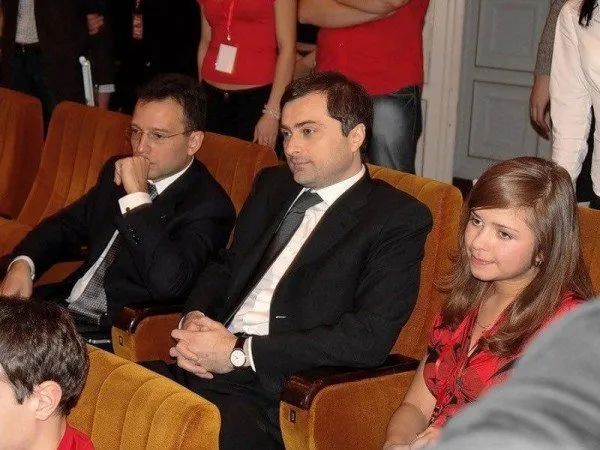
Surkov (center) and Drokova (right)
Years later, investigative journalists from The Insider reported that Surkov allegedly used the movement not only to pursue political objectives but also for personal purposes — including access to young women — a pattern that, according to the investigation, may not have been limited to him alone.
According to investigations by Proekt, Putin had a year-long relationship with Alisa Kharcheva, a seventeen-year-old aspiring journalism student. The relationship reportedly began in the fall of 2010 and continued for roughly a year. Kharcheva allegedly made regular visits to Putin’s country residence outside Moscow.
The introduction, journalists say, was facilitated by Nashi.
On October 7, 2010 — Putin’s 58th birthday — Nashi released an “erotic calendar” featuring twelve semi-nude female journalism students from Moscow State University. Kharcheva, who was seventeen at the time and had not yet been admitted to the university, appeared on the page for April. The calendar was delivered to Putin together with the girls’ contact details. Putin’s spokesman Dmitry Peskov publicly confirmed that the gift had been received.
Kharcheva in the calendar made for Putin
============
Whatever the true mix of motives, by 2011 Drokova had left Russia and moved to the United States to start over.
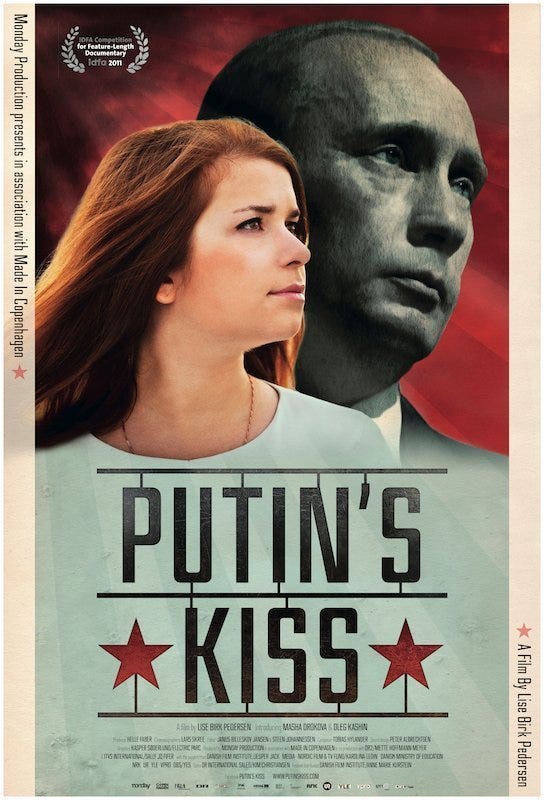
In America, she rapidly reinvented herself. She began working with venture capital firms and publicly framed her earlier political activism as a mistake — a youthful error shaped by the environment she had grown up in. Her transformation itself became the subject of a documentary film, Putin’s Kiss, directed by Danish filmmaker Lise Birk Pedersen, which followed her journey from Kremlin youth icon to aspiring Western liberal.
And released Epstein Files show correspondence with Maria (Masha) Drokova:
And yet the Epstein files now complicate this carefully constructed narrative. In the latest document releases, Maria Drokova’s name appears more than 1,600 times — suggesting that the American chapter of her life may be far more entangled, and far less transparent, than her public reinvention once implied.
Epstein’s Prize
When Maria Drokova’s name first surfaced in connection with Jeffrey Epstein, it appeared in a specific and consistent role. In emails from 2017–2018, she introduced herself to journalists as Epstein’s representative and public relations advisor, offering interviews and coordinating media contact on his behalf. This is how many people in media and tech circles first encountered her in relation to Epstein — not as a casual acquaintance, but as someone speaking for him.
After the first wave of Epstein-related document releases, Drokova publicly minimized her involvement. She told journalists that her interactions with Epstein were sporadic, unpaid, and largely accidental — brief professional exchanges that had been exaggerated after the fact. Crucially, she emphasized that she does not appear in court records, victim testimonies, or official witness lists connected to Epstein’s criminal cases.
Now the emails show sustained, initiative-driven engagement. Drokova was not merely responding to Epstein’s requests; she actively proposed strategies to rehabilitate his reputation. She suggested producing a documentary or feature film about him and recommended Danish director Lise Birk Pedersen — the same filmmaker who had previously made a documentary about Drokova herself. She proposed establishing a prestigious scientific prize bearing Epstein’s name, explicitly framing it as something that could rival or even surpass the Nobel Prize.
Perhaps most strikingly, she outlined plans for a foundation ostensibly dedicated to combating sexual harassment. Such a project, she argued, would generate “good optics among women” and provide access to large networks of ambitious female activists. Epstein, she implied, could be repositioned as a patron of science, a defender of women, and a misunderstood public figure. The irony of such proposals, given what is now known about Epstein, hardly needs spelling out.
Another recurring theme in the correspondence is Drokova’s embrace of pseudo-intellectual and mystical frameworks — from discussions of ayahuasca experiences to bizarre theories about intelligence being correlated with genetic ancestry. In one message, she proposed using DNA testing services to identify “the smartest people” based on ethnic percentages, ideas that Epstein did not discourage.
Drokova is also mentioned in a 2020 Federal Bureau of Investigation report based on information from a confidential source. According to that report, she referred to Epstein as a “wonderful person” who was being treated unfairly.
Retired, living in the Scottish Borders after living most of my life in cities in England. I can now indulge my interest in all aspects of living close to nature in a wild landscape. I live on what was once the Iapetus Ocean which took millions of years to travel from the Southern Hemisphere to here in the Northern Hemisphere. That set me thinking and questioning and seeking answers.
In 1998 I co-wrote Millennium Countdown (US)/ A Business Guide to the Year 2000 (UK) see https://www.abebooks.co.uk/products/isbn/9780749427917




 borderslynn
You must be logged in to post a comment.