A frequently recurring theme when discussing the history of Palestine, is the question of “who was there first?”. The implication being, whoever was there first deserves ownership of the land. I have lost count of how many times I have encountered the argument that “The Jewish people have been in Palestine before the Muslims/Arabs,” or a variation thereof. This has always struck me as an interesting example of how people learn just enough history to support their world view, separating it completely from any historical context or the larger picture of the region.
Since this question is so widespread, and since I see it answered in different, and in my opinion, unhelpful ways, I would like to open up the topic for wider discussion.
The argument is simple to follow: Palestinians today are mostly Arabs. The Arabs came to the Levant with the Muslim conquest of the region. Therefore, Arabs -and as an extension Palestinians- have only been in Palestine and the Levant since the seventh century AD.
There are a couple of glaring problems with this line of thought. First of all, there is a clear conflation of Arabs, Muslims and Palestinians. None of these are interchangeable. Arabs have had a long history in the Levant before the advent of Islam. For example, The Nabataean kingdom ruled over Jordan, southern Palestine and Sinai a whole millennium before Muslims ever set foot in the area. Another example would be the Ghassanid kingdom, which was a Christian Arab kingdom that extended over vast areas of the region. As a matter of fact, many prominent Christian families in Palestine today, such as Maalouf, Haddad and Khoury, can trace their lineage back to the Ghassanid kingdom.
The second problem with this is that there is a misunderstanding of the process that is the Arabization of the Middle East and North Africa. Once again, we must view the Islamization of newly conquered lands and their Arabization as two distinct phenomena. The Islamization process began instantly, albeit slowly. Persia, for example took over 2 centuries to become a majority Muslim province. The Levant, much longer. The Arabization of conquered provinces though, began later than their Islamization. The beginning of this process can be traced back to the Marwanid dynasty of the Ummayad Caliphate. Until that point, each province was ruled mostly with its own language, laws and currency. The process of the Arabization of the state united all these under Arabic speaking officials, and made it law that the language of state and of commerce would become Arabic. Thus, it became advantageous to assimilate into this identity, as many government positions and trade deals were offered only to Muslim Arabs.
So although the vast majority of the population of these lands were not ethnically Arab, they came to identify as such over a millennium. Arab stopped being a purely ethnic identity, and morphed into a mainly cultural and linguistic one. In contrast to European colonialism of the new world, where the native population was mostly eradicated to make place for the invaders, the process in MENA is one of the conquered peoples mixing with and coming to identify as their conquerors without being physically removed, if not as Arabs, then as Muslims.
Following from this, the Palestinian Arabs of today did not suddenly appear from the Arabian Peninsula in the 7th century to settle in Palestine, but are the same indigenous peoples living there who changed how they identified over time. This includes the descendants of every group that has ever called Palestine their home. When regions change rulers, they don’t normally change populations. Throughout history, peoples have often changed how they identified politically. The Sardinians eventually became Italians, Prussians became Germans. It would be laughable to suggest that the Sardinians were kicked out and replaced by a distinct foreign Italian people. We must separate the political nationalist identity of people from their personhood as human beings, as nationalism is a relatively modern concept, especially in the Middle East.
Naturally, no region is a closed container. Trade, immigration, invasion and intermarriage all played a role in creating the current buildup of Palestinian society. There were many additions to the people of the land over the millennia. However, the fact remains that there was never a process where Arab or Muslim conquerors completely replaced the native population living there, only added to them.
So, what does this all mean for Palestine?
Absolutely nothing.
Although the argument has many ahistorical assumptions and claims, it is not these which form its greatest weakness. The whole argument is a trap. The basic implication of this line of argumentation is as follows:
If the Jewish people were in Palestine before the Arabs, then the land belongs to them. Therefore, the creation of Israel would be justified.
From my experience, whenever this argument is used, the automatic response of Palestinians is to say that their ancestors were there first. These ancestors being the Canaanites. The idea that Palestinians are the descendants of only one particular group in a region with mass migrations and dozens of different empires and peoples is not only ahistorical, but this line of thought indirectly legitimizes the original argument they are fighting against.
This is because it implies that the only reason Israel’s creation is unjustified is because their Palestinian ancestors were there first. It implies that the problem with the argument lies in the details, not that the argument as a whole is absolute nonsense and shouldn’t even be entertained.
The ethnic cleansing, massacres and colonialism needed to establish Israel can never be justified, regardless of who was there first. It’s a moot point. Even if we follow the argument that Palestinians have only been there for 1300 years, does this suddenly legitimize the expulsion of hundreds of thousands? Of course not. There is no possible scenario where it is excusable to ethnically cleanse a people and colonize their lands. Human rights apply to people universally, regardless of whether they have lived in an area for a year or ten thousand years.
If we reject the “we were there first” argument, and not treat it as a legitimizing factor for Israel’s creation, then we can focus on the real history, without any ideological agendas. We could trace how our pasts intersected throughout the centuries. After all, there is indeed Jewish history in Palestine. This history forms a part of the Palestinian past and heritage, just like every other group, kingdom or empire that settled there does. We must stop viewing Palestinian and Jewish histories as competing, mutually exclusive entities, because for most of history they have not been.
These positions can be maintained while simultaneously rejecting Zionism and its colonialism. After all, this ideologically driven impulse to imagine our ancestors as some closed, well defined, unchanging homogenous group having exclusive ownership over lands corresponding to modern day borders has nothing to do with the actual history of the area, and everything to do with modern notions of ethnic nationalism and colonialism.
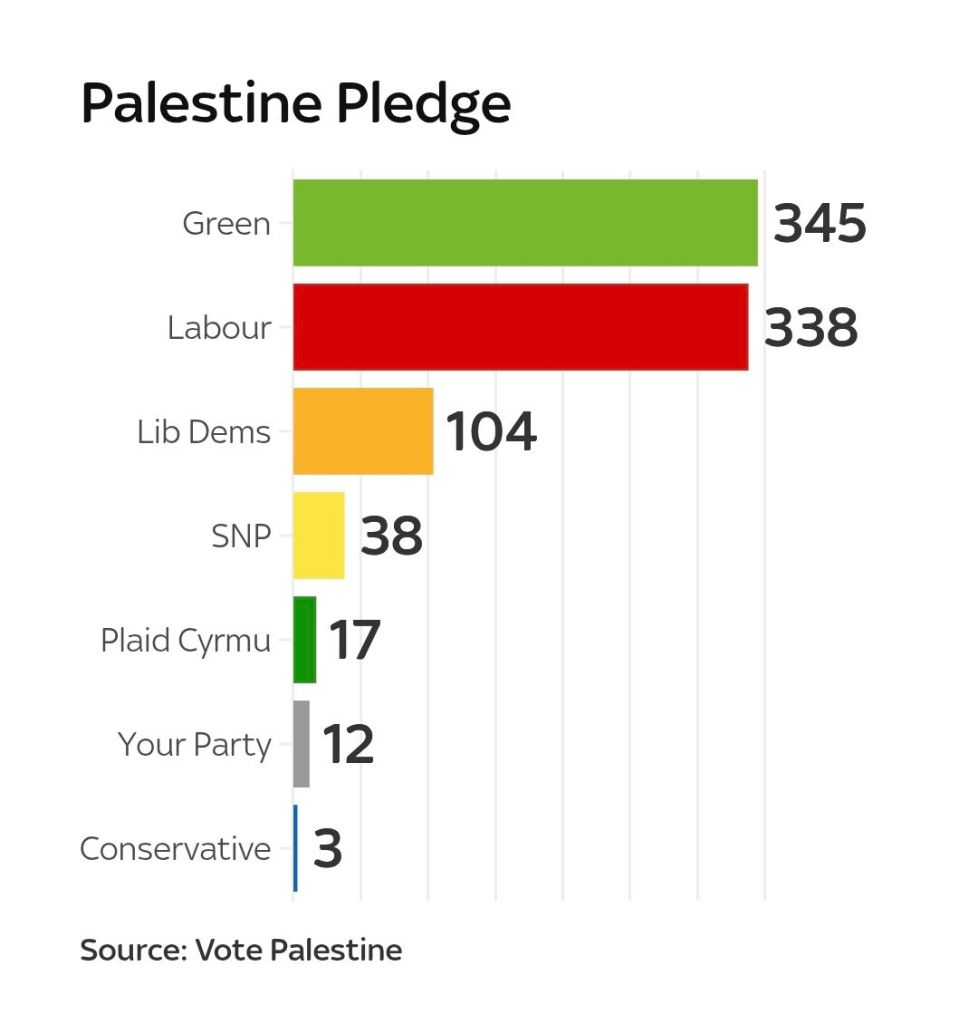
Over 1,000 councillors sign Palestine solidarity pledge amid claims of ‘political opportunism’
Story by Amanda Akass, political correspondent
More than a thousand local councillors have signed a pledge of solidarity with the Palestinian people.
And some days ago:
UK ban on Palestine Action as terror group unlawful, High Court rules
The Home Office will challenge the judgment in favor of the direct action group, which it branded a terrorist organization last year.
The ban on Palestine Action was the first on a direct action group, and catergorized it alongside groups like Islamic State, Hezbollah and al-Qaeda. | Jonathan Brady/PA Images via Getty Images
LONDON — Britain’s High Court ruled Friday that the ban on Palestine Action as a terrorist organization is unlawful.
The organization’s co-founder Huda Ammori successfully challenged the British government’s decision to proscribe Palestine Action under the Terrorism Act 2000 after three judges, led by Victoria Sharp, said ministers acted unlawfully.
Membership or support of the group was made illegal last July and punishable by prison sentences of up to 14 years.
Ammori argued the move by the Home Office disproportionately interfered with freedom of expression and freedom of assembly, which the court concurred with. Judges also said the ban was not consistent with the government’s policy to limit the ability to declare groups as terrorist organizations.
“The nature and scale of Palestine Action’s activities falling within the definition of terrorism had not yet reached the level, scale and persistence to warrant proscription,” the summary read.
However, Judge Sharp said the ban will not be lifted until a further court order “pending the possibility of an appeal.” In its judgment, the court said Palestine Action carried out acts “amounting to terrorism,” was not an “ordinary protest group” and intended to “promote the use of violence.”
The ban on Palestine Action was the first on a direct action group, and catergorized it alongside groups like Islamic State, Hezbollah and al-Qaeda. Palestine Action previously broke into RAF Brize Norton in June and damaged two military jets.
Since the proscription, more than 2,700 people have been arrested and hundreds have been charged in a civil disobedience campaign for expressing support for the group, according to the Defend Our Juries group.
In a statement, Ammori said the verdict was a “monumental victory both for our fundamental freedoms here in Britain and in the struggle for freedom for the Palestinian people,” adding the ban was a “Trumpian abuse of power which would have seen this Labour government proscribe the Suffragettes.”
Home Secretary Shabana Mahmood expressed her disappointment at the judgment, which the government will fight in the Court of Appeal, and said the ban was not disproportionate.
“The proscription of Palestine Action followed a rigorous and evidence-based decision-making process,” Mahmood said in a statement. “The proscription does not prevent peaceful protest in support of the Palestinian cause, another point on which the court agrees.
Four activists from the proscribed Palestine Action group in the UK are still on hunger strikes in prison.
Palestine Action-linked hunger strikers (left to right) Teuta Hoxha, Heba Muraisi, Kamran Ahmed and Lewie Chiaramello [Courtesy of Prisoners for Palestine]
Four members of the Palestine Action group, which has been proscribed as a terrorist organisation in the United Kingdom, are continuing with their hunger strikes in different prisons around the country.
Four other Palestine Action members have ended their hunger strikes – some after being hospitalised.
Retired, living in the Scottish Borders after living most of my life in cities in England. I can now indulge my interest in all aspects of living close to nature in a wild landscape. I live on what was once the Iapetus Ocean which took millions of years to travel from the Southern Hemisphere to here in the Northern Hemisphere. That set me thinking and questioning and seeking answers.
In 1998 I co-wrote Millennium Countdown (US)/ A Business Guide to the Year 2000 (UK) see https://www.abebooks.co.uk/products/isbn/9780749427917





![[Courtesy: Prisoners for Palestine]](https://www.aljazeera.com/wp-content/uploads/2026/01/S2-1767268060.jpg?resize=770%2C513&quality=80)

 borderslynn
You must be logged in to post a comment.