Donald Trump Jr.’s Private DC Club Has Mysterious Ties to an Ex-Cop With a Controversial Past
The Executive Branch has a reported membership list that includes Trumpworld elites like David Sacks. A WIRED review of corporate filings reveals an under-the-radar player: a notorious former DC police officer.
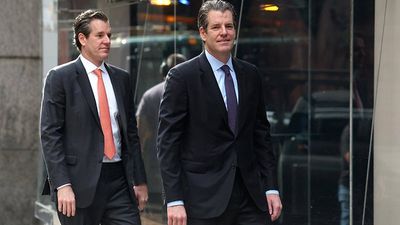
Photograph: Fayez Nureldine/Getty ImagesSave this story
When the Executive Branch soft-launched in Washington, DC, last spring, the private club’s initial buzz centered on its starry roster of backers and founding members. The president’s eldest son, Donald Trump Jr., is one of the club’s several co-owners, according to previous reporting. Founding members reportedly include Trump administration AI czar David Sacks and his All-In podcast cohost Chamath Palihapitiya, as well as crypto bigwigs Tyler and Cameron Winklevoss.
Wired
David Sacks, from ‘PayPal mafia’ to Trump’s AI and crypto tsar
Today, 14 years after the 2010 film “The Social Network” catapulted them into the public eye, the Winklevoss twins continue to make headlines.Shutterstock
The Winklevoss twins, Cameron and Tyler, have a story that’s stranger than fiction. It involves a bitter legal battle, a massive financial bet, and a rise to crypto prominence.
In the early 2000s, while studying at Harvard, the twins had a vision for a social network, and co-founded a social network called ConnectU. They were self-taught HTML coders, which they started tinkering around with from age 13.
From Harvard to betrayal
They then enlisted a coding prodigy named Mark Zuckerberg to bring it to life. Facebook soon launched, and the Winklevoss twins felt Zuckerberg stole their idea.
Tyler Winklevoss and Cameron Winklevoss, attend the opening bell ceremony for American Bitcoin at the Nasdaq Market in New York City, U.S., September 16, 2025. REUTERS/Brendan McDermid
The twin brothers behind the crypto company Gemini Space Station attempted to block a nominee to the Commodity Futures Trading Commission, a position President Donald Trump had nominated, and now they’ve angered several in that orbit.
Trump’s CFTC nominee, Brian Quintenz, drew the ire of Tyler and Cameron Winklevoss after a behind-the-scenes fight became public, the Wall Street Journal reported.
The company founded by the Winklevoss bros fell under investigation by the U.S. Securities and Exchange Commission during President Joe Biden’s administration after they failed to “register a cryptocurrency asset lending program before offering it to retail investors,” Reuters reported earlier this week. They settled the case this week and the company went public last week, then the conversations with Quintenz were exposed.
Chamath Palihapitiya is the Founder and CEO of Social Capital, a technology investment company, and Co-founder and CEO of 8090, an AI company. Under his leadership, Social Capital has incubated and invested in groundbreaking companies across various sectors, including healthcare, artificial intelligence, climate change, and space exploration. Some of Social Capital’s notable investments include Yammer (Microsoft), Slack (Salesforce), Swarm Technologies (SpaceX), Relativity Space, Groq, MrBeast, Palmetto, and 8090. Before founding Social Capital, Chamath was a senior executive at Facebook, where he was the leader of the company’s Growth, Platform, and Mobile teams. Born in Sri Lanka, and raised in Canada, Chamath now resides in Silicon Valley with his wife and five children. He holds a degree in Electrical Engineering from The University of Waterloo.
Initial reports identified several co-owners, including Trump Jr. and his associates Omeed Malik, Chris Buskirk, and brothers Zach and Alex Witkoff. However, a subsequent investigation by Mother Jones uncovered the involvement of Glenn Gilmore, a real estate developer from the San Francisco Bay Area, whose titles in the club’s corporate documents vary from co-owner to president. Yet another name has surfaced in the club’s corporate filings: Sean LoJacono
A notorious DC cop:
Sean LoJacono, a former police officer with a controversial past, is a beneficial owner of the club.
==========
The Controversial Past of Sean LoJacono
LoJacono, a former Metropolitan Police Department officer, became notorious in 2017 for his role in a contentious stop and frisk incident that led to a lawsuit. During the encounter with a man named M.B. Cottingham, LoJacono was accused of conducting an invasive body search, which was captured on video and went viral. In the recording, Cottingham expressed his shock at the nature of the search, stating, “He stuck his finger in my crack. Stop fingering me, though, bro.” The incident ignited a heated debate about aggressive policing tactics in Washington, DC.
In 2018, the American Civil Liberties Union of the District of Columbia filed a lawsuit against LoJacono on behalf of Cottingham, alleging that the officer had violated his rights during the search. Although the District of Columbia settled the case with Cottingham without admitting any wrongdoing, the fallout from the incident had significant implications for LoJacono’s career. Following an internal investigation, the MPD moved to dismiss him, but he successfully appealed the decision through the police union’s collective bargaining agreement, allowing him to return to the force as of November 2023.
LoJacono’s Role in the Executive Branch
Despite being cleared to return to the MPD, LoJacono has chosen a different path. His LinkedIn profile indicates that he is now the “Director of Security and Facilities Management” at the Executive Branch, a position he has held since June 2025. In the club’s incorporation paperwork filed in March 2025, LoJacono is listed as the “beneficial owner” of the business, raising questions about the extent of his involvement and influence within the club. This designation indicates that he holds a significant stake, if not a controlling interest, in the Executive Branch.
Understanding Beneficial Ownership
The term “beneficial owner” refers to individuals who have a substantial interest in a company, whether through direct ownership or managerial roles. According to Gary Kalman, executive director of Transparency International U.S., beneficial ownership can imply a significant minority stake, although it does not necessarily equate to majority control. The implications of this designation are crucial, as they illuminate the potential influence LoJacono may wield within the club, despite its more high-profile co-owners.
World Liberty Financial is the Trump family’s crypto business.Jonathan Raa / NurPhoto via Getty Images
Key Takeaways
World Liberty Financial, the Trump family’s crypto business, in January applied for a national banking license and launched an interface allowing users to borrow and earn points.
It is an “experiment into the convergence of politics, finance, and blockchain technology,” a crypto research firm says.
Get personalized, AI-powered answers built on 27+ years of trusted expertise.ASK
The Trump family has a range of business interests—including a crypto company with big financial ambitions.
The company, World Liberty Financial, has a lending market called WLFI Markets. It has applied for a national banking charter through its World Liberty Trust subsidiary. And it bills itself as a DeFi, or “decentralized finance,” ecosystem, which broadly means it seeks to remove middlemen from financial transactions.
World Liberty Financial was founded by President Donald Trump, his sons, the president’s special envoy Steve Witkoff, and Witkoff’s sons. Its USD1 stablecoin, which aims to stay pegged to the U.S. dollar, is at the center of the Trump family’s crypto venture—as is its token WLFI, which was recently trading around 11 cents, a fraction of its peak around 33 cents since its September launch.
WHY THIS MATTERS TO INVESTORS
World Liberty Financial offers a token and a stablecoin, but it has also signaled efforts to get into broader financial services.
WLFI Markets lets users borrow and lend against digital assets using USD1. The app isn’t available everywhere in the U.S., including New York. But if it gains traction, it could boost the circulating supply of USD1 and, potentially, the interest income generated by the assets that back it.
As a nationally chartered bank, World Liberty Trust would move from the fringes of payments into the central plumbing. Most stablecoin issuers make money from the interest earned on the assets backing the coins, generally including U.S. Treasurys, but if it were to also be a bank it could offer, and charge for, a range of financial services. (Think payments, clearing, asset custody, and the like.)
While the company has obvious political associations, World Liberty Financial, the WLF Protocol and WLFI tokens are “not political,” per the company’s white paper. That document shows that an entity called DT Marks DEFI LLC received 22.5 billion WLFI tokens and a right to receive 75% of the project’s revenue.1 That entity is connected to undisclosed Trump family members and the president through a series of holding companies, according to The Wall Street Journal.2
Retired, living in the Scottish Borders after living most of my life in cities in England. I can now indulge my interest in all aspects of living close to nature in a wild landscape. I live on what was once the Iapetus Ocean which took millions of years to travel from the Southern Hemisphere to here in the Northern Hemisphere. That set me thinking and questioning and seeking answers.
In 1998 I co-wrote Millennium Countdown (US)/ A Business Guide to the Year 2000 (UK) see https://www.abebooks.co.uk/products/isbn/9780749427917


:max_bytes(150000):strip_icc():format(webp)/GettyImages-2260000264-d4302aace73f4036b1f16298e25f8b45.jpg)

 borderslynn