In the documents, officials with the Department of Homeland Security state plans to “implement a new detention model by the end of Fiscal Year 2026,” which involves the creation of large-scale “hubs” across the country that would hold thousands of detainees.
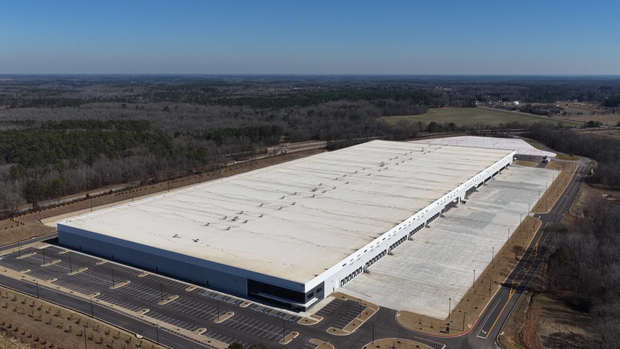
The document release comes after Social Circle leaders met with DHS officials earlier this week to discuss the agency’s plan to turn a warehouse it recently purchased in the city into one of those “mega centers.”
There is ice activity happening here in Baltimore right now.
In the “Ice Detention Reengineering Initiative” document, the agency said it plans to reduce the total number of facilities from hundreds to around 34 while increasing the total bed capacity.
“The facility in Social Circle is expected to house anywhere from 7,500 to 10,000 detainees and will be constructed using a modular design so that capacity can be scaled up or down as needed,” the city posted on Facebook on Wednesday.
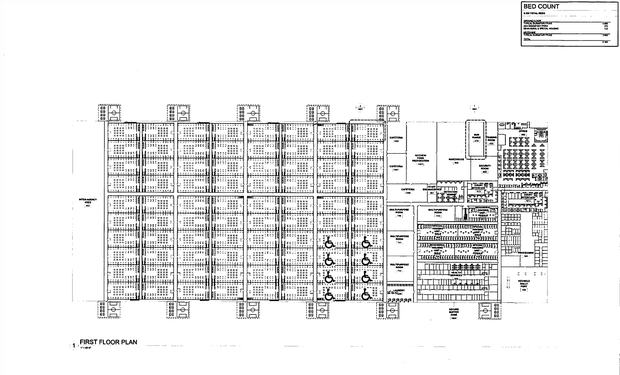
A screenshot of one of the pages of the U.S. Immigration and Customs Enforcement’s document showing what detainee housing at the Social Circle facility would look like. U.S. Immigration and Customs Enforcement
Once construction has begun, the agency estimates to begin accepting detainees sometime between mid-May and June, and is expected to employ 2,000 to 2,500 staff.
The document says detainees will stay in the “mega-centers” for around 60 days. “Processing sites,” like the one expected to be in Oakwood, Georgia, will have detainees stay some time between three and seven days.
The documents show that the facility will include holding areas, gyms, recreational spaces, cafeterias, a gun range, and other services.
Concerns over straining infrastructure
In an infrastructure analysis provided to the city by DHS officials, the agency says that the detention facility will be designed “to not affect the existing infrastructure adversely in any way.”
“The design currently includes on sit mitigation strategies for wastewater treatment. Additional contingencies are in place if required due to non-engineering circumstances,” the document reads.
ICE officials also claim the economic benefits of the facility will help Social Circle complete the construction of another wastewater treatment plant that was already planned for industrial growth.
The warehouse of Hightower Trail is expected to become an ICE facility holding thousands of detainees. CBS News Atlanta
City leaders have consistently expressed concerns over how the facility may strain its services, pointing to the fact that it would nearly triple the area’s population when fully up and running.
“The City’s concerns regarding water and sewer infrastructure have not been addressed to our satisfaction. We continue to have more questions than answers,” the city wrote. “DHS referenced a wastewater analysis to support its claims of available capacity; however, a portion of that capacity was attributed to the A. Scott Emmons Treatment Facility. This treatment facility is not owned by the City of Social Circle, is not located within the city limits, is in a different county, and does not connect to the City’s utility system or this building.”
Social Circle officials also criticized the agency’s plan for the water supply, saying a “cistern-based” approach, where tanks are filled during off-hours, would not offset the increasing demand from the facility.
“To be clear, the City has repeatedly communicated that it does not have the capacity or resources to accommodate this demand, and no proposal presented to date has demonstrated otherwise,” they wrote.
The nationwide detention center plan is estimated to cost $38.3 billion, which would be funded through Congress’s allocation of funds via the One Big Beautiful Bill Act.
More than 75,000 immigrants were being detained by ICE as of mid-January, up from 40,000 when Trump took office a year earlier, according to federal data released earlier in February.
Two of Immigration and Customs Enforcement’s (ICE) biggest contractors for building and managing detention centers have posted record revenue in 2025, as companies are expanding their facilities nationwide to hold more immigrants apprehended by the Trump Administration.
GEO Group, which operates 19 facilities for ICE around the country, reported $2.6 billion in total revenue in 2025, up 6% from $2.43 billion in 2024. CoreCivic, which owns and operates at least ten ICE detention facilities, reported $2.2 billion in total revenue in 2025, up 13% from $1.96 billion in 2024.
Going back to Michael D Sellers Substack on the topic, here is another extract:
How big is this, really?
ICE detention has already surged. AP reports detention numbers rising from roughly 40,000 to about 75,000, with a push toward 92,600 beds by the end of FY 2026.
To put the scale in plain terms:
DHS’s own FY 2026 budget justification talks about sustaining 50,000 detention beds.
The “reengineering” plan being reported targets 92,600 beds.
That is not a marginal increase. It’s close to a doubling of the bed base implied by DHS’s budget narrative—an attempt to build a detention system sized for sustained mass apprehension, not episodic surges.
A second scale check: ICE vs. federal prison
The Bureau of Prisons currently reports 153,121 total federal inmates (with 138,755 in BOP custody and additional federal inmates in other facility types).
If ICE reaches 92,600 beds, immigration detention alone would approach two-thirds the size of the entire federal prison population.
That comparison doesn’t say the systems are identical—they’re not. But it does clarify what “mega detention” actually means: an incarceration-scale institution built inside the executive branch, expanding on a timetable measured in months.
Why warehouses? Because warehouses are policy.
Warehouses are the perfect chassis for this kind of state project:
enormous footprints
highway access
modular interiors
relatively fast retrofits
and a zoning vocabulary that can be softened (“processing,” “staging,” “temporary”) until the beds are already installed
AP describes ICE quietly purchasing large warehouses in at least 20 communities, with local officials repeatedly saying they learned about plans late or indirectly.
This is the central political move: use real estate to make the policy a fait accompli.
The pressure point: scale so big it breaks normal governance
The reason this is detonating locally is not simply ideological opposition to enforcement. It’s that mega-centers create problems that local government is not designed to absorb quietly:
water and sewer demands
EMS capacity and hospital load
traffic, transport, staffing
tax base and land use
litigation exposure and public safety escalation
In Social Circle, Georgia, reporting described a proposed facility that could hold double the town’s population—a statistic so stark it becomes a narrative by itself.
In Romulus, Michigan, Axios reported that a federal document helped confirm a plan for a facility near Detroit Metro Airport while local officials complained they still lacked basic details—an illustration of the “paperwork moves faster than consent” dynamic.
In Maryland, Reuters reported a state lawsuit alleging DHS spent over $100 million on a site for a 1,500-bed facility without required environmental review or public input—an attempt to drag the program back inside normal legal process.
These aren’t detached anecdotes. They’re the same conflict repeating: institutional-scale detention introduced as a procurement project, leaving communities to fight it after the machinery is already in motion.
“American Gulag” is loaded language. Here’s what earns it.
Historically, “gulag” refers to something specific and far more extreme than immigration detention in the United States. That matters.
But the phrase does useful work as a warning label for a narrower idea: a domestic confinement system that is being industrialized, scaled, and normalized through logistics rather than debated through politics.
The reporting supports three ingredients of that warning:
Scale (tens of thousands of additional beds; mega-centers)
Secrecy-by-process (towns learning late; deals moving before public input)
Democratic bypass (lawsuits and backlash triggered by perceived end-runs)
Even those who favor strict immigration enforcement should pause at the method. Because method becomes morality when the state is building the capacity to cage people at industrial scale.
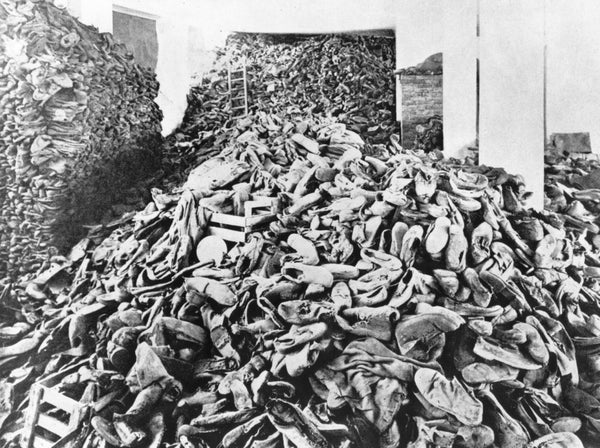
Evil has marched upon the Earth many times, more recently, the industrialised mechanism of the Holocaust:
January 10, 2019
A Biologist Reconstructs the Grotesque Efficiency of the Nazis’ Killing Machine
Lewi Stone used his statistical prowess to reveal the furious intensity of the Holocaust’s industrial-scale genocide during three months of 1942
The American version is sloppier but just as cruel, it is like a Gazan type genocide, depriving people of clean water, sanitation, food and adequate safe shelter. Death by a thousand cuts, it is traumatic and a desolate experience of hopelessness.
Retired, living in the Scottish Borders after living most of my life in cities in England. I can now indulge my interest in all aspects of living close to nature in a wild landscape. I live on what was once the Iapetus Ocean which took millions of years to travel from the Southern Hemisphere to here in the Northern Hemisphere. That set me thinking and questioning and seeking answers.
In 1998 I co-wrote Millennium Countdown (US)/ A Business Guide to the Year 2000 (UK) see https://www.abebooks.co.uk/products/isbn/9780749427917


 borderslynn