Sultan bin Sulayem, CEO of one of the world’s largest port operators, DP World, resigned from his position earlier this month after he showed up thousands of times in the files, linking him to conversations referencing sex trafficking, as well as signing his name on the sale of Jeffrey Epstein’s new island in 2016, Great Saint James, after the owner refused to sell to Epstein due to his criminal history.
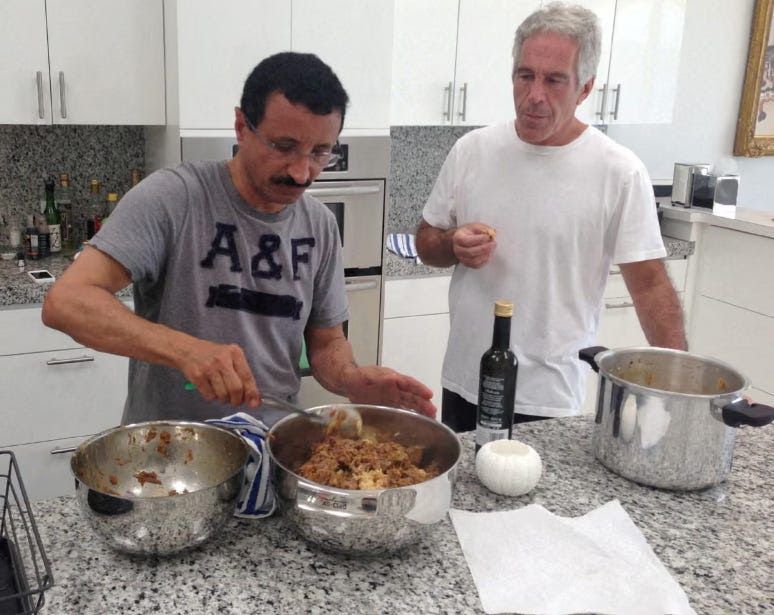
Sulayem and Epstein cooking it up
The FBI did not search the island.
Les Wexner, Epstein and Maple Inc., company controlled by Epstein and based in the US Virgin Islands.
………..The 7-story, 40-room neoclassical mansion on Manhattan’s Upper East Side is cited 14 times in Epstein’s federal indictment in 2019, with prosecutors alleging Epstein recruited and brought dozens of underage victims to the palatial residence. Originally built for Macy’s heir Herbert Straus in the 1930s, the house was purchased for $13 million in 1989 by retail tycoon Leslie Wexner, who was Epstein’s main client and business partner for decades starting in the late 1980s. (Wexner has said he severed ties with Epstein in 2007.)
In 2011, Wexner transferred the property to Maple Inc., a U.S. Virgin Islands-based company controlled by Epstein. Epstein’s executors valued the home at $56 million after his death in August 2019 and put it up for sale for $88 million; it ultimately sold for $51 million in March 2021 to Michael Daffey, a former Goldman Sachs executive. A lawyer for Epstein’s estate told Forbes at the time that just under $51 million from the sale was transferred to the estate and the victims’ compensation fund
============
Great St. James Island and Little St. James Island, U.S. Virgin Islands
Epstein bought the 70-plus-acre Little St. James Island, located in the U.S. Virgin Islands, for nearly $8 million in 1998. It came to be known as “pedophile island” after Epstein allegedly used it as the center of his sex trafficking ring. In 2016, he also purchased the larger island right next to it, the 160-plus-acre Great St. James, for $22.5 million. Between 2001 and 2018, Epstein allegedly brought underaged girls and young women to Little St. James and forced them to engage in sexual acts and forced labor, according to a criminal case filed by the government of the U.S. Virgin Islands in 2020. The complaint also alleged that Epstein had bought Great St. James to “further shield his conduct on Little St. James from view” and “prevent his detection by law enforcement or the public.””
Epstein’s estate valued the islands—which featured a helipad, a private dock, a main residence and several villas—at a collective $31 million after his death in 2019 but later listed them for an asking price of $125 million. The estate settled with the U.S. Virgin Islands government in December 2022, agreeing to pay $105 million in cash—including returning more than $80 million in tax benefits—plus pay an additional $450,000 to repair environmental damage around Great St. James, due to Epstein’s alleged razing of centuries-old structures built by enslaved workers on the island.
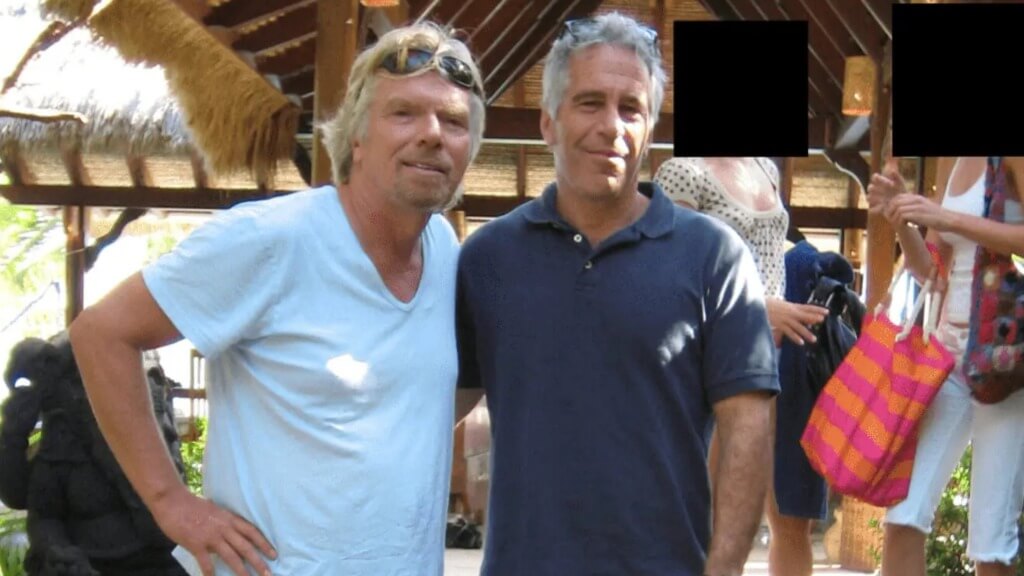
And Ruchard Branson, a neighbouring billionaire friend of Jeffrey Epstein:
Uncovering Richard Branson’s relationship with Jeffrey Epstein
The discrepancies between the Virgin Group CEO’s statements and Paste’s comprehensive timeline of Branson’s presence in the documents raise questions that do not have answers.
Ever since January 30, when the Justice Department released 3.5 million documents related to the Epstein case, many prominent figures—politicians, CEOs, professors, heads of the Nobel Prize committee—have come under renewed scrutiny for their ties to Epstein. The music world has hardly been immune, as can be seen in Paste’s thorough coverage of the Casey Wasserman revelations and the subsequent backlash he received from artists. Wasserman, however, was not the only music mogul named in the files. The founder of Virgin Records, the British billionaire Richard Branson, is featured at length, with 798 pings of his last name alone in Epstein’s emails. The inclusion is not particularly surprising, given that Branson’s famous private island in the Caribbean, Necker Island, is just 20 minutes away from Epstein’s own private island by helicopter and ten minutes by plane, according to Epstein himself. Epstein even had a framed photo of himself and Branson in his mansion. But the full extent of the relationship between Epstein and Branson has yet to be determined.
Richard Branson famously co-founded the Virgin Group in 1970, which grew over the next 50 years to include the Virgin Atlantic airline, Virgin Trains and the Virgin Rail Group, the Virgin Galactic space tourism company, and crucially here for us at Paste, Virgin Records—one of the most predominant music labels of the past half-century, having signed everyone from the Rolling Stones to the Sex Pistols to Taylor Swift. While Virgin Records is no longer under Branson’s direct control (he sold the label to Thorn EMI in 1992, before Universal Music Group acquired it in 2012), it is still heavily associated with the English business magnate; it, like all other Virgin companies, features a quote from Branson himself at the bottom of its webpage: “Embedding purpose into your business will help it to stand out, and align it with customers who have the same values.”
Like many business magnates in this day and age, Branson has already faced scrutiny over his treatment of women. In 2017, Joss Stone backing singer Antonia Jenae accused Branson of sexually assaulting her on Necker Island. Janae alleged: “We were by the bar and he was saying bye to everyone. He came up to me and put his face in my breasts. He went ‘brrrrrr’ and just walked away. It was surreal, totally out of the blue. Joss and I were like, ‘What the hell was that?!’ Everyone was wondering why I wasn’t angry because I’m usually a firebrand. But I was just too shocked.” A spokeswoman for Virgin Management denied this: “Everyone appeared to enjoy their time on the island. Richard has no recollection of this matter and neither do his family and friends, who were with him on the island at the time. There would never have been any intention to offend or make anyone feel uncomfortable in any way and Richard apologises if anyone felt that way during their time on the island.”
While there has been coverage of Richard Branson’s inclusion in the files, much of it revolves around the same few quotes (an understandably eye-catching reference that Branson made to Epstein’s “harem” in 2013, as well as Branson’s offer of public relations advice to the then-already-convicted sex offender) and the official statement that was given to The Independent by Branson’s PR team. When Paste asked for comment for this piece, the Virgin Group again sent the same statement:
“Any contact Richard and Joan Branson had with Epstein took place on only a few occasions more than twelve years ago, and was limited to group or business settings, such as a charity tennis event. When Epstein offered a charity donation, the Bransons asked their team to carry out due diligence before accepting the donation, which uncovered serious allegations. As a result of what the due diligence uncovered, Virgin Unite did not take the donation and Richard and Joan decided not to meet or speak with Epstein again. Had they had the full picture and information, there would have been no contact whatsoever—Richard believes that Epstein’s actions were abhorrent and supports the right to justice for his many victims.”
The spokesperson then went on to provide us with the same explanation of Epstein and Branson’s relationship that was previously shared with The Independent. Essentially, the basic story is that Epstein and Branson had only minimal contact, limited primarily to a few “brief business meetings on Necker Island,” none of which Branson actually invited Epstein to, and that Branson “had no knowledge of the crimes that have since come to light.” However, a careful review of the released files produced discrepancies between the emails themselves and the official statements the Virgin Group gave to the press.
In response to Paste’s further inquiries, the Virgin spokesperson then provided information about additional interactions between Jeffrey Epstein and Richard Branson that were not included in their initial reply. When asked to clarify the claims made in that second response (that the pair’s first contact was in September 2013, for instance), the spokesperson provided information on further additional interactions. Yet even with three separate statements, each including more information than the last, inconsistencies remained between the information given to Paste by the Virgin spokesperson and the information made publicly available in the released files. This does not mean Branson himself is implicated in any wrongdoing, but rather, that significant questions remain about Branson’s exposure to Epstein and his inner circle, and the degree of his awareness of Epstein’s activities.
As such, Paste is providing a newly comprehensive timeline of Jeffrey Epstein and Richard Branson’s relationship as detailed in the files, including quotes from the statements received from Virgin’s spokesperson wherever relevant.
TIMELINE
January 10, 2006: First mention of a meeting between Epstein and Branson
None of the three sets of statements supplied by the Virgin Group make any mention of an official in-person meeting between Epstein and Branson prior to April 2013. However, in the emails, we see Epstein himself apparently discussing one such meeting as early as January 2006, seven years prior to the first meeting Branson’s spokesperson mentioned. As Epstein wrote to Harvard psychologist Howard Gardner on January 10, 2006: “sorry I missed you…. I met with Richard Bransn, who is working on creating what he terms an elder statesman council of the world… and asked who I thought might be appropriate… I told him i have no idea but he should contact you and inquire , about your work on trustees.”……………..
This itself seems to all be true, although Branson’s team (namely, Nicola Elliott, who was at one point Branson’s Executive Assistant) did play a role in facilitating this as well. On December 28, 2010, Bill Richardson’s Deputy Chief of Staff, Janis Hartley, contacted Elliott to inform her that “Jeffrey Epstein has volunteer [sic] to pickup the Governor at Necker Island on Friday, January 7th.” The two then went on to coordinate the specifics of the pick up.
On January 7, 2011, two important exchanges occurred: First, Epstein emailed the British politician and diplomat Peter Mandelson (who, it is worth noting, has been summoned to testify before the US Congress regarding his own ties to Epstein at this very moment) to say he “had breakfast with richard branson, he is also a big fan of africa.” Mandelson replied, inscrutably, “Let’s go for it.” Later that day, Epstein emailed Branson himself with a vaguely ominous-sounding message under the subject heading “a treat”: “dear neighbor, thanks for your hospitality this morning. Though its a little late to find new friends. I hope you and I can also meet that challenge.” Branson replied on January 10 with: “Dear Jeffrey, I’m sure we will. All the best, Richard.”
These emails suggest that what occurred on January 7 was not just Richardson being “collected by Epstein’s helicopter,” as the Virgin Group’s statements attest. Rather, it seems Branson and Epstein had a friendly breakfast, one that went well enough for Epstein to reach out to tell Mandelson about it, and for Epstein and Branson themselves to exchange warm (albeit oddly phrased) emails about the relationship that was formed.
Early 2011: Ongoing contact between Epstein and Branson, largely initiated by Epstein
For the next two or so months, Epstein contacted Branson frequently about his desire to get together, but Branson was never available. On January 13, Epstein told Branson he’d be in New York mid-month and Paris later if Branson was around; Branson was not, due to a leg injury. (Despite the apparent innocence of this exchange, Epstein then reassured Branson that “at the bottom of my emails I have always added a copyright notice. It gives great pause to publications that might get hold of them someday”). The next day, January 14, Epstein asked Branson if he wanted some company on Necker; Branson responded: “Dear Jeffrey, Sorry, would love to have done but had to go to Europe in the end. Love to the girls! Best, Richard.” Epstein told Branson he would be in Paris for the next week on January 21, but Branson was “sadly in San Diego.” On February 18, Epstein wrote Branson to say “fun people on the island,, both types,,are you here” but Branson “[v]ery sadly” was not. (The Virgin Group maintains that Branson did not understand what Epstein meant by that email, and thus replied with a “brush-off” in response.)
It is, of course, worth emphasizing that none of these emails indicate wrongdoing on Branson’s part, as he seemingly declined to meet with Epstein on any of these occasions. However, it is also worth emphasizing that there are multiple phrases throughout these emails that cast some doubt upon the Virgin Group’s insistence that Branson was utterly ignorant of Epstein’s doings. Virgin’s statements make it seem as though Branson did not know Epstein personally at this point, with the extent of their contact being Epstein picking up Richardson from Necker Island. And yet, as early as 2011, Epstein tried to coax Branson to come visit with the promise of “both types” of “fun people on the island,” and, elsewhere that same year, an unprompted Branson signed off with the phrase “Love to the girls!”
Retired, living in the Scottish Borders after living most of my life in cities in England. I can now indulge my interest in all aspects of living close to nature in a wild landscape. I live on what was once the Iapetus Ocean which took millions of years to travel from the Southern Hemisphere to here in the Northern Hemisphere. That set me thinking and questioning and seeking answers.
In 1998 I co-wrote Millennium Countdown (US)/ A Business Guide to the Year 2000 (UK) see https://www.abebooks.co.uk/products/isbn/9780749427917



 borderslynn
You must be logged in to post a comment.