And Iran keeps its oil transiting from Kharg Island safely to its customers:
Iran still exporting millions of barrels of oil through Strait of Hormuz even as other traffic paralyzed
Story by Tim Lister, CNN
• 18h
If the United States assumed, before attacking Iran, that the major oil producer would be reluctant to close the Strait of Hormuz for fear of blocking its own oil exports, it miscalculated.
Ships near the Strait of Hormuz are broadcasting Chinese affiliations in an apparent bid to avoid attack, at a time when Iran’s new supreme leader vows to keep the strategic waterway closed.
If China sends ships to Strait of Hormuz (as requested by Trump) it will create safe passage because it will protect its friend, Iran.
Donald Trump has urged China, along with other nations, to send warships to the Strait of Hormuz to help secure this vital shipping route, which has been affected by Iran’s blockade. He emphasized the need for international cooperation to keep the strait open and safe for maritime traffic. Sky London Evening Standard
Depleting US stockpiles makes America vulnerable to those countries who hold larger stockpiles. Is this Putin’s long game?:
Trump administration and Democrats at odds over risk to US weapons stockpiles from Iran war
WASHINGTON (AP) — The U.S. and Israeli strikes on Iran have raised concerns among Democrats and others about diminishing American stockpiles of certain weapons, illustrating a long-standing production problem that some experts say could present challenges if another conflict emerges.
The Trump administration has repeatedly said American forces have all of the weapons they need to fight the Iran war, now in its second week. President Donald Trump posted Friday on social media that several defense contractors had agreed to quadruple production of weapons “as rapidly as possible,” although he did not detail the specific systems being manufactured.
Questions about the nation’s weapons stockpiles have grown as the U.S. campaign against Iran escalates, with many Democratic lawmakers arguing that Trump is waging a “war of choice.” Missile defense systems are under the most strain, according to experts, with Patriot and Terminal High Altitude Area Defense, or THAAD, interceptors in high demand in Ukraine and Israel, respectively.
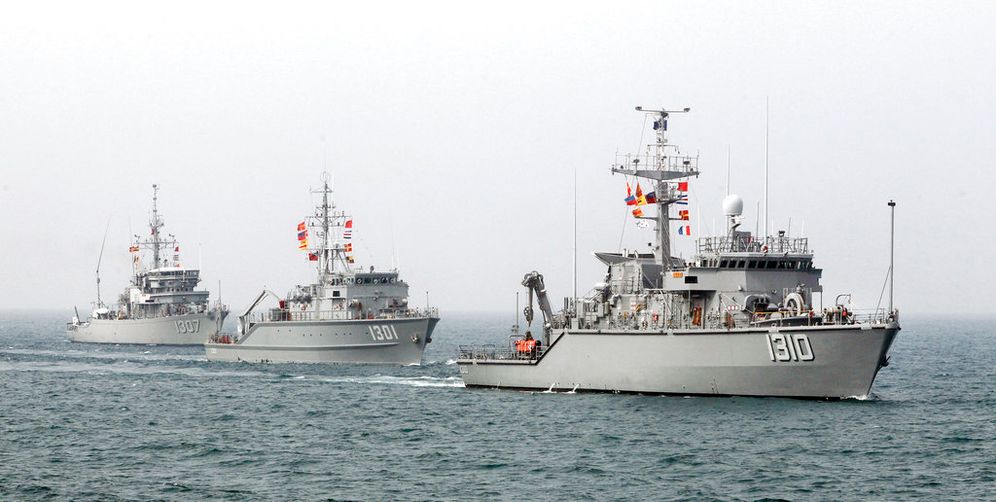
US Minesweeper ships were sent to Malaysia rather than stationed with US flotilla at start of Iraq war. This news gave Iran confidence to lay mines in the Strait of Hormuz.
US moves two Gulf-based minesweepers to Malaysia – report
Navy cites ‘logistical stop’ as concerns grow over Iran’s ability to disrupt key oil shipping route
i24NEWS
3 min read
March 17, 2026 at 05:10 AM
The US Navy said two of its three Gulf-based warships equipped with mine clearing capabilities have traveled roughly 4,000 miles to Malaysia for what it described as a “logistical stop,” according to a report by the Financial Times.
The redeployment comes amid growing concern over Iran’s ability to lay sea mines in the Strait of Hormuz, a critical maritime chokepoint through which about 20 percent of global oil exports pass. The risk of disruption to shipping in the waterway has raised alarm among governments and energy markets as oil prices soar and Iran threatens to continue using its control of the strait as economic leverage.
“The popular demand is to continue our effective defense and make the enemy regret. The lever of blocking the Strait of Hormuz must continue to be used,” said Iran’s new supreme leader Mojtaba Khamenei in a televised statement read out by an Iranian news anchor last week.
The vessels are part of a three-ship deployment assigned to the US Fifth Fleet in Bahrain. The ships were sent to the region last year to help secure maritime traffic and counter potential threats linked to tensions with Iran
Sobering thought: China could cut off supplies of essential metals for making US weapons:
Read distraction-free on Substack
America’s War on Iran Depends on Chinese Hardware
Missiles, fighter jets, drones, aircraft carriers, submarines—they all depend on critical metals controlled by Beijing.
Mar 12, 2026
4
3
America Is Waging War on Iran With Chinese Hardware
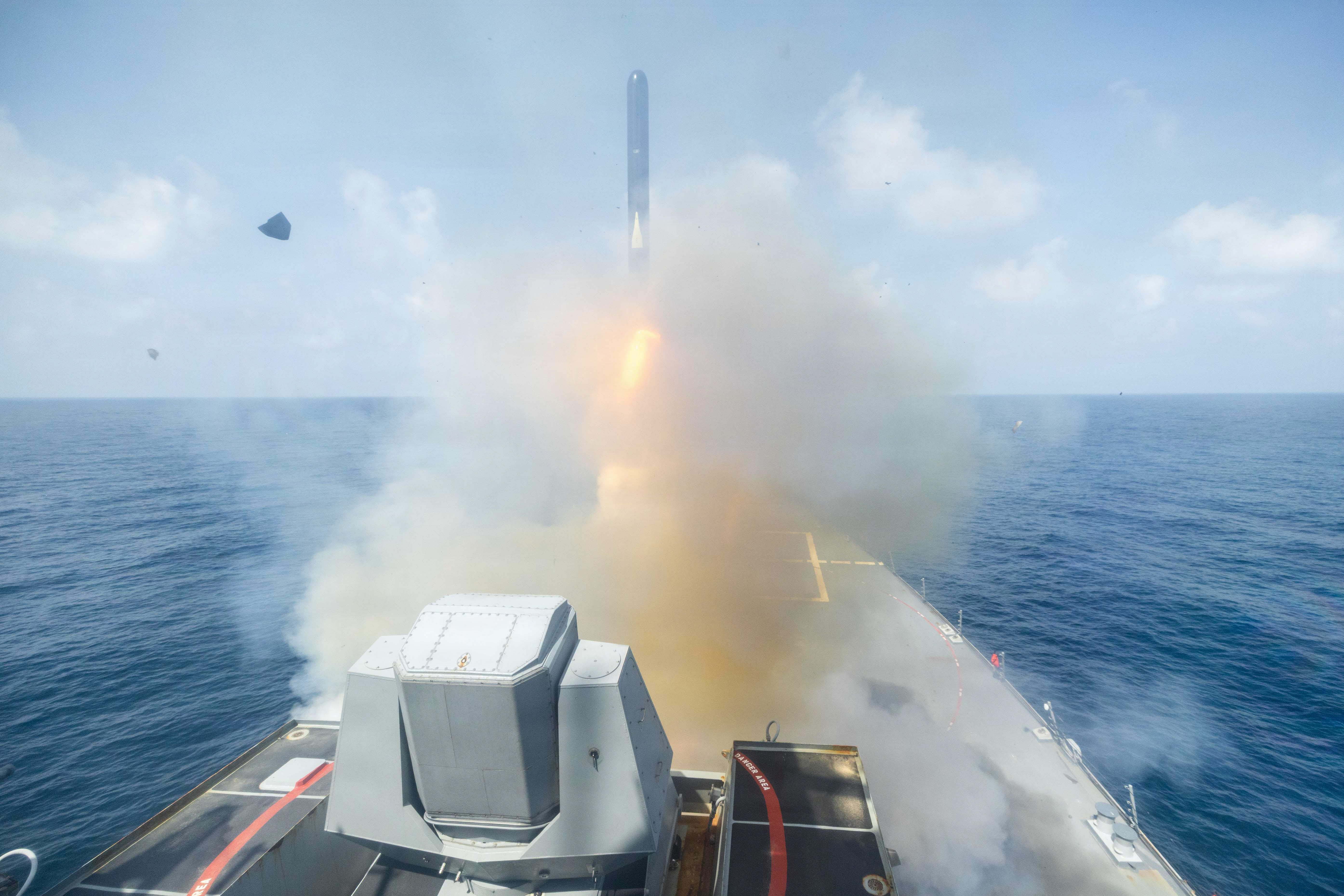
A Tomahawk missile fired at Iran from an American destroyer—loaded with Chinese components.
If you want to understand why critical metals are so important to the modern world, just look at the war on Iran. From fighter jets to missiles to drones, virtually every type of weapon the US is wielding—and the defensive systems it is using to thwart Iranian counterattacks—depend on components made with rare earths, lithium, nickel and other critical metals.
That fact, however, points up a major strategic vulnerability. Those components, and the metals from which they’re made, are almost all produced in a single country—and it’s not the United States, nor even one of its allies. As a recent report by Govini, an American defense analytics company, sums up: “From raw minerals to advanced weapon systems—from rock to rocket … America’s military superiority increasingly depends on China.”
There are countless Chinese-produced metals and parts embedded throughout hundreds of American weapons systems, but probably the most concerning are rare earth magnets. These bits of hardware perform a head-spinning variety of jobs in a wide range of weapons.
Missiles, whether offensive types like Tomahawk cruise missiles or defensive ones like those used in Patriot and THAAD interception systems, typically depend on rare earth magnets to move the control fins that steer the projectile to its target. “These magnets must be extremely powerful, compact, and resistant to heat and vibration,” notes Rare Earth Exchanges, an American research outfit. That means magnets made with the rare earth neodymium for strength, alloyed with dysprosium and terbium to increase resistance to heat and stress. Most precision-guided missiles also require neodymium magnets, or in some cases magnets made with samarium, another rare earth, for components used in target tracking and data-link stabilization.
Predator drones, Joint Direct Attack Munition ‘smart’ bombs, radar systems and other weapons also rely on rare earth magnets. So do the war machines that launch those weapons. According to the Pentagon, missile-firing destroyers, submarines, fighter jets, and bombers all require hundreds or thousands of pounds of rare earths.
Then there are good old lithium ion batteries, which are as ubiquitous in the military as they are in your own gadget-supported life. Many war-fighting drones, as I’ve written before, are powered by the same kind of batteries made of lithium, cobalt and nickel that are used in cell phones, laptops and dustbusters. So are military lasers, radios, night vision goggles and satellites.
A whole constellation of other metals are used in all manner of military gear. “Critical minerals such as aluminium, titanium, magnesium, and scandium form the structural backbone of drones,” says SFA-Oxford, a British consulting outfit. “Communication, electronics, and precise navigation systems depend on specialised materials like beryllium, gallium, germanium, and indium, whose unique properties ensure reliability, accuracy, and operational effectiveness.” According to Govini, “more than 80,000 parts across 1,900 weapon systems incorporate antimony, gallium, germanium, tungsten, or tellurium.” The list includes destroyers, aircraft carriers and nuclear missiles.
As I’ve said before: “You can probably guess why all of this is a problem. Who manufactures over 70 percent of the world’s batteries? Who makes more than 90 percent of the world’s rare earth magnets? Who produces most of the world’s gallium, indium, and other critical metals? China, China, and China.”
That means America’s war fighting capacity could be seriously hobbled if China were to cut off those supplies.
His resignation reflects unease within Trump’s base about the war and shows that questions about the justification for the use of force in Iran extend to the right of Trump’s base and to senior members of his administration.
A former political candidate with connections to right-wing extremists, Kent was confirmed to his post last July on a 52-44 vote (AP)
This is the letter in full:
President Trump,
After much reflection, I have decided to resign from my position as Director of the National Counterterrorism Center, effective today.
I cannot in good conscience support the ongoing war in Iran. Iran posed no imminent threat to our nation, and it is clear that we started this war due to pressure from Israel and its powerful American lobby.
I support the values and the foreign policies that you campaigned on in 2016, 2020, 2024, which you enacted in your first term. Until June of 2025, you understood that the wars in the Middle East were a trap that robbed America of the precious lives of our patriots and depleted the wealth and prosperity of our nation.
In your fist administration, you understood better than any modern President how to decisively apply military power without geting us drawn into never-ending wars. You demonsiratd this by killing Qasam Solamani and by defeating ISIS.
Early in this administration, high-ranking Israeli officials and influential members of the American media deployed a misinformation campaign that wholly undermined your America First platform and sowed pro-war sentiments to encourage a war with Iran.
This echo chamber was used to deceive you into believing that Iran posed an imminent threat to the United States, and that should you strike now, there was clear path to a swift victory.
This was a lie and is the same tactic the Israelis used to draw us into the disastrous Iraq war that cost our nation the lives of thousands of our best men and women. We cannot make this mistake again.
As a veteran who deployed to combat 11 times and as a Gold Star husband who lost my beloved wife Shannon in a war manufactured by Israel, | cannot support sending the next generation off to fight and die in a war that serves no benefit to the American people nor justifies the cost of American lives.
I pray that you will reflect upon what we are doing in Iran, and who we are doing it for. The time for bold action is now. You can reverse course and chart a new path for our nation, or you can allow us to slip further toward decline and chaos. You hold the cards.
It was an honor to serve in your administration and to serve our great nation.
Did Iranian missiles cause a fire on the USS Gerald R. Ford aircraft carrier? US Navy clarifies
The Trump administration had dispatched the USS Gerald R. Ford, the world’s largest aircraft carrier, from the Caribbean Sea to the Red Sea ahead of the initial strikes on the IR of Iran
After repeated plumbing issues, the USS Gerald R. Ford, the world’s largest aircraft carrier, has now reported a fire incident. The US Navy confirmed the incident but ruled out the blaze being caused in combat with Iran or its proxy groups.
Two US Navy sailors suffered burn injuries after the fire broke out on Thursday. The flames were detected and doused in the laundry section of the aircraft carrier. Neither sailor was seriously injured in the incident, US media reports quoted the Navy as saying.
A wise head gone:
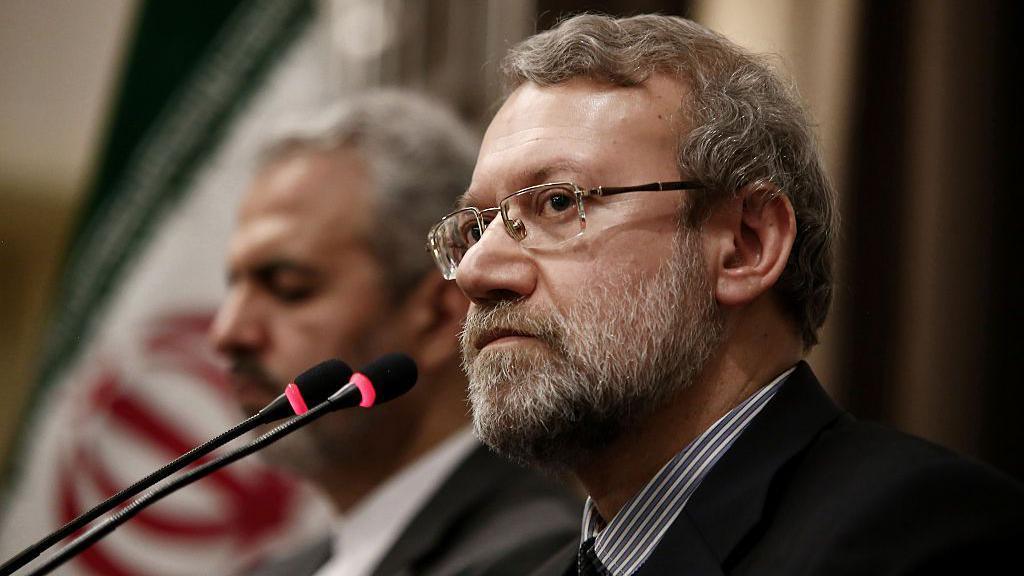
Death of Ali Larijani deepens crisis at heart of Iran’s leadership
Image caption,Larijani was viewed as one of Iran’s most influential political figures
ByAmir Azimi
BBC Persian
Published17 March 2026
Updated 4 hours ago
The Israeli air strike which killed Iran’s security chief, Ali Larijani, has removed one of the Islamic Republic’s most experienced and influential policymakers at a critical moment.
Larijani was not a military commander, but he was a central figure in shaping Iran’s strategic decisions.
As secretary of the Supreme National Security Council, he sat at the heart of decision-making on war, diplomacy, and national security.
His voice carried weight across the system, particularly in managing Iran’s confrontation with the United States and Israel.
After the killing of Supreme Leader Ali Khamenei on 28 February, Larijani struck a defiant tone, signalling that Iran was prepared for a long conflict.
His death, now confirmed by state media, comes amid a broader campaign in which several senior Iranian officials and commanders have been killed within a matter of weeks. This pattern suggests a sustained effort to weaken Iran’s leadership structure during wartime.
Despite his hardline stance against the West, Larijani was often described inside Iran as a pragmatist. He combined ideological loyalty with a technocratic approach, favouring calculated strategy over rhetoric.
He remained deeply sceptical of engagement with Western powers, but he was also involved in key diplomatic efforts, including acting as an envoy in Iran’s long-term co-operation agreement with China.
From BBC News
March 19, 2026, below is an extract from Substack,Michael D Sellers observation on recent Tulsi Gabbard hearing:
That is why Jon Ossoff’s exchange with Gabbard was so damaging. He did not let her hide behind procedural fog. He reminded her that she was at the worldwide threats hearing precisely to present the intelligence community’s assessment of threats, and he pointed out that her own opening statement said exactly that. When she insisted it was not the intelligence community’s responsibility to determine what is and is not an imminent threat, Ossoff answered with the obvious: “No, it is precisely your responsibility to determine what constitutes a threat to the United States.” Then he said what everyone watching could already see: she was evading the question because a candid answer would contradict the White House.
That is the real story of the hearing. Not merely that Democrats were angry. Not merely that there was a theatrical exchange. The real story is that the administration’s public legal-political justification and its intelligence presentation are no longer lining up cleanly in public view.
In fact, the contradiction was sharper than that.
Gabbard was perfectly willing to affirm two other points. She said it was the intelligence community’s assessment that Iran’s nuclear enrichment program had been “obliterated” by last summer’s strikes. She also said it was the intelligence community’s assessment that there had been no effort since then to rebuild that enrichment capability. But when Ossoff asked the obvious follow-up — if that was the assessment, then was it also the assessment that Iran nevertheless posed an imminent nuclear threat — Gabbard refused to answer.
That sequence matters because it strips away one common defense of the administration: that the truth is all hidden inside classified material the public cannot see. Wednesday’s hearing did not look like an official prevented from speaking. It looked like an official willing to make the statements that helped the White House and unwilling to make the one statement that would have tested the White House’s core rationale.
Retired, living in the Scottish Borders after living most of my life in cities in England. I can now indulge my interest in all aspects of living close to nature in a wild landscape. I live on what was once the Iapetus Ocean which took millions of years to travel from the Southern Hemisphere to here in the Northern Hemisphere. That set me thinking and questioning and seeking answers.
In 1998 I co-wrote Millennium Countdown (US)/ A Business Guide to the Year 2000 (UK) see https://www.abebooks.co.uk/products/isbn/9780749427917






 borderslynn