Israel’s unlawful use of white phosphorus in new Lebanon attacks ‘extremely alarming’: Rights group
Authorities have over the past years accused Israel of using controversial white phosphorus rounds, in attacks authorities say have harmed civilians and the environment.
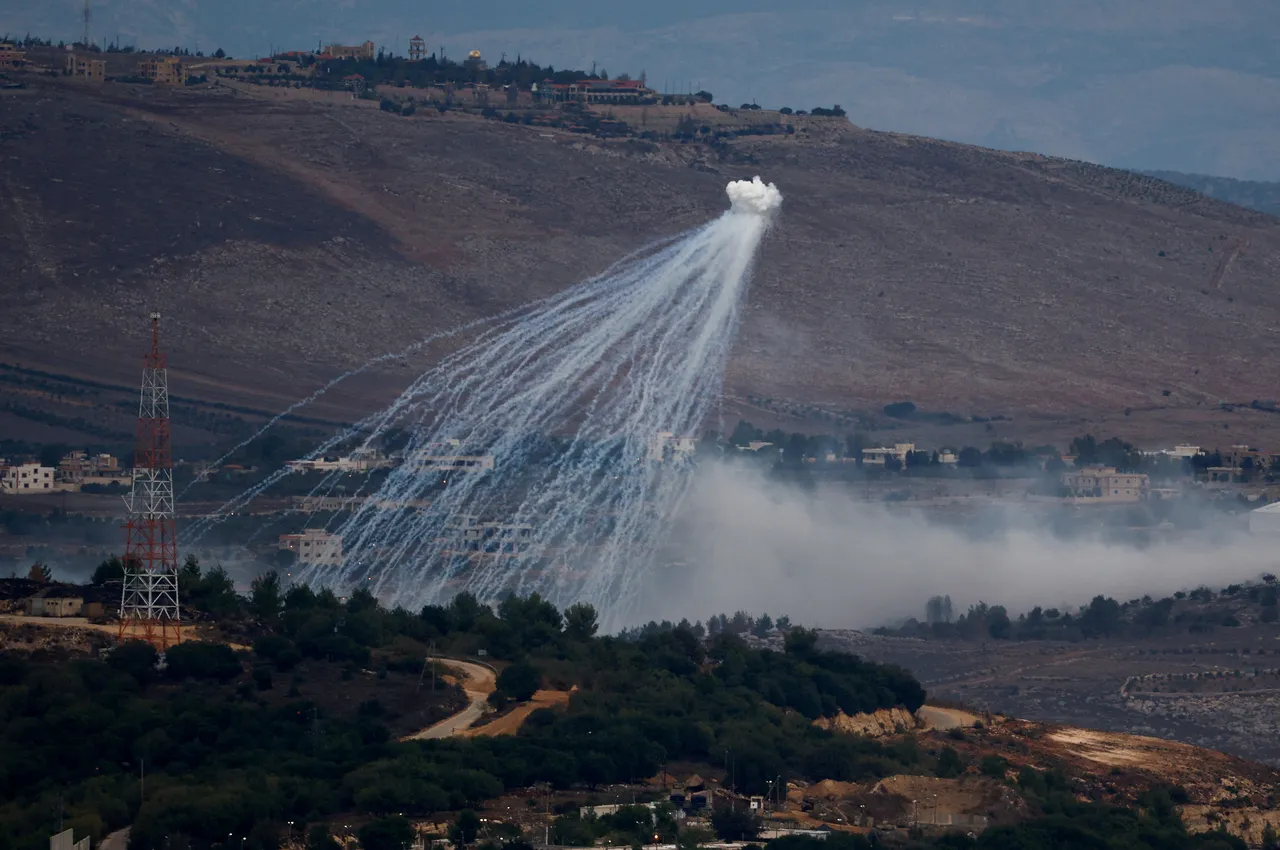
ShareWhite phosphorus can be used to create smokescreens and to illuminate battlefields. / Reuters
March 9, 2026
Israel has “unlawfully” used white phosphorus over residential parts of a southern Lebanese town last week, according to a new report by Human Rights Watch/
“The Israeli military unlawfully used artillery-fired white phosphorus munitions over homes on March 3 2026, in the southern Lebanese town of Yohmor,” the New York-based rights group said in a report on Monday.
HRW added that it “verified and geolocated seven images showing airburst white phosphorus munitions being deployed over a residential part of the town and civil defence workers responding to fires in at least two homes and one car in that area”.
White phosphorus, a substance that ignites on contact with oxygen, can be used to create smokescreens and to illuminate battlefields.
But the munition can also be used as an incendiary weapon and can cause fires, horrific burns, respiratory damage, organ failure and death.
Increasingly we learn of strikes on hospitals after Gazan health centres were decimated by Israeli strikes.
Like an earthquake: Inside Israel’s deadly strike on medical centre
Story by Bel Trew and Rana Najjar
• 2d
The Independent
Medical centre destroyed by Israeli missile in Lebanon
Current Time 0:15
/
Duration 1:16
The Israeli strike on the healthcare centre was so huge that it felt like an earthquake. Without warning, the missile tore through the four-storey building in southern Lebanon, punching open concrete floors, eviscerating every wall, and gouging out a multistorey crater in the ground.
The dozen medics based there, whose job it was to respond to the injured across 20 nearby villages, were finishing dinner. There was nowhere to hide.
Israel’s intensified military operations continue to threaten an already weakened health system, amidst worsening mass population displacement and acute shortages of food, water, medical supplies, fuel and shelter.
Four major hospitals in Gaza (Kamal Adwan Hospital, Indonesia Hospital, Hamad Hospital for Rehabilitation and Prosthetics, and European Gaza Hospital) have had to suspend medical services in the past week due to their proximity to hostilities or evacuation zones, and attacks. WHO has recorded 28 attacks on health care in Gaza during this period and 697 attacks since October 2023.
Only 19 of Gaza Strip’s 36 hospitals remain operational, including one hospital providing basic care for the remaining patients still inside the hospital, and are struggling under severe supply shortages, lack of health workers, persistent insecurity, and a surge of casualties, all while staff work in impossible conditions. Of the 19 hospitals, 12 provide a variety of health services, while the rest are only able to provide basic emergency care. At least 94% of all hospitals in the Gaza Strip are damaged or destroyed.
01 July 2025, Port Sudan, Sudan – Since the conflict in Sudan erupted in April 2023, the health system has come close to collapse, leaving millions without care. Health facilities have been devastated and many medical staff forced to leave. Yet amid all the destruction communities and health workers continue to work on the frontlines, providing what services they can.
From January to June 2025, the World Health Organization (WHO), in partnership with Sudan’s Federal Ministry of Health and the United Nations Development Programme (UNDP), reassessed Sudan’s progress towards Sustainable Development Goal 3 (SDG 3) targets. The reassessment was funded by the secretariat fund of the Global Action Plan on Healthy Lives and Well-being for All and conducted in liaison with the WHO Regional Office for the Eastern Mediterranean.
Data from the Health Resources Availability Monitoring System (HeRAMS) paint a sobering picture: 38% of health facilities are non-functional and only 14% of hospitals remain operational. In Khartoum, which once provided 70% of national health services, many hospitals have been destroyed or repurposed for military use.
The impact is profound. More than 4.9 million children under 5 suffer from acute malnutrition. Immunization coverage has collapsed from 90% to 51%, leaving millions of children vulnerable to vaccine-preventable diseases.
“The war has had a profoundly negative impact on child health services in Sudan, leading to increased mortality and morbidity among children,” said Dr Humayun Rizwan, Health Policy Advisor, Universal Health Coverage, WHO Sudan.
Over 1 million pregnant women need reproductive health services, yet many cannot access even the most basic care. Maternal mortality has risen by 30%, and skilled birth attendance has dropped from 85.9% to 77%.
Health workers continue to serve in makeshift clinics, often without pay or protection. Community volunteers and local NGOs have stepped in to deliver basic medicines, nutrition support and maternal care. In Kassala and Blue Nile states, pre-existing community health networks help sustain outreach and education efforts.
Projecting Sudan’s health trajectory through to 2036, the reassessment posits 3 scenarios – worsening, static and improving. In the absence of urgent action – the worsening scenario –mortality figures will continue to grow and the health system faces long-term collapse. But with stabilization, scaled up investments and sustained humanitarian access – the improving scenario – Sudan could recover some lost ground by 2030.
Retired, living in the Scottish Borders after living most of my life in cities in England. I can now indulge my interest in all aspects of living close to nature in a wild landscape. I live on what was once the Iapetus Ocean which took millions of years to travel from the Southern Hemisphere to here in the Northern Hemisphere. That set me thinking and questioning and seeking answers.
In 1998 I co-wrote Millennium Countdown (US)/ A Business Guide to the Year 2000 (UK) see https://www.abebooks.co.uk/products/isbn/9780749427917



 borderslynn