Israel killed three journalists in south Lebanon on Saturday, their TV channels and authorities said, prompting condemnation from the Lebanese government who called the killings a “blatant war crime”.
Ali Shoeib, from the Hezbollah-owned al-Manar television station, Fatima Ftouni and her brother and cameraman Mohammed Ftouni from the pro-Hezbollah outlet al-Mayadeen, were killed in the strike targeting their car.
Israel claimed the attack shortly afterwards, saying the target was Shoeib, whom it accused of being a Hezbollah “terrorist” in an intelligence unit who had reported on the locations of Israeli soldiers in southern Lebanon. The Israeli military provided no further evidence to support the claim and made no comment on the killing of the other journalists.
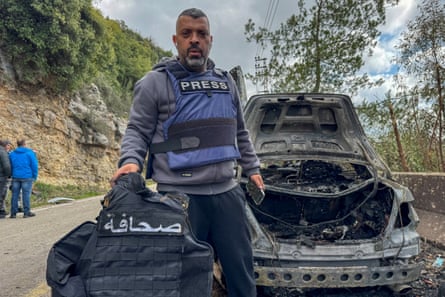
Jamal al-Ghurabi, a journalist for al-Mayadeen, holds up press vests removed from the car. Photograph: Ali Hankir/Reuters
Shoeib was a well known war correspondent in Lebanon, where he reported for al-Manar for nearly three decades. His death was met with a wave of condolences from audiences and journalists in Lebanon, many of whom said he was considered a mentor figure in Lebanese journalism.
Ftouni had also been reporting from the frontlines of the Israel-Hezbollah war in recent days, filming in front of battles in the town of Taybeh, south Lebanon. Her own family had been killed in Israeli strikes weeks earlier.
Eighteen months earlier, she and her colleagues were struck by an Israeli bomb while they were sleeping in a hotel in south Lebanon; Ftouni survived but two of her colleagues did not. Commenting on the deaths of her colleagues at the time, Ftouni said that “it is the silence of the international community that let this happen”.
The three journalists were struck as they were driving in Jezzine, a district in south Lebanon far from the frontlines. Local television showed at least four missiles were shot at the car and footage appeared to show a missile being fired between the journalists’ car and bystanders as the latter tried to approach and help. Video of the aftermath showed singed press jackets and helmets, as well as tripods and microphones that had been pulled from the car.
West Bank: IDF launches investigation after CNN footage shows soldiers confronting crew at gunpoint
During filming at an outpost near Tayasir, a CNN crew said a soldiers pointed weapons at them while making remarks about the future of the outpost and the West Bank
i24NEWS
3 min read
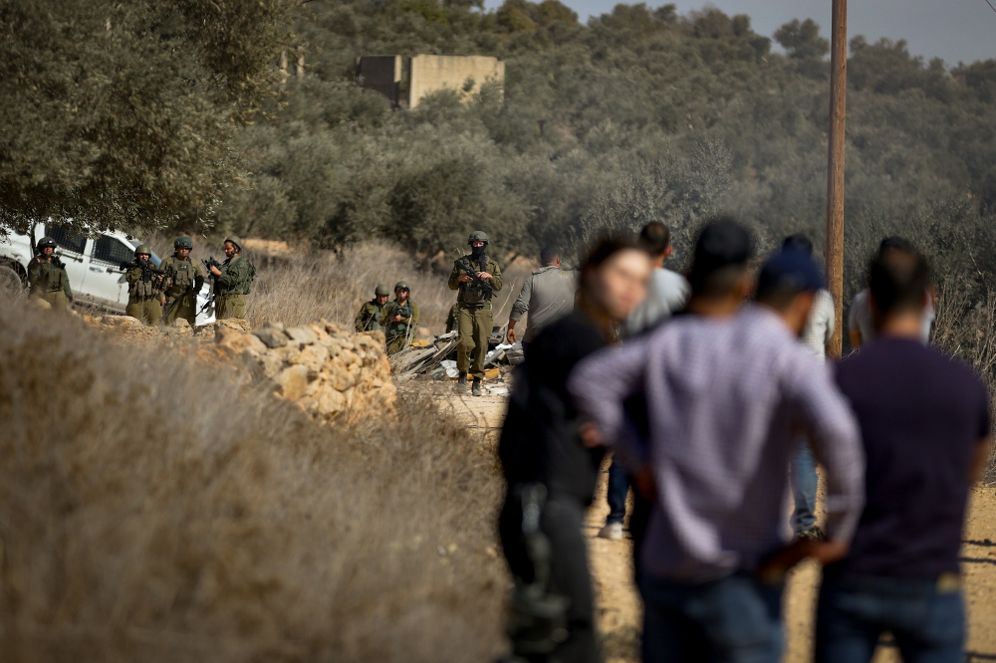
March 29, 2026 at 05:11 AMlatest revision March 29, 2026 at 05:12 AMFile photo of clashes involving Israelis and Palestinian in the West Bank village of Qusra, October 29, 2024. Flash90
Footage aired by CNN from a report on rising tensions in the West Bank has sparked international controversy after documenting a confrontation between Israel Defense Forces soldiers and a film crew.
The incident took place in the northern West Bank, where CNN correspondent Jeremy Diamond and his team had arrived to cover an outpost established in memory of Yehuda Sherman, who was killed in a prior attack near Homesh.
According to the footage, IDF soldiers approached the crew during filming, pointed their weapons at them, and ordered them to sit on the ground.
Retired, living in the Scottish Borders after living most of my life in cities in England. I can now indulge my interest in all aspects of living close to nature in a wild landscape. I live on what was once the Iapetus Ocean which took millions of years to travel from the Southern Hemisphere to here in the Northern Hemisphere. That set me thinking and questioning and seeking answers.
In 1998 I co-wrote Millennium Countdown (US)/ A Business Guide to the Year 2000 (UK) see https://www.abebooks.co.uk/products/isbn/9780749427917



 borderslynn