United States F-15 Fighter Jet Crashes in Western Kuwait
By Waleeja Khan|8 minutes ago|
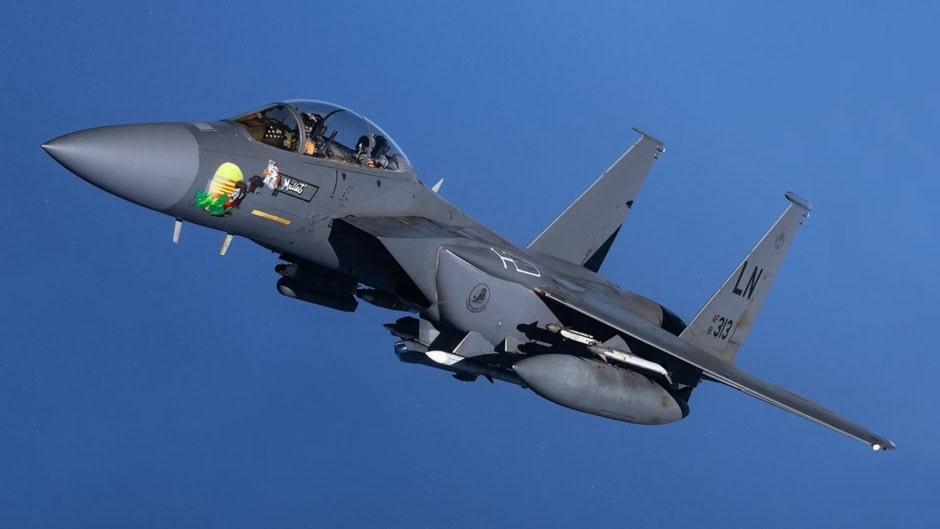
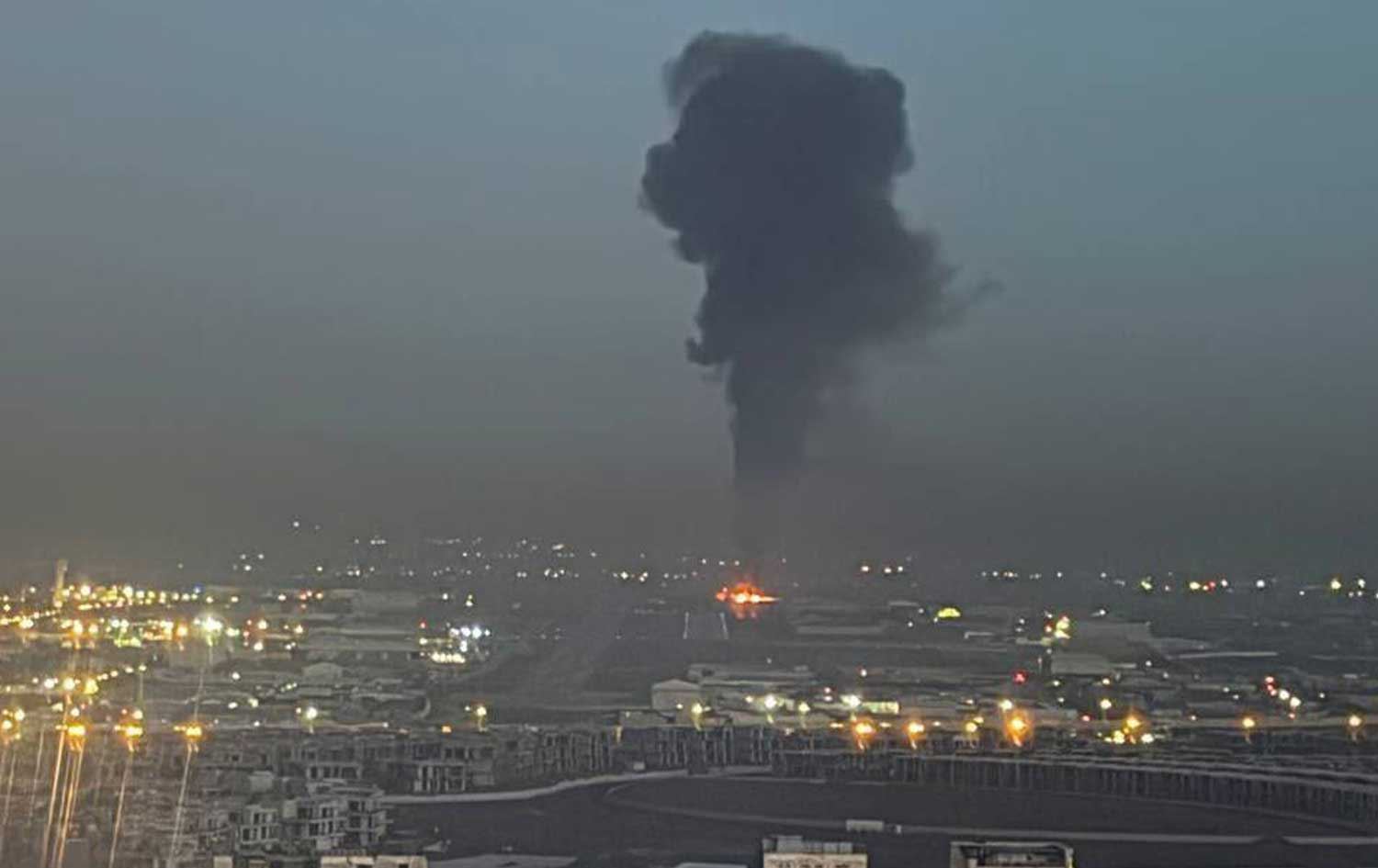
A United States Air Force F‑15E Strike Eagle fighter jet crashed in western Kuwait on March 2, 2026, amid ongoing military operations in the Middle East. The pilot safely exited moments before the aircraft hit the ground and suffered minor injuries. Authorities confirmed there were no other casualties.
The incident occurred during a period of peak tensions in the region, following recent US and Israeli operations targeting Iranian assets.
Videos shared on social media show the jet descending rapidly and smoke rising from the crash site, with local residents assisting the pilot before he was taken for medical attention.
The US has confirmed that three of their F-15 fighter jets were shot down by Kuwait in a friendly fire blunder – as video shows the $90million planes tailspinning in smoke to the ground.
Kuwait’s Defence Ministry said crews are safe after the crashes this morning, which saw at least two pilots eject from their planes near a US military base in Kuwait.
A US Central Command (CENTCOM) official confirmed that American military aircraft were ‘downed’ in Kuwait on Monday morning, as an Iraqi pro-militia outlet shared footage of a US pilot after ejecting from his aircraft in Kuwait City.
US CENTCOM said that three of its F-15 jets, which were ‘flying in support of Operation Epic Fury’ – the name of the US military operation against Iran – ‘went down over Kuwait due to an apparent friendly fire incident’.
It said all six crew ejected safely and have been recovered, evacuated and transferred to hospitals for health checks.
Kuwait’s Ministry of Defence said it was coordinating with the US regarding the ‘circumstances of the incident’ and is continuing investigations into the ’causes of the incident’.
Four American service members were killed, and others were “seriously wounded” during U.S. military operations against Iran, U.S. Central Command officials said.
The deaths of three service members were initially announced over the weekend, but CENTCOM officials said early Monday that a fourth, who was “seriously wounded during Iran’s initial attacks, eventually succumbed to their injuries.”
Additionally, an official with U.S. Central Command told Task & Purpose that 18 U.S. troops had been seriously wounded as of 7:30 a.m. ET on Monday. The Command’s initial post on Sunday said that five had been “seriously wounded” and “several” other troops “sustained minor shrapnel injuries and concussions,” but were in the process of being returned to duty.
Secretary of Defense Pete Hegseth said Monday at the Pentagon that the casualties were the result of an Iranian weapon hitting an American tactical operation center. He did not specify the location of the fatal strikes, though other publications have reported it was in Kuwait.
According to CNN, the six US service members were killed when a direct Iranian strike—believed to be a drone or projectile that penetrated air defenses—hit the center of a fortified but makeshift tactical operations center (a triple-wide trailer used as office space) at Kuwait’s Shuaiba port just after 9 a.m. local time, with no warning sirens or evacuation alert, causing an explosion that blew out the walls, left parts of the structure burning for hours, and initially left some troops unaccounted for until their remains were later recovered.
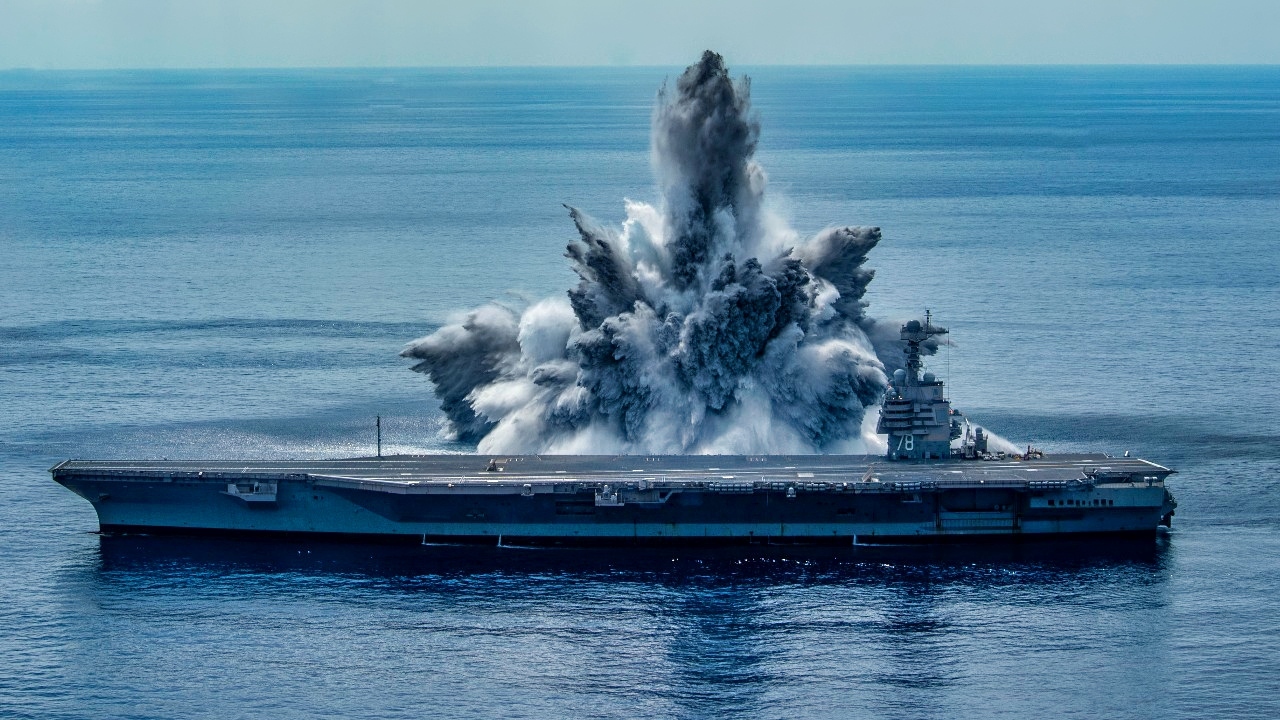
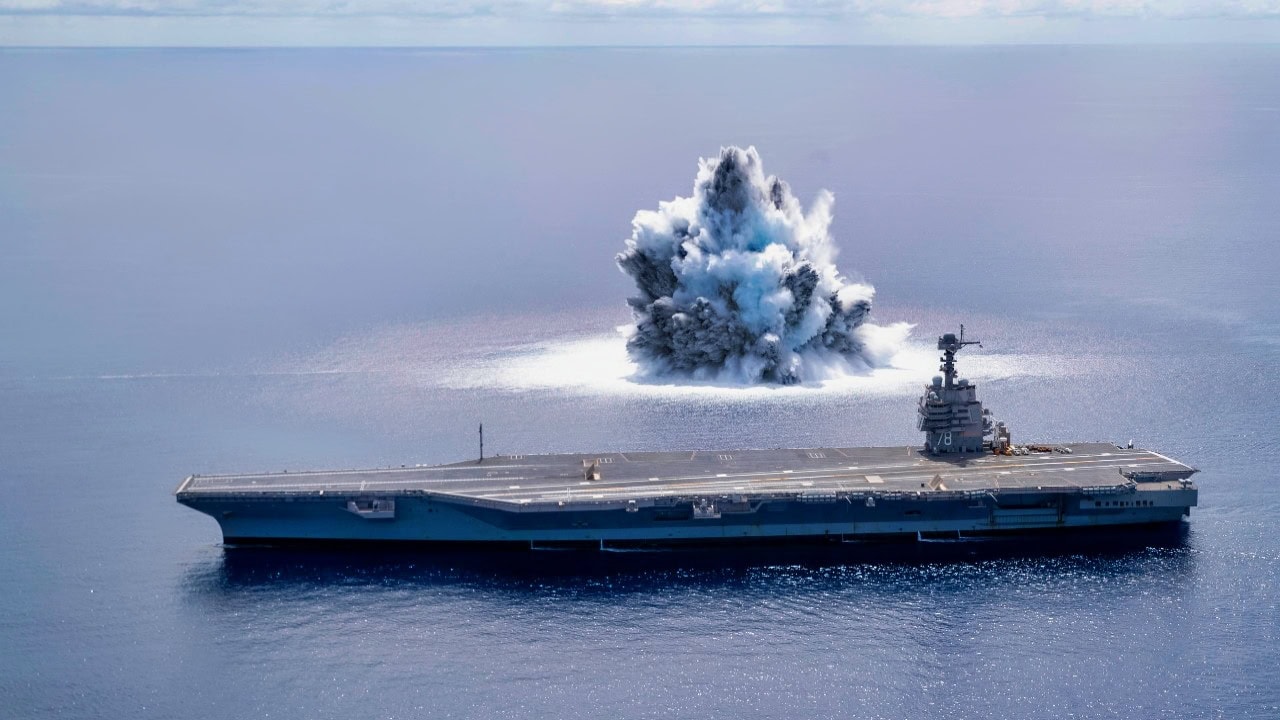
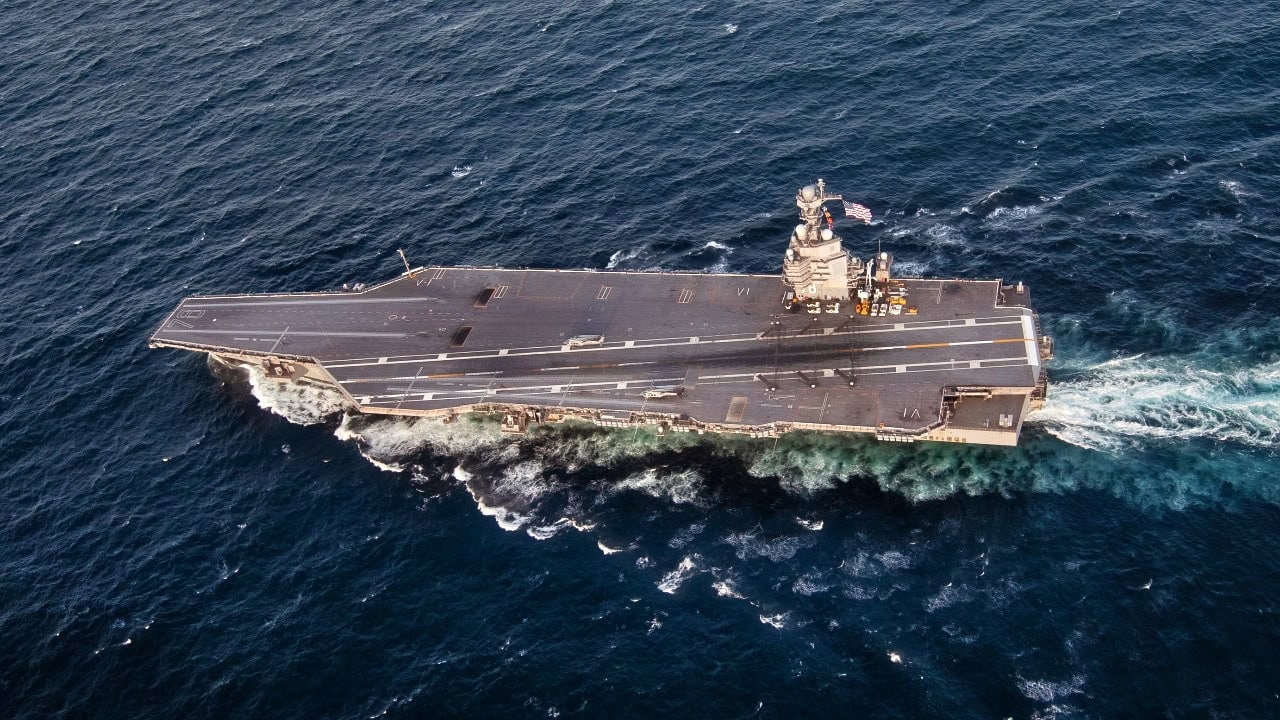
The aircraft carrier USS Gerald R. Ford (CVN 78) successfully completes the third and final scheduled explosive event of Full Ship Shock Trials while underway in the Atlantic Ocean, Aug. 8, 2021. The U.S. Navy conducts shock trials of new ship designs using live explosives to confirm that our warships can continue to meet demanding mission requirements under harsh conditions they might encounter in battle. (U.S. Navy photo by Mass Communication Specialist 3rd Class Novalee Manzella)
Summary and Key Points – The USS Gerald R. Ford is heading toward the Middle East as tensions with Iran raise the possibility of a military confrontation, but the deployment is also exposing the human cost of keeping a carrier at sea for so long.
-Sailors and families are dealing with missed milestones, uncertainty, and rising fatigue as the ship moves toward what could become an 11-month deployment.
-Reports of sewage system problems and long waits for working toilets have added to frustrations on board. Even so, the Ford remains a central symbol of U.S. naval power, deterrence, and readiness during a volatile regional moment.
USS Gerald R. Ford Has a Message for Iran: The U.S. Navy’s Biggest Carrier Is Heading East
The USS Gerald Ford, in recent days, has been headed towards the Middle East, with the possibility of a military confrontation between the United States and Iran.
Per The Jerusalem Post, the USS Gerald Ford, after crossing the Mediterranean, is set to dock in Haifa, Israel.
“The Ford carrier strike group, officially known as Carrier Strike Group 12, entered the Mediterranean after transiting the Strait of Gibraltar, a movement reported by multiple outlets tracking US naval deployments. The US Navy has not formally confirmed when the carrier will dock,” the Jerusalem Post wrote.
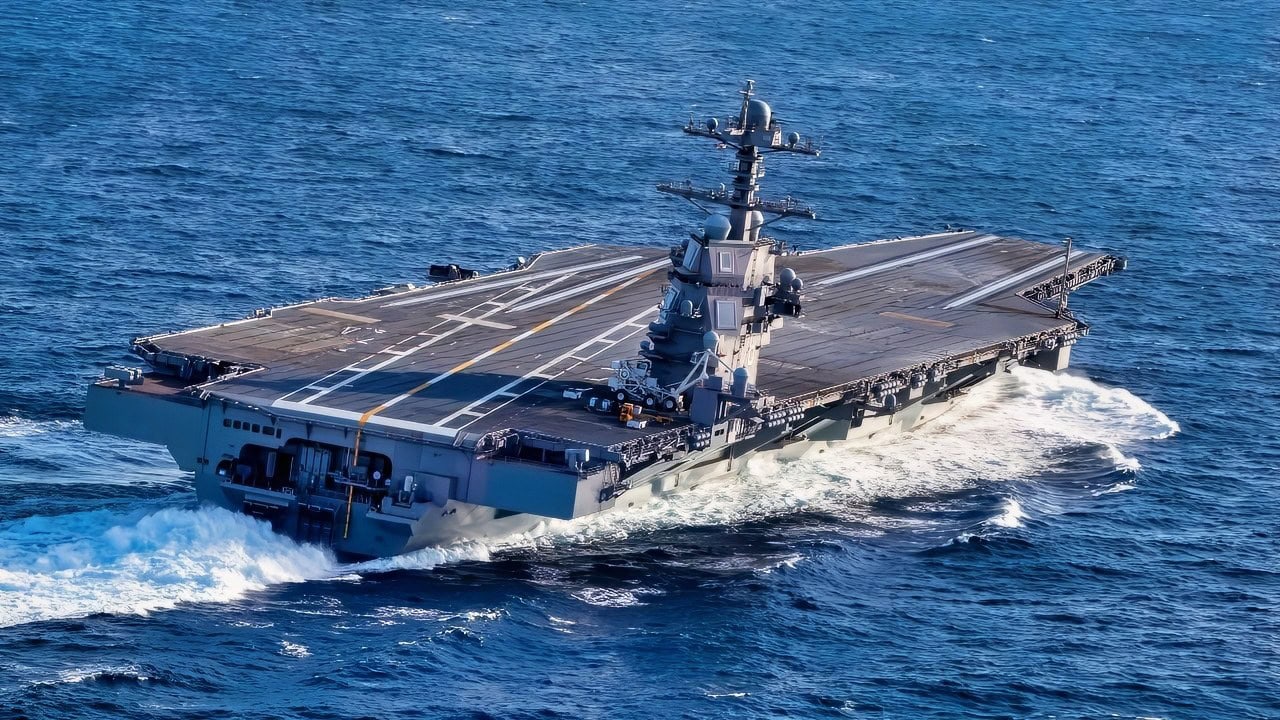
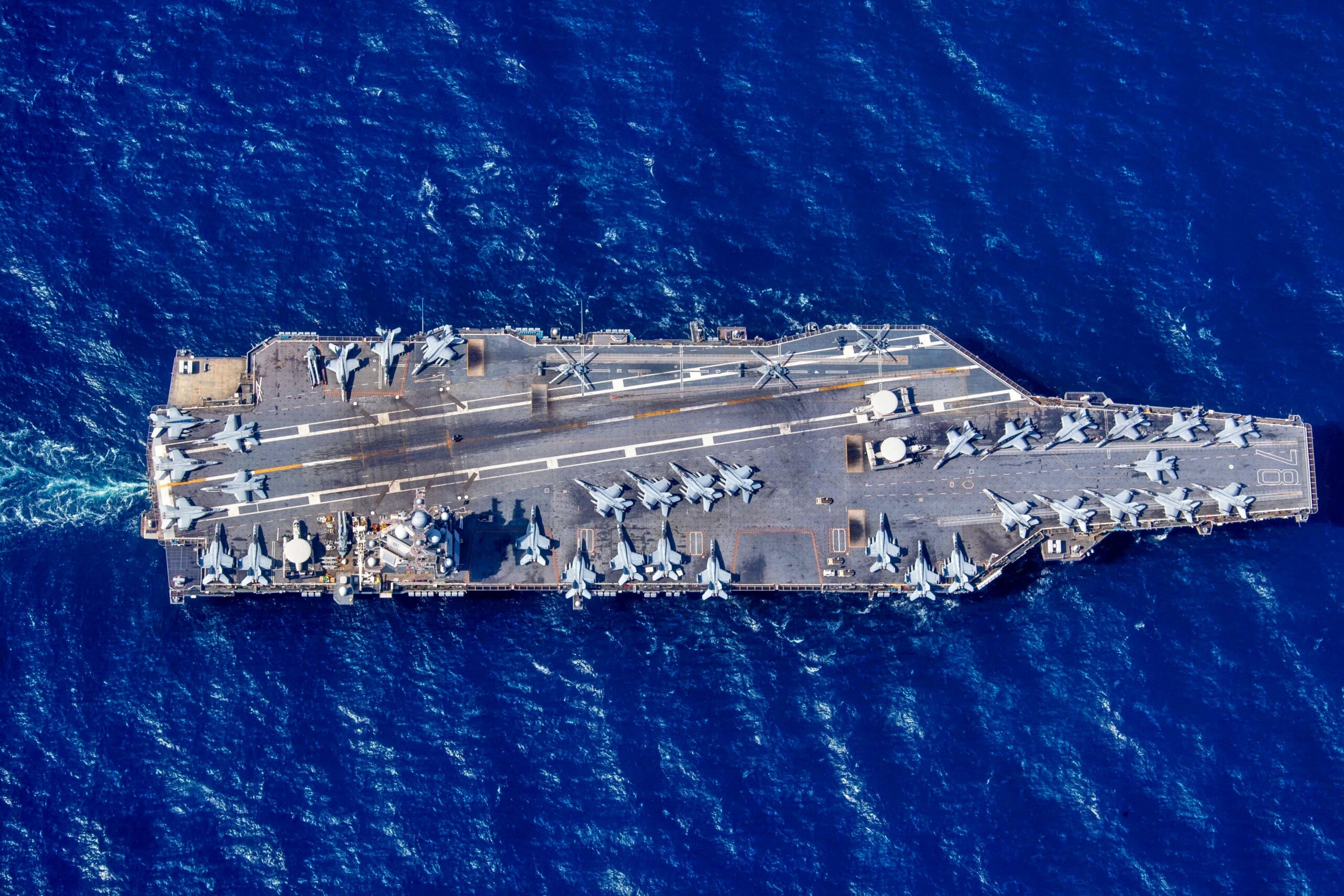
ATLANTIC OCEAN (Oct. 29, 2019) USS Gerald R. Ford (CVN 78) conducts high-speed turns in the Atlantic Ocean. Ford is at sea conducting sea trials following the in port portion of its 15 month post-shakedown availability. (U.S. Navy photo by Mass Communication Specialist 3rd Class Connor Loessin)
ATLANTIC OCEAN (Oct. 29, 2019) USS Gerald R. Ford (CVN 78) conducts high-speed turns in the Atlantic Ocean. Ford is at sea conducting sea trials following the in port portion of its 15 month post-shakedown availability. (U.S. Navy photo by Mass Communication Specialist 3rd Class Connor Loessin)
Haifa, including its port, was struck hard during the Israel/Iran war last summer.
The USS Gerald Ford has been deployed since last June and was previously in the Caribbean, ahead of the January operation that captured Venezuelan leader Nicolas Maduro. That has led to one of the longest deployments in Naval history, and that, according to a new report in the Wall Street Journal, is beginning to take a toll on sailors and their families.
According to the Journal story, there are all sorts of stories of the deployment taking a toll.
“One sailor missed the death of his great-grandfather. Another is thinking about leaving the Navy after almost a year away from her toddler daughter. Two more said the ship had sewage problems,” the Journal story, by Lara Seligman and Milàn Czerny, said.
“President Trump’s decision to extend for a second time the deployment of the aircraft carrier USS Gerald R. Ford is taking a toll on the ship’s sailors and their families, and leading some to consider leaving the Navy when they return to home port, according to interviews with sailors on board the ship and their family members back home,” the story added.
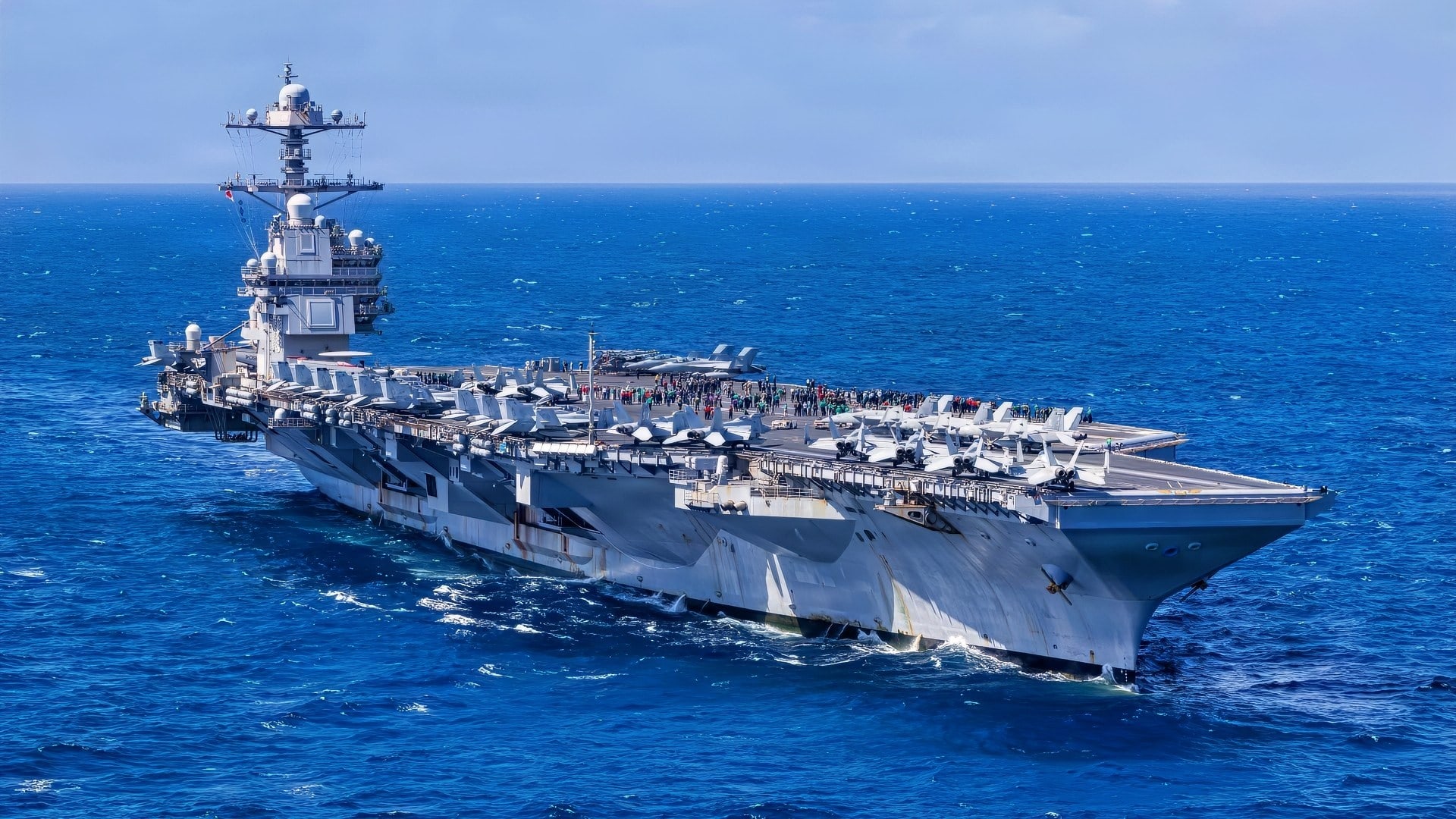
The ship, which has a crew of about 5,000 people and is the world’s largest aircraft carrier and the Navy’s newest, had been headed to the Mediterranean when it was rerouted to the Caribbean ahead of the Venezuela mission.
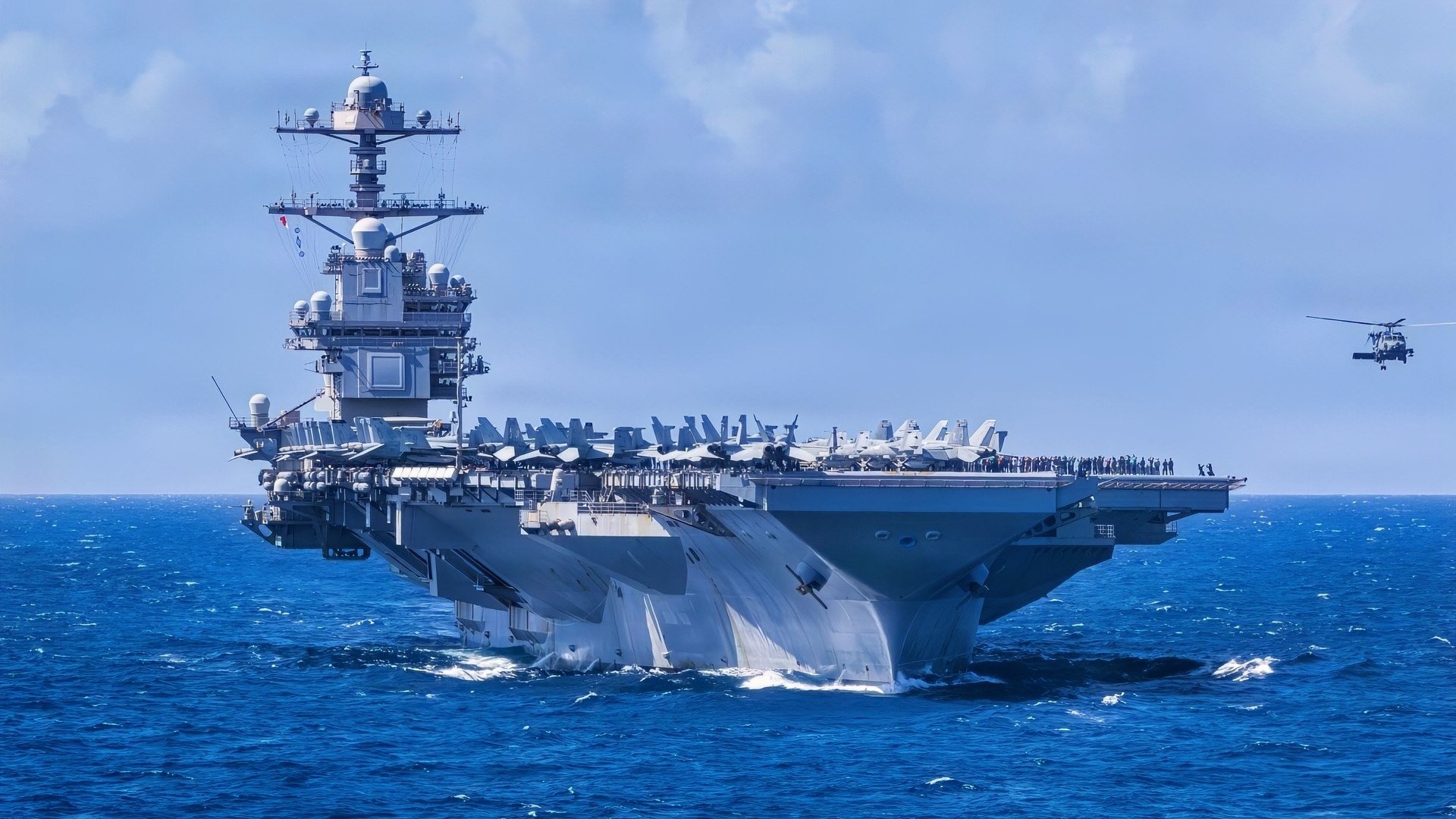
The world’s largest aircraft carrier, Ford-class aircraft carrier USS Gerald R. Ford (CVN 78), transits the Caribbean Sea during Carrier Air Wing 8’s aerial change of command ceremony, Jan. 19, 2026. U.S. military forces are deployed to the Caribbean in support of the U.S. Southern Command mission, Department of War-directed operations, and the president’s priorities to disrupt illicit drug trafficking and protect the homeland. (U.S. Navy photo)
U.S. Navy Carrier Air Wing 8 aircraft fly in formation over the world’s largest aircraft carrier, Ford-class aircraft carrier USS Gerald R. Ford (CVN 78), during Carrier Air Wing 8’s aerial change of command ceremony while underway in the Caribbean Sea, Jan. 19, 2026. U.S. military forces are deployed to the Caribbean in support of the U.S. Southern Command mission, Department of War-directed operations, and the president’s priorities to disrupt illicit drug trafficking and protect the homeland. (U.S. Navy photo)
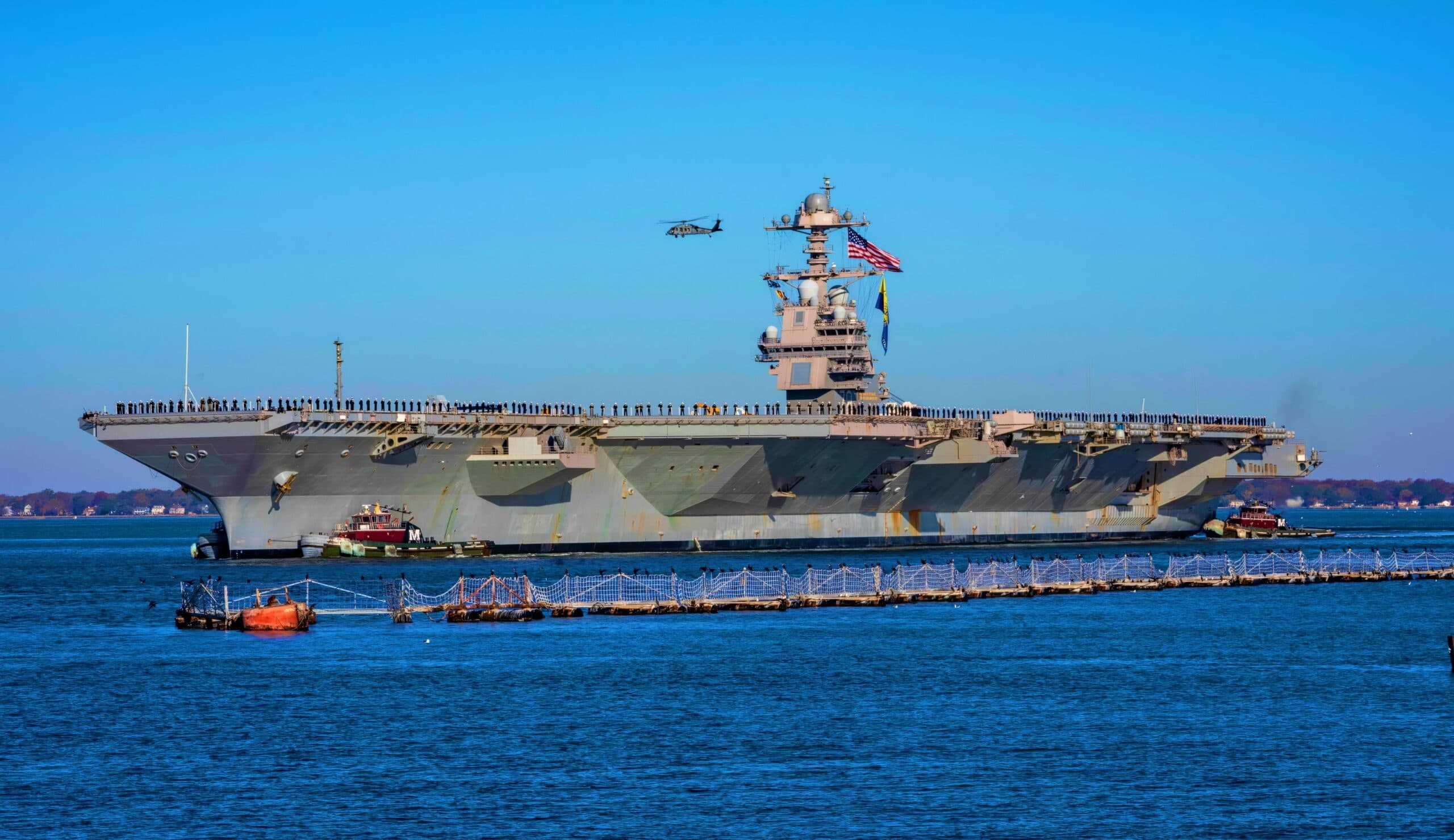
NORFOLK (Nov. 26, 2022) The USS Gerald R. Ford (CVN 78) returns to Naval Station Norfolk after completing their inaugural deployment to the Atlantic Ocean with the Gerald R. Ford Carrier Strike Group (GRFCSG), Nov. 26. The GRFCSG, returned to Naval Station Norfolk following a scheduled deployment with Allies and partners in an effort to build strategic relationships and contribute to a stable and conflict-free Atlantic region, while also showcasing the U.S. Navy’s most advanced class of aircraft carrier. (U.S. Navy Photo/Video by Mass Communication Specialist First Class Nathan T. Beard)
“Carrier deployments during peacetime are typically six months long, with planners allowing for a few months of potential overrun if needed,” Mark Montgomery, a retired rear admiral, told the Journal. “But the Ford’s sailors have been away from home for eight months already, setting up a possible deployment of 11 months, he said. That would break the record for a continuous deployment by a U.S. Navy ship.”
The Journal story implied that this is starting to be a problem.
“Overtaxed crews can be a problem across the Navy’s fleet, beyond just the Ford,” the WSJ story said. “In April and May 2025, near the end of an eight-month deployment, the aircraft carrier USS Harry S. Truman lost several jet fighters while countering Houthi rebel attacks in the Red Sea. A Navy investigation blamed the high operational tempo of the mission.”
The Aircraft Carrier Crew Members Speak
The Journal talked to some sailors aboard the Gerald R. Ford.
“One sailor on board the Ford told the Journal that many crew members are angry and upset, with some saying they want to leave the Navy at the end of the deployment,” the Journal reported. “The sailor said she was strongly considering quitting herself. She said she misses her toddler daughter, but the unpredictability of when she would see her family again hurt the most.”
The Journal also obtained a letter that the carrier’s commanding officer, Capt. David Skarosi, sent in mid-February, after its deployment was extended.
“I’ve spoken to many of your Sailors who are coming to terms with missing Disney World plans, weddings they already RSVP’d to attend, and spring break trips to Busch Gardens,” Capt. Skarosi wrote in the letter. However, he added that “when our country calls, we answer.”
“Other sailors on board the Ford see extended periods away from home as just a part of the job,” the Journal story said. “One told the Journal that although the extension was hard and everyone was tired, all sailors knew what they had signed up for. Their mission is to make sure that fighting never hits the home front, he said—and that can require long and stressful deployments.”
Toilet Trouble on USS Gerald R. Ford
Back in January, even before USS Gerald Ford headed to the Middle East, NPR reported that “issues with the toilets on the USS Ford continue even as it continues its deployment to the Caribbean.” Long deployments often mean delayed repairs, and that appears to be the case with the Gerald Ford.
Steve Walsh of the local station WHRO told NPR that the story first came from a soldier’s mother.
“ I was contacted by the mother of a sailor on board USS Ford. She was concerned about sanitary conditions on the carrier, which had just deployed from its home port in Norfolk in June,” Walsh told NPR. “A number of toilets were out of commission, and she wanted to know why. NPR has obtained documents that include a series of emails that detail the ship’s effort to grapple with the breakdowns.”
The aircraft carrier USS Gerald R. Ford (CVN 78) completes the first scheduled explosive event of Full Ship Shock Trials while underway in the Atlantic Ocean, June 18, 2021. The U.S. Navy conducts shock trials of new ship designs using live explosives to confirm that our warships can continue to meet demanding mission requirements under harsh conditions they might encounter in battle. (U.S. Navy photo by Mass Communication Specialist 3rd Class Riley B. McDowell)
The Ford-class aircraft carrier USS Gerald R. Ford (CVN 78) and the Italian aircraft carrier ITS Cavour (CVH 550) transit the Atlantic Ocean March 20, 2021, marking the first time a Ford-class and Italian carrier have operated together underway. As part of the Italian Navy’s Ready for Operations (RFO) campaign for its flagship, Cavour is conducting sea trials in coordination with the F-35 Lightning II Joint Program Office’s Patuxent River Integrated Test Force to obtain official certification to safely operate the F-35B. Gerald R. Ford is conducting integrated carrier strike group operations during independent steaming event 17 as part of her post-delivery test and trials phase of operations.
The Journal story had an update on the toilet situation.
“The Navy official said the Ford’s sewage system, which uses vacuum technology to transport waste from roughly 650 toilets on board, has experienced issues during the deployment, averaging about one maintenance call a day,” the Journal said. “But the situation is improving and the problems haven’t impacted the carrier’s ability to carry out its mission, the official said.”
Danger?
Meanwhile, a WION News story this week looked at an even worse potential problem: That Iran, following an attack, could retaliate against the USS Gerald R. Ford or the USS Abraham Lincoln.
“The USS Gerald R. Ford is the largest and most advanced warship in the world. It recently entered the Mediterranean Sea after a long deployment. The massive 100,000-tonne carrier brings devastating firepower but also presents a highly valuable target,” the report said.
About the Author: Stephen Silver
Stephen Silver is an award-winning journalist, essayist, and film critic, and contributor to the Philadelphia Inquirer, the Jewish Telegraphic Agency, Broad Street Review, and Splice Today. The co-founder of the Philadelphia Film Critics Circle, Stephen lives in suburban Philadelphia with his wife and two sons. For over a decade, Stephen has authored thousands of articles that focus on politics, national security, technology, and the economy. Follow him on X (formerly Twitter) at @StephenSilver, and subscribe to his Substack newsletter.
ERBIL, Kurdistan Region – A pro-Iran armed group in Iraq said Sunday it carried out a drone attack targeting US military sites in Erbil, as Iran vowed to retaliate for the killing of its supreme leader.
The pro-Iran Saraya Awliya al-Dam (Guardians of Blood Brigades) group said in a statement dated Sunday that its “mujahideen” conducted an operation “with a squadron of drones” against “American bases in Erbil.”
Early Sunday, a large plume of smoke rose over Erbil following the strike. Casualties and damage were not immediately clear.
The statement said the attack was “in fulfillment of our religious duty and in support of the Islamic Republic of Iran against the Zionist-American aggression” and “defense of Iraq’s sovereignty.”
The claim came as pro-Iran armed groups vowed retaliation following US and Israeli strikes on Iran on Saturday. Other missiles and drones were intercepted by US-led coalition forces over the city on the same day.
Also on Saturday, the pro-Iran group Kataib Hezbollah said it would “soon begin targeting” American bases after a Popular Mobilization Forces (PMF) base it uses in Iraq’s central Babil province was struck several times the same day. On Thursday, the group warned the Kurdistan Regional Government (KRG) against cooperating with what it described as “hostile foreign forces.”
“This will impose additional burdens upon it that may threaten its security and future,” the group said, calling on its fighters to “prepare to wage a war of attrition that may be long-term, exceeding the estimates of the US administration.”
Iran began its response less than three hours after the start of the US and Israeli strikes on Saturday, targeting sites in Israel, Saudi Arabia, Qatar, the United Arab Emirates, Bahrain, Kuwait, and the Kurdistan Region, according to Iranian state media.
Western forces in Erbil relocate ahead of possible US strikes on Iran
France, Norway, Germany, Sweden and Italy among countries that have repositioned troops in the region
In this file photo, German Soldiers receive a pre-flight brief before boarding the US Army Boeing CH-47 Chinook at Erbil Air Base, Iraq, 31 October 2025 (US Army photo by Capt. Bernard Jenkins Jr.)
Published date: 24 February 2026 11:42 GMT|Last update: 4 days 8 hours ago
A few days ago, amidst heightened US–Iran tensions, a military helicopter landed at the Erbil airport in the Kurdistan region of Iraq.
Although Western troops are rarely seen on the city’s streets, Erbil Air Base is heavily staffed with soldiers, and military helicopters fly overhead every day.
Now, this airport could potentially become a target for Iran if the situation escalates.
Since 2018, the Kurdistan region, including Erbil’s airport, has come under attack by drones, rockets and ballistic missiles from Iran and its proxies.
In July last year, a suicide drone was shot down above the airport amidst attacks on oil fields in the region. On 21 January, a drone also targeted an Iranian Kurdish opposition party, killing one Kurdish fighter.
=========
The Erbil base has a large target on it not only due to US withdrawal from other Iraqi bases but also because attacking it provides the Iranians with an opportunity to make a declaration to local US partners in the region as to the cost of working with the Americans,” Nicholas Heras, the senior director for the Strategy and Programs Unit in the Academic Division at the New Lines Institute, told MEE.
Highlights: Bill Clinton’s testimony about Epstein ties concludes after more than 6 hours
Democrats on the House Oversight Committee are renewing calls for President Donald Trump to testify about Jeffrey Epstein as former President Bill Clinton is deposed in New York. “We’re talking to the wrong president today,” said Rep. Suhas Subramanyam. (AP Video: Ted Shaffrey)
Former President Bill Clinton finished his testimony before members of Congress for their investigation over convicted sex offender Jeffrey Epstein. The closed-door deposition ended after more than six hours of questioning from lawmakers about his connections to the disgraced financier.
“I saw nothing, and I did nothing wrong,” the former Democratic president said in an opening statement he shared on social media at the outset of the deposition.
The deposition in Chappaqua, New York, marks the first time a former president has been compelled to testify to Congress.
It comes a day after Clinton’s wife, former Secretary of State Hillary Clinton, sat for her own deposition, where she told lawmakers that she had no knowledge of how Epstein had sexually abused underage girls and had no recollection of even meeting him.
Neither Clinton has been accused of any wrongdoing.
FORWARD: THE IRANIAN-AMERICAN WAR – A MILITARY DISASTER IN THE MAKING
Today in the midst of the opening salvos of a new war in the Middle East, it is appropriate to not only analyze the current situation (we will publish a number of Special Reports as the War develops) but republish the Special Report originally. published on September 30, 2025. That Report discussed the Military’s current contempt for President Trump’s judgement as Commander in Chief. I believe it is important background and puts this new War in context.
This new conflict is nothing less than the LBJ Vietnam War on steroids without boots on the ground, and no plausible path to defeat this Iranian Regime without them. There is no question, based on the past century and a quarter of American military experience, that boots on the ground, either ours or theirs, such as convincing the Iranian Army to smash the Islamic Revolutionary Guard and then setting up a new secular government, can achieve Trump’s proclaimed objective: destroy the current Islamic Republic. That appears far from doable, and would probably result in a massive civil war between Islamic zealots and the secular civil society.
Meanwhile the Persian Gulf oil shipments have been disrupted threatening an huge increase in oil prices according to the New York Times. All tanker oil traffic is avoiding the Strait of Hormuz. The owners of oil tankers and their insurance companies fear the destruction of their ships, Very Large Crude Carriers (VLCC) each one costing $130 million. This, in effect, closes the Strait. On top of this, while Supreme Leader Ali Khamenei, the Commander in Chief of the Islamic Revolutionary Guard guard and two other members of the National Defense Council have been killed, ten other key members of the Islamic Military establishment, including the Commander in Chief of the Army remain very much alive, according to the Times, quoting Israeli and U.S. sources.
The Military leadership, including the Chairman of Joint Chiefs of Staff, argued strongly against the launching of a massive air war because a Regime Change is not a military objective that an air war can achieve. Without an achievable objective the Military is wasting its resources, weapons and billions of dollars of expense to move carriers, planes and personnel, not to mention the inevitable casualties such a war will incur. This advice is similar to the advice the Joint Chiefs of Staff and the theater commander William Westmorland gave President Lyndon Johnson in 1966: the North Vietnam invasion of South Vietnam could not be broken from the air. Their only recommendation to win the war was a combined arms ground invasion advancing toward Hanoi and the North’s major port of Haiphong. Johnson rejected the Generals’ advice for fear of bringing China into the war, as happened in Korea. The war lasted another seven years.
As China, Russia and United States weild military power, here is a reminder of a quote of Dwight D Eisenhower:
Dwight D. Eisenhower’s 1953 address emphasized that military expenditures detract from vital social services, warning of the moral and economic consequences of excessive militarization. His message urged a balance between security and investment in human welfare amidst global challenges.
Sultan bin Sulayem, CEO of one of the world’s largest port operators, DP World, resigned from his position earlier this month after he showed up thousands of times in the files, linking him to conversations referencing sex trafficking, as well as signing his name on the sale of Jeffrey Epstein’s new island in 2016, Great Saint James, after the owner refused to sell to Epstein due to his criminal history.
Sulayem and Epstein cooking it up
The FBI did not search the island.
Les Wexner, Epstein and Maple Inc., company controlled by Epstein and based in the US Virgin Islands.
………..The 7-story, 40-room neoclassical mansion on Manhattan’s Upper East Side is cited 14 times in Epstein’s federal indictment in 2019, with prosecutors alleging Epstein recruited and brought dozens of underage victims to the palatial residence. Originally built for Macy’s heir Herbert Straus in the 1930s, the house was purchased for $13 million in 1989 by retail tycoon Leslie Wexner, who was Epstein’s main client and business partner for decades starting in the late 1980s. (Wexner has said he severed ties with Epstein in 2007.)
In 2011, Wexner transferred the property to Maple Inc., a U.S. Virgin Islands-based company controlled by Epstein. Epstein’s executors valued the home at $56 million after his death in August 2019 and put it up for sale for $88 million; it ultimately sold for $51 million in March 2021 to Michael Daffey, a former Goldman Sachs executive. A lawyer for Epstein’s estate told Forbes at the time that just under $51 million from the sale was transferred to the estate and the victims’ compensation fund
============
Great St. James Island and Little St. James Island, U.S. Virgin Islands
Epstein bought the 70-plus-acre Little St. James Island, located in the U.S. Virgin Islands, for nearly $8 million in 1998. It came to be known as “pedophile island” after Epstein allegedly used it as the center of his sex trafficking ring. In 2016, he also purchased the larger island right next to it, the 160-plus-acre Great St. James, for $22.5 million. Between 2001 and 2018, Epstein allegedly brought underaged girls and young women to Little St. James and forced them to engage in sexual acts and forced labor, according to a criminal case filed by the government of the U.S. Virgin Islands in 2020. The complaint also alleged that Epstein had bought Great St. James to “further shield his conduct on Little St. James from view” and “prevent his detection by law enforcement or the public.””
Epstein’s estate valued the islands—which featured a helipad, a private dock, a main residence and several villas—at a collective $31 million after his death in 2019 but later listed them for an asking price of $125 million. The estate settled with the U.S. Virgin Islands government in December 2022, agreeing to pay $105 million in cash—including returning more than $80 million in tax benefits—plus pay an additional $450,000 to repair environmental damage around Great St. James, due to Epstein’s alleged razing of centuries-old structures built by enslaved workers on the island.
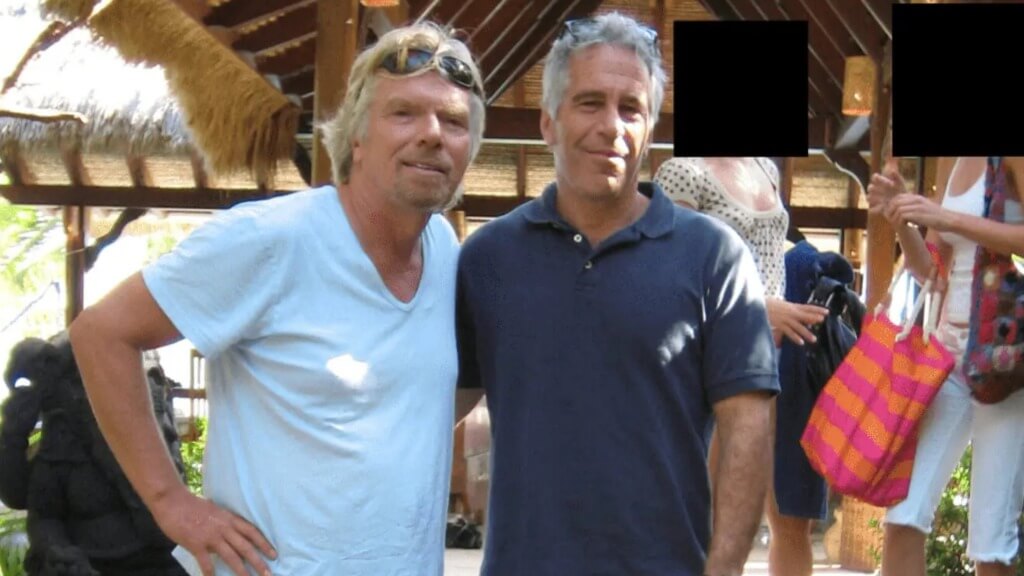
And Ruchard Branson, a neighbouring billionaire friend of Jeffrey Epstein:
Uncovering Richard Branson’s relationship with Jeffrey Epstein
The discrepancies between the Virgin Group CEO’s statements and Paste’s comprehensive timeline of Branson’s presence in the documents raise questions that do not have answers.
Ever since January 30, when the Justice Department released 3.5 million documents related to the Epstein case, many prominent figures—politicians, CEOs, professors, heads of the Nobel Prize committee—have come under renewed scrutiny for their ties to Epstein. The music world has hardly been immune, as can be seen in Paste’s thorough coverage of the Casey Wasserman revelations and the subsequent backlash he received from artists. Wasserman, however, was not the only music mogul named in the files. The founder of Virgin Records, the British billionaire Richard Branson, is featured at length, with 798 pings of his last name alone in Epstein’s emails. The inclusion is not particularly surprising, given that Branson’s famous private island in the Caribbean, Necker Island, is just 20 minutes away from Epstein’s own private island by helicopter and ten minutes by plane, according to Epstein himself. Epstein even had a framed photo of himself and Branson in his mansion. But the full extent of the relationship between Epstein and Branson has yet to be determined.
Richard Branson famously co-founded the Virgin Group in 1970, which grew over the next 50 years to include the Virgin Atlantic airline, Virgin Trains and the Virgin Rail Group, the Virgin Galactic space tourism company, and crucially here for us at Paste, Virgin Records—one of the most predominant music labels of the past half-century, having signed everyone from the Rolling Stones to the Sex Pistols to Taylor Swift. While Virgin Records is no longer under Branson’s direct control (he sold the label to Thorn EMI in 1992, before Universal Music Group acquired it in 2012), it is still heavily associated with the English business magnate; it, like all other Virgin companies, features a quote from Branson himself at the bottom of its webpage: “Embedding purpose into your business will help it to stand out, and align it with customers who have the same values.”
Like many business magnates in this day and age, Branson has already faced scrutiny over his treatment of women. In 2017, Joss Stone backing singer Antonia Jenae accused Branson of sexually assaulting her on Necker Island. Janae alleged: “We were by the bar and he was saying bye to everyone. He came up to me and put his face in my breasts. He went ‘brrrrrr’ and just walked away. It was surreal, totally out of the blue. Joss and I were like, ‘What the hell was that?!’ Everyone was wondering why I wasn’t angry because I’m usually a firebrand. But I was just too shocked.” A spokeswoman for Virgin Management denied this: “Everyone appeared to enjoy their time on the island. Richard has no recollection of this matter and neither do his family and friends, who were with him on the island at the time. There would never have been any intention to offend or make anyone feel uncomfortable in any way and Richard apologises if anyone felt that way during their time on the island.”
While there has been coverage of Richard Branson’s inclusion in the files, much of it revolves around the same few quotes (an understandably eye-catching reference that Branson made to Epstein’s “harem” in 2013, as well as Branson’s offer of public relations advice to the then-already-convicted sex offender) and the official statement that was given to The Independent by Branson’s PR team. When Paste asked for comment for this piece, the Virgin Group again sent the same statement:
“Any contact Richard and Joan Branson had with Epstein took place on only a few occasions more than twelve years ago, and was limited to group or business settings, such as a charity tennis event. When Epstein offered a charity donation, the Bransons asked their team to carry out due diligence before accepting the donation, which uncovered serious allegations. As a result of what the due diligence uncovered, Virgin Unite did not take the donation and Richard and Joan decided not to meet or speak with Epstein again. Had they had the full picture and information, there would have been no contact whatsoever—Richard believes that Epstein’s actions were abhorrent and supports the right to justice for his many victims.”
The spokesperson then went on to provide us with the same explanation of Epstein and Branson’s relationship that was previously shared with The Independent. Essentially, the basic story is that Epstein and Branson had only minimal contact, limited primarily to a few “brief business meetings on Necker Island,” none of which Branson actually invited Epstein to, and that Branson “had no knowledge of the crimes that have since come to light.” However, a careful review of the released files produced discrepancies between the emails themselves and the official statements the Virgin Group gave to the press.
In response to Paste’s further inquiries, the Virgin spokesperson then provided information about additional interactions between Jeffrey Epstein and Richard Branson that were not included in their initial reply. When asked to clarify the claims made in that second response (that the pair’s first contact was in September 2013, for instance), the spokesperson provided information on further additional interactions. Yet even with three separate statements, each including more information than the last, inconsistencies remained between the information given to Paste by the Virgin spokesperson and the information made publicly available in the released files. This does not mean Branson himself is implicated in any wrongdoing, but rather, that significant questions remain about Branson’s exposure to Epstein and his inner circle, and the degree of his awareness of Epstein’s activities.
As such, Paste is providing a newly comprehensive timeline of Jeffrey Epstein and Richard Branson’s relationship as detailed in the files, including quotes from the statements received from Virgin’s spokesperson wherever relevant.
TIMELINE
January 10, 2006: First mention of a meeting between Epstein and Branson
None of the three sets of statements supplied by the Virgin Group make any mention of an official in-person meeting between Epstein and Branson prior to April 2013. However, in the emails, we see Epstein himself apparently discussing one such meeting as early as January 2006, seven years prior to the first meeting Branson’s spokesperson mentioned. As Epstein wrote to Harvard psychologist Howard Gardner on January 10, 2006: “sorry I missed you…. I met with Richard Bransn, who is working on creating what he terms an elder statesman council of the world… and asked who I thought might be appropriate… I told him i have no idea but he should contact you and inquire , about your work on trustees.”……………..
This itself seems to all be true, although Branson’s team (namely, Nicola Elliott, who was at one point Branson’s Executive Assistant) did play a role in facilitating this as well. On December 28, 2010, Bill Richardson’s Deputy Chief of Staff, Janis Hartley, contacted Elliott to inform her that “Jeffrey Epstein has volunteer [sic] to pickup the Governor at Necker Island on Friday, January 7th.” The two then went on to coordinate the specifics of the pick up.
On January 7, 2011, two important exchanges occurred: First, Epstein emailed the British politician and diplomat Peter Mandelson (who, it is worth noting, has been summoned to testify before the US Congress regarding his own ties to Epstein at this very moment) to say he “had breakfast with richard branson, he is also a big fan of africa.” Mandelson replied, inscrutably, “Let’s go for it.” Later that day, Epstein emailed Branson himself with a vaguely ominous-sounding message under the subject heading “a treat”: “dear neighbor, thanks for your hospitality this morning. Though its a little late to find new friends. I hope you and I can also meet that challenge.” Branson replied on January 10 with: “Dear Jeffrey, I’m sure we will. All the best, Richard.”
These emails suggest that what occurred on January 7 was not just Richardson being “collected by Epstein’s helicopter,” as the Virgin Group’s statements attest. Rather, it seems Branson and Epstein had a friendly breakfast, one that went well enough for Epstein to reach out to tell Mandelson about it, and for Epstein and Branson themselves to exchange warm (albeit oddly phrased) emails about the relationship that was formed.
Early 2011: Ongoing contact between Epstein and Branson, largely initiated by Epstein
For the next two or so months, Epstein contacted Branson frequently about his desire to get together, but Branson was never available. On January 13, Epstein told Branson he’d be in New York mid-month and Paris later if Branson was around; Branson was not, due to a leg injury. (Despite the apparent innocence of this exchange, Epstein then reassured Branson that “at the bottom of my emails I have always added a copyright notice. It gives great pause to publications that might get hold of them someday”). The next day, January 14, Epstein asked Branson if he wanted some company on Necker; Branson responded: “Dear Jeffrey, Sorry, would love to have done but had to go to Europe in the end. Love to the girls! Best, Richard.” Epstein told Branson he would be in Paris for the next week on January 21, but Branson was “sadly in San Diego.” On February 18, Epstein wrote Branson to say “fun people on the island,, both types,,are you here” but Branson “[v]ery sadly” was not. (The Virgin Group maintains that Branson did not understand what Epstein meant by that email, and thus replied with a “brush-off” in response.)
It is, of course, worth emphasizing that none of these emails indicate wrongdoing on Branson’s part, as he seemingly declined to meet with Epstein on any of these occasions. However, it is also worth emphasizing that there are multiple phrases throughout these emails that cast some doubt upon the Virgin Group’s insistence that Branson was utterly ignorant of Epstein’s doings. Virgin’s statements make it seem as though Branson did not know Epstein personally at this point, with the extent of their contact being Epstein picking up Richardson from Necker Island. And yet, as early as 2011, Epstein tried to coax Branson to come visit with the promise of “both types” of “fun people on the island,” and, elsewhere that same year, an unprompted Branson signed off with the phrase “Love to the girls!”
Anthropic has until Friday evening to either give the U.S. military unrestricted access to its AI model or face the consequences, reports Axios.
Defense Secretary Pete Hegseth told Anthropic CEO Dario Amodei in a meeting Tuesday morning that the Pentagon will either declare Anthropic a “supply chain risk” — a designation usually reserved for foreign adversaries — or invoke the Defense Production Act (DPA) to force the company to tailor a version of the model to the military’s needs.
The DPA gives the president the authority to force companies to prioritize or expand production for national defense. It was recently invoked during the COVID-19 pandemic to compel companies like General Motors and 3M to produce ventilators and masks, respectively.
Anthropic has long stated that it doesn’t want its technology used for mass surveillance of Americans or for fully autonomous weapons — and is refusing to compromise on these points.
Pentagon officials have argued the military’s use of technology should be governed by U.S. law and constitutional limits, not by the usage policies of private contractors.
Using the DPA in a dispute over AI guardrails would mark a significant expansion of the law’s modern use. It would also reflect an expansion of a broader pattern of executive branch instability that has intensified in recent years, according to Dean Ball, senior fellow at the Foundation for American Innovation and former senior policy advisor on AI in Trump’s White House.
“It would basically be the government saying, ‘If you disagree with us politically, we’re going to try to put you out of business,’” Ball said.
In the documents, officials with the Department of Homeland Security state plans to “implement a new detention model by the end of Fiscal Year 2026,” which involves the creation of large-scale “hubs” across the country that would hold thousands of detainees.
The document release comes after Social Circle leaders met with DHS officials earlier this week to discuss the agency’s plan to turn a warehouse it recently purchased in the city into one of those “mega centers.”
There is ice activity happening here in Baltimore right now.
In the “Ice Detention Reengineering Initiative” document, the agency said it plans to reduce the total number of facilities from hundreds to around 34 while increasing the total bed capacity.
“The facility in Social Circle is expected to house anywhere from 7,500 to 10,000 detainees and will be constructed using a modular design so that capacity can be scaled up or down as needed,” the city posted on Facebook on Wednesday.
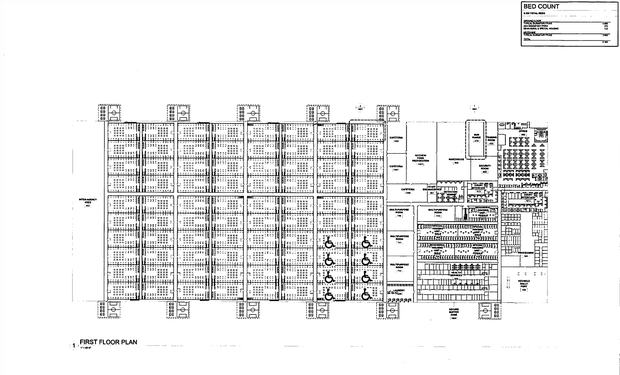
A screenshot of one of the pages of the U.S. Immigration and Customs Enforcement’s document showing what detainee housing at the Social Circle facility would look like. U.S. Immigration and Customs Enforcement
Once construction has begun, the agency estimates to begin accepting detainees sometime between mid-May and June, and is expected to employ 2,000 to 2,500 staff.
The document says detainees will stay in the “mega-centers” for around 60 days. “Processing sites,” like the one expected to be in Oakwood, Georgia, will have detainees stay some time between three and seven days.
The documents show that the facility will include holding areas, gyms, recreational spaces, cafeterias, a gun range, and other services.
Concerns over straining infrastructure
In an infrastructure analysis provided to the city by DHS officials, the agency says that the detention facility will be designed “to not affect the existing infrastructure adversely in any way.”
“The design currently includes on sit mitigation strategies for wastewater treatment. Additional contingencies are in place if required due to non-engineering circumstances,” the document reads.
ICE officials also claim the economic benefits of the facility will help Social Circle complete the construction of another wastewater treatment plant that was already planned for industrial growth.
The warehouse of Hightower Trail is expected to become an ICE facility holding thousands of detainees. CBS News Atlanta
City leaders have consistently expressed concerns over how the facility may strain its services, pointing to the fact that it would nearly triple the area’s population when fully up and running.
“The City’s concerns regarding water and sewer infrastructure have not been addressed to our satisfaction. We continue to have more questions than answers,” the city wrote. “DHS referenced a wastewater analysis to support its claims of available capacity; however, a portion of that capacity was attributed to the A. Scott Emmons Treatment Facility. This treatment facility is not owned by the City of Social Circle, is not located within the city limits, is in a different county, and does not connect to the City’s utility system or this building.”
Social Circle officials also criticized the agency’s plan for the water supply, saying a “cistern-based” approach, where tanks are filled during off-hours, would not offset the increasing demand from the facility.
“To be clear, the City has repeatedly communicated that it does not have the capacity or resources to accommodate this demand, and no proposal presented to date has demonstrated otherwise,” they wrote.
The nationwide detention center plan is estimated to cost $38.3 billion, which would be funded through Congress’s allocation of funds via the One Big Beautiful Bill Act.
More than 75,000 immigrants were being detained by ICE as of mid-January, up from 40,000 when Trump took office a year earlier, according to federal data released earlier in February.
Two of Immigration and Customs Enforcement’s (ICE) biggest contractors for building and managing detention centers have posted record revenue in 2025, as companies are expanding their facilities nationwide to hold more immigrants apprehended by the Trump Administration.
GEO Group, which operates 19 facilities for ICE around the country, reported $2.6 billion in total revenue in 2025, up 6% from $2.43 billion in 2024. CoreCivic, which owns and operates at least ten ICE detention facilities, reported $2.2 billion in total revenue in 2025, up 13% from $1.96 billion in 2024.
Going back to Michael D Sellers Substack on the topic, here is another extract:
How big is this, really?
ICE detention has already surged. AP reports detention numbers rising from roughly 40,000 to about 75,000, with a push toward 92,600 beds by the end of FY 2026.
To put the scale in plain terms:
DHS’s own FY 2026 budget justification talks about sustaining 50,000 detention beds.
The “reengineering” plan being reported targets 92,600 beds.
That is not a marginal increase. It’s close to a doubling of the bed base implied by DHS’s budget narrative—an attempt to build a detention system sized for sustained mass apprehension, not episodic surges.
A second scale check: ICE vs. federal prison
The Bureau of Prisons currently reports 153,121 total federal inmates (with 138,755 in BOP custody and additional federal inmates in other facility types).
If ICE reaches 92,600 beds, immigration detention alone would approach two-thirds the size of the entire federal prison population.
That comparison doesn’t say the systems are identical—they’re not. But it does clarify what “mega detention” actually means: an incarceration-scale institution built inside the executive branch, expanding on a timetable measured in months.
Why warehouses? Because warehouses are policy.
Warehouses are the perfect chassis for this kind of state project:
enormous footprints
highway access
modular interiors
relatively fast retrofits
and a zoning vocabulary that can be softened (“processing,” “staging,” “temporary”) until the beds are already installed
AP describes ICE quietly purchasing large warehouses in at least 20 communities, with local officials repeatedly saying they learned about plans late or indirectly.
This is the central political move: use real estate to make the policy a fait accompli.
The pressure point: scale so big it breaks normal governance
The reason this is detonating locally is not simply ideological opposition to enforcement. It’s that mega-centers create problems that local government is not designed to absorb quietly:
water and sewer demands
EMS capacity and hospital load
traffic, transport, staffing
tax base and land use
litigation exposure and public safety escalation
In Social Circle, Georgia, reporting described a proposed facility that could hold double the town’s population—a statistic so stark it becomes a narrative by itself.
In Romulus, Michigan, Axios reported that a federal document helped confirm a plan for a facility near Detroit Metro Airport while local officials complained they still lacked basic details—an illustration of the “paperwork moves faster than consent” dynamic.
In Maryland, Reuters reported a state lawsuit alleging DHS spent over $100 million on a site for a 1,500-bed facility without required environmental review or public input—an attempt to drag the program back inside normal legal process.
These aren’t detached anecdotes. They’re the same conflict repeating: institutional-scale detention introduced as a procurement project, leaving communities to fight it after the machinery is already in motion.
“American Gulag” is loaded language. Here’s what earns it.
Historically, “gulag” refers to something specific and far more extreme than immigration detention in the United States. That matters.
But the phrase does useful work as a warning label for a narrower idea: a domestic confinement system that is being industrialized, scaled, and normalized through logistics rather than debated through politics.
The reporting supports three ingredients of that warning:
Scale (tens of thousands of additional beds; mega-centers)
Secrecy-by-process (towns learning late; deals moving before public input)
Democratic bypass (lawsuits and backlash triggered by perceived end-runs)
Even those who favor strict immigration enforcement should pause at the method. Because method becomes morality when the state is building the capacity to cage people at industrial scale.
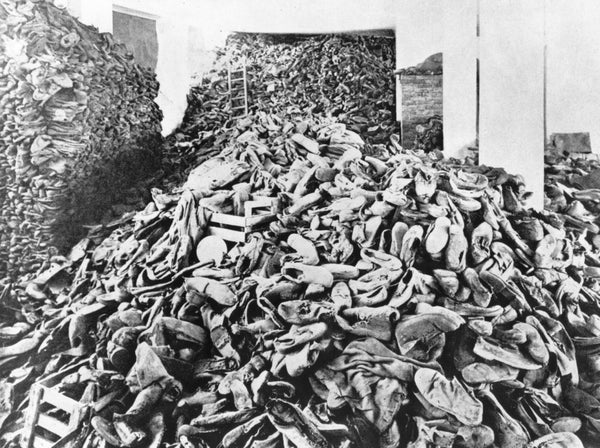
Evil has marched upon the Earth many times, more recently, the industrialised mechanism of the Holocaust:
January 10, 2019
A Biologist Reconstructs the Grotesque Efficiency of the Nazis’ Killing Machine
Lewi Stone used his statistical prowess to reveal the furious intensity of the Holocaust’s industrial-scale genocide during three months of 1942
The American version is sloppier but just as cruel, it is like a Gazan type genocide, depriving people of clean water, sanitation, food and adequate safe shelter. Death by a thousand cuts, it is traumatic and a desolate experience of hopelessness.
A nearly blind Burmese refugee who was abandoned by border patrol agents has been found dead in Buffalo, New York, city officials confirmed.
Nurul Amin Shah Alam, 56, had been missing since 19 February, when he was dropped off by border patrol following his release from Erie county holding center, according to the Investigative Post.
A city hall spokesperson, Ian Ott, told the Investigative Post that homicide detectives were “investigating the circumstances and timeframe of events leading up to his death, following his release from custody”.
Shah Alam had been in the Erie county holding center for the past year, after being arrested by Buffalo police in 2025 on charges of assault, trespassing and possession of a weapon. The arrest stemmed from an incident in which Shah Alam got lost while on a walk and ended up on the porch of a woman’s home. He had been using a curtain rod as a walking stick, according to his attorney.
The woman called the police, and when Shah Alam did not follow police commands to drop his curtain rod, they Tasered and beat him, his attorney said.
He was released on bail, and then transferred to border patrol custody.
Border patrol agents then dropped him off at a Tim Hortons about five miles from his home. Neither his attorney nor his family were notified of his release.
“We are saddened to learn that our client, Nurul Amin Shah Alam, was found deceased last night in the City of Buffalo,” the Legal Aid Bureau of Buffalo said in a statement shared with the Guardian.
Jessica Zweng, Substack:
In the post-civil rights era of the 1960’s and 1970’s, the United States had banned formal categories of discrimination and was on the brink of prison abolition. During the 1980’s backlash, the manufactured drug-war replaced race with crime as the socially acceptable marker of dangerousness and the modern era of mass incarceration and immigration detention began. Following the 9/11 attacks, the cross-stitching of everyday criminality, immigration control, and national security terrorized common crime and solidified an apparatus of government power primed to exercise the endgame of a nationalist authoritarian regime. The centerpiece of this transformation was a federal enforcement agency whose origin myth is to rid the nation’s interior of the disposable and despised—socially, legally, and politically enabled through the designation of the “criminal alien.”
ICE officer training is ‘deficient’ and ‘broken,’ former agency lawyer tells congressional forum
By Associated Press
Updated Feb 24, 2026
ICE whistleblower Ryan Schwank …
AP —
A former US Immigration and Customs Enforcement lawyer who was responsible for training new deportation officers warned Monday that the agency’s training program for new recruits is “deficient, defective and broken.”
Ryan Schwank’s comments during a forum held by congressional Democrats come at a time of intense scrutiny of the officers tasked with carrying out President Donald Trump’s mass deportation agenda. Critics, including rights groups and Democratic politicians, have accused deportation officers of using excessive force when arresting immigrants, attacking bystanders who record their conduct and failing to follow constitutional protections of people’s rights.
Arming ICE:
Fear as senator discovers staggering true amount Trump spent on arming ICE
Homeland Security Investigations (HSI) officers stand guard in Minneapolis, Minnesota. REUTERS/Tyrone Siu
A report produced by the office of Sen. Adam Schiff reveals that federal immigration enforcement agencies amassed a gigantic weapons stockpile during the first year of President Donald Trump’s second term.
In total, the report released by Schiff (D-Calif.) finds that US Immigration and Customs Enforcement (ICE) and Customs and Border Protection (CBP) committed to spending over $144 million on weapons and ammunition over the last year, a massive increase over these agencies’ spending on weapons in years past.
“In just one year, ICE’s spending commitments on weapons, ammunition, and accessories surged fourfold—an increase of over 360 percent—when compared to ICE’s contracts in 2024,” states the report. “In 2025, CBP’s contracts for weapons, ammunition, and accessories doubled when compared to CBP’s 2024 contract totals.”
Hostorical Database errors and failures:
American Citizens in the Deportation Database: When Surveillance Goes Wrong
How algorithmic bias and database errors put U.S. citizens at risk of detention and deportation
Thousands of U.S. citizens have been wrongly detained or deported by ICE
Database errors and algorithmic bias disproportionately affect communities of color
Surveillance systems cannot reliably distinguish citizens from non-citizens
Constitutional rights are routinely violated through automated enforcement
Mixed-status families face ongoing harassment from flawed targeting systems
⚠️ Constitutional Crisis
Between 2007 and 2015, ICE detained or removed at least 2,840 U.S. citizens. The real number is likely much higher due to inadequate record-keeping and ongoing cases.
The Scale of the Problem
Immigration and Customs Enforcement (ICE) and Customs and Border Protection (CBP) rely heavily on algorithmic systems and databases to identify deportation targets. These systems, designed to process millions of records quickly, routinely misidentify U.S. citizens as deportable immigrants, leading to wrongful detention, deportation, and constitutional violations.
The problem is systemic, not exceptional. Surveillance databases used for immigration enforcement are plagued by errors, outdated information, and algorithmic bias that disproportionately affects citizens of color, particularly those with Latino surnames or mixed-status family situations.
A view of the site where Mexican Army troops killed Nemesio Oseguera Cervantes, known as El Mencho, during an operation in Guadalajara, Mexico, on Feb. 22, 2026. Photo: Stringer/Anadolu via Getty Images
A new player in the U.S. military’s decadeslong war on drugs announced itself to the world on Sunday, providing intelligence that supported a Mexican military operation that killed the head of the infamous Jalisco New Generation Cartel.
Though details continue to emerge from the operation, which set off a spasm of violence that left at least 70 people dead, some of the information that led Mexican security forces to Nemesio “El Mencho” Oseguera Cervantes was delivered by a new Joint Interagency Task Force called Counter Cartel, based out of Southern Arizona.
The outfit operates out of Fort Huachuca, a military intelligence hub nestled in a rugged mountain chain 15 miles north of the U.S.–Mexico border. According to media reports, the task force, staffed by a combination of some 300 military and civilian employees, provided its Mexican counterparts with a “detailed target package” in the run-up to Sunday’s operation. The CIA also provided key support for the mission.
Existence of the task force was first revealed in a little-noticed ceremony at the Davis-Monthan Air Force Base in Tucson, Arizona, last month. Its online footprint is slight. The information that is publicly available, however, confirms deepening ties between President Donald Trump’s domestic homeland security agenda and his lethal drug war operations abroad.
Known internally as JIATF-CC, the task force is part of the U.S. Military’s Northern Command, once considered a backwater that today enjoys renewed prominence under Trump and Secretary of War Pete Hegseth. In the past year, Trump and Hegseth have used the Southern Command, NORTHCOM’s counterpart in the Western Hemisphere, as well the Pentagon’s Special Operations Command, to conduct the kinds of targeted killing missions long associated with the war on terror against targets in Latin America.
After the Mexican military killed drug cartel kingpin Nemesio Rubén Oseguera Cervantes, widely known as El Mencho, officials detailed the weapons recovered in the firefights. The stockpile included a rocket-propelled grenade launcher, 10 long arms, handguns, and grenades, officials said.
Mexico Defense Minister Ricardo Trevilla Trejo said that, as with other Mexican crime scenes, about 80% of the recovered weapons were bought in the United States and smuggled into Mexico. The details were shared in a Feb. 23 news conference, a day after the killing of El Mencho.
Gun ownership in Mexico is tightly restricted. There is only one military-run gun store in the country, in Mexico City, where weapons sales are strictly regulated. But easy access to guns in the United States has created an “iron river” of firearms flooding Mexico’s black market.
The Justice Department has withheld some Epstein files related to allegations that President Trump sexually abused a minor, an NPR investigation finds. It also removed some documents from the public database where accusations against Jeffrey Epstein also mention Trump.
Some files have not been made public despite a law mandating their release. These include what appear to be more than 50 pages of FBI interviews, as well as notes from conversations with a woman who accused Trump of sexual abuse decades ago when she was a minor.
NPR reviewed multiple sets of unique serial numbers appearing before and after the pages in question, stamped onto documents in the Epstein files database, FBI case records, emails and discovery document logs in the latest tranche of documents published at the end of January. NPR’s investigation found dozens of pages that appear to be catalogued by the Justice Department but not shared publicly.
The Justice Department declined to answer NPR’s questions on the record about these specific files, what’s in them and why they are not published. After publication, the Justice Department reached out to NPR, taking issue with how its responses to questions were framed. Department of Justice spokeswoman Natalie Baldassarre reiterated DOJ’s stance that any documents not published are privileged, are duplicates or relate to an ongoing federal investigation.
Following NPR’s reporting, the House Oversight Committee’s ranking member, Rep. Robert Garcia, D-Calif., released a statement about the missing files.
Shalom Baranes was born soon after his parents fled Libya amid antisemitic sentiment there, coming to the United States as a child with the help of the Hebrew Immigrant Aid Society, now known as HIAS. He rose to prominence as an architect in Washington, D.C., where he has designed both private and government buildings, including the Pentagon, that trend toward the modern.
=============
Trump’s new White House ballroom architect is a Jewish immigrant who has advocated for refugees
Shalom Baranes is a prominent architect in the D.C. area
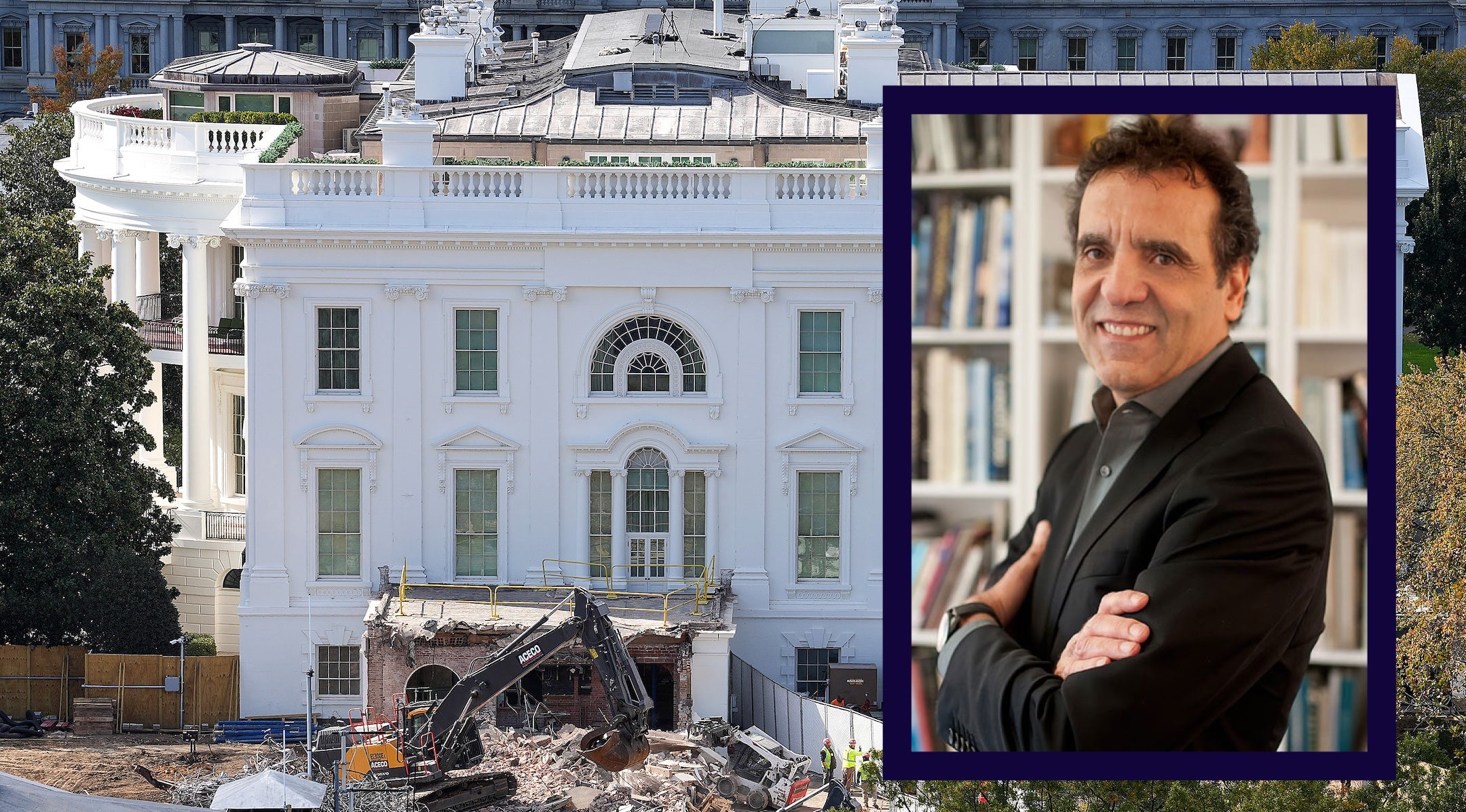
An excavator works to clear rubble after the East Wing of the White House was demolished on Oct. 23, 2025. Shalom Baranes, inset, has been chosen to lead the reconstruction. Photo by Eric Lee/Getty Images; Shalom Baranes Associates
(JTA) — After parting ways with the first architect hired to carry out his vision for the White House’s East Wing, President Donald Trump has picked a replacement — turning to a firm run by prominent Jewish architect who once called on Trump to keep the country’s doors open to refugees and immigrants.
Shalom Baranes was born soon after his parents fled Libya amid antisemitic sentiment there, coming to the United States as a child with the help of the Hebrew Immigrant Aid Society, now known as HIAS. He rose to prominence as an architect in Washington, D.C., where he has designed both private and government buildings, including the Pentagon, that trend toward the modern.
The White House confirmed on Friday that it had chosen his firm, Shalom Baranes Associates, to continue the East Wing project, centered around the ballroom that Trump wishes to construct. Trump clashed with the first architect on the job over the ballroom’s size.
“Shalom is an accomplished architect whose work has shaped the architectural identity of our nation’s capital for decades, and his experience will be a great asset to the completion of this project,” a White House spokesman, Davis Ingle, said in a statement on Friday.
The firm did not immediately publicly confirm its attachment to the project, and Baranes did not reply to a Jewish Telegraphic Agency request for comment.
Baranes’ selection stands out in an administration that has typically favored partisan and ideological loyalists. Baranes is a repeated donor to Democratic candidates who has openly advocated against one of Trump’s signature policies, his efforts to limit refugee admissions.
In 2017, two months into Trump’s first term, Baranes penned an op-ed for the Washington Post about the new president’s travel ban. Trump had declared a ban on migrants from seven mostly Muslim countries and refugees from around the world soon after taking office, igniting wide opposition including from Jewish groups.
“The anti-immigrant sentiment I feel today is nothing new to me,” he wrote. “When my Jewish parents arrived in the United States just a few years after fleeing persecution in an Arab regime, it was as difficult for them to be accepted here as it is for Muslims now.”
Baranes laid out his criticism gingerly while saying he hoped the travel ban would be short-lived.
“As I watch the news and see families struggling to leave their countries and escape tyranny, I wonder who among them will make it to our shores and become part of the next generation of researchers, teachers, inventors, real estate developers and, yes, architects,” he wrote. “My hope is that the Trump administration will take actions to ensure that the travel ban is indeed temporary, so that good, hard-working individuals fleeing tyranny can find a new home as I did — and that each of them will be given the same opportunity to help build this great nation that I had.”
Among the Jewish groups to lobby against Trump’s travel ban was HIAS, the organization that had helped Baranes and his family come to the United States. HIAS declined to comment on his selection as White House architect but said through a spokesperson that the organization was working to respond to Trump’s crackdown on refugees, which the president renewed last week after an Afghan refugee shot and killed a member of the National Guard in Washington.
The ruling could come just before the National Capital Planning Commission, the central planning agency of the federal government, plans to vote on the project. The 12-member commission, the majority of whom are Trump-appointed allies, will hold the public hearing on March 5.
But the judge’s verdict won’t be the end of the saga.
“I know it will be appealed. Whichever side wins, the other side will appeal,” said U.S. District Court Judge Richard J. Leon last month. “So this case is going to go to the DC Circuit, for certain, and, maybe, perhaps even to the Supreme Court. Who knows?”
Renderings briefly posted Feb. 13 before being removed reveal the scale of a proposed 89,000-square-foot White House ballroom.
At issue is a lawsuit the National Trust for Historic Preservation filed in December against Trump and several federal agencies, asking to halt construction on the 90,000-square-foot ballroom. The non-profit group argued that Trump should have sought Congress’s authorization before the demolition of the East Wing.
Trump’s team has countered in court that the president did not need approval from lawmakers because the project is not using taxpayer dollars and instead is being funded by private donations.
Trump’s project has gone through various changes since the White House first announced its plans in July, including financing, seating capacity and cost. The price tag jumped from $200 million to $400 million, and the ballroom is now expected to accommodate 1,000 people.
Detailed renderings reveal the scale of the proposed 89,000-square-foot White House ballroom. The images by Shalom Baranes Associates—later removed from the National Capital Planning Commission’s … Show more
The National Capital Planning Commission/Shalom Baranes Associates, Architects
What is the court considering?
Judge Leon, an appointee of President George W. Bush, said there were many “novel” issues at play in the case. He is considering whether the president has the authority to demolish the East Wing and construct the ballroom using a deliberately complicated funding setup with private money while circumventing Congressional authorization.
During last month’s hearing, Leon said he also wanted the Trump administration to clearly state what the “dividing line” was between what is permitted and what is not permitted in terms of future construction and demolition in the White House complex.
Detailed renderings reveal the scale of the proposed 89,000-square-foot White House ballroom. The images by Shalom Baranes Associates—later removed from the National Capital Planning Commission’s … Show more
The National Capital Planning Commission/Shalom Baranes Associates, Architects
“I do think if the plan was to just bulldoze the entire White House and build something completely different in its place,” it would exceed the scope of presidential authorization for “alteration and improvement,” said Jacob Roth, an attorney for the defendants.
“I would hope so,” Leon responded, while also noting that the administration had taken a “pretty expansive interpretation of the language.”
Roth also described the Executive Mansion as the “core site.” He said Congress declared in 1961 by statute that the site was “an important thing to preserve.”















 borderslynn
You must be logged in to post a comment.