IMO reports 3,000 vessels and 20,000 seafarers trapped in the Persian Gulf after Iran shut the Strait of Hormuz. 16 ships attacked, 15,000 cruise passengers stranded.
Ships floating in the Persian Gulf off the coast of Dubai near the Strait of Hormuz on March 28, 2026. (Supplied: Sentinel Hub)
Link copiedShare
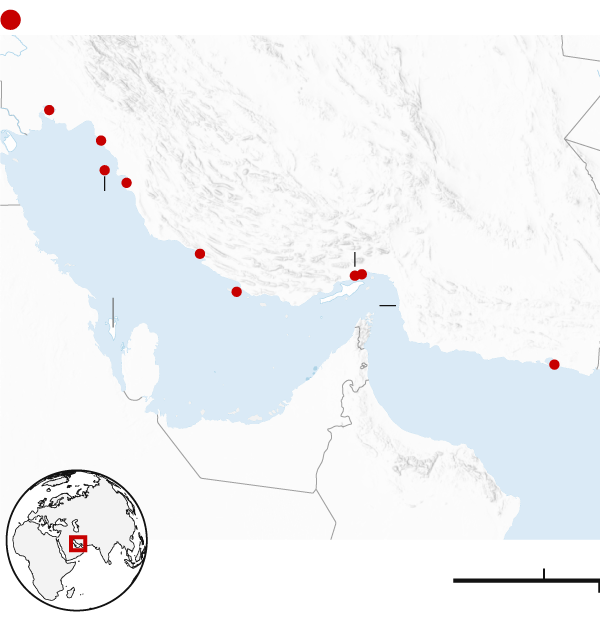
Interviews and first-hand accounts from sailors stranded in the Persian Gulf — under threat of drone attacks, missiles, and exploding boats — reveal an increasingly dire humanitarian crisis unfolding.
Iran’s blockade of one of the world’s most critical shipping lanes, the Strait of Hormuz, has unleashed pain on global markets.
The normally busy strait has been mostly empty since the start of the war. But inside the Persian Gulf, some 2,000 ships remain.
And while the US-Israel war with Iran rages on, the crews on those stranded ships are facing their own battle of attrition.
And now the blockade along Iranian ports to deny them sales of oil:
IMF Portwatch
Strait of Hormuz reopens under Ceasefire, but 800+ ships remain stranded amid uncertainty
Shipowners are rushing to understand the fine print of a US-Iran ceasefire that could temporarily unblock the Strait of Hormuz and open an exit for more than 800 vessels trapped in the Persian Gulf.
At least 2 ships exit Gulf from Iran despite US blockade: Tracking data
13m
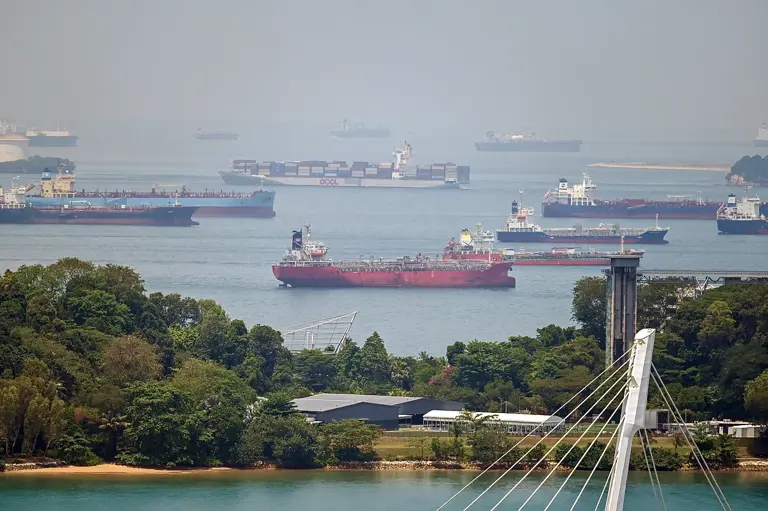
A container ship (top C) sails past oil tankers anchored along Singapore straits in Singapore on April 14, 2026.
[Editor’s Note: Follow Khaleej Times live blog amid US-Israel-Iran war for the latest regional developments.]
At least two ships sailing from Iranian ports crossed the Hormuz Strait on Monday despite a US military blockade, maritime tracking data indicated Tuesday.
They were among at least four Iran-linked vessels that used the route after Washington’s blockade came into effect at 1400 GMT on Monday, according to maritime data provider Kpler.
The Liberia-flagged bulk carrier Christianna crossed after unloading 74,000 tonnes of corn at the Iranian port of Bandar Imam Khomeini, passing Iran’s Larak Island in the strait around 1600 GMT on Monday, Kpler data showed.
Iran war latest: US-sanctioned ships pass through Strait of Hormuz as Trump blockade begins
Iran has been accused of “economic terrorism” in the Strait of Hormuz. Ships have been warned they could face now capture by the US. But two tankers made it through as Trump’s blockade of the crucial route began.
Operating like an Uber taxi in the Strait of Hormuz?:
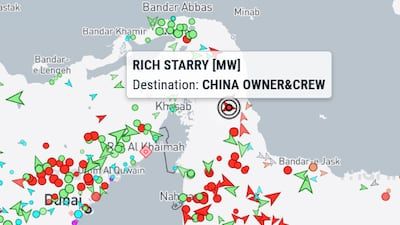
Meanwhile, as the world watches how the US will enforce its blockade in the Strait of Hormuz, Malawi-flagged, Chinese-owned tanker Rich Starry passed through the waterway.
A Chinese tanker under US sanctions, which passed through the Strait of Hormuz earlier on Tuesday after the US imposed a blockade on the waterway, was seen turning back late afternoon.
Rich Starry, a medium-range tanker, initially appeared to have made the journey, becoming the first to sail through the strait since the US began its operation on Monday evening, data from MarineTraffic and VesselFinder showed. However, it was seen heading back towards Hormuz around 5.30pm UAE time. US President Donald Trump imposed the blockade after US-Iran talks in Islamabad on Saturday failed to end the war and reopen the channel.
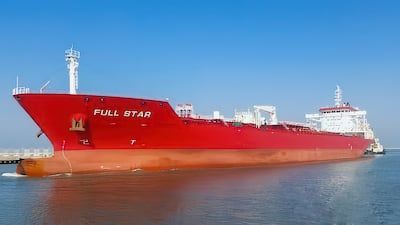
Rich Starry, known previously as Full Star, is carrying about 250,000 barrels of methanol and the tanker and its owner, Shanghai Xuanrun Shipping, were placed under US sanctions for dealing with Iran, Reuters reported. Two more tankers under US sanctions, the Murlikishan, which has carried Russian and Iranian oil, and Panama-flagged Peace Gulf, are also attempting to pass through the strait on Tuesday, Reuters said.None of the three ships transiting the strait were heading to Iranian ports.
The article goes on to explain:
The waterway, through which about 20 per cent of the world’s oil and gas normally passes, was effectively closed by Iran during its 40-day war with the US and Israel, leading to a surge in oil and gas prices and affecting global supply chains.
Before the war began on February 28, about 140 ships passed through the waterway each day. A maximum of 14 a day have travelled through since the two-week ceasefire was agreed to by the US and Iran on April 8. An estimated 230 vessels loaded with oil are stuck in the Arabian Gulf.
Mr Trump on Monday said 34 ships had sailed through the strait the previous day, without providing further details.
Twenty-eight commercial vessels crossed through the strait during the weekend, according to Kpler. “Traffic stayed weak on Monday, with just six commercial vessel transits versus 14 on Sunday, indicating continued subdued activity rather than any meaningful rebound,” Ana Subasic, trade risk analyst at the market intelligence firm, told The National.
The US blockade may support some incremental movement while the ceasefire holds, “particularly if owners interpret the enforcement posture as more targeted than initially feared”, Ms Subasic said.
“That said, we would stop short of describing this as a meaningful normalisation of traffic at this stage. There remains enough uncertainty around enforcement, counterparty exposure, insurance and overall operating risk from both sides that many market participants are likely to remain cautious and in a wait-and-see mode for the near term,” she added.
The US naval blockade of the strait moves the situation “from a price shock to a structural disruption of global trade”, said Raj Abrol, chief executive of risk platform Galytix.
“The impact goes well beyond energy prices – it ripples through shipping routes, insurance premiums, supply chains and input costs across every sector. This blockade only confirms that we should expect protracted volatility across all of these indicators, not a return to stability.”
Meanwhile, China’s Foreign Ministry on Tuesday called the US blockade of Iranian ports “dangerous and irresponsible”.
The move by the US to increase military deployments and impose a targeted blockade will deepen the conflict and further jeopardise the safety of navigation through the strait, media reports cited ministry spokesman Guo Jiakun as saying.
China urges all parties to respect the current ceasefire and remain committed to dialogue and peace talks, the official added.
During the war, Iran earned about $9 billion from crude exports, which exceeds it daily profits before the start of the conflict, energy intelligence company Kpler found. The US blockade is expected to cut about $150 million a day in oil revenue for Tehran.
About 190 million barrels of Iranian crude are at sea, with an estimated 50 million barrels west of Singapore and 140 million east of it, and most of it is destined for China, Homayoun Falakshahi, head of oil analytics at Kpler, told The National.
UNCLOS (United Nations Convention on the Law of the Sea)
WHY EVERY COUNTRY HAS A STAKE
Singapore is not alone in expressing its concern. The Gulf states, facing direct consequences from the closure of the Strait of Hormuz, have also rejected Iran’s imposition of tolls and called for passage rights to be upheld. The International Maritime Organization (IMO) has reiterated that such tolls would set a dangerous precedent.
It is tempting to see these rules as something that mainly benefits powerful naval states and large shipping states. However, navigational rights have never just been about the passage of warships and tanker fleets.
They were always grounded in something more fundamental that benefits all states: the freedom of trade.
Take the 11-member Association of Southeast Asian Nations (ASEAN), 10 are coastal or archipelagic states that have significantly benefitted from the expansion of coastal state jurisdiction under UNCLOS (with the exception of geographically disadvantaged Singapore). The Philippines and Indonesia fought for and gained vast tracts of maritime space through their archipelagic waters, while they and other coastal ASEAN states acquired 200-nautical mile exclusive economic zones (EEZs).
While these countries may not be the largest flag states in the world nor the biggest naval powers, they have critical maritime interests and are dependent on maritime trade.
Did JD Vance cost Viktor Orban his premiership? Trump ally’s polling plunged after supportive visit by US Vice President… before he suffered crushing election defeat
Netanyahu Coalition Figures Publicly Back Viktor Orbán Ahead of Hungary Vote
Israeli politicians praised Orban for his support of Israel and tough stance on antisemitism. The election tests the future of Hungary’s far-right populism and holds significant implications for Israel’s diplomatic standing in Europe
(Brussels) – Hungary’s withdrawal from the International Criminal Court (ICC) is an insult to victims and survivors of the world’s worst crimes, Human Rights Watch said today.
Hungarian authorities formally notified the United Nations secretary-general on June 2, 2025, that Hungary is withdrawing from the Rome Statute, the ICC’s founding treaty, following a May 20 decision by the parliament. Prime Minister Viktor Orbán announced his government’s intention to leave the ICC on April 3, during Israeli Prime Minister Benjamin Netanyahu’s visit to Budapest despite an ICC warrant against him for serious crimes in Gaza.
“After refusing to arrest Netanyahu, an ICC fugitive, when he visited the country, Hungary is now doubling down on impunity by leaving the court altogether,” said Liz Evenson, international justice director at Human Rights Watch. “The European Union and ICC members should press Hungary to reconsider this decision given the court’s critical work across the globe.”
Netanyahu and former Israeli Defense Minister Yoav Gallant are wanted by the ICC for alleged war crimes and crimes against humanity committed in Gaza, including starving civilians, intentionally directing attacks against a civilian population, murder, and persecution. Human Rights Watch has documented war crimes, crimes against humanity, and acts of genocide by Israeli authorities in Gaza since October 7, 2023.
ICC member countries have a legal obligation to arrest and surrender anyone sought by the court who is in their territory. ICC judges are currently assessing Hungary’s failure to arrest Netanyahu to make a legal determination on whether Hungary breached its obligation to cooperate with the court. Such a determination could then be transmitted to the ICC Assembly of States Parties for further action.
Hungary’s withdrawal will take effect one year after the notification to the UN secretary-general. Until then, Hungary remains bound by its ICC obligations, including executing the court’s arrest warrants. If Hungary’s withdrawal takes effect, it will become the third ICC member to leave the court. Burundi and the Philippines withdrew from the ICC in 2017 and 2019, respectively. It will also be the only non-ICC member state in the European Union.
The European Union and its member states have long been strong supporters of the ICC and have pledged to support the court’s independence and to ensure cooperation. Adherence to the values of the Rome Statute and its ratification are conditions to be fulfilled for new members to join the EU. Hungary’s withdrawal contradicts common EU objectives and values, Human Rights Watch said.
President Donald Trump has suggested the United States will destroy Iranian “civilisation” if Tehran does not open the Strait of Hormuz and submit to his terms.
About 12 hours before the Tuesday night deadline he set for Iranian authorities, Trump shared a social media post threatening to irreversibly obliterate Iran.
“A whole civilisation will die tonight, never to be brought back again. I don’t want that to happen, but it probably will,” Trump wrote on his Truth Social platform.
Iran is the heir to the millennia-old Persian civilisation, one of the most influential in human history.
For more than two weeks, the US president has been warning that he would order the destruction of Iran’s civilian infrastructure, including bridges and power stations, if his demands are not met.
His latest post on Tuesday reflected the escalating and angry rhetoric he has deployed since the US and Israel launched the war on Iran on February 28.
Legal experts said targeting civilian infrastructure is a war crime.
“It’s horrific. It’s pure evil. It’s disqualifying,” Yasmine Taeb, legislative and political director for the advocacy group MPower Change Action Fund, said of Trump’s threats.
“It’s the words of a deranged, unstable madman.”
Taeb called for a “stronger reaction” from US lawmakers and the international community against Trump’s rhetoric and policies.
Democrats call for ending war
Several Democratic members of the US Congress on Tuesday condemned Trump’s threats and called for ending the war.
Chuck Schumer, the top Democrat in the Senate, called Trump an “extremely sick person” after the president’s post on Tuesday.
Sign up for Al Jazeera
“Each Republican who refuses to join us in voting against this wanton war of choice owns every consequence of whatever the hell this is,” the senator wrote on X.
Hakeem Jeffries, the top Democrat in the House of Representatives, called on legislators from Trump’s Republican Party to “put patriotic duty over party and stop the madness.”
“Congress must immediately end this reckless war of choice in Iran before Donald Trump plunges us into World War III,” Jeffries said in a social media post.
Last month, Congress failed to pass a resolution to curb Trump’s powers to attack Iran.
The US president has not obtained authorisation from lawmakers to launch the military campaign against Iran in what critics said is a violation of the US Constitution, which grants Congress the power to declare war.
On Tuesday, Congresswoman Rashida Tlaib said the 25th Amendment of the constitution should be invoked to remove Trump from office because he is unfit to serve.
“After bombing a school and massacring young girls, the war criminal in the White House is threatening genocide,” Tlaib wrote in a social media post, referring to the Minab school attack in southern Iran that killed more than 170 people.
Congressman Jim McGovern stressed that the US military is required to disobey “illegal orders”.
“This is evil. The President of the United States’ genocidal threat to commit war crimes is illegal under federal & international law,” McGovern said (on X).
Despite the intensifying opposition to the war on the Democratic side, dissent against Trump has remained faint among Republicans.
On Tuesday, Congressman Mike Lawler played down Trump’s threat to kill off Iran’s civilisation, saying the president would target only the country’s civilian infrastructure.
“It is their energy infrastructure and their civilian infrastructure, including roads and bridges. That will cripple the Iranian regime and certainly their economy,” Lawler told CNN.
The Republican lawmaker said Trump is acting “within his legal authorities to conduct this war” as commander-in-chief of the US armed forces.
The deadline
The US president set 8pm in Washington, DC, (00:00 GMT) on Tuesday as the “final” deadline for Iran.
On the first day of the war, the US and Israel killed Iranian Supreme Leader Ali Khamenei and several other top officials.
The attacks have killed more than 2,000 people and hit schools, residential buildings and medical facilities.
Despite the losses, the governing system in Tehran appears to have held together with the Islamic Revolutionary Guard Corps – a wing of the Iranian military that is designated as a “terrorist” group in the US – spearheading the war effort.
There have been no major defections or antigovernment protests in Iran since the start of the war, and Khamenei was replaced by his son Mojtaba.
Iran has retaliated with rocket and drone attacks against Israel and US assets across the entire Middle East.
Iranian forces have also targeted civilian and energy infrastructure in the Gulf region and blocked the Strait of Hormuz to most shipping, sending energy prices soaring.
Still, Trump has insisted that he achieved “regime change” in Iran and the US has “won” the war.
On Tuesday, Trump left the door open for a diplomatic resolution despite his dramatic threat, saying “maybe something revolutionarily wonderful can happen.”
“We will find out tonight, one of the most important moments in the long and complex history of the World. 47 years of extortion, corruption, and death will finally end. God Bless the Great People of Iran!” Trump wrote.
Iranian officials have remained defiant, threatening to meet any US escalation with similar military measures in the region and beyond.
Later on Tuesday, US Vice President JD Vance also issued a warning to Iran, saying that the US wants oil and gas to flow “freely”.
“They’ve got to know, we’ve got tools in our toolkit that we so far haven’t decided to use,” he said during a speech in Hungary. “The president of the United States can decide to use them, and he will decide to use them if the Iranians do not change their course of conduct.”
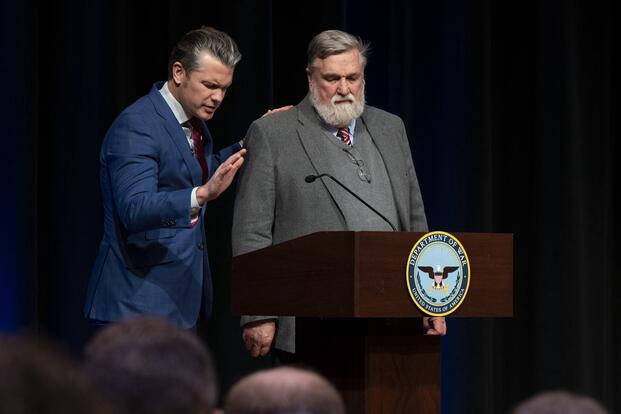
The Pentagon is defending its invitation to have Doug Wilson, a pastor whose views on issues including women voters and slavery have been deemed by some as radical, partake in a Christian prayer service on Tuesday.
Wilson, 72, joined U.S. Defense Secretary Pete Hegseth during what has become a monthly staple under the Secretary’s leadership, starting in May 2025 with Hegseth’s pastor in Tennessee, Brooks Potteiger, and continuing as recently as this week. Wilson and Hegseth exchanged words of gratitude and appreciation towards one another and of their faith during the afternoon event.
Sweeping the strait: US destroyers transit Hormuz for 1st time since Iran war began
US destroyers transited the Strait of Hormuz for the first time since the war began, as Washington initiated mine-clearing operations to reopen the critical shipping route.
A child’s instant shock and horror, caught on social media, as she chats playfully with friends but Israeli bombs interrupt her, destroying a neighboring block of flats:
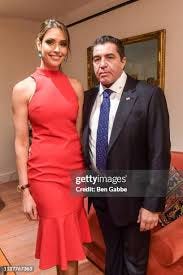
Melania and Donald Trump’s matchmaker speaks out after her stunning speech denouncing Epstein ties… and is willing to testify under OATH about how they met
Ambassador Paolo Zampolli said Thursday that he’s ready to testify before Congress to prove that he was the individual who introduced President Donald Trump and First Lady Melania Trump.
Zampolli made the pronouncement in a phone interview with the Daily Mail after the First Lady made a stunning statement in the White House on serial pedophile Jeffrey Epstein – an announcement that apparently even took the President by surprise.
Among the comments she made, the First Lady denied rumors that it was Epstein who introduced Melania to her future husband.
‘I’m ready to testify in Congress, in front of Congress, to say who introduced the First Lady, and I’m ready to even bring another 50 witnesses to say they were present that night,’ the Italian-American diplomat said in an interview with the Daily Mail. ‘The whole world knows this. This is old news.’
The first couple, as the story goes, met at a New York Fashion Week party in September 1998 held at the Kit Kat Club and hosted by Zampolli, who at the time was a modeling agent.
Asked about what prompted the First Lady’s shock statement, Zampolli said he believed Melania earnestly feels for Epstein’s many victims.
‘I’m sure she cares about the victims and everybody that has been a victim has a right to expose this animal,’ Zampolli told the Daily Mail. ‘I think the First Lady has the biggest heart in the world, she’s a family woman, and she’s our marvelous First Lady,’ he added.
Marc Beckman, senior adviser to the First Lady, told the Daily Mail that Melania spoke out because ‘enough is enough’ and ‘the lies must stop.’
Michael Wolff has recordings of Epstein telling him it was he who introduced Donald and Melania when they first had sex on his plane, the ‘Lolita Express’
Michael Wolff claims that Jeffrey Epstein played a key role in introducing Melania Trump to Donald Trump in 1998. However, Melania has denied this assertion, stating that she met Trump at the Kit Kat Klub in New York. Indiatimes Wikipedia
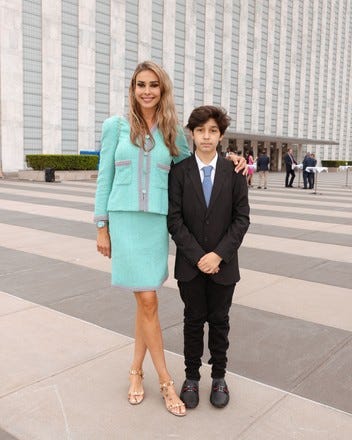
Former modeling agent and longtime ally to President Donald Trump, Paolo Zampolli asked a top ICE official for help “to settle a personal score” and have the mother of his child deported during a custody battle, according to The New York Times.
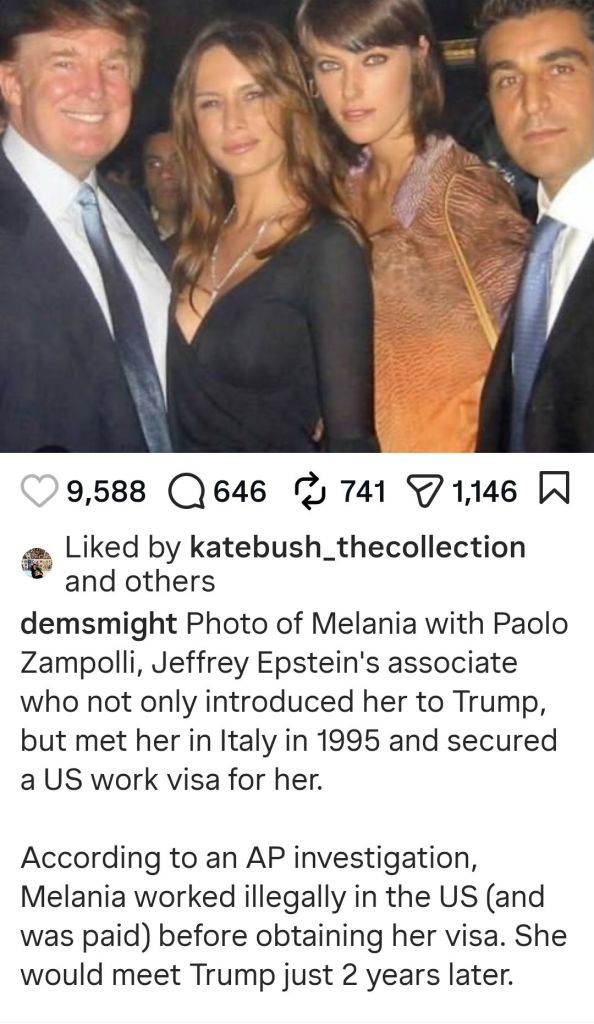
Zampolli, a now presidential special envoy, introduced Trump to the president’s now wife Melania.
He found out that his Brazilian ex-girlfriend, Amanda Ungaro, had arrested on charges of fraud at her work and in custody at a Miami jail — and last year talked to a top official at ICE, David Venturella, to see if she could be placed in ICE detention, citing that she was in the country illegally, The Times reported.
The two had been going through a custody battle over their teenage son and “now he saw an opportunity” to try and get him back, Friday’s report stated.
A source familiar with Zampolli’s communications and records acquired by The Times revealed that Ungaro was picked up from a Miami jail by ICE agents before she could make bail and later deported. Although this could have happened without her ex-boyfriend’s involvement, it raises questions about how members of the Trump administration have used the federal government during Trump’s second term to pursue personal vendettas.
Zampolli denied to The Times that he sought special favors or that he had requested federal officials take Ungaro into custody.
The Department of Homeland Security told The Times that Ungaro was detained and deported over an expired visa after being charged with fraud.
“Any suggestion that she was arrested and removed for political reasons or favors is FALSE,” the DHS statement said.
Zampolli has often bragged about his loyalty to the Trumps, and has known the president for more than 30 years. He even recruited Melania, a former model, from Slovenia. Zampolli also had ties to the late financier and convicted child sex offender Jeffrey Epstein.
“In the city’s modeling scene, Mr. Zampolli also intersected with Jeffrey Epstein, the financier who would later be accused of sexually abusing hundreds of girls and young women,” according to The Times. “The men once discussed buying a modeling agency together, and Mr. Zampolli’s name appears several times in the millions of Epstein documents recently released by the Justice Department.
“In one 2011 email, Mr. Epstein warned an Emirati businessman: ‘Be careful, zampoli is trouble. Lots.’ He added, ‘He sells stories to the press.'”
Zampolli has denied having a close friendship with Epstein. He added that his name was not included as frequently as other people, such as professors, celebrities or monarchs.
“At least I was included, because if you’re not on the list, you’re a loser, right?” Zampolli told The Times.
Important framing: The following summarizes claims, allegations, and statements reported in documents, not established conclusions. Where possible, document IDs are cited. No criminal guilt is asserted.
There’s a growing online narrative weaving together some of the most controversial figures of the past three decades: Donald Trump, Jeffrey Epstein, and Paolo Zampolli — and at the center of one of the more provocative claims is a relatively obscure name: Amanda Ungaro.
bekah day has done extensive research on Paolo and is actively communicating with Amanda, who has been deported by the Trump administration, for up to date information about Amanda check her posts.
Amanda Is a Survivor of Jeffrey Epstein’s Trafficking
Before that, she was introduced to John Casablancas—Zampolli’s mentor—at just 13 years old. By 15, she was being groomed by Zampolli. At 16, she was flying on Epstein’s plane alongside known predators.
Amanda and Zampolli would remain entangled for 19 years. They share a son, Giovanni. What began with exploitation escalated into long-term physical, emotional, sexual, and financial abuse. When Amanda finally left Paolo, the retaliation began.
At 17, Amanda Ungaro was invited by Jean-Luc Brunel to fly to the US on Epstein’s plane:
Jeffrey Epstein Controversy
One of the most widely discussed aspects of Ungaro’s story involves her connection to Jeffrey Epstein. She has spoken publicly about a flight she took in 2002 on a private jet owned by Epstein, when she was 17 years old. According to her account, she was invited onto the flight by modeling agent Jean-Luc Brunel.
The trip, which reportedly traveled from Paris to New York, left her feeling uncomfortable, as she later described the presence of several very young girls on board and an unsettling atmosphere.
Zampolli remains an important figure because of his association with the Trumps. Not only did he introduce Melania to Trump, he also secured her modelling and paper work. Ungaro, while being an immigrant like Melania, navigated her life in the US very differently. She stayed in America while renewing her different types of visas and unlike Melania, her dream of securing a permanent residence in the country failed as she ultimately got deported.
‘Be Careful With Me, B**’: Melania Trump Receives Brutal Warning From Amanda Ungaro—Who Is She?
Deported Brazilian model Amanda Ungaro publicly threatened Melania Trump with legal action one day before the First Lady’s surprise White House denial of any Epstein ties.
Amanda Ungaro, the Brazilian ex-partner of one of Donald Trump’s closest associates, has publicly warned First Lady Melania Trump of legal action in a series of alarming posts on X that surfaced just hours before Mrs Trump’s unscheduled Epstein address at the White House.
Ungaro, 41, appeared to direct her messages at an archived post from the First Lady’s official account, @FLOTUS45, which featured a farewell message dated January 2021. Replying directly to that post on 9 April, Ungaro issued a string of escalating statements.
‘I have nothing left to lose in my life. I will tear down the entire system—be careful with me b**,’ she wrote. In a follow-up post, she added: ‘I will tear down your corrupt system, even if it’s the last thing I do in my life. I will go all the way—I am not afraid.’
She went further still, writing: ‘Maybe you should be afraid of what I know… of who you are, and who your husband is.’ In another post, she claimed she would ‘take legal action’ against the First Lady and her husband, before making additional unverified allegations.
Ungaro also referenced what she described as a long-standing personal connection, claiming: ‘I have known you for 20 years. You knew I was detained in ICE. You were present in my life—every year on my son’s birthday, even sending Secret Service and being the first to congratulate him, back in 2016.’
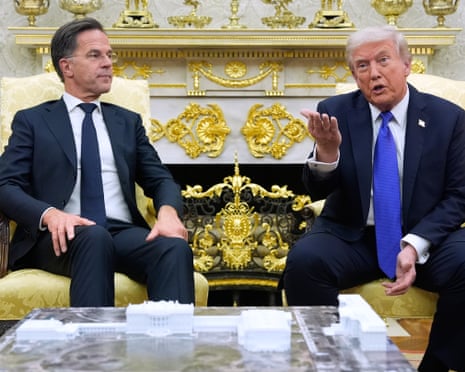
Trump calls Nato ‘very disappointing’, suggests it needs to have pressure placed on it to ‘understand anything’
Donald Trump has taken to his Truth Social platform again on Thursday to renew his criticism of the alliance.
The US president posted that “none of these people” (which people is unclear), including “our own, very disappointing Nato, understood anything unless they have pressure placed upon them!!!”.
Whether that relates to earlier reports (13.28) that Trump told the Nato secretary general, Mark Rutte, he wanted to see concrete commitments within days from Nato members for helping to secure the strait of Hormuz remains to be seen.
Rutte is expected to speak at an event in Washington later today.
Published date: 8 April 2026 13:15 BST|Last update: 16 hours 42 mins ago
A massive wave of Israeli strikes hit Lebanon on Wednesday, killing at least 254 people, just hours after a ceasefire between Iran and the US was agreed.
Lebanon’s Civild Defense said at least 1,165 people were wounded across the country, with the capital Beirut hit by the most violent bombardment since the start of the current war.
The Israeli military carried out several simultaneous strikes on central Beirut and its suburbs without warning, triggering widespread panic on the capital’s streets.
A series of air strikes were also launched in several areas in southern Lebanon and the Beqaa in the east.
Bulldozers were clearing rubble from the streets to make way for ambulances transporting dozens of people to hospitals across Beirut.
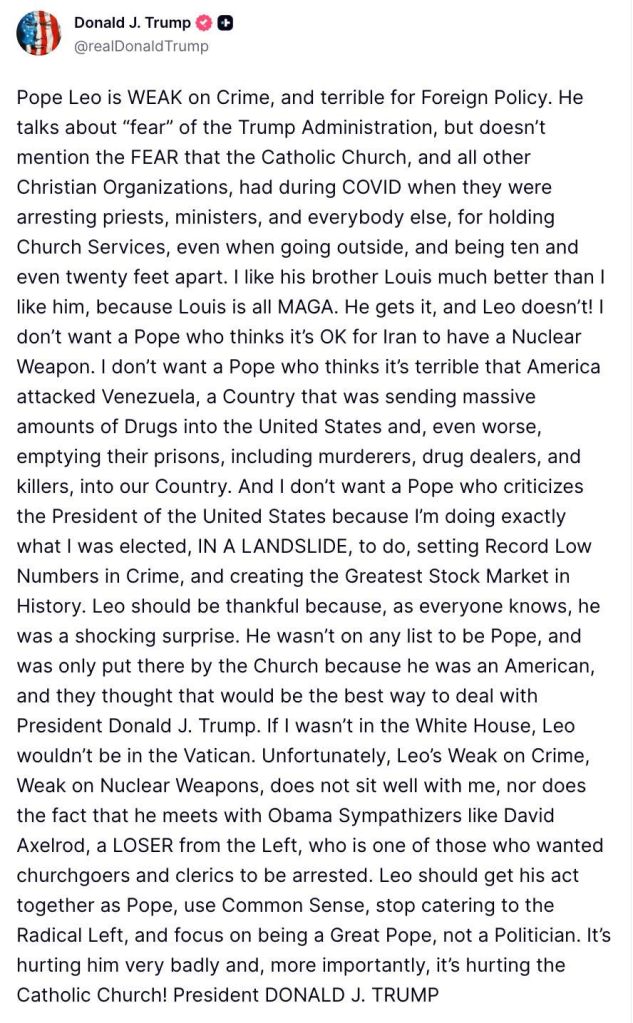
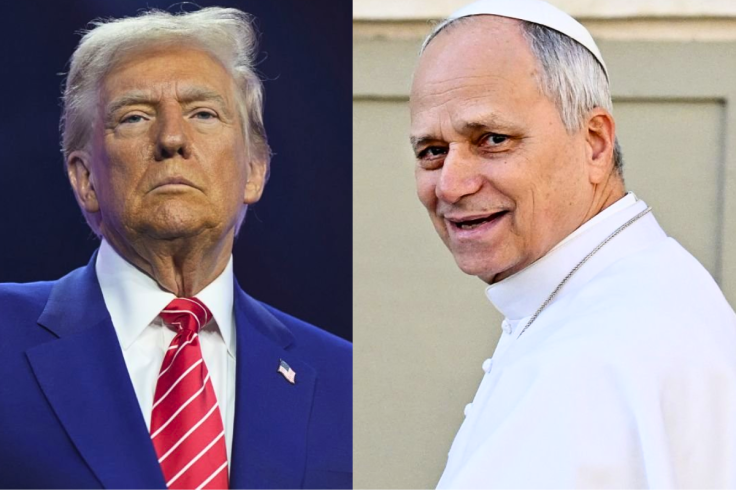
The New ‘Avignon Papacy’? Pentagon Officials Reportedly Invoked Medieval Captivity to Threaten Vatican and Force Pope’s Support
Vatican officials interpreted the 14th century reference as a veiled threat to use military force against the Holy See
By Jim Manzon Published 09 April 2026, 10:29 AM BST
The Vatican cancelled Pope Leo’s US visit over Pentagon tensions, with the Pope instead spending the Fourth of July in Sicily, where he will visit migrants on Lampedusa. Bill Madden/X
A senior Pentagon official summoned Pope Leo XIV’s ambassador to a closed-door meeting in January and told him the United States ‘has the military power to do whatever it wants in the world’ and that ‘the Catholic Church had better take its side,’ according to accounts from Vatican and US officials briefed on the extraordinary encounter.
As the meeting grew heated, one American official invoked the Avignon Papacy, a 14th-century period when the French monarchy wielded military force to bring the Catholic Church to heel.
That era began with an attack on Pope Boniface VIII that led to his death and ended with the papacy relocated from Rome to Avignon under French control for nearly seven decades.
Vatican officials interpreted the reference as a veiled threat to use military force against the Holy See, according to independent Vatican reporter Christopher Hale, who confirmed the meeting took place.
There is no public record of any Vatican official ever being summoned to the Pentagon before this encounter.









 borderslynn
You must be logged in to post a comment.