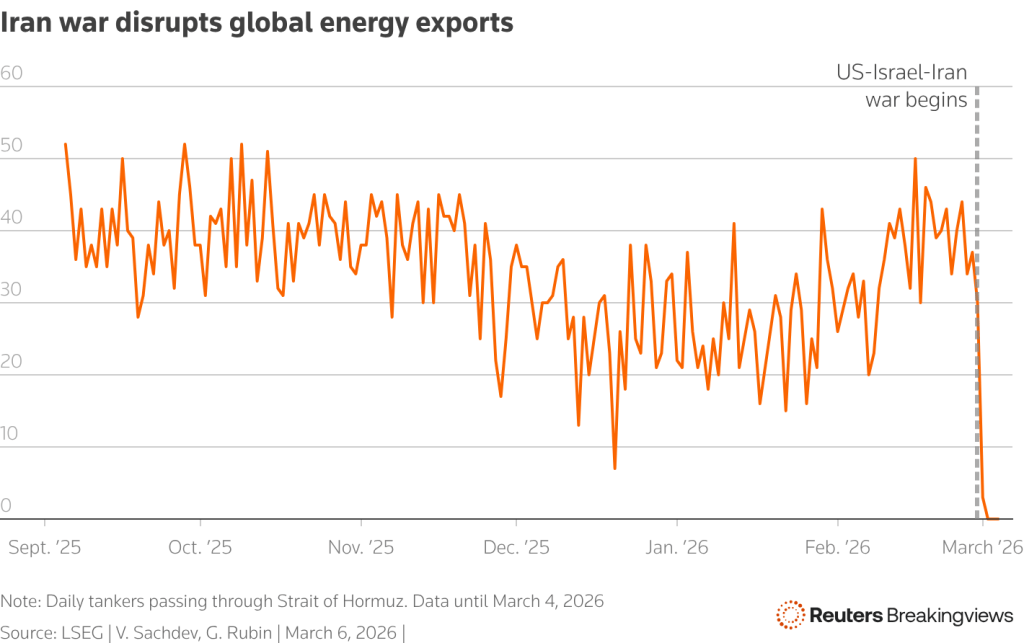
Iran effectively closed the strait to US and allied vessels starting March 2, 2026, following US-Israeli airstrikes on Iran. Iran is permitting selective passages for non-aligned nations (India, Turkey, China) while attacking Western-aligned vessels. Traffic has dropped to near-zero with only handful of transits daily.
Elsewhere reports:
Over 350 ships stranded as Hormuz crisis sparks global supply, inflation fears
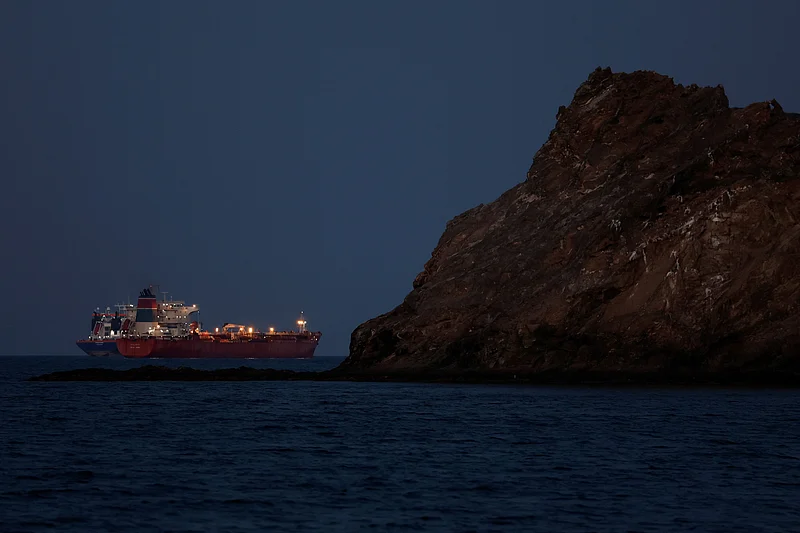
A tanker sits anchored as the traffic is down in the Strait of Hormuz, amid the U.S.-Israeli conflict with Iran, in Muscat, Oman.. Photo: Reuters
In the UAE, Jebel Ali Port has emerged as a temporary refuge for dozens of ships, while others remain anchored offshore awaiting security clearance or insurance coverage
Dubai’s flagship maritime gateway, Jebel Ali Port, remains fully operational despite a decline in inbound vessel traffic as regional maritime conditions continue to affect shipping routes through the Gulf.
Port operator DP World confirmed that the port’s infrastructure has not sustained damage and that operations across terminals are continuing normally.
However, incoming vessel calls have decreased as shipping lines adjust schedules and routing decisions amid ongoing regional tensions affecting maritime corridors.
Rerouting measures
DP World stated that contingency planning and operational adjustments are underway to ensure supply chain continuity despite reduced vessel arrivals.
Group CEO Yuvraj Narayan indicated that the company is implementing regional rerouting strategies alongside mitigation measures to maintain logistics flows across its network.
The operator explained that logistical and security considerations remain elevated for both port operators and shipping companies operating in the region.
Shipping lines have begun evaluating alternative routes and operational adjustments to reduce exposure to disruptions along major maritime corridors.
Ports outside the Strait of Hormuz, including Port of Khorfakkan and Port of Fujairah, provide alternative maritime access to the UAE.
However, their container handling capacity remains significantly lower than Jebel Ali’s throughput levels, limiting their ability to absorb large scale cargo diversions.
Strong financial performance
Despite the operational challenges, DP World reported strong financial results for the previous year. Profit attributable to company owners rose nearly 43% to $1.07bn, supported by robust performance across its global ports, terminals and logistics divisions.
Uncertainty:
Iranian missile strike shuts down Middle East’s largest container port
Dubai authorities say fire was a result of Iranian attack being intercepted
Smoke rises from the port of Jebel Ali following a reported Iranian strike on Sunday.
DP World’s Jebel Ali Port, the largest container port in the Middle East, was forced to close after being hit by missile debris.
The Dubai-based ports and logistics group said all four terminals there are now fully operational after a temporary “precautionary suspension” of activities on Sunday that is thought to be related to damage caused by Iran’s retaliatory strikes against Gulf countries.
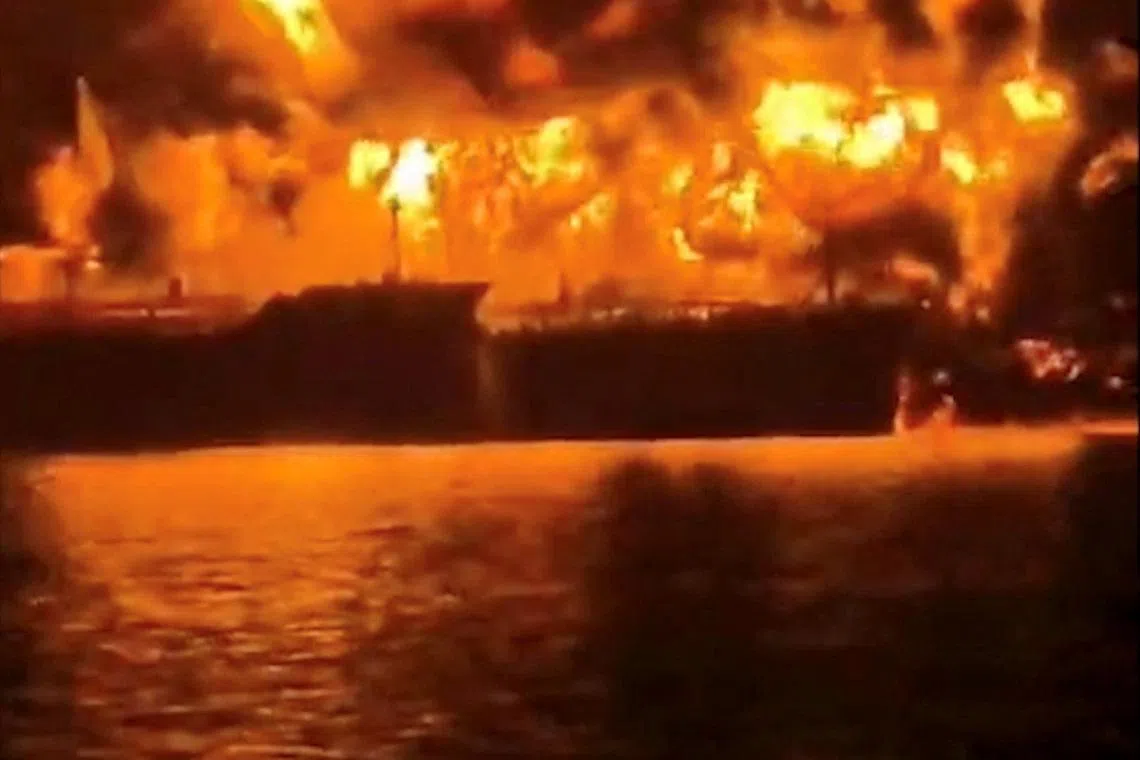
Video footage posted on social media on Sunday showed an explosion believed to be inside the port that produced a giant fireball rising dozens of feet in the air.
TikTok Investors Set to Pay $10 Billion Fee to Trump Administration
What Happened: Investors backing a U.S.-controlled version of TikTok agreed to pay a $10 billion fee to the U.S. Treasury as part of a deal brokered by Trump officials. The unusually large payment was required for the White House to approve a transaction involving investors, including Oracle, MGX, and Silver Lake.
Why It Matters: The deal shows Trump again inserting the government directly into private corporate transactions. Forcing companies to pay massive fees for political approval blurs the line between national security oversight and pay-to-play schemes.
Silver Lake Technology Management, L.L.C., is an American global private equity firm focused on technology and technology-enabled investments. Silver Lake is headquartered in Menlo Park and New York City, and has offices in London, Hong Kong, and Singapore Continued in Wikipedia
Abu Dhabi Fund MGX Emerges As Key Player In Two Major Trump-Era Deals
ByZach Everson,Former Staff. Zach Everson is a staff writer at Forbes covering money in politics.
Oct 15, 2025, 01:24pm EDT
Topline
MGX, a state-backed Abu Dhabi fund, has surfaced in two of the most scrutinized deals in Donald Trump’s second term—it’s reportedly set to take a stake in TikTok’s U.S. business and used a Trump-linked stablecoin for a $2 billion transaction that may have benefited the president’s family financially.
Key Facts
The Abu Dhabi government created MGX in March 2024 as a technology investment company, tasked with “accelerat[ing] the development and adoption of AI and advanced technologies” through global partnerships, according to a launch announcement.
MGX was launched by Mubadala, Abu Dhabi’s sovereign wealth fund, and G42, an artificial intelligence holding company, in which Microsoft has invested $1.5 billion.
The fund targets semiconductors, infrastructure, software, tech-enabled services, life sciences and automation services, with past investments in OpenAI, Anthropic, xAI, Databricks, Altera and Binance.
Sheikh Tahnoon bin Zayed Al Nahyan chairs MGX’s board—he’s also the deputy ruler of Abu Dhabi, the United Arab Emirates’ National Security Adviser and chair of G42’s board as well as those of four other companies.
MGX’s CEO, Ahmed Yahia Al Idrissi, studied at MIT, worked in investment banking and previously oversaw private equity investments at Mubadala.
Asked about the TikTok talks, MGX chief communications officer Noelle Camilleri told Forbes, “On TikTok, we don’t have anything to share at this time.”
News Peg
In April 2024, President Joe Biden signed a bipartisan bill banning TikTok in the United States over privacy and data concerns, effective January 2025. The ban was never enforced, and on Sept. 25, Trump signed an executive order, “Saving TikTok While Protecting National Security,” that would allow the platform to remain available. The executive order paves the way for U.S. investors to take majority control, while the Chinese parent company ByteDance’s stake will drop to less than 20%. The new owners have not been confirmed but, citing unnamed sources, CNBC reported that MGX, Oracle and private-equity firm Silver Lake will be the main investors, owning a combined 45% of TikTok USA. Oracle and Silver Lake did not respond to inquiries. On Wednesday, MGX announced it was teaming with the Artificial Infrastructure Partnership and BlackRock to buy Aligned Data Centers in a deal that values the company, which has 50 facilities, at $40 billion.
Key Background
The TikTok deal is not the first time MGX has been tied to Trump’s administration. The day after his second inauguration, Trump announced Stargate, a $500 billion AI infrastructure initiative backed by MGX, OpenAI, Oracle and Japan’s SoftBank. And earlier in September, MGX joined Silver Lake in buying a 51% stake in Altera, Intel’s programmable-chip unit. The U.S. government owns 9.9% of Intel, after taking the extraordinary step of purchasing an $8.9 billion stake as part of the Trump administration’s semiconductor strategy.
Dubai Abu Dhabi news highlights: The Dubai Media Office said the authorities are currently responding to a fire from a drone-related incident in the vicinity of Dubai International Airport.
Wall Street Bankers Offered Lucrative Access to Join the Pentagon
What Happened: A recruiting presentation from headhunting firm Heidrick & Struggles pitched Wall Street bankers on joining a new Pentagon investment unit managing up to $200 billion in government funds. The pitch promised “unmatched access” to senior officials and suggested recruits could later leverage those relationships with sovereign wealth funds and foreign elites.
Why It Matters: The plan turns a Pentagon investment office into a pipeline for insider access, corruption, and private profit. It blurs the line between national security and Wall Street enrichment while distorting defense priorities.
Homeland Security Secretary Kristi Noem signed off on a massive border wall contract for a Texas construction company previously accused in court of smuggling migrants into the United States and arming them “to take part in a wild shootout,” according to the Daily Beast.
From Intersteller News, Substack – here is an extract from a long piece on the above topic:
The founders of SLSCO Ltd. — the Sullivan brothers — have donated hundreds of thousands of dollars to Republican political campaigns and causes. (The Daily Beast)
In American politics, that alone is not unusual.
Corporate political donations are common across industries.
Defense contractors donate to politicians who oversee military spending.
Energy companies donate to lawmakers who regulate drilling.
Construction companies donate to politicians who fund infrastructure.
The border wall economy follows the same pattern.
Companies seeking government contracts often support political leaders whose policies create those contracts.
Critics argue this creates a feedback loop.
Policy creates money.
Money flows back into politics.
Politics produces more policy.
In this ecosystem, immigration enforcement is not just a policy question.
It becomes an industry.
Here is the strange paradox at the heart of the story.
On one hand, the Trump administration’s immigration agenda has emphasized strict border enforcement.
Officials have repeatedly argued that human smuggling is one of the most dangerous criminal enterprises along the southern border.
In fact, the Department of Homeland Security has described smuggling networks as responsible for thousands of deaths and billions in illegal profits. (The Daily Signal)
Yet the company accused of participating in smuggling practices was still eligible to receive major federal contracts.
Supporters of the administration argue the allegations were never proven in court.
Critics argue the government should apply stricter scrutiny to contractors working on sensitive national security projects.
The disagreement reflects a broader divide in American politics.
How much evidence is enough to disqualify a contractor?
And how much risk is acceptable when billions of taxpayer dollars are involved?
The biggest aluminum smelter in the world is the Huomei Hongjun Aluminium Smelter located in China, with a production capacity of 1,060,000 tonnes per year. Following it are the Dubai Aluminium Co (Dubal) and Krasnoyarsk Aluminium Works in Russia. Wikipedia gulfbusiness.com
Gulf States:
The Gulf Cooperation Council (GCC) region has become a global hub for aluminium production, thanks to its abundant natural resources, strategic location, and cutting-edge facilities. aluminium production plays a vital role in the region’s economy, contributing significantly to exports, industrial development, and diversification strategies, particularly in countries like the UAE, Saudi Arabia, and Bahrain.
Below, we look at the top 10 aluminium companies in the GCC that are driving the industry forward.
Company initiates controlled shutdown of Lines 1, 2 and 3
Prioritises use of raw material stocks for Lines 4, 5 and 6
Alba has aluminium smelting capacity of 1.62 million tons/yr
March 15 (Reuters) – Aluminium Bahrain (ALBH.BH), opens new tab, known as Alba, said on Sunday it had initiated a shutdown of three aluminium smelting lines accounting for 19% of its capacity to preserve business continuity amid ongoing disruption in the Strait of Hormuz.
The closures are the latest impact on the Middle East aluminium sector, which accounts for around 9% of global supply, from the U.S.-Israeli war on Iran. Fears of shortages propelled London Metal Exchange aluminium to a nearly four-year high of $3,546.50 per metric ton on Thursday.
Huomei Hongjun Aluminum and Electricity Company has built the country’s first automatic production line for aluminium ingot casting, which automates slag breaking, ingot casting, packaging, weighing, and other processes. The announcement was made by Liu Ruihong, Secretary of the Party Committee of Inner Mongolia Huomei Hongjun Aluminium Electric. Huomei Hongjun Aluminium & Electricity has played the two cards of “green aluminium” and “smart factory” in recent years, accelerating the transition to low-carbon, clean, and intelligent, making the aluminium industry bigger and stronger, and creating clean production in the aluminium industry model.
Oil explosions can release harmful pollutants into the air, including volatile organic compounds, sulfur dioxide, and particulate matter, which can lead to serious health issues for nearby communities. These emissions can contribute to respiratory problems, cardiovascular diseases, and even cancer due to long-term exposure to toxic substances. National Wildlife Federation sciencemediacentre.org
And
Bombing of Iran’s oil infrastructure to have major environmental fallout, experts warn
Monitors admit they are struggling to keep track of the environmental disasters arising from widening war
Israel’s bombing of Iran’s oil infrastructure will have major long-term environmental repercussions, experts have warned, as monitors admitted they were struggling to keep track of the environmental disasters arising from the widening war.
Even as Iranians filled the streets to mark the appointment of a new supreme leader, the Shahran oil depot north-east of Tehran and the Shahr-e fuel depot to its south continued to burn on Monday, two days after they were bombed by Israeli warplanes.
In the immediate aftermath of the attacks, Iran’s environmental agency and the Iranian Red Crescent Society had warned Tehran residents to stay at home, warning the toxic chemicals spread by airstrikes on five fossil fuel installations around the city could lead to acid rain and damage the skin and lungs.
On Monday, the head of the World Health Organization, Tedros Adhanom Ghebreyesus, said: “Damage to petroleum facilities in Iran risks contaminating food, water and air – hazards that can have severe health impacts especially on children, older people, and people with pre-existing medical conditions.”
Understanding the multifaceted humanitarian challenges of the Gulf War reveals vital lessons about warfare’s far-reaching consequences, emphasizing the importance of global responses, ethical considerations, and sustained recovery efforts in future military conflicts.
Conflict in the Strait of Hormuz is spilling into the Indian Ocean
The effective blockade of the strait during the US-Israeli war with Iran has increased the chance of accidents and forced ships into alternative routes with their own risks.
The US-Israeli war with Iran has turned the Indian Ocean into a theatre for major maritime confrontations.
On 2 March, in response to US-Israeli strikes, Iran announced it was closing the Strait of Hormuz, the vital maritime chokepoint that connects Gulf waters and the wider Indian Ocean beyond. On 4 March, a US submarine sunk the Iranian frigate IRIS Dena off the coast of Sri Lanka. Since the outbreak of the conflict, at least 18 vessels have been attacked in Gulf waters.
The US now claims Iran’s navy is destroyed. Despite this, the Strait of Hormuz remains functionally closed.
While some analysts argue that Iran lacks the power to fully control the strait, Iran’s strategy does not depend on naval control. If Iran can launch missile or drone attacks from its coast, it can impose enough risk to disrupt shipping. The recent experience in the Red Sea illustrates this dynamic: a relatively small number of Houthi missile and drone attacks caused container traffic in the region to fall by roughly 90 per cent in 2024.
Iran’s ability to essentially close the strait will have a knock-on effect on wider maritime traffic, creating new security risks as ships seek alternative routes. While Iran has vowed to disrupt international trade to inflict pressure on US President Donald Trump, the US may seek to intercept ships bound for Iran, creating dangerous conditions for escalation in the increasingly crowded Indian Ocean and beyond.
Heightened risks of accidents and US seizures
The current conflict has created a de facto blockade in which the US seeks to deny maritime transit or access to Iran, while Tehran simultaneously seeks to stop all movement through the Strait.
These competing strategies have created a highly uncertain operating environment for commercial vessels in the Gulf. According to a briefing from Lloyd’s List Intelligence, more than 40 ships disabled their Automatic Identification System (AIS) signals at the start of the conflict – a practice known as ‘going dark.’ Ships typically disable AIS to conceal illicit activity. Many of these vessels are part of Iran’s sanctioned shadow fleet. The number of dark vessels is likely to increase.
At the same time, several Gulf countries have begun employing GPS jamming to interfere with guided missiles. While intended as a defensive measure, this jamming also disrupts navigation systems used by civilian ships. AIS signals can become scrambled or unreliable, making it more difficult for vessels to communicate with each other and avoid collisions. With maritime search and rescue capabilities already constrained by the conflict, such interference significantly increases the risk of accidents.
Amid this chaos, Iran announced that it would permit Chinese ships to transit through the Strait. In response, some ships are attempting to use their transponders to identify as Chinese. For example, a Liberian-flagged bulk carrier ship called SinoOcean broadcast its destination signal as ‘CHINA OWNER_ALL CREW’ to transit the Strait of Hormuz. Related workHow will the Iran war affect the global economy?
While these operations are not necessarily aimed at illicit activity, they do represent a newer category of false flag operations in shipping, which involve the deliberate misrepresentation of a vessel’s flag state to evade oversight. This tactic is most often used by shadow fleet vessels moving sanctioned commodities. Under the UN Convention on the Law of the Sea, both false flags and changing a ship’s flag during a voyage are considered illegal.
Taken together, GPS jamming, dark vessels, and false flag signals create significant uncertainty about the identity and activities of ships in the region. This ambiguity complicates attribution for maritime incidents and increases the likelihood that naval forces will misinterpret commercial behaviour.
In response, it is possible that the US will pursue more ships seizures across the Indian Ocean, especially under the pretext of the ongoing conflict. On 24 February, before the attack on Iran, the US seized an oil tanker allegedly linked to Venezuela’s illicit oil trade off the coast of Sri Lanka. Back in November, the US also seized a cargo ship going from China to Iran across the Indian Ocean.
Alternative routes in a crowded ocean
The blocking of the Strait of Hormuz will redirect shipping into other routes that pose their own risks. Since 2 March, the volume of traffic around Hormuz has dropped precipitously. Many ships have also decided to avoid the Suez Canal as a precautionary measure.
This will increase traffic through the Mozambique Channel and Cape of Good Hope as ships attempt to take the long way around Africa. Due to the slowdown, rising costs, and uncertainty about the duration of conflict, many ships may also remain at ports along the Indian Ocean.
These shifts in maritime traffic will create new security risks. Congested or poorly patrolled routes often attract piracy and other illicit activities. For example, pirates operating from Somalia have historically attacked ships off the coast of Africa in the western Indian Ocean, and piracy is on the rise again.
About a dozen B-1 bombers are now at RAF Fairford in the United Kingdom as a base from which to launch strikes on Iran, people familiar with the matter told Air & Space Forces Magazine—which could represent more than half of the U.S. Air Force’s mission-capable Lancer fleet.
The buildup at the air base in Gloucestershire, England, started March 6 when the U.K. Ministry of Defense started allowing the U.S. to use its bases for attacks on Iran and has continued apace in recent days, open-source data shows. All told, as many as 15 bombers are at the base, with three B-52 Stratofortresses in addition to the B-1s.
The press office for U.S. Central Command declined to comment. On March 7, the U.K. Ministry of Defense said in a statement that “United States has started using British bases for specific defensive operations to prevent Iran firing missiles into the region.” U.S. bombers are striking Iranian missile sites, the U.S. military says.
There are 44 B-1s in the Air Force inventory, but a portion of them are not available for operations at any given time, either for testing or for maintenance. As of late 2024, the service maintained a 47 percent mission-capable rate for the aircraft—suggesting around 20-22 jets are actually available.
While the U.S. has used both its B-52 and B-2 bombers to strike Iran, the B-1 is the most heavily deployed right now. It has the largest internal payload and is the service’s faster-flying bomber, making it ideal for reaching long distances and striking multiple targets over a wide area.
“I’m not surprised by it,” said retired Col. Mark Gunzinger, director of future concepts and capability assessments at AFA’s Mitchell Institute for Aerospace Studies and a former B-52 pilot. “I think the Air Force is using its bomber force quite effectively.”
A U.S. Air Force B-1B Lancer takes off in support of Operation Epic Fury, March 6, 2026. U.S. Air Force photo
“For a fight of even this magnitude, relying on only one bomber variant could really put a lot of strain on that force and on their air crews,” Gunzinger said.
In the first few days of the operation, bombers were flying roughly 36-hour round-trip sorties from the continental United States to Iran and back. Those distances are doable but reduce the number of flights crews can make.
Initially, British leaders denied the United States use of its bases, such as Fairford and Diego Garcia, an island military base in the Indian Ocean. But officials relented following a March 5 Iranian drone attack on a U.K. base in Cyprus.
In a five-minute address on March 11, U.S. Central Command head Adm. Brad Cooper specifically referenced a bomber mission as part of the ongoing strikes.
“Just last night our bomber force hit a large ballistic missile factory,” Cooper said. He noted that such a strike was an example of targeting both current and future threats.
One B-1 arrived at Fairford on March 6, with four more arriving March 7. Those bombers were joined by three B-52s and three B-1s on March 9, and four B-1s on March 10, according to open source and flight tracker data.
Being able to fly out of Fairford significantly increases sortie rates.
“It certainly reduces strain on pilots, shorter sortie durations, less refueling, all translates to higher sortie rates,” Gunzinger said. “Greater rates mean more bombs on target.”
The B-1’s flexibility and munition carriage volume might also hint at why it’s in greater use at this stage.
B-1 Lancers and B-52 Stratofortresses Unleash Fury on Iran from British Soil
byAero News Journal-March 13, 2026
London, March 13 – The escalation in the ongoing conflict between the United States and Iran has reached a significant new phase with the deployment of U.S. Air Force B-1 Lancer and B-52 Stratofortress bombers operating from Royal Air Force Fairford in the United Kingdom. Under Operation Epic Fury, which commenced on February 28, 2026, these strategic bombers are now launching long-range precision strikes deep into Iranian territory. The use of RAF Fairford as a forward operating base marks a strategic shift, allowing American forces to conduct sustained missions against hardened targets, including missile facilities, command centers, and other military infrastructure. This basing decision followed approval from British authorities for defensive operations against Iranian missile capabilities, enabling rapid response and extended reach without relying solely on assets closer to the Middle East theater.
The B-1B Lancer, known for its supersonic speed and substantial payload capacity, has been particularly active in delivering bunker-busting munitions and precision-guided weapons to neutralize deeply buried Iranian ballistic missile sites and underground launchers. Multiple B-1Bs arrived at RAF Fairford in early March 2026, with reports indicating a substantial fleet now supporting the campaign. Complementing these efforts, the iconic B-52H Stratofortress bombers, originating from bases such as Minot Air Force Base in North Dakota, have joined the operations. Capable of carrying massive ordnance loads over intercontinental distances, the B-52s have targeted command-and-control posts and missile-related infrastructure, contributing to the degradation of Iran’s retaliatory capabilities. These heavy bombers, supported by aerial refueling, undertake lengthy missions from the UK, underscoring the transatlantic alliance’s role in projecting power across vast distances.
The strikes form part of a broader U.S.-led effort to diminish Iran’s military posture, focusing on air superiority and the systematic reduction of threats posed by its missile arsenal and associated networks. U.S. Central Command has emphasized that these operations aim to establish dominance in the airspace and prevent further escalatory actions from Tehran. The integration of B-1 and B-52 platforms enhances the campaign’s effectiveness, combining the B-1’s agility for targeted deep strikes with the B-52’s endurance for large-scale bombardment. As the conflict progresses, the forward deployment to the UK facilitates more frequent and intensive sorties, reducing transit times and increasing operational tempo against key Iranian assets.
This development highlights the enduring strategic importance of allied basing in modern warfare, allowing the U.S. Air Force to leverage advanced bombers like the B-1 Lancer and B-52 Stratofortress for decisive impact far from home stations. The ongoing missions from RAF Fairford signal a commitment to sustained pressure on Iranian military elements, as part of efforts to secure regional stability amid heightened tensions.
Trump says war with Iran will end when ‘I feel it in my bones’
Story by Ryan Mancini
• 1d
The Hill
Success In Iran? Trump and Hegseth Praise U.S. Military Amid Second Week Of Strikes | TRENDING
fallen warriors as they returned to American soil.
Current Time 0:08
Duration 6:44
President Trump on Friday said he knows the U.S. military operation in Iran will come to an end when he can “feel it in my bones,” a remark that comes almost two weeks after joint U.S. and Israeli strikes on the Middle Eastern country began.
Since the bombing began, one thing has become steadily clearer: the hard-liners stayed in control. The IRGC was hit, but it did not fracture. Iran’s ruling system absorbed the blow, reconstituted leadership, and kept functioning. U.S. intelligence now says in multiple reports from multiple agencies and analysts: the regime is not at risk of imminent collapse.
That is news, but it is not the revelatory part.
The revelatory part is this: the resilience now visible in Iran was not merely a conclusion reached after the war failed to produce regime collapse. It was a assessment made clearly before the war and communicated clearly to Trump, who ignored it. Reuters has now reported that before the attack, CIA assessments presented to the White House warned that if Ali Khamenei were killed, he could be replaced by other hard-line figures, including elements of the Islamic Revolutionary Guard Corps or equally hard-line clerics. Reuters also reported that a separate U.S. intelligence report noted there had been no IRGC defections even during January’s mass anti-government protests, a crucial signal because successful revolutions usually require at least some fracture inside the coercive apparatus. This buttressed the assessment that the regime would not collapse. And it raises even more “what was he thinking?” questions.
The same pattern appears on the economic side. The Wall Street Journal reports that before the war, Joint Chiefs Chairman Dan Caine warned Trump in multiple briefings that an American attack could prompt Iran to shut the Strait of Hormuz, through which about 20% of the world’s oil exports pass. Trump went ahead anyway, believing Tehran would likely capitulate before it could close the strait or cause major economic damage.
Put plainly: Trump does not just appear to have misread the war. He appears to have brushed aside intelligence that undercut the political premise of the war before it started, and military warnings about the economic consequences if it escalated. (Comment: I’m not the only intel oriented Substacker reporting this — see Jeff Stein’s article at Spytalk. He’s on it too.)
What was known before the war
In the run-up to the U.S.-Israeli attack, the CIA produced assessments over a two-week period examining what might happen in Iran after a U.S. intervention. Those assessments consistently concluded that even if Khamenei were killed, he would almost certainly be replaced by hard-line figures from the IRGC or hard-line clerics. Reuters also noted that the reports did not treat any single scenario as certain, but hard-line continuity was clearly the most probable outcome in the assessment.
That matters because it cuts directly against the fantasy version of regime change that hovered over the opening phase of the war: kill the top leader, shock the system, trigger panic, open the way for internal collapse. It’s now clear the CIA never bought that script as the likely outcome.
Two days later, Reuters added another critical detail. It reported that the CIA assessments had been presented to the White House before the attack, and that they were reinforced by at least one separate U.S. intelligence report showing there had been no IRGC defections during the January protests. That is not a minor point. It goes to the heart of whether a regime is vulnerable to overthrow. If the coercive core stays loyal, battered autocracies often survive. If it fractures, they can fall. Reuters’ sourcing points toward a prewar intelligence picture in which the coercive core was still holding.
In other words, the idea that Iran’s regime was resilient was not something discovered only after the bombing began. It was already in the intelligence stream. Trump just ignored it.
What was learned after the war began
Postwar intelligence has only reinforced that picture.
Multiple US intelligence sources reported on March 11 that U.S. intelligence assessed Iran’s government was not currently at risk of collapse despite nearly two weeks of U.S. and Israeli bombardment. The reporting said the leadership remained largely intact, the regime retained control of the public, and the hard-line power structure was still functioning.
Reuters later reported that Trump’s aides were struggling to shape an exit from the conflict while Iran’s leadership continued to fight back and U.S. intelligence indicated that the regime was not at risk of collapse anytime soon. That same Reuters report says Iran has proved a much tougher and better-armed foe than the White House’s Venezuela analogy seemed to assume.
This is the distinction that matters. Before the war, the intelligence pointed to hard-line continuity and no obvious path to regime collapse. After the war began, the intelligence pointed to exactly what those earlier warnings implied: the regime was still standing.
The Strait of Hormuz warning
The Wall Street Journal fills in the other half of the accountability case.
According to the Journal, Dan Caine warned Trump in multiple briefings before the Feb. 28 assault that Iran would likely close the Strait of Hormuz if attacked. Trump acknowledged the possibility but decided to move ahead, believing Tehran would capitulate before it could shut the strait or cause serious economic damage. He also believed the U.S. military could handle the fallout if necessary.
That is not a side issue. It goes to strategic judgment.
The strait is the world’s most important oil chokepoint. A president choosing war after being warned that the adversary may respond by choking energy flows is making a decision with obvious global consequences. The Journal reports that Trump was warned about precisely that scenario and chose to gamble that Iran would fold first.
That gamble now looks catastrophic.
So where did Trump get the idea they would fall?
This is where the reporting becomes revealing in a different way.
At least on the evidence now in public view, the confidence that Iran would crack does not appear to have come from the CIA. It appears to have come from Trump’s own worldview, his reading of prior operations, and a highly compressed decision process.
The Wall Street Journal reports that Trump’s decision was shaped by his confidence in U.S. military power and by what he saw as the success of previous operations, including last summer’s strike on Iranian nuclear sites and the January mission in Venezuela. The Journal says those episodes reinforced his belief that swift regime change could be managed through a well-executed military operation and a more accommodating successor. It adds, bluntly, that “that didn’t happen this time.” Instead, Mojtaba Khamenei emerged as supreme leader and vowed to keep blocking the Strait of Hormuz.
The Journal also reports that planning was handled by a very small circle that included JD Vance, Marco Rubio, and Pete Hegseth, and that this narrowed the range of advice and dissent reaching the president. Even basic questions — including how to ensure a friendly successor in Tehran — were left unresolved.
Reuters points in a similar direction. It reported that although Trump publicly urged Iranians to “take back” their country, senior U.S. officials remained skeptical that the battered opposition could topple the regime in the near term. Reuters also reported that officials had grown pessimistic that any Washington-backed opposition figure could realistically control the country if the government fell.
So the picture that emerges is not one in which the intelligence community told Trump the regime would collapse and events proved them wrong. It is closer to the opposite. The intelligence pointed toward resilience. Trump appears to have preferred a story of rapid coercion, rapid capitulation, and manageable fallout.
This is the real scandal
Wars are full of uncertainty. Intelligence is not prophecy. No serious person should pretend that the CIA can predict every succession struggle or street uprising with perfect accuracy.
But that is not the issue here.
The issue is whether the president was warned that the most optimistic assumptions behind escalation were doubtful before he launched it. The Reuters and Wall Street Journal reporting strongly suggests that he was. Reuters says CIA assessments warned that killing Khamenei could simply harden the regime’s continuity under other hard-liners, and that other intelligence reporting showed no sign of the IRGC fracture that real regime collapse would likely require. The Journal says Trump was warned that Iran could close the Strait of Hormuz and chose to believe it would surrender before that could happen.
That turns this from a story about bad luck into a story about accountability.
The resilience of the Iranian regime is not the revelation. The revelation is that Trump was told repeatedly in advance that regime change was highly unlikely — and went to war expressly for regime change anyway. When that didn’t work, the adlibbing began. And here we are.
Accountability is not a meaningful feature of life in America in 2026 — at least not when it comes to the highest levels of the Executive Branch. It’s wishful thinking to believe that independent media calling Trump out will accomplish any meaningful accountability — but we try. We try. Thank you—especially paid supporters—for helping give responsible independent media a voice. Collectively we may accomplish something. Your help matters.
Thanks for reading DEEPER LOOK ! This post is public so feel free to share it.
















You must be logged in to post a comment.