Roe Deer

Nothing gives me greater pleasure than to suddenly catch sight of a doe with usually two kids. The neat white tail of the mother is so attractive and her wonderful leaps and bounds across the difficult terrain of the fells fill me with wonder as her young follow faithfully, believing her to be their protector. She intends to be with them until they can cope on their own, and then she will chase them away to find their own territory, leaving her clear to mate again.

Some would say that Roe are probably the most fascinating and interesting species of British wild deer. Their behaviour is thoroughly individualistic. They are so elegant and graceful and seem to me to symbolise euphoric freedom as they blend into the magnificent landscape surrounding our cottage. But freedom is always an illusion.
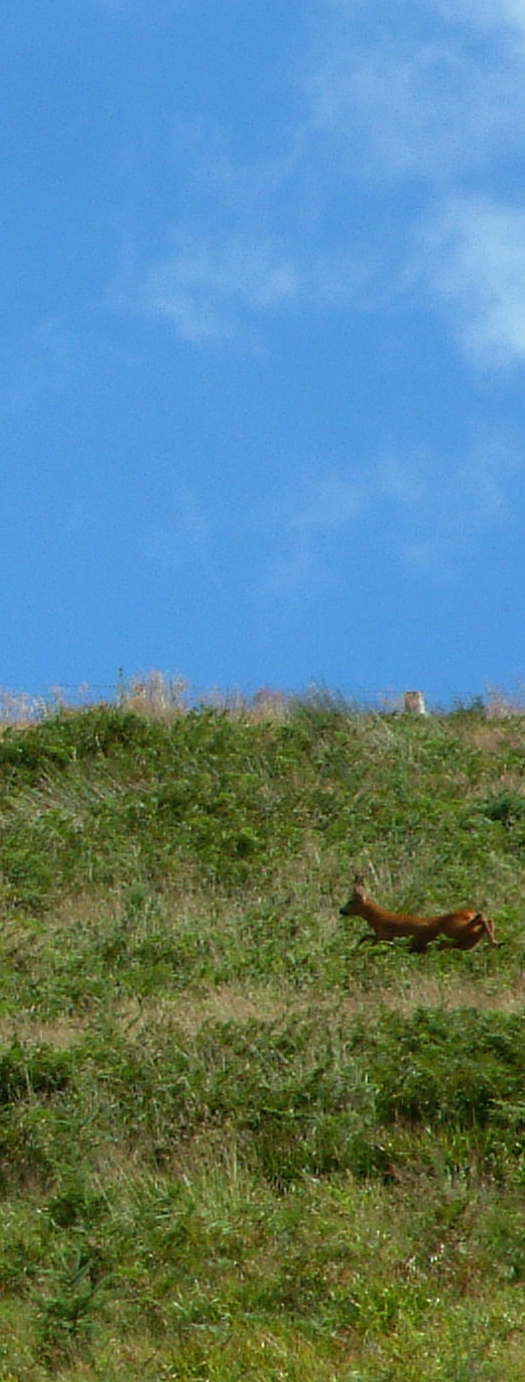
Escaping from our sight, the roe deer

Roe deer were originally native to Scotland since becoming marooned here when the land bridges to Europe were finally covered by water. The majority of the world’s Roe population lives within the former Eastern Bloc.

Remains identified as Roe in Britain have been found dating back to the Interglacial period (400,000 BC) along with other species now extinct in Britain. There are three subspecies and the European Roe, Capreolus capreolus stands between 60-75 cm at the shoulder with bucks weighing between 24 and 30 kg, whilst the does are 2-6 kg lighter.

The Roe feed mainly on grass, leaves, berries and young shoots. They love very young, tender grass with a high moisture content, i.e., grass that has received rain the day before. Roe deer will not generally venture into a field that has had or has livestock (sheep, cattle) in it because the livestock make the grass unclean. All year round their antlers damage saplings and the bark of young trees since they rub against them to progress the antler growth. The average length for European Roe antlers is between 20-30cm. The bucks shed their antlers between October and December, the older bucks shedding first.

Roe were numerous through Roman and Saxon times, but suffered a steady decline through the mediaeval period. A few miles from our cottage there lies a medieval deer park. This is a reserve, with an enclosing bank with a ditch within the enclosed area (designed to make it easy for deer to leap in, but difficult for them to get out). Armies would use these parks to camp on their way to battle too. The effort to build these deer parks would have been considerable and they have remained largely intact after centuries.

William the Conqueror created laws that protected his royal right to kill deer, anyone else would be penalised by death. After the Normans, Roe were later declared as being ‘beasts of the warren’ (unworthy of noble hunting) in 1338. This was great news for the expanding peasant population who were then allowed to hunt them as a food source. Medieval Scots also ate swans, peacocks, seals, lampreys and porpoises. They ate lots of birds including small wild birds as well as geese and pheasants. Fish was very popular, they ate herring, pike, salmon and bream as well as eels.

Forest clearance and over-hunting led to Roe deer becoming extinct in England by 1700 in southern and central England and all of Wales. In Scotland the Roe remained in wooded patches. Deer were still a protected species until the 19th Century, even though Henry VIII had long since abolished the law which gave the death penalty for non royals to kill deer. The ‘royal beasts of the chase’ were the red and roe deer, and to this day are still associated with royal hunting activities. It is still a class of sport for people who can afford to pay for the experience. Only gamekeepers get paid for killing deer on behalf of anxious landowners protecting their trees or crops.

Hunting obsessions in England led to several reintroductions of Roe during Victorian times and colonies were established in Dorset, Sussex and East Anglia. This, combined with woodland and forest planting in the 20th century has meant that Roe deer have become widespread and abundant today. Reintroduction spread to Northern England and Scotland. The present Roe deer population is probably at its highest since the Middle Ages. Income can be generated for landowners who can offer hunting holidays.

Even in the built up area of Gateshead where I used to live, we would often see young deer race across open fields and across a busy main road into wild grass areas. Roe deer typically occur in open, deciduous, mixed or coniferous woodlands. They also inhabit moorland, and large gardens in rural or suburban areas. They are common here in the Scottish Borders, consequently the winter kill of does will soon commence and the stealthy gamekeeper will be driving by our cottage for night hunting.

Earlier this year our dogs found heads and legs of deer scattered about the fells. Being Labradors they brought them to us proudly. Not a pretty sight for lovers of this exquisitely designed beast, especially when the dog wants to play with the limbs and crunch the heads. Not easy to bury these things successfully from the heightened sense of smell of a retriever. It did mean that as the things rotted we kept being presented with decaying items for the next few months.

Posted in anthropocene | Tagged , , , , | Leave a comment

Forest

When we first arrived at our remote cottage to live there was a large forest of conifers up the slope of the fell on which we lived. The fell is 599 metres, which is just short of being a mountain. We live on the lower slopes but we are the highest dwelling of the valley. We saw two winters of snow covered fells and the forest of conifers was like a Christmas Card. We thought it was wonderful to see each day. Then it was chopped down, which was a shock to us. Apparently it was 30 to 40 years old. It took 2 men with specialised machinery working night and day in a bad winter to cut it down within 3 months. They lived in an RV during that time, but it must have been grim. Certainly the devastating scene they left was grim. The dark gash on the fell remains an ugly scar to this day although they have dug it over and cleaned it up as best they could. This taught me about the work of the Forestry Commission which I did not know existed until we moved to Scotland.

Our original landlord had his estate planted with Sitka Spruce, Scots Pine and Larch (as advised by the Forestry Commission) and a large area of broadleaved trees to cosmetically conceal the growing pine forests. Then a new owner took over and she planted broadleaved trees over most of the estate. She chose Oak, Birch, Rowan, Hazel, Willow. She has covered the tops of the fells too, only leaving the peat bogs and marshes and other unsuitable ground free of trees. She had sought advice about the Ancient Woodlands which once existed here and her plan is to re-introduce those trees and thus increase the biodiversity of the land.

This caused me to take an interest in those ancient woodlands.

Apparently, after the last Ice Age, a gradual process of tree re-colonisation began in Scotland. The, in botanical terms, pioneer tree, was the Birch. It was the dominant tree and used for everything imaginable by the humans who began to resettle in this country when the climate permitted. At one time, the great Caledonian forest stretched across 3.7 million acres of the Scottish Highlands.

Around 5 thousand years ago the Caledonian forest initially consisted of birch, hazel, pine and oak. This woodland cover extended to Shetland and the Western Isles. Ancient woodland is directly descended from the original woodland that developed after the retreat of the ice sheets in Britain 10,000 years ago. Early agriculture led to clearing land and the invasion of Scotland by the Roman legions of Agricola in 82AD, having the greatest impact in the Lowlands, led to at least half of the natural woodland disappearing.

Temperatures were warmer when the ice was retreating, but became cooler again, and wetter which, combined with human activities, led to woodland being replaced by peatland. During the 17th and 18th centuries many of the remaining woods were heavily exploited for timber, charcoal and tan-bark.

Major changes in land-use in Scotland occurred after the Jacobite rebellion of 1745 with consequences for woodland extent and distribution, including the Clearances (where people were replaced by sheep), the switch from a cattle-based to a sheep-based economy and the rapid increase in commercial plantations, which had only occurred on a small scale until the work of the ‘Planting Dukes’ of Atholl around 1740. The Perthshire website proudly boasts:

The seat of the Dukes of Atholl is at Blair Castle, north of Pitlochry. Generations of these so-called ‘Planting’ Dukes shaped the landscape seen today, especially around Dunkeld. Between 1738 and 1830, the family planted around 27 million conifers in the area. Some even say some of the rocky faces of Craig a Barns, just north of Dunkeld, were planted using cannon loaded with larch seed! Also in 1738, young European larches were collected in the Tyrol to be grown on at Dunkeld as the source of seed for these large scale plantings. One of these original trees survives – the Parent Larch, planted near the west end of Dunkeld Cathedral and the ancestor of many of those trees seen on the Atholl estates. See it as part of a gentle ramble – signposted and waymarked – from Dunkeld.

The Military Survey of Scotland, compiled by General Roy around 1750 has helped verify the continuity of woodland cover across the whole of Scotland.

At the beginning of the 20th century, woodland management was at a low ebb in Scotland. For the woodlands as in much else, the First World War changed everything. Lloyd George said in 1919 that Britain “had more nearly lost the war for want of timber than of anything else”. The date of that quote is significant – in 1919 the Forestry Commission was created with the primary aim of preventing such a strategic weakness from arising again. Since the 1940s the area of woods and forests in Scotland has increased from perhaps 4% of total land area to a current figure of some 17.8% mainly as a result of large scale afforestation. These quick growing timber forests became notorious when cut down they left barren landscape scars. Such plantings continued to wreck the scenery until the mid 1980s when the PR improved by the Commission becoming more sensitive to landscape, biodiversity, recreation, rural development and community involvement. Now timber is not as much in demand, wind farms are the new money maker for investors. They cause dreadful harm too to the once wild landscapes of Scotland, but they give investors a good return as they are subsidised by us, the ratepayer.

Posted in anthropocene | Tagged , , , , | Leave a comment

Blue Moon

Blue Moon

Looking back on August it was an interesting month for a number of reasons. 2 full moons occurred – which is termed the Blue Moon. It will occur again in 2015.

It was also the month Neil Armstrong died. Langholm, in the Scottish Borders, was a place he visited some years ago to find out about the Armstrong Clan when he visited their museum. His photograph is on the display there, dressed in his astronaut outfit. On news of his death, various people of Langholm spoke on the radio about the memory of the surprise visit of this special man. All over the world, those old enough to remember, relived the morning we watched transfixed as he stepped on to the moon in 1969.

The night of the 30th August was the coldest ever recorded for this month in the UK.

I saw the fading Blue Moon today in the western sky as the sun was rising in the east. When the moon was born, around 4.5 billion years ago, it was about 22,500km (14,000 miles) away, compared with the quarter of a million miles (402,336 km) today. Patrick Moore has been explaining the Universe to his UK audience since I was a child. He is now 89. He has always had a particular interest in the Moon, particularly the far side, a small part of which is visible from Earth as a result of the Moon’s libration; the Moon has remained his specialist subject all through his life. But he talked us through the long transmisson gaps of the morning when Neil Armstrong landed on the moon. The BBC had lost the tapes of their historic commentary, but listeners had called in to BBC Radio 4 to say they had retained quality recordings. After all these years we heard clips from these pristine tapes and it was so evocative.

Patrick Moore will no doubt be excited that researchers are still pressing to study the dark side of the moon just as he has always thought there should have been more dust collections from that side. The moon is directly exposed to the solar wind (streams of high-energy particles, consisting mostly of hydrogen atoms and ions (protons) constantly emitted by the Sun). But the side facing the sun will have the depth of dust destroyed by the Sun’s rays, but the dark side will not. The history of the impact of these solar winds will be archived over several billion years in the depth of dust on the dark side. Understanding what is happening to the Sun is obviously important as we depend on it for Life itself. The Sun has been found to be changing in a complex way and scientists can more easily study the moon to find out what is happening to the sun.

The BBC website explained the following:

The migration of the Moon away from the Earth is mainly due to the action of the Earth’s tides.

The Moon is kept in orbit by the gravitational force that the Earth exerts on it, but the Moon also exerts a gravitational force on our planet and this causes the movement of the Earth’s oceans to form a tidal bulge.

Due to the rotation of the Earth, this tidal bulge actually sits slightly ahead of the Moon. Some of the energy of the spinning Earth gets transferred to the tidal bulge via friction.

This drives the bulge forward, keeping it ahead of the Moon. The tidal bulge feeds a small amount of energy into the Moon, pushing it into a higher orbit like the faster, outside lanes of a test track.

This phenomenon is similar to the experience one feels on a children’s roundabout. The faster the roundabout spins the stronger the feeling of being slung outwards.

As the Earth’s rotation slows down, our whole planet may start to slowly wobble and this will have a devastating effect on our seasons.

During August, researchers from the University of Bern, Switzerland, made a significant breakthrough suggesting an answer to this Lunar Paradox.

They think they have a new explanation for how the moon may have formed rather than the one we are used to hearing about a major collision between Earth and an impactor the size of Mars, known as ‘Theia’.

Scientists have simulated the collision, 4.5 billion years ago, between Earth and an impactor the size of Mars, known as ‘Theia’ this process is known as the ‘lunar paradox’. Contrary to belief, the moon appears to be made up of material that would not be expected if the current collision theory is correct. ‘Our model considers new impact parameters, which were never tested before,’ said lead author Andreas Reufer.

Exploring a different geometry than previous simulations, they considered new impact configurations such as the so-called “hit-and-run collisions,” where a significant amount of material is lost into space on orbits unbound to Earth.

“Our model considers new impact parameters, which were never tested before. Besides the implications for the Earth-Moon system itself, the considerably higher impact velocity opens up new possibilities for the origin of the impactor and therefore also for models of terrestrial planet formation,” explains lead author of the study, Andreas Reufer.

“While none of the simulations presented in their research provides a perfect match for the constraints from the actual Earth-Moon-system, several do come close,” adds Alessandro Morbidelli, one of the Icarus’ Editors. “This work, therefore, suggests that a future exhaustive exploration of the vast collisional parameter space may finally lead to the long-searched solution of the lunar paradox”.

This is all very interesting but most of us non scientists love the Moon for its radiant light when the countryside is otherwise pitch black. But it depends on your circumstances why you may prefer a moon – or not. WWII pilots called such light the ‘Bombers Moon’ as the illumination helped them take aim more directly. The Moon’s light also reflected in bodies of water which would help with identifying places such as dams. The citizens below feared a full moon knowing the bombers could hone in on their location more exactly. Escaping from well guarded territory was also not a good idea on a moonlit night.

During the day yesterday there were several fox hunts. I saw two cubs break cover and be pursued by the 40 or so hounds near our cottage. I don’t know if they escaped but my heart hurt to watch this ‘sport’ at such close quarters. The full moon will prevent the night time fox hunts where the lampers use a 4×4 and three men to kill the fox. One man drives, one man shines a bright lamp, one man aims the gun when they have identified the fox, usually frozen in fascination by the light, its red eyes looking back at the gun. All this happens around our cottage, and often the lamp shines in the bedroom window for some time. Do they think I am keeping a fox in there?

I used to have a Siberian Husky and she used to howl at the moon. She looked just like a wolf. I loved her to do that.

Posted in anthropocene | Tagged , , , , , , , | Leave a comment

The fox hounds are out

I hear the fox hounds being brought out for their daily preparation for the season beginning September. Their baying sets my five dogs off barking, and I have to bring them in to shut them up. The local hunts involve men on trail or quad bikes where once they rode horses. The 4×4’s line up on the fell road above our cottage as they stand and watch ‘the fun’ as the menagerie charge madly over the rolling landscape.

Celtic Britain used the Agassaei breed for hunting. Later The Romans brought their Castorian and Fulpine hound breeds. Hunting man and beast has been made more effective using dogs over the centuries.

The Arctic Fox (scientific name Alopex lagopus) was once native to Scotland, but is now extinct. It is a smaller size fox than the Red Fox, but as one might expect, the Arctic Fox has a thicker undercoat to withstand extreme temperatures. On the fringes of the Arctic, both types of foxes may co-exist. The larger Red Fox can out compete for food, but the more north and more cold the temperature then the Arctic Fox dominates.

Hunting in Scandinavia, despite the protection laws since 1928, has put Arctic Foxes in Europe into the critically endangered classification.

The brown hare was imported by the Romans, but the larger red fox, was imported more recently from Scandinavia after the early hunts of the 17th century wiped out the remaining fox population.

The last wolf in the British Isles was said to have been killed in Scotland in 1743. Auroch, the enormous wild bovine that once roamed the Isle, is extinct. The European elk—known in North America as the moose—was wiped out several thousand years before the Romans arrived; lynx and brown bear were gone by 500 AD; wild boar by the end of the 13th century. Beaver went missing 400 years ago.

The first recorded fox hunts were in Norfolk, 1534, believing foxes to be pests on the farm. More organised hunts occurred in the 17th century when packs of hounds were trained to hunt foxes, and then foxes and hares. Fox Hunting was developed by Hugo Meynell, Master of the Quorn Hunt between 1753 and 1800.

Hunting was and is to this day a royal sport. Kings and Queens of England have loved shooting wildlife since gun technology improved in the late 18th to early 19th century. King George V for example, on 18 December 1913 shot over a thousand pheasants out of a total bag of 3937.

When game shooting became popular, the increased income to landowners from the sport meant gamekeepers had to be employed to protect the birds being reared for the purpose of paid shoots. Thus foxes, magpies and birds of prey were culled to the point of extinction in the profitable areas where these sports were developed. The landowners landscaped the shooting areas to provide grouse butts (small stone, wood and turf constructions) and suitable habitats to rear game, which included forests for pheasants. In this way, shooters could lie in wait for the beaters to frighten the birds toward their awaiting guns.

The gamekeeper became important to the continuing income generation of the landowner and they now are associated with wildlife conservation, having a membership organisation today which teaches best practice, for example, the right way to snare a fox.

Game Laws were relaxed in 1831 which meant anyone could obtain a permit to take rabbits, hares and gamebirds. Consequently there are many people who enjoy killing sprees in their spare time. I used to hear rabbits being shot from dawn ‘till dusk on a Sunday in the North East of England. Here in the Scottish Borders I hear far fewer gunshots.

Hunting with dogs (including hunting for fox, deer, mink and hare coursing) was banned in Scotland by the Protection of Wild Mammals (Scotland) Act 2002 and in England and Wales by the Hunting Act 2004. This was an attempt to prevent some forms of cruelty to foxes being perpetuated

Before the Act came into force in February 2005, foxhunts killed foxes in one of two ways: roughly half were chased until they went to ground, after which they were dug out with terriers. This resulted in underground battles between terrier and fox which could last many hours or days, and severe injuries were often inflicted on both animals, similar to dog fighting. The remaining foxes above ground were caught by the hounds to be torn apart when already exhausted from the chase.

The rural community view hunting as a crucial part of rural history, vital for conservation, a method of pest control.

The season is almost upon us and the sound of hounds baying and my dogs barking in alarm back at them will go on for months ahead. The fox is not supposed to be their quarry, instead drag hunting inspires the chase. But the foxes will die despite this, as they are not welcome in these areas where lambs are to be born each spring and birds reared for the shooting season now underway.

Posted in anthropocene | Tagged , , , , , , | Leave a comment

Have gun will kill

Ornithologists do not recognise the pheasant as a UK bird, although it has the most beautiful plumage of any bird resident in these Isles. It was an Asian bird, finally domesticated and brought to Britain by the Romans adding to their dietary requirements whilst away from Italy. When the Romans left, they seem to have taken the bird with them, as it does not appear in records here until the 1200s.

It will not be long before 20 million pheasant are released as game for the waiting, evenly spaced shooters, on various specially chosen pieces of land around the UK. These pheasants have been reared and fed up all year for the purpose of being shot by shooters who hope to get their money’s worth out of the day’s shoot. They don’t want the birds to be too fat so they will not rise into the skies above them. They don’t want them to be so unused to threats through careful rearing that they don’t even try to take evasive action. But, rearing this bird to be shot since the mid 1800s does encourage a type of bird which has lost its initiative to forage or think for itself. Never mind. There is big money to be made providing rural employment all year leading to the short shooting season.

When I first arrived here in the Scottish Borders I thrilled to the sight of a pheasant flying and pecking on the fell outside the window of the cottage. We often watched the young pheasants running ahead of us up the road near a small wood, their amusing gait making us laugh as they eventually ran at speed off onto the grass. We did not know they were there simply because the wood nearby was where they were being especially reared. Similarly, the red legged partridge would delight us as around 20 would appear suddenly outside the window, their markings incredibly beautiful too. But we soon learned they were being reared also for the shooting season.

And the carrion crow. Such an intelligent bird, fascinating to watch as they pick up a snail and break its shell on a fence just as I smash the shell on a nut, providing a tasty meal. We loved to watch them dedicatedly building their nest in the ash tree by the cottage. Their young hatched out and the parents worked so hard feeding their couple of chicks. One balmy evening they were beginning to fledge, all basking on the high branches, testing the pre-flight conditions with parents encouragingly sitting close by. Then a shooter drove up, took aim, and blasted the crow family out of their nest, killing one juvenile which was in the nest and winging a parent. The other juvenile flew earlier than it had anticipated. Crows are considered ‘vermin’ like the feral pigeons, and can be shot all year round. We did not expect this family to be shot as we sat in our garden sharing the pleasant evening with them.

The rural economy justifies these activities as high income deriving sports and locals will say ‘aye bin’ – meaning ‘it’s always been that way’. No-one likes their income threatened, but now climate change is doing the threatening as less birds survive the rearing period during extreme weather. What will the people replace this ‘sport’ with for the future? Or will they continue to think maybe next year will be better, when we now know climate change has given all the warnings that things can only get worse.

Posted in anthropocene | Tagged , , , | Leave a comment

Nature’s attributes half way up a mountain

We live by a strongly flowing burn. We are used to wet weather, therefore the ground is often boggy, but it drains fast. We are half way up a mountain so the height increases UV light and the conditions attract fewer butterflies and moths than on lower areas. But we do see plenty of the British Green Veined White from Spring through to Autumn. It particularly likes being higher and can be seen fluttering around the fells when few other butterflies are around. The Small Heath is also found higher up from our cottage.

We have had a particularly wet year when the Jet Stream got stuck over the UK. Consequently it was dreadful for the poor insects and birds. Although the Green Veined White has been plentiful, not so the Small Tortoishell which I expect to arrive with other Vanessids such as the Red Admiral. Of the Brown butterlies only Ringlets abound, loving the dampness of the surroundings. I expect the beautiful Peacock soon, but I am fearful it also will not arrive in the numbers we are used to seeing.

The Moths are fewer too, but those I have seen are the Beautiful Golden Y, the Silver Y, Gold Spangle, Gold Spot, Clouded Bordered Brindle, Silver Ground Carpet and Small Magpie,

How exquisite all insects are, the spiders, bees and wasps, ants, flies of all kinds – there must be thousands of varieties and I am no entymologist.

The wild flowers here in August are typically:

Harebell, Sweet Cicely, Angelica, Meadowsweet (Lady of the Meadow, Meadow Queen and Queen-of-the-Meadow) , Tormentil (eart-barth (earth bark), Wild Thyme, Rough Hawksbit and a variety of Thistle.

These are acidic grasslands with heath bedstraw with bent and fescue grasses, amongst which grow the wild flowers.

In acidic grasslands, small heath and meadow-brown butterflies lay their eggs upon fine-leaved fescues. Short-tailed field voles, feeding on grass stems and roots, in turn fall prey to short-eared owls. Rabbits are common, particularly where the soil is easily excavated, and they too make easy meals for buzzards, foxes and stoats.

Jointed rushes grow in the boggy areas, which are many! At this time of year they have flowered and are going to seed like all the grasses.

The main raptor is the buzzard. We also have owls, long eared, tawny and barn. Amongst their prey are the numerous small birds which constantly busy themselves catching insects and eating seeds such as: tree, rock and meadow pipit; swallows and house martins; greenfinch, chaffinch, goldfinch; lesser redpoll; great tit; stonechat and whinchat.

Along the burn fly dippers and herons.

The carrion crow and not far from us, the ravens fly over the fields mostly where the sheep are grazing.

Every day is full of surprises. More to learn about, more of the richness of nature all around us. It was probably there to see when I lived a busy life in the city, but I could not stop and wonder. I was too stressed and distracted with the typical effort of family commitments. Now I can take my time, and I do.

Posted in anthropocene | Tagged , , , , , | Leave a comment

Glorious 12th

Yesterday was the ‘Glorious 12th’ and all grouse (lagopus lagopus scoticus ) in Scotland would have been finding themselves the target of many shooters had it not been a Sunday. No game may be shot on a Sunday. From today they may be shot and so pull in much needed income for those employed in the shoots on land owned in Scotland.

I saw two grouse as I walked down our lane yesterday to put our rubbish out. We have had a very, very wet year and so there are far fewer grouse successfully breeding.

The League Against Cruel Sports believes the sport is barbaric and should have been banned long ago. A representative has said:

“Each year, from August to December, picturesque moorlands are invaded by groups of men and even children armed with guns, having paid for the pleasure of shooting and injuring thousands of terrified birds.”

Many Estate Managers have had to cancel the shooting due to the low numbers of grouse. This happened last year too.

One said:

“Hens that had hatched were unable to look after their chicks. Many nested again and their nests were flooded out, and in July the chicks that had survived were too big to shelter under the hens when the rain came again.”

But Scottish Land & Estates, which represents over 2,500 landowners in Scotland, say “despite the mixed picture in terms of bird numbers, country sports enthusiasts have dusted off their guns and headed to the hills to try and bag a brace.”

Shooting on the large estates of Scotland was particularly popular with the Victorians who were inspired by the romantic imagery of the Scottish Highlands brought to life by painters

A Typical day day of a party of eight guns, with accommodation, commissions, tips, ammunition and refreshments, could well be £50,000 plus. The 2500 landowners in Scotland make every effort to attract self-made men – occasionally women – who express their career success with a day’s shooting. These people are likely to be high-achieving, networking-savvy go-getters treating themselves and their friends to a unique thrill.

The Prince of Wales (later Edward VII) took up the sport when his mother, Queen Victoria, purchased Balmoral in 1852. Images of the romanticised man, with gun and dog on the moors became popular in paintings of the day and aristocrats flocked to take up the sport, particularly in Scotland.

Today there are nothing like as many birds as there were then, as the red grouse eats nothing else but heather. Global warming, the spread of parasitic ticks and the loss of moorland for forestry have come together as a perfect storm for the grouse.

Much of the money made from the sport is put into managing the land to improve conditions for grouse. In this way it is often claimed that without the millions of pounds income, conservation of the moors would not happen.

Posted in anthropocene | Tagged , , , , | Leave a comment

Dark Skies

And the dark skies. Oh let me tell you about the dark skies. No pollution of any kind to blot out the awe inspiring canopy of stars once night falls. Over us is our own galaxy, the Milky Way, so incredible with myriads of stars within the creamy mass. I knew very little about astronomy, still don’t know much, but I gaze in wonder every night on that sky so mysterious and rolling on with infinite glory. We leave in a Dark Skies status region, with the first Dark Sky Park in the UK a short drive away, the Kielder Observatory another even shorter drive in the opposite direction. Where I might have looked up and have seen 100 stars over the city, here I can see 1000 with the naked eye.

Stone Age humans will have gazed on the wondrous sky and felt the same awe we feel today. Over time humans began to piece together various factors which linked to their new farming skills, such as noticing the stellar patterns changed with the seasons. They would learn to plant crops when Virgo and her accompanying constellation appeared in the sky. When Orion arrives in the sky it is time to harvest and to prepare for winter. There are various stone circles in Scotland linked to religious and astronomical practices which helped early humans to feel more in control of their uncertain futures.

The earliest pursuit of mathematics that we have evidence of is 580 – 500 BCE when Pythagoras in Greece, a strict vegetarian, who believed in a silent order for the first 5 years of membership of his cult, recognized the existence of irrational numbers and he and his followers were interested in the relationship between music and mathematics.

Then Aristotle, Athens, a pupil of Plato in 384 – 322 BCE surmised the Solar System must be heliocentric, following his geometrical estimates of the relative sizes and distances of the Earth, Moon and Sun.

Eratosthenes of Cyrene (276-197 BCE) calculated a map of the world, a method for finding prime numbers called Eratosthenes’ Sieve, and estimated the circumference of the Earth.

Claudius Ptolemy, Alexandria (around 100 – 170AD) developed the most sophisticated mathematical model of the motions of the Solar System based upon the geocentric (Earth-centered) model and the principle of perfect circular motion.

Since then many great thinkers have lived in dangerous times due to religion dominating the minds of the population and people did not dare to disagree with proclaimed ‘beliefs’. Despite setbacks, over centuries of conflict and persecution, understanding has triumphed with present day breakthroughs such as ‘Curiosity’ the rover which successfully landed on Mars and is sending back pictures for us all to see with our Internet links. We can look up there and know that, building on the intelligence of mankind we have not only sent man to the moon, but have been able to build technology to explore planets millions of miles away from the Earth.

The first stone circle (so far located in Turkey) was built in 9000 BCE and they continued to be built around the world for thousands of years. No stone-circles appear to have been built in N. Europe after 1,500 BCE. But we have many in Scotland and it is has been shown that many required a strong geometrical and astronomical understanding. There are many recumbent circles in Scotland and these seem to be linked to lunar cycles. They are almost unique to Scotland. A website on the subject states:

http://www.ancient-wisdom.co.uk/stonecircles.htm#purpose

Recumbent Stone Circles are one of the most definite proofs we have that Neolithic people were not only aware of the 18.6 year lunar cycle, but that they followed it closely. They demonstrate that the lunar cycle was considered an important part of the social complex in North-eastern Scotland c. 3,000 BC – 1,500 BC.

The intelligence of human beings can be traced through the constant revelations made by archaeologists using the latest technology plus expertise from across the sciences to analyse the findings.

Knowledge of our world should have led to us protect and value it, to respect one another and work toward benefits for all through intelligent and reasoned analysis. But our Achilles Heel is a human desire to retain power by restricting knowledge and ruling through fear of the unknown. So we say ‘knowledge is power’ and we expect only a selected few to grasp the reigns and ride over the rest of us.

Looking up at the universe in which we live can make any human wax philosophical. We feel so small and insignificant, and it is easy for a seemingly confident person to emphasise our impotence in the face of the overwhelming sense of ignorance most of us experience. We can be conned by so called ‘experts’ and lose sight of our own abilities to question and produce answers. Yet each of us has the spark within us to be curious, to explore, to try and understand this wonderful sense of being. Living in the Scottish Borders has given me a greater feeling of belonging to something so wonderful and available for me to discover in my own time with whatever abilities I possess. That is all any human being should aim to find time to do. I am glad I lived long enough to do it.

Posted in anthropocene | Tagged , , , | Leave a comment

The Weavers

When we arrived at this cottage in which we now live, we found it was better insulated than any home we had ever lived in – which is excellent as we live half way up a mountain. It used to be a ‘bothy’ a type of building we knew nothing about. Anyone who has hiked around rural areas will know the term, but we had mostly walked around shopping malls and streets of cities.

The bothy which preceded our cottage was used for the shepherd to treat sheep away from the main steading, particularly for lambing. Attached to the bothy is a pen to control sheep. Although the bothy had been knocked down and rebuilt as a 2 room cottage, the pen remained in use by the local shepherd until the new landowner sold all the sheep last year. Lambing last year was particularly intense and we were more or less trapped in our cottage, surrounded by sheep and a very busy shepherd dealing with lambs being born every minute or so. He worked solidly and saved many lambs which might have been stillborn but for his swift action and competent manner. Although we had to keep out of his way (and his marvellous collie helper) we saw all the action like a documentary on good shepherding. Previous shepherds working on the estate had never been as thorough or as humane.

9000 years ago a population of 8000 lived in one of the oldest villages known to archaeologists, in Çatalhöyük, Anatolia, Turkey. The Neolithic people lived there for at least 1000 years. They did not have roads or lanes and their four walled homes were pressed up against each other. They farmed 7 miles away from their homes and did not seem to understand how to construct doors or windows, but they were weavers who could create striped fabric. They adorned their walls with high art and, since discovered in 1965, the place attracts many tourists.

Here, it is a 20 mile round trip to the nearest village where the population is around 800 souls. The village was built as a clearance village in the 1700s to create a village of weavers for the growing textile industry. It was built on a flood plain like the Çatalhöyük village. When the river rises and flooding ensues it causes havoc, despite work to build defenses. I wonder how the people of Çatalhöyük managed. I am sure humans then and now are not that different. When Çatalhöyük was discovered, the Scottish Borders had a thriving textile industry. Perhaps there is a link with the Middle Eastern ancestors bridging back over those 9000 years to those weavers.

Posted in anthropocene | Leave a comment

Land Use

10,000 years BCE there were around 1 million humans walking this planet. By 1800 AD there were around 1 billion. From Stone Age man, hunting and gathering a wide ranging diet we became farmers, and by 1800 we were dividing up the land of Britain through the Enclosure Act.

There are 7 billion plus world population today. Agriculture is big business with so many mouths to feed.

Humans began farming within small populations around the same time all over the world. People learned through trial and error to develop farming techniques, but some were more inventive than others. Archaeologist have found Incas never had wheels, but Mesopotamians and the Mayas of Central America did. No-one has yet been able to show how grass was grown into an edible form of corn, how bread was invented, how something so inedible as grass became a world wide necessity through farming and baking techniques. As farming requires a settled community around it, then the diet of that community becomes refined down to basics. No longer is the wide ranging healthier diet of the nomadic life available to all.

Hills and mountains are constantly eroded, particularly as an Ice Age melts away, reducing the nutrients in the soil and creating scrub, heath and bog. Where I live, I watch the rains sweep away the rocks, smashing them up on their way to the sea via the many sikes, burns and rivers around our cottage. These high places will one day be gone, washed away. The skin of the Earth constantly changing, we can only imagine what it may have looked like before the last Ice Age.

Land around me has been used to farm sheep for centuries. It was Neolithic Man who made sheep dependent on humans (domesticated), about 10,000 years ago, in south west Asia. People learned sheep were found to be suppliers of milk, clothing material, as well as meat. Sheep were a feral animal in Europe when they were domesticated in Asia. European sheep, genetically, are thought to be descended from Type B compared to Type A for Asian and C linked with Turkey and China. A Type B sheep was found in the Bronze Age in China and thought to have been introduced in 5000 BC.

In the Highlands of Scotland, indigenous people were forced from their homes and no longer allowed to live on land they used to cultivate and survive on. Instead, the land was given over for sheep walks. The sheep were considered more important to the landowners than people. For a short while, such landowners became very rich until the competition from New Zealand sheep farmers broke their hold on the market.

I knew very little about sheep when we came to live here. Being surrounded by a few thousand sheep which fed right up to the fence of the cottage resulted in a fast learning curve. We became very fond of them and grew to recognize them as you would neighbours in your street. They do not have an easy life. The ewes bond with their lambs in a powerful way. They are excellent mothers unless they are unwell. When the lambs leave to be taken to market, they scream for their babies for a few hours, until hoarse. Then they seem to accept they are lost, gone forever. They lose their milk and become fitter, ready for their next pregnancy. These sheep do not have coats which can be used to make wool as they are coarse. They are farmed for their meat only.

We also had around 200 cattle intermingling with the sheep, roaming the hills, making dramatic silhouettes against the skyline as they moved through the fells. As with sheep, it was Neolithic Man in the Near East who domesticated the cow. Cows are strong, so could be used to pull the plough or carry loads, and their blood was found to be nutritious (often extracted from the living animal). One dead cow could feed a large group of people and the skins could be used for clothing and for making useful items. The cattle on this farm were reared for beef.

Land has to be cleared to make way for cattle and sheep. In Britain this started about 6,000 years ago. Wildwood was cut down and probably burned to grow grass for the animals. Early on the cattle would be small, supplying milk and beef. Gradually cattle were farmed for milk, or beef. Beef cows suckle the calf for between 7 and 10 months. After weaning the calves are finished through a variety of feeding systems. Cows are lovely animals, though we found them scary when they came to our fence and had their calves with them. They hate dogs, so, seeing them in our garden, they used to look so fierce and bay at us all. We had to quickly get the dogs in if they arrived unexpectedly, as they often did.

All the sheep and cows are now gone as the new estate owner is planting trees, replacing the animals. The people of Scotland mostly departed these shores (late 1600s onwards) and left it to the landowners to choose how to make profits from the hectares they purchased. There are only around 5254800 (mid-2011) people living in Scotland today, and that population has been boosted by foreign immigrants (over 42,000 arrived in 2011).

Scotland is full of history, enchantment and mystery. 61% of UK windfarms are built in Scotland, reducing the splendour of wild landscapes to industrial degradation. This is clean energy and our Scottish Parliament are proud of their policy of accelerating the placing of Turbines taller then The Eye in London amongst the greatest landscape views in the world, hacking the peat away to ground the monstrous eyesores and possibly knowing, in 25 years time, they will not be decommissioned as promised. I rather expect them to be left to rot. But I am unlikely to be around to find out.

Posted in anthropocene | Tagged , | Leave a comment