Ice Ages

The first life on Earth was in the form of bacterial algae, which are photosynthetic organisms. If it were not for them we would never have had oxygen, and without oxygen we would never have had fire.

Life has been extinguished during the 4 ice ages this planet has undergone (rhythmically every 41,000 years). They occur because sunlight shining on the North Pole is insufficient and an ice age ensues. The Earth interacts with the Sun, Moon and other planets in such a way as to evolve seasons which have set the rhythms of our existence. As the Earth tilts on its axis the North Pole tilts toward the sun in summer and away in winter. Around every 23 millennia (1000 years is a millennium) the Earth wobbles (Milankovitch wobble) until the Earth changes its angle of tilt between 22 and 25 degrees cyclically every 41 millennia. It is currently at 23.5 degrees. It takes all those thousands of years to settle back to its ideal state. During that period snow and ice build up in the polar areas and create massive ice sheets. More tilt results in colder winters and hotter summers. Conversely, less tilt will lead to milder winters and cooler summers. As the snow and ice build at the polar region during an ice age, the land closer to the pole also builds more snow and ice. It is thought now that CO2 was the driver which triggered the acceleration of the melting of the last ice age.

Snow and ice reflect the sun’s rays back into space (the albedo effect), leading to an acceleration of cooling. Albedos are on a continuum from 0 (complete absorption) to 1 (complete reflection). As we know our planet is heating up due to CO2 and methane accelerating the process, and that reduces ice and snow, even some cloud cover. We are seeing glaciers retreating much faster than was predicted only a few years ago (although for some reason they are not doing so in the Himalayas). Without the reflection of the sun’s rays back out into space, the sea and land absorb the heat, which intensifies the heating process. Even if we can instantly stop the emissions of greenhouse gases, the heating up will continue as it has a momentum.

Since 1850 to 1980, around 90 to 120 billion metric tons (90-120 trillion kilograms) of carbon dioxide were released into the atmosphere, and an estimated 165 billion metric tons of carbon dioxide were added to the atmosphere by industrial nations through the burning of coal, oil, and gas. Fossil fuel burning has been estimated to release 5.6 gigatons of carbon into the atmosphere each year. Another 2.4 gigatons of carbon per year (about 30 percent of the total) is contributed from burning tropical forests. When, in 1997, Indonesian farmers used slash and burn techniques the result was greater greenhouse gases released than all the cars and power plants in Europe emit in an entire year.

Archeo-geneticists analysed large quantities of mitochondrial DNA from Europeans who belong to two major lineages named J and T. It is known that these haplo-groups originated in the Middle East and migrated to Europe around 9,000 years ago, as the Ice Age drew to a close.

Stone Age man existed in the Middle East around 10,000 years ago (Neolithic Man). Skara Brae in Orkney is the site of a group of ten houses dating back to the Neolithic Period, and thought to be lived in during 3180 BCE–2500 BCE, the people surviving for at least 600 years there.

A few thousand years ago. the Middle East was also where the wolves of the area were bred by the people to become our domesticated dogs here in Europe starting with the chow chow, Shar-pei , the Siberian Husky and the Afghan hound. As a dog lover that fascinates me. We have five dogs currently, collies, Labrador, terrier and daschund. Their genetics go back to the Middle East, and, as a European, most probably I do too.

Our ancestors would have walked across land now submerged by seas and oceans, but then, as the ice receded, coastlines were extended. These form the continental shelves which are now measured to identify fishing rights and oil drilling territorial sovereign ownership.

Example: The Celtic Seas include the shelf area west of Scotland – ICES Subarea Via is quoted in the Irish Statute Book S.I. No. 501/1998 — Herring (Prohibition on Fishing in Ices Divisions Vb, Vian and Vib) Order, 1998. “the specified area” means ICES Sub-area Vb), ICES Sub-area VIa, North of 56 00’N and in that part of VIa which is situated east of 07 00’W and North of 55 00’N, excluding the Clyde and ICES Sub-area VIb.

As the ice retreated the landscape was gouged and moulded by the vast water forces which shaped it so dramatically to become the land on which I walk on a daily basis. Over the thousands of years since the process of melting began, the weather has wreaked its changes too. I never fail to feel overwhelmed by the visual and tactile impact I experience living here.
Posted in anthropocene | Tagged | Leave a comment

Iapetus Ocean

Drilling to the deepest parts of the Earth as possible has led scientists to infer the Earth is about 4.6 billion years old. A period of geological time known as the Archean ( 3.5-3.4 billion years ago) has been studied through modern drilling techniques and evidence reveals climate and geological conditions at that time, regarded by geologists as the cradle for the appearance of bacterial life on Earth.

The oldest crater, 100km wide, was found in Greenland in 2012. It is around 300 billion years old and being studied now as the oldest crater, previously the oldest found was 200 billion years old. The concept of so many billions is hard for me to grasp, especially as our earliest ancestors only emerged millions of years ago.

A 6 million year old fossil found in Ethiopia is thought to be the earliest ancestor of the human race. Finding human-like fossils any older than 6 million years is very unlikely due to the ever changing nature of the skin of the Earth. But life could have been extinguished many times during the billion upon billions of years the Earth has undergone its various cyclic processes. The Earth is an integrated system with the universe, swinging out of control and back into a form of near homeostasis in a rhythmic pattern over thousands and billions of years. Maybe 6 plus million years ago we climbed out of the swamp and became what we are now. But other forms of life may have lived on this planet many times over, and been extinguished when conditions became impossible.

The British Isles was formed between 443 – 416 Millennia ago. The land which originally developed was in the southern hemisphere. It has been named Avalonia which parted from the land mass Gondwana, then collided with another land mass, Baltica, and all drifted toward Laurentia. An ice age in this period in the southern hemisphere extinguished life. When Laurentia collided with Baltica, what would become England was joined to what became Scotland. As ice sheets melted and tectonic plates shifted, the faults created the boundary between the Lowlands and Highlands of Scotland. The Southern Upland Fault and the Iapetus Suture, running from the Solway Firth to Lindisfarne, marks the close of the Iapetus Ocean and the joining of the north to the south of Britain.

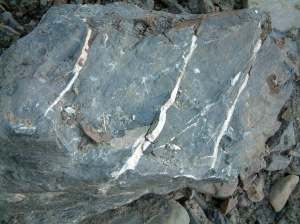
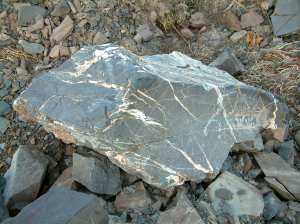
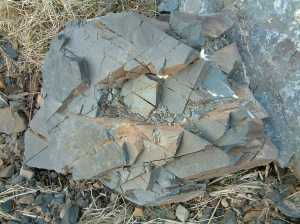
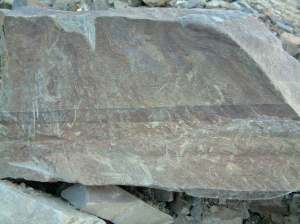
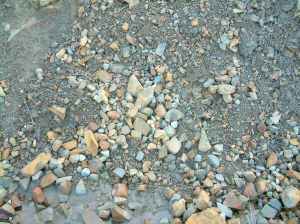
The Palaeozoic era was a dramatic period of Earth development as the land masses split, reformed, moved from south to north amid great changes in climate and environment. Around 416 thousand years ago the land I stand on now travelled as the seabed of the Iapetus Ocean and was pushed up during the collision with Avalonia and Baltica to become the Southern Uplands of the Scottish Borders. The rocks which have been quarried by our cottage to be used to build a 5 mile track between South Mid Hill and Tudhope are greywacke. Well named, it is grey, dark rock with much sandstone, some quartz and feldspar interspersed. It is said to be a ‘texturally immature sedimentary rock found in the Palaeozoic strata’.

During the last Glacial Maximum (ending 12,500 years ago) most of the planet was inhospitable. It was cold and dry with frequent storms. The atmosphere was laden with dust. The sea level was lowered due to the ice sheets locking away the water. If any living thing could survive in such harsh conditions, they would have found the continental shelves above the ocean linking land masses together. Ice covered the whole of the British Isles except for a narrow band of southern England where it was a polar desert. The melting of the glaciers since that time changed the shape and contours of the land mass through water erosion to create valleys and the smooth rolling braes of the Borders. Once more habitable, humans created their own history here, albeit as dramatic as the landscape.

DSCF0043DSCF0044DSCF0046DSCF0045

quarried rock, once the seabed of the Iapetus ocean

quarried rock, once the seabed of the Iapetus ocean

DSCF0038DSCF0039

Posted in anthropocene | Tagged , , | Leave a comment

Blipping in the Scottish Borders

BLIPPING IN THE UK

I live in the Scottish Borders. I love this place, contrasting as it does to all the English city life I have endured during 60 years of my life. The ‘banks and braes’ help me to take time to consider what it means to connect with this wild, mostly untouched environment. It was formed through a mighty collision of land masses 100 thousand years ago. It took nearly 400 thousand years for the land to arrive from the southern hemisphere, pass through the tropics and arrive in the northern hemisphere. The land our cottage stands on was once the seabed of the Iapetus Ocean. How can I not be overwhelmed?

Thanks to reading books and searching the Internet, I am a little better informed about this tiny location on our spinning planet. You can check out the facts for yourself. I may make mistakes as I may have misunderstood the science passed from specialist to layperson through the written word. I do think I have grasped the gist of it though.

My ageing process has made me think about the ageing of the Earth. James Lockhart has postulated this Earth is so old that it is unlikely to last more than another 500 million years. ‘An old lady.’

The surface of the earth remains young as it is constantly changing and reforming. Not so for my skin, though being away from polluting air has helped!

Posted in anthropocene | Leave a comment