
1933: the stirrings of WWII and opportunities for lucrative trade emerging.
I refer you to the book (published 2001) by Edwin Black ‘IBM and the Holocaust’.
It is a magnificent piece of work and reveals the integral aspect of trade and profit during wartime, where holding high moral standards is excluded from the process.
As a child born a couple of years after the war ended, I have been curious about the era before I was born and ever since.
I read books like this which have shocked yet enlightened me about how minority discontent can overturn majority complacency and turn day into never ending night for so many.
I looked up the summary as it best covers this startling piece of work.
Crown Publishing Group, 1 Jul 2001 – History – 528 pages
IBM and the Holocaust is the stunning story of IBM’s strategic alliance with Nazi Germany — beginning in 1933 in the first weeks that Hitler came to power and continuing well into World War II. As the Third Reich embarked upon its plan of conquest and genocide, IBM and its subsidiaries helped create enabling technologies, step-by-step, from the identification and cataloging programs of the 1930s to the selections of the 1940s.
Only after Jews were identified — a massive and complex task that Hitler wanted done immediately — could they be targeted for efficient asset confiscation, ghettoization, deportation, enslaved labor, and, ultimately, annihilation. It was a cross-tabulation and organizational challenge so monumental, it called for a computer. Of course, in the 1930s no computer existed.
But IBM’s Hollerith punch card technology did exist. Aided by the company’s custom-designed and constantly updated Hollerith systems, Hitler was able to automate his persecution of the Jews. Historians have always been amazed at the speed and accuracy with which the Nazis were able to identify and locate European Jewry. Until now, the pieces of this puzzle have never been fully assembled. The fact is, IBM technology was used to organize nearly everything in Germany and then Nazi Europe, from the identification of the Jews in censuses, registrations, and ancestral tracing programs to the running of railroads and organizing of concentration camp slave labor.
IBM and its German subsidiary custom-designed complex solutions, one by one, anticipating the Reich’s needs. They did not merely sell the machines and walk away. Instead, IBM leased these machines for high fees and became the sole source of the billions of punch cards Hitler needed.
IBM and the Holocaust takes you through the carefully crafted corporate collusion with the Third Reich, as well as the structured deniability of oral agreements, undated letters, and the Geneva intermediaries — all undertaken as the newspapers blazed with accounts of persecution and destruction.
Just as compelling is the human drama of one of our century’s greatest minds, IBM founder Thomas Watson, who cooperated with the Nazis for the sake of profit.
Only with IBM’s technologic assistance was Hitler able to achieve the staggering numbers of the Holocaust. Edwin Black has now uncovered one of the last great mysteries of Germany’s war against the Jews — how did Hitler get the names?
About the author (2001)
The son of Polish survivors, Washington-based writer EDWIN BLACK is the author of the award-winning Holocaust finance investigation, The Transfer Agreement, and is an expert on commercial relations with the Third Reich.
And then I refer you to another book by Gordon Thomas, ‘Gideon’s Spies’, (last update published 2009) in which he describes how Robert Maxwell became involved with PROMIS (Prosecutors Management Information System) which was created by a US company, Inslaw. According to federal documents, PROMIS was misappropriated by the Dept of Justice after a visit to Inslaw by an Israeli Mossad representative, Rafi Eitan in 1983.
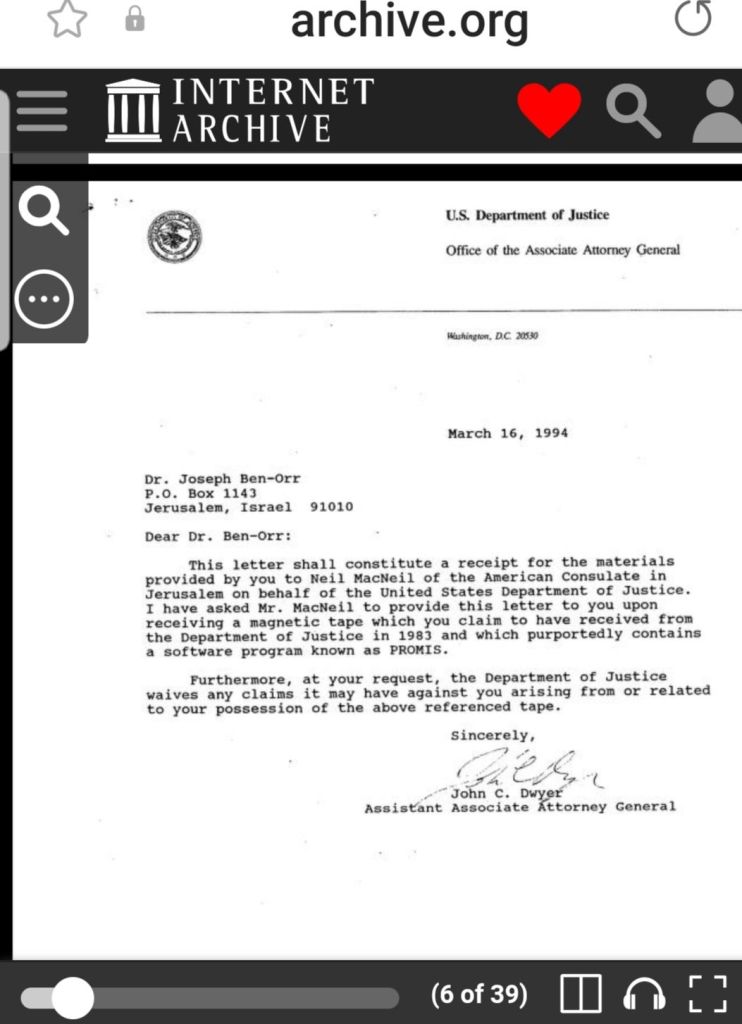
There were two key players linked to the PROMIS software leaving the US:
Rafi Eitan, an Israeli soldier during the War of Independence and the Palestinian Nakba (1948 – 49). He became Mossad’s deputy director of operations.
and his US friend:
Dr. Earl Brian, a young American physician who, when he knew Rafi Eitan, was working for Governor Ronald Reagan in California. Earl Brian was known to have close business ties with Ronald Reagan.
PROMIS was then given or sold to, at profit, Israel and was later licensed to as many as 80 countries by Earl Brian.
Israeli LAKAM programmers rearranged the various components of PROMIS in a such a way that no one could relate it back to Inslaw as their creation. Yet Eitan chose to keep the name for marketing purposes. They streamlined the software to amass and correlate data at a speed and scale beyond human capability.
They also used it to track Palestinians.
Brian Meese, another close friend and business associate of Earl Brian and who had become Presidential counsel to President Ronald Reagan, is thought to have profited from sales of the stolen PROMIS software.
Then this article online explains:
The implications continue: that Meese profited from the sales of the stolen property. That Brian, Meese’s business associate, may have been involved in the October Surprise (the oft-debunked but persistent theory that the Reagan campaign conspired to insure that US hostages in Iran were held until after Reagan won the 1980 election, see sidebar). That some of the moneys derived from the illegal sales of PROMIS furthered covert and illegal government programs in Nicaragua. That Oliver used PROMIS as a population tracking instrument for his White House-based domestic emergency management program.
https://www.wired.com/1993/01/inslaw
Gordon Thomas describes how the final PROMIS was not ready for sale until someone had programmed a trapdoor, so they could track all activities by licensed users in their various countries. To do this, Ben-Menashe was asked by Rafi Eitan if he knew anyone who could do that work. Indeed he did. He was at school with a northern California whizz kid, who had been a child genius and who was likely to take on such a project. Once approached, this person was offered $5,000 for the work (cheap at the price) and this person accepted. Once ready, the software had to be tested.
Jordan was selected as the site, not only because it bordered on Israel, but because it had become a haven for the leaders of the Intifada. From the desert kingdom, they directed the Arab street mobs on the West Bank and Gaza to launch further attacks inside Israel. After an atrocity, PLO terrorists would slip across the border into Jordan, doing so often with the connivance of the Jordanian army.
Consequently, long before the Intifada, Jordan had become a proving ground for Mossad to develop its electronic skills. In the 1970s, Mossad technicians had tapped into the computer IBM had sold to the country’s intelligence service. The information gained had supplemented that provided by the deep-cover Kate’s Rafi Eitan had placed inside King Hussein’s palace. Promis would offer much more.
P.201 Gideon’s Spies
Earl Brian used his company to sell Promis to Jordan and once installed in Amman’s military HQ, ‘they discovered the Jordanians had a French-designed system to track the movement of PLO leaders. Promis was then secretly wired into the French system which PLO leaders the Jordanians were tracking.’ (Gideon’s Spies)
The next sale of PROMIS was to Arafat. Only one person could make that sale, and that was Robert Maxwell.
Maxwell needed little convincing and, in his usual ebullient manner when there was a deal to be profited from, said he had a computer company through which to sell Promis. Degem Computers Limited was based in Tel Aviv and was already playing a useful role in Mossad’s activities. Maxwell had allowed Mossad operatives, posing as Degem employees, to use the company’s suboffices in Central and South America. Now Maxwell saw an opportunity not only to make a healthy profit from marketing Promis through Degem, but to further establish his own importance to Mossad and ultimately Israel.
P.202, ‘Gideon’s Spies’

 borderslynn
Pingback: It’s only men doing business | borderslynn