Our country has been invaded and fought over since the Romans, like lands across the world, there have been many peoples who were conquered, made to live under some ruling empire.
All empires ended. But the world has seen its last empire. The Great British Empire. Since that ended, all land has been fought over as resources become depleted and climate change pushes people away from inhospitable land.
Monarchs of history have interbred, attempting to create allies and access to each other’s resources. That time is over too.
Since 1917, before the end of World War 1, the British monarchs were declared to belong to the anglicised name of the House of Windsor, by King George V.
The House of Windsor
On 17 July 1917, at a meeting of the Privy Council, King George V declared that ‘all descendants in the male line of Queen Victoria, who are subjects of these realms, other than female descendants who marry or who have married, shall bear the name of Windsor’. It remains the family name today.
In 1901, the House of Saxe-Coburg and Gotha succeeded the House of Hanover with the accession of King Edward VII, son of Queen Victoria and Prince Albert of Saxe-Coburg and Gotha.
In 1917 the name change came about due to anti-German sentiment in the United Kingdom during WW1. These feelings reached a peak in March 1917 when the Gotha GIV, a heavy aircraft capable of crossing the English Channel, began bombing London and it became a household name.
Add to that the abdication of King George’s first cousin, Tsar Nicholas II, Emperor of Russia, which raised the spectre of the eventual abolition of all monarchies in Europe. The King changed the family name plus all German titles and house names were anglicized. The name had a long association with monarchy in Britain, through the town of Windsor and Windsor Castle.
There have been four British monarchs of the House of Windsor: King George V, King Edward VIII, King George VI and Queen Elizabeth II.
The German and Russian family blood links were consigned to the past, but they could not remove the ancestral line written in their genetics.
The name Saxe-Coburg-Gotha came into the British Royal Family in 1840 with the marriage of Queen Victoria to Prince Albert, son of Ernst, Duke of Saxe-Coburg & Gotha. Queen Victoria herself was the last monarch of the House of Hanover.
The House of Hanover ruled Britain for nearly 200 years, and this dynasty oversaw the modernisation of Britain. Despite their not insignificant place in British history, the monarchs of the House of Hanover are often glossed over. But the six Hanoverian monarchs were some of Britain’s most colourful characters – their reigns were filled with scandal, intrigue, jealousy, happy marriages and terrible familial relationships.
They lost America but oversaw the rise of the British Empire to span nearly 25% of the world’s population and surface area. The Britain Victoria left in 1901 was dramatically different to the one the German-born George I arrived in in 1714.
The House of Hanover ushered in two famous periods in English history: the Georgian era and the Victorian era, which is where we get our Georgian and Victorian architecture from………
Founded by George, Duke of Brunswick-Lüneburg, the House of Hanover originated in Germany in 1635 as a cadet branch of the House of Welf. Their rise to power in Great Britain and Ireland would come through descendants of this house 79 years later in 1714 under the Act of Settlement 1701, through their cousins Queen Anne, King William III and Queen Mary II. Through the Act of Settlement 1701 and the death of Queen Anne without an heir, they were placed next in line to the throne. Between 1714 and 1901 The Hanoverians gave us six monarchs.
Queen Victoria was the last monarch of the House of Hanover.
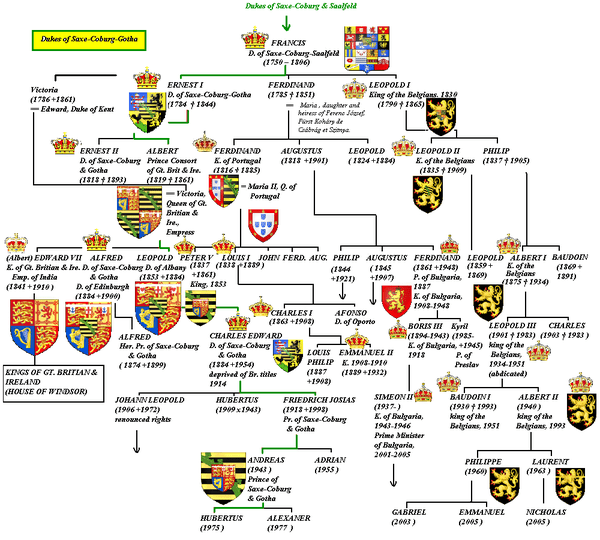
Prince Albert of Saxe-Coburg-Gotha (Francis Albert Augustus Charles Emmanuel) was born on 26 August 1819, just three months after Victoria. Albert’s father and Victoria’s mother were brother and sister (as shown in the tree above), meaning Victoria and Albert were cousins. They married in February 1840.
In those days it was common to marry a cousin, though now it is known the offspring may have genetic problems.
Victoria and Albert had nine children, with their second child Edward becoming King on his mother’s death:
Victoria, Princess Royal
Edward VII of the United Kingdom
Princess Alice
Alfred, Duke of Saxe-Coburg and Gotha
Princess Helena
Princess Louise
Prince Arthur, Duke of Connaught and Strathearn
Prince Leopold, Duke of Albany
Princess Beatrice
Victoria died on 22 January 1901, outliving her beloved husband Prince Albert by forty years, and becoming the country’s longest reigning monarch. During her lifetime the nation saw the Industrial Revolution and British Empire developed dramatically; the Victorian era is a significant chapter in Britain’s history.
Victoria’s eldest son Edward married Princess Alexandra of Denmark in 1863, and they went on to have six children, including George, their second eldest son, who became King in 1910 when Edward passed away. The eldest son Albert died before his father.
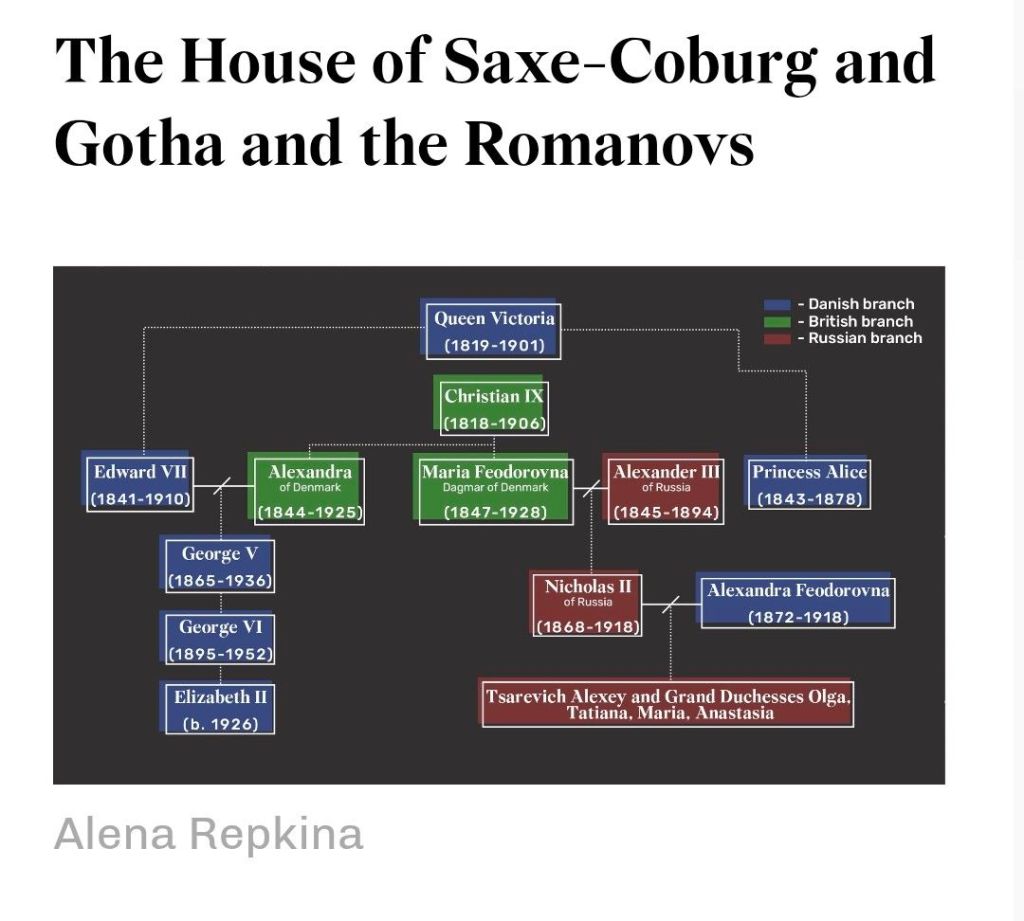
The Russian Romanov Tsar family were related to King George V.
Windsor-Romanov relations.
In 1917, the British king George V (1865-1936) decided to break relations with his two cousins, German Emperor Wilhelm II (1859-1941) and Russian Emperor Nicholas II (1868-1918). After Nicholas II, George V’s first cousin, was overthrown from the Russian throne during the Revolution of 1917, the British Government offered Nicholas II and his family political asylum – but George V opposed this decision, seeing the Romanovs’ presence in his country inappropriate.
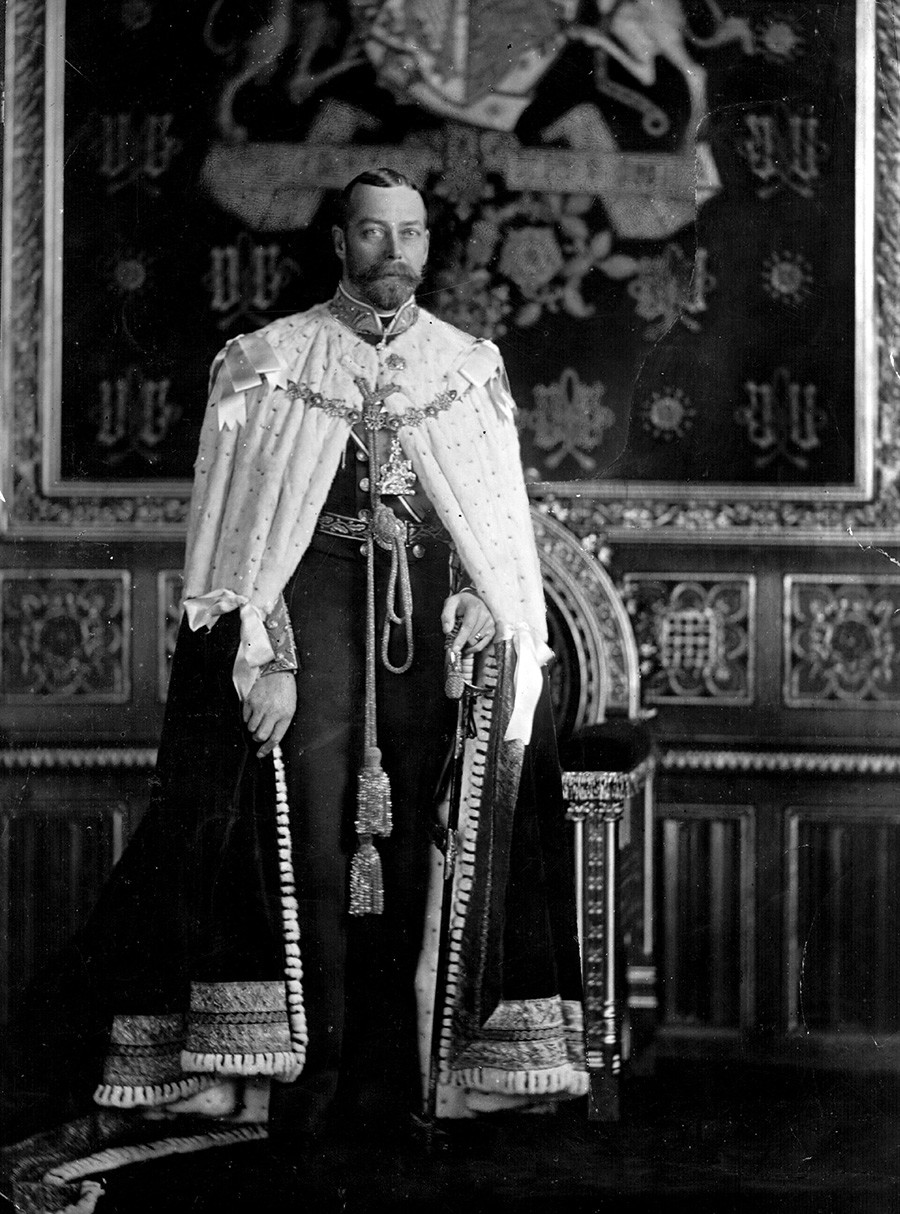
King George V
After Nicholas and his family were killed by the Bolsheviks, George V wrote in his diary: “It was a foul murder. I was devoted to Nicky, who was the kindest of men and thorough gentleman: loved his country and people.”
However, only two years later, a British battleship was sent to Crimea to rescue the 72-year-old Maria Feodorovna (1847-1928), Nicholas II’s mother and, at the same time, George V’s aunt.
Retired, living in the Scottish Borders after living most of my life in cities in England. I can now indulge my interest in all aspects of living close to nature in a wild landscape. I live on what was once the Iapetus Ocean which took millions of years to travel from the Southern Hemisphere to here in the Northern Hemisphere. That set me thinking and questioning and seeking answers.
In 1998 I co-wrote Millennium Countdown (US)/ A Business Guide to the Year 2000 (UK) see https://www.abebooks.co.uk/products/isbn/9780749427917



You must be logged in to post a comment.