Shalom Baranes was born soon after his parents fled Libya amid antisemitic sentiment there, coming to the United States as a child with the help of the Hebrew Immigrant Aid Society, now known as HIAS. He rose to prominence as an architect in Washington, D.C., where he has designed both private and government buildings, including the Pentagon, that trend toward the modern.
=============
Trump’s new White House ballroom architect is a Jewish immigrant who has advocated for refugees
Shalom Baranes is a prominent architect in the D.C. area
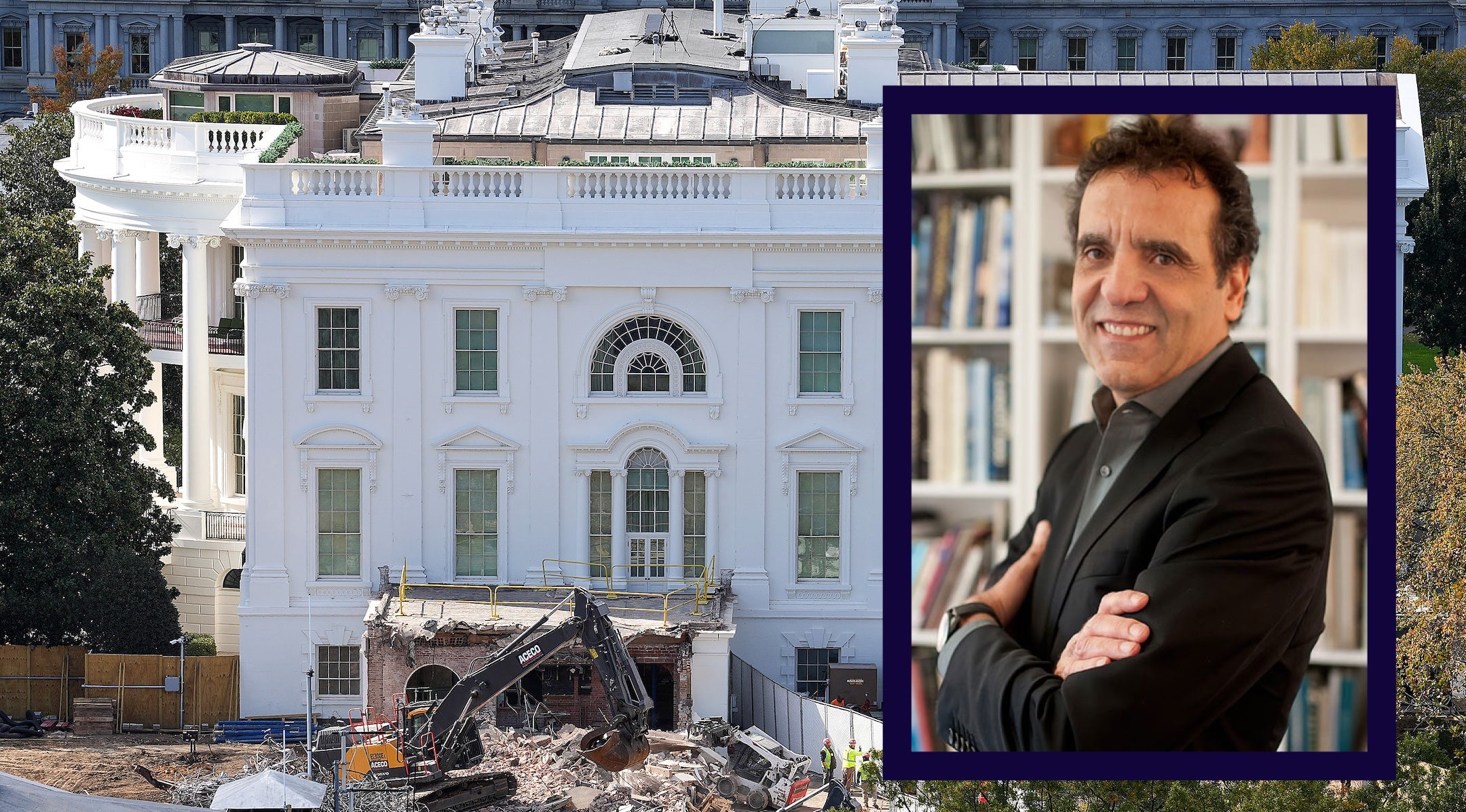
An excavator works to clear rubble after the East Wing of the White House was demolished on Oct. 23, 2025. Shalom Baranes, inset, has been chosen to lead the reconstruction. Photo by Eric Lee/Getty Images; Shalom Baranes Associates
(JTA) — After parting ways with the first architect hired to carry out his vision for the White House’s East Wing, President Donald Trump has picked a replacement — turning to a firm run by prominent Jewish architect who once called on Trump to keep the country’s doors open to refugees and immigrants.
Shalom Baranes was born soon after his parents fled Libya amid antisemitic sentiment there, coming to the United States as a child with the help of the Hebrew Immigrant Aid Society, now known as HIAS. He rose to prominence as an architect in Washington, D.C., where he has designed both private and government buildings, including the Pentagon, that trend toward the modern.
The White House confirmed on Friday that it had chosen his firm, Shalom Baranes Associates, to continue the East Wing project, centered around the ballroom that Trump wishes to construct. Trump clashed with the first architect on the job over the ballroom’s size.
“Shalom is an accomplished architect whose work has shaped the architectural identity of our nation’s capital for decades, and his experience will be a great asset to the completion of this project,” a White House spokesman, Davis Ingle, said in a statement on Friday.
The firm did not immediately publicly confirm its attachment to the project, and Baranes did not reply to a Jewish Telegraphic Agency request for comment.
Baranes’ selection stands out in an administration that has typically favored partisan and ideological loyalists. Baranes is a repeated donor to Democratic candidates who has openly advocated against one of Trump’s signature policies, his efforts to limit refugee admissions.
In 2017, two months into Trump’s first term, Baranes penned an op-ed for the Washington Post about the new president’s travel ban. Trump had declared a ban on migrants from seven mostly Muslim countries and refugees from around the world soon after taking office, igniting wide opposition including from Jewish groups.
“The anti-immigrant sentiment I feel today is nothing new to me,” he wrote. “When my Jewish parents arrived in the United States just a few years after fleeing persecution in an Arab regime, it was as difficult for them to be accepted here as it is for Muslims now.”
Baranes laid out his criticism gingerly while saying he hoped the travel ban would be short-lived.
“As I watch the news and see families struggling to leave their countries and escape tyranny, I wonder who among them will make it to our shores and become part of the next generation of researchers, teachers, inventors, real estate developers and, yes, architects,” he wrote. “My hope is that the Trump administration will take actions to ensure that the travel ban is indeed temporary, so that good, hard-working individuals fleeing tyranny can find a new home as I did — and that each of them will be given the same opportunity to help build this great nation that I had.”
Among the Jewish groups to lobby against Trump’s travel ban was HIAS, the organization that had helped Baranes and his family come to the United States. HIAS declined to comment on his selection as White House architect but said through a spokesperson that the organization was working to respond to Trump’s crackdown on refugees, which the president renewed last week after an Afghan refugee shot and killed a member of the National Guard in Washington.
The ruling could come just before the National Capital Planning Commission, the central planning agency of the federal government, plans to vote on the project. The 12-member commission, the majority of whom are Trump-appointed allies, will hold the public hearing on March 5.
But the judge’s verdict won’t be the end of the saga.
“I know it will be appealed. Whichever side wins, the other side will appeal,” said U.S. District Court Judge Richard J. Leon last month. “So this case is going to go to the DC Circuit, for certain, and, maybe, perhaps even to the Supreme Court. Who knows?”
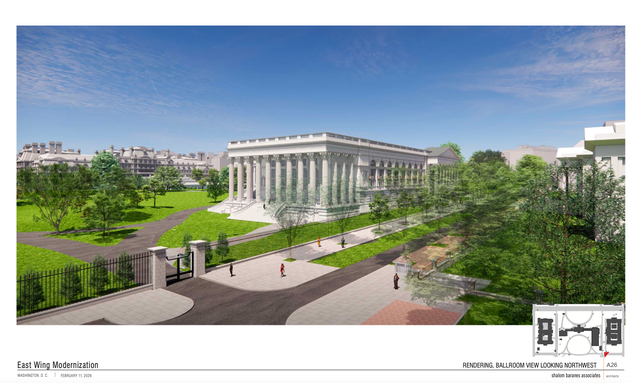
Renderings briefly posted Feb. 13 before being removed reveal the scale of a proposed 89,000-square-foot White House ballroom.
At issue is a lawsuit the National Trust for Historic Preservation filed in December against Trump and several federal agencies, asking to halt construction on the 90,000-square-foot ballroom. The non-profit group argued that Trump should have sought Congress’s authorization before the demolition of the East Wing.
Trump’s team has countered in court that the president did not need approval from lawmakers because the project is not using taxpayer dollars and instead is being funded by private donations.
Trump’s project has gone through various changes since the White House first announced its plans in July, including financing, seating capacity and cost. The price tag jumped from $200 million to $400 million, and the ballroom is now expected to accommodate 1,000 people.
Detailed renderings reveal the scale of the proposed 89,000-square-foot White House ballroom. The images by Shalom Baranes Associates—later removed from the National Capital Planning Commission’s … Show more
The National Capital Planning Commission/Shalom Baranes Associates, Architects
What is the court considering?
Judge Leon, an appointee of President George W. Bush, said there were many “novel” issues at play in the case. He is considering whether the president has the authority to demolish the East Wing and construct the ballroom using a deliberately complicated funding setup with private money while circumventing Congressional authorization.
During last month’s hearing, Leon said he also wanted the Trump administration to clearly state what the “dividing line” was between what is permitted and what is not permitted in terms of future construction and demolition in the White House complex.
Detailed renderings reveal the scale of the proposed 89,000-square-foot White House ballroom. The images by Shalom Baranes Associates—later removed from the National Capital Planning Commission’s … Show more
The National Capital Planning Commission/Shalom Baranes Associates, Architects
“I do think if the plan was to just bulldoze the entire White House and build something completely different in its place,” it would exceed the scope of presidential authorization for “alteration and improvement,” said Jacob Roth, an attorney for the defendants.
“I would hope so,” Leon responded, while also noting that the administration had taken a “pretty expansive interpretation of the language.”
Roth also described the Executive Mansion as the “core site.” He said Congress declared in 1961 by statute that the site was “an important thing to preserve.”
Retired, living in the Scottish Borders after living most of my life in cities in England. I can now indulge my interest in all aspects of living close to nature in a wild landscape. I live on what was once the Iapetus Ocean which took millions of years to travel from the Southern Hemisphere to here in the Northern Hemisphere. That set me thinking and questioning and seeking answers.
In 1998 I co-wrote Millennium Countdown (US)/ A Business Guide to the Year 2000 (UK) see https://www.abebooks.co.uk/products/isbn/9780749427917



 borderslynn