Stablecoins are a type of cryptocurrency designed to maintain a stable value by pegging to fiat currencies, commodities, or financial instruments, aiming to offer a less volatile alternative to cryptocurrencies like Bitcoin.
There are four primary types of stablecoins: fiat-collateralized, commodity-backed, crypto-collateralized, and algorithmic. Each employs different mechanisms to maintain price stability; many can be found through top crypto exchanges.
Despite their potential benefits, investors should be cautious. Stablecoins involve third-party auditors for verification of reserves, which introduces risk in a system aiming to minimize third-party reliance.
Regulatory scrutiny of stablecoins is increasing worldwide due to their growing market impact, with various jurisdictions implementing measures to ensure they are backed by adequate reserves.
Tether (USDT) is the most widely used stablecoin, consistently ranking as one of the top cryptocurrencies by market capitalization, pegged to the U.S. dollar with a 1:1 backing.1
What Are Stablecoins?
Stablecoins, which can be found through top crypto exchanges, are designed to bridge the gap between the unpredictability of popular cryptocurrencies like Bitcoin (BTC) and the stability required for everyday financial transactions. By pegging their value to fiat currencies, commodities, or other financial instruments, stablecoins offer a crypto alternative with reduced volatility. As a result, they provide a more consistent medium of exchange capable of fulfilling daily transactional needs, unlike their more volatile cryptocurrency counterparts.
Stablecoins are an important part of the cryptocurrency market. Their value is designed to remain steady and they let people move money.Investopedia / Daniel Fishel
The Significance of Stablecoins in the Cryptocurrency Market
Bitcoin is the most popular cryptocurrency. On Oct. 6, 2025, it reached an all-time high of $126,198.07; however, it experiences significant price swings. For example, its price increased from around $6,000 in March 2020 to over $63,000 in April 2021, then dropped nearly 50% in the next two months. It often fluctuates over 10% in just a few hours.2
This volatility appeals to traders but makes everyday transactions risky for buyers and sellers. Investors holding cryptocurrencies for long-term appreciation don’t want to become famous for paying 10,000 Bitcoins for two pizzas. Similarly, most merchants don’t want to lose money if the price of a cryptocurrency plunges after they get paid in it.
For a currency that isn’t legal tender to work as a medium of exchange, it must stay relatively stable to ensure short-term purchasing power. In traditional fiat exchange, even 1% daily movements are rare.
As the name implies, stablecoins aim to address this problem by promising to hold the value of the cryptocurrency steady in a variety of ways.
Important
Investors should be cautious with stablecoins because they need an auditor to verify their reserves. While most auditors are trustworthy, auditing introduces another third party into a system meant to minimize third-party involvement.
Some argue that stablecoins are unnecessary because the U.S. dollar is widely accepted. Others believe digital currencies not controlled by central banks are the future. With that in mind, four types of stablecoins, based on the assets used to stabilize their value, have been created.
Tether (USDT) and TrueUSD (TUSD) are popular stablecoins backed by U.S. dollar reserves and denominated at parity to the dollar.34 As of December 2025, Tether (USDT) was the third-largest cryptocurrency by market capitalization, worth more than $184 billion.5
Posted: 5 February 2025, 11:00 CETUpdated: 25 June 2025, 10:55 CET5 min read
Giancarlo Devasini, a former plastic surgeon turned crypto billionaire, is one of Italy’s top 5 richest people. He’s the Chief Financial Officer of Bitfinex, a major crypto exchange, and Tether, the company behind the USDT stablecoin.
Devasini is the largest shareholder of Tether, with an estimated 47% stake, which, according to Forbes, is the source of his $9.2 billion fortune. This makes him the 3rd richest person in crypto, behind Binance founder Changpeng Zhao (CZ) and Coinbase’s Brian Armstrong.
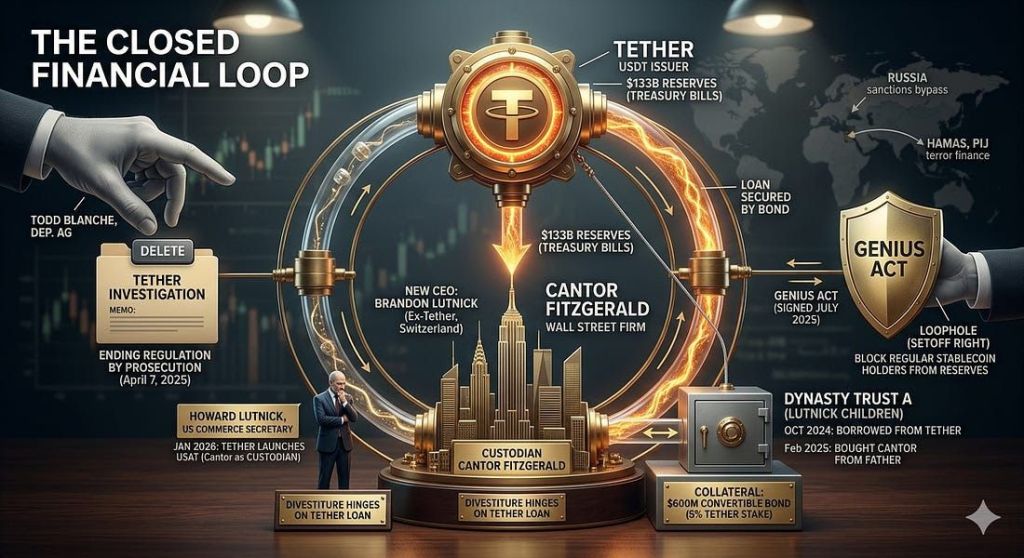
Cantor Fitzgerald is Tether’s investment banker and has advised the stablecoin issuer with its push into the Bitcoin mining industry, Swan noted in the filing.
Nev Shalev found Epstein wrote emails ( located in The Files ) in 2013 to Thorbjørn Jagland in order he try and get Putin to utilise his plan to undermine the US dollar using the concept of stablecoin. This was a year before Putin invaded and occupied Crimea.
Already there were reported assertions about Thorbjørn Jagland (a month ago) and his relationship with Jeffrey Epstein, prior to Nev Shalev’s (see Narativ,Substack) finds:
And a trove of emails spanning years suggests that ThorbjørnJagland, a former prime minister, foreign minister, Nobel peace prize chair and secretary-general of the Council of Europe may have accepted luxury holidays to Epstein’s Palm Beach resort and his private Caribbean island, sought personal loans and engaged in sexual banter with Epstein. Police at Norway’s economic crimes unit are investigating Jagland on suspicion of aggravated corruption. Jagland has denied wrongdoing and through lawyers says he is “confident of the outcome” of the investigation.
Putin’s name appears more than 1,000 times in the released Epstein files, but the majority of those references come from news clippings and media digests Epstein received rather than his personal correspondence.
Epstein’s private emails, however, show repeated attempts in the 2010s to arrange a meeting with the Russian president, often through former Norwegian prime minister Thorbjørn Jagland. There is no evidence in the Justice Department files that such a meeting ever took place.
The Genius Act if July 2025 has now passed into law:
Tether’s situation is more complicated. USDT is the dominant stablecoin by market cap, but Tether is not a U.S.-based entity and has historically been less transparent about reserve composition. The GENIUS Act applies to any stablecoin used by U.S. persons, which means Tether either needs to comply or risk losing access to U.S. exchanges. How Tether navigates this over the next year will be one of the most consequential stories in crypto.
For smaller stablecoin projects, the compliance bar just got significantly higher. A startup issuing a dollar-pegged token from a DAO cannot meet monthly audited reserve requirements the way a regulated financial institution can. The law effectively consolidates the market around well-capitalized, compliant issuers.
Banks Are Coming, and the FDIC Already Made the First Move
On December 16, 2025, the FDIC approved a proposed rule that would let FDIC-supervised banks issue payment stablecoins through subsidiaries. The OCC followed with its own proposed rulemaking on February 25, 2026. Both agencies are working toward a July 18, 2026 deadline to finalize regulations, exactly one year after the law was signed.
This is the part that most crypto-native commentary underestimates. The GENIUS Act goes beyond restricting existing stablecoin issuers. It is an on-ramp for traditional banks to enter the stablecoin market. JPMorgan, Bank of America, and any FDIC-insured institution can now apply to issue their own dollar tokens. They bring existing deposit infrastructure, regulatory relationships, and distribution networks that dwarf anything in crypto today.
The practical effect over the next two to three years could be a stablecoin market that looks very different from the current USDT/USDC duopoly. Bank-issued stablecoins with FDIC-supervised reserve structures could capture significant market share, particularly for institutional use cases like settlement, payroll, and cross-border payments.
Retired, living in the Scottish Borders after living most of my life in cities in England. I can now indulge my interest in all aspects of living close to nature in a wild landscape. I live on what was once the Iapetus Ocean which took millions of years to travel from the Southern Hemisphere to here in the Northern Hemisphere. That set me thinking and questioning and seeking answers.
In 1998 I co-wrote Millennium Countdown (US)/ A Business Guide to the Year 2000 (UK) see https://www.abebooks.co.uk/products/isbn/9780749427917

:max_bytes(150000):strip_icc():format(webp)/terms_s_stablecoin_FINAL-89e1671b1f24486b84b74cebe6836573.jpg)



Pingback: MUSK, THIEL grew up in apartheid South Africa | borderslynn