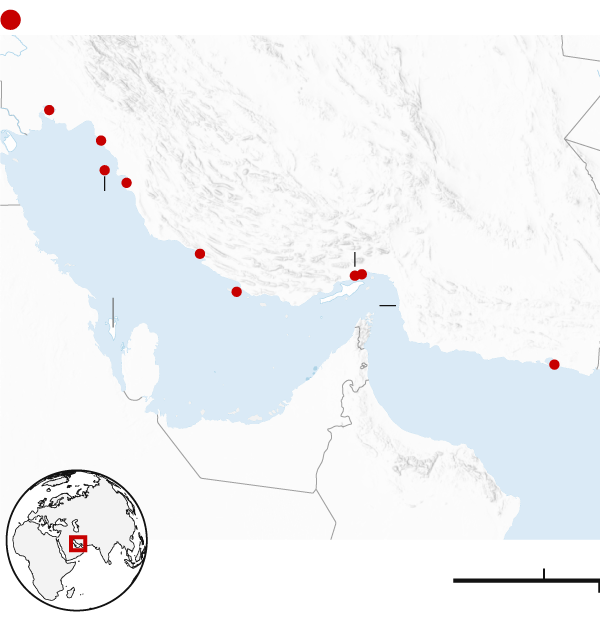
IMO reports 3,000 vessels and 20,000 seafarers trapped in the Persian Gulf after Iran shut the Strait of Hormuz. 16 ships attacked, 15,000 cruise passengers stranded.
Ships floating in the Persian Gulf off the coast of Dubai near the Strait of Hormuz on March 28, 2026. (Supplied: Sentinel Hub)
Link copiedShare
Interviews and first-hand accounts from sailors stranded in the Persian Gulf — under threat of drone attacks, missiles, and exploding boats — reveal an increasingly dire humanitarian crisis unfolding.
Iran’s blockade of one of the world’s most critical shipping lanes, the Strait of Hormuz, has unleashed pain on global markets.
The normally busy strait has been mostly empty since the start of the war. But inside the Persian Gulf, some 2,000 ships remain.
And while the US-Israel war with Iran rages on, the crews on those stranded ships are facing their own battle of attrition.
And now the blockade along Iranian ports to deny them sales of oil:
IMF Portwatch
Strait of Hormuz reopens under Ceasefire, but 800+ ships remain stranded amid uncertainty
Shipowners are rushing to understand the fine print of a US-Iran ceasefire that could temporarily unblock the Strait of Hormuz and open an exit for more than 800 vessels trapped in the Persian Gulf.
At least 2 ships exit Gulf from Iran despite US blockade: Tracking data
13m
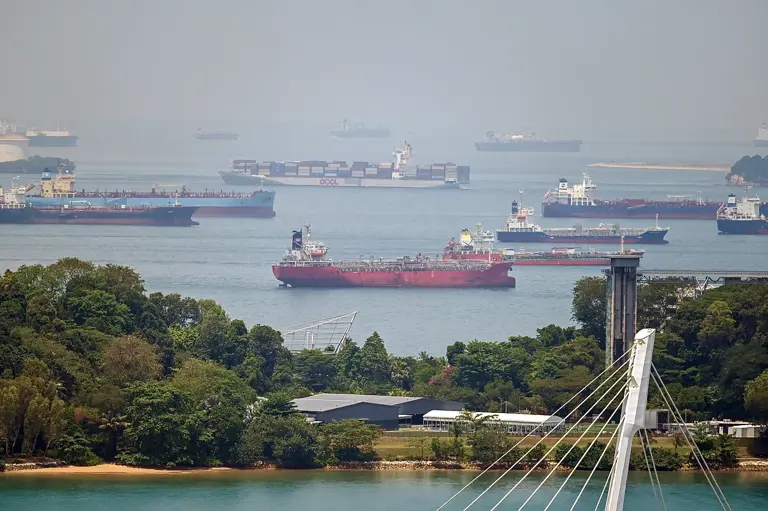
A container ship (top C) sails past oil tankers anchored along Singapore straits in Singapore on April 14, 2026.
[Editor’s Note: Follow Khaleej Times live blog amid US-Israel-Iran war for the latest regional developments.]
At least two ships sailing from Iranian ports crossed the Hormuz Strait on Monday despite a US military blockade, maritime tracking data indicated Tuesday.
They were among at least four Iran-linked vessels that used the route after Washington’s blockade came into effect at 1400 GMT on Monday, according to maritime data provider Kpler.
The Liberia-flagged bulk carrier Christianna crossed after unloading 74,000 tonnes of corn at the Iranian port of Bandar Imam Khomeini, passing Iran’s Larak Island in the strait around 1600 GMT on Monday, Kpler data showed.
Iran war latest: US-sanctioned ships pass through Strait of Hormuz as Trump blockade begins
Iran has been accused of “economic terrorism” in the Strait of Hormuz. Ships have been warned they could face now capture by the US. But two tankers made it through as Trump’s blockade of the crucial route began.
Operating like an Uber taxi in the Strait of Hormuz?:
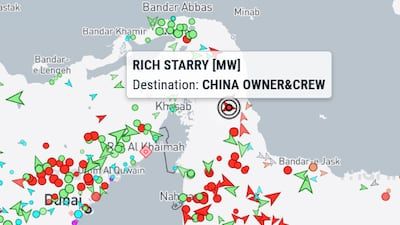
Meanwhile, as the world watches how the US will enforce its blockade in the Strait of Hormuz, Malawi-flagged, Chinese-owned tanker Rich Starry passed through the waterway.
A Chinese tanker under US sanctions, which passed through the Strait of Hormuz earlier on Tuesday after the US imposed a blockade on the waterway, was seen turning back late afternoon.
Rich Starry, a medium-range tanker, initially appeared to have made the journey, becoming the first to sail through the strait since the US began its operation on Monday evening, data from MarineTraffic and VesselFinder showed. However, it was seen heading back towards Hormuz around 5.30pm UAE time. US President Donald Trump imposed the blockade after US-Iran talks in Islamabad on Saturday failed to end the war and reopen the channel.
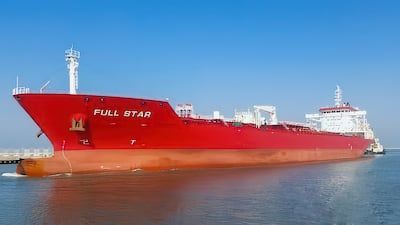
Rich Starry, known previously as Full Star, is carrying about 250,000 barrels of methanol and the tanker and its owner, Shanghai Xuanrun Shipping, were placed under US sanctions for dealing with Iran, Reuters reported. Two more tankers under US sanctions, the Murlikishan, which has carried Russian and Iranian oil, and Panama-flagged Peace Gulf, are also attempting to pass through the strait on Tuesday, Reuters said.None of the three ships transiting the strait were heading to Iranian ports.
The article goes on to explain:
The waterway, through which about 20 per cent of the world’s oil and gas normally passes, was effectively closed by Iran during its 40-day war with the US and Israel, leading to a surge in oil and gas prices and affecting global supply chains.
Before the war began on February 28, about 140 ships passed through the waterway each day. A maximum of 14 a day have travelled through since the two-week ceasefire was agreed to by the US and Iran on April 8. An estimated 230 vessels loaded with oil are stuck in the Arabian Gulf.
Mr Trump on Monday said 34 ships had sailed through the strait the previous day, without providing further details.
Twenty-eight commercial vessels crossed through the strait during the weekend, according to Kpler. “Traffic stayed weak on Monday, with just six commercial vessel transits versus 14 on Sunday, indicating continued subdued activity rather than any meaningful rebound,” Ana Subasic, trade risk analyst at the market intelligence firm, told The National.
The US blockade may support some incremental movement while the ceasefire holds, “particularly if owners interpret the enforcement posture as more targeted than initially feared”, Ms Subasic said.
“That said, we would stop short of describing this as a meaningful normalisation of traffic at this stage. There remains enough uncertainty around enforcement, counterparty exposure, insurance and overall operating risk from both sides that many market participants are likely to remain cautious and in a wait-and-see mode for the near term,” she added.
The US naval blockade of the strait moves the situation “from a price shock to a structural disruption of global trade”, said Raj Abrol, chief executive of risk platform Galytix.
“The impact goes well beyond energy prices – it ripples through shipping routes, insurance premiums, supply chains and input costs across every sector. This blockade only confirms that we should expect protracted volatility across all of these indicators, not a return to stability.”
Meanwhile, China’s Foreign Ministry on Tuesday called the US blockade of Iranian ports “dangerous and irresponsible”.
The move by the US to increase military deployments and impose a targeted blockade will deepen the conflict and further jeopardise the safety of navigation through the strait, media reports cited ministry spokesman Guo Jiakun as saying.
China urges all parties to respect the current ceasefire and remain committed to dialogue and peace talks, the official added.
During the war, Iran earned about $9 billion from crude exports, which exceeds it daily profits before the start of the conflict, energy intelligence company Kpler found. The US blockade is expected to cut about $150 million a day in oil revenue for Tehran.
About 190 million barrels of Iranian crude are at sea, with an estimated 50 million barrels west of Singapore and 140 million east of it, and most of it is destined for China, Homayoun Falakshahi, head of oil analytics at Kpler, told The National.
UNCLOS (United Nations Convention on the Law of the Sea)
WHY EVERY COUNTRY HAS A STAKE
Singapore is not alone in expressing its concern. The Gulf states, facing direct consequences from the closure of the Strait of Hormuz, have also rejected Iran’s imposition of tolls and called for passage rights to be upheld. The International Maritime Organization (IMO) has reiterated that such tolls would set a dangerous precedent.
It is tempting to see these rules as something that mainly benefits powerful naval states and large shipping states. However, navigational rights have never just been about the passage of warships and tanker fleets.
They were always grounded in something more fundamental that benefits all states: the freedom of trade.
Take the 11-member Association of Southeast Asian Nations (ASEAN), 10 are coastal or archipelagic states that have significantly benefitted from the expansion of coastal state jurisdiction under UNCLOS (with the exception of geographically disadvantaged Singapore). The Philippines and Indonesia fought for and gained vast tracts of maritime space through their archipelagic waters, while they and other coastal ASEAN states acquired 200-nautical mile exclusive economic zones (EEZs).
While these countries may not be the largest flag states in the world nor the biggest naval powers, they have critical maritime interests and are dependent on maritime trade.
Retired, living in the Scottish Borders after living most of my life in cities in England. I can now indulge my interest in all aspects of living close to nature in a wild landscape. I live on what was once the Iapetus Ocean which took millions of years to travel from the Southern Hemisphere to here in the Northern Hemisphere. That set me thinking and questioning and seeking answers.
In 1998 I co-wrote Millennium Countdown (US)/ A Business Guide to the Year 2000 (UK) see https://www.abebooks.co.uk/products/isbn/9780749427917





You must be logged in to post a comment.