Franklin D. Roosevelt established a significant relationship with Gulf states, particularly Saudi Arabia, during a historic meeting with King Abdul Aziz Ibn Saud aboard the USS Quincy on February 14, 1945. This meeting laid the groundwork for long-term U.S.-Saudi relations, primarily focused on securing access to Saudi oil reserves. Sky HISTORY TV Channel Brookings
Since the build up of US troops to assure protection and create a safe place to trade (in US petrodollars) the Gulf States have become a hub of prosperity and had a bright, safe future to attract talent from around the world. Since the Israeli – US illegal war on Iran, the US presence on GCC territory has become a magnet for comprehensive and catastrophic attacks from asymmetric warfare the US had not expected.
It began (January 13, 2026) with the realisation by the Trump administration, that Americans would be in danger in Iran:
Trump orders Americans to evacuate Iran immediately as military chaos looms
The State Department has issued an urgent directive for all American citizens to leave Iran immediately, citing escalating protests and potential violence, as Trump threatens military action
The US Embassy in Iran has issued an urgent warning for all American citizens to leave the country immediately, as escalating protests threaten to turn violent, potentially resulting in arrests and injuries.
NPR has learned that hundreds of sailors were evacuated back to the United States from their base in Bahrain after the base was attacked by Iranian missiles and drones. In addition to the base in Bahrain, NPR has learned that there have been evacuations at other U.S. military bases in the region, though the exact details are unknown at this point.
Bahrain is the home of the Navy’s 5th Fleet, making it a central hub for providing maritime security in the Middle East region, including protecting commercial shipping. The country is an island in the Persian Gulf that sits roughly 124 nautical miles away from the coast of Iran, which makes Bahrain well within range of Iranian drone and missile strikes.
Around 8,000 people were stationed at the base in Bahrain before the U.S. attacked Iran on Feb. 28.
On the opening day of the war, the base, known as Naval Support Activity (NSA) Bahrain, was struck multiple times. Posts on social media showed a ballistic missile and Iraniandrones slamming into the base. Satellite imagery from the company Planet shows that at least seven buildings in and around the base were struck between Feb. 28 and March 6.
And the consequences of this disastrous illegal war has put the global economy into a spiral from which it will be hard to recover:
Economic shock from Iran war risks driving up global debt levels, says IMF
Conflict is pushing up price of energy and food, fuelling higher borrowing costs and hitting growth, report says
The Iran war risks triggering a rise in global debt levels, forcing governments to choose between cushioning a cost of living shock and maintaining sound public finances, the International Monetary Fund has warned.
Against a volatile backdrop of the Middle East conflict, the Washington-based fund said the war could add to the already strained position of government finances throughout the world.
In its half-yearly fiscal monitor, the IMF said global debt levels were on track to increase because the war was pushing up the price of energy and food, fuelling higher government borrowing costs, and hitting economic growth.
After a rise in gross government debt levels to almost 94% of GDP last year, it warned this figure was on track to reach 100% by 2029, a level previously reached only in the aftermath of the second world war.
“The outbreak of war in the Middle East has added a new source of fiscal pressure to an already strained global landscape,” it said in the report.
“The conflict has material global reach, disrupting energy supplies, tightening financial conditions, and forcing governments to choose between shielding their populations from price spikes and preserving fiscal space.”
Global energy prices have surged since the first US-Israeli airstrikes on Iran on 28 February, risking a renewed inflation shock that has fuelled a sell-off in global debt markets – driving up borrowing costs for governments worldwide.
The IMF said on Tuesday that a further escalation of the conflict could trigger a global recession that would affect the UK more than any other G7 nation.
As finance ministers from around the world gather in Washington for the fund’s spring meetings, including the UK chancellor, Rachel Reeves, the IMF said any energy support schemes to shield the impact for households and businesses should be targeted and temporary.
Highlighting the risk to public finances worldwide after a succession of economic shocks had driven global debt levels higher in the past two decades, it said: “Support should be targeted and temporary, focusing on those most exposed and least able to absorb price increases.”
It also warned countries with precarious public finances against using further borrowing to cushion the blow. “A better approach is to reallocate spending within the same limits and prioritise crisis-related spending (which could be more politically feasible).
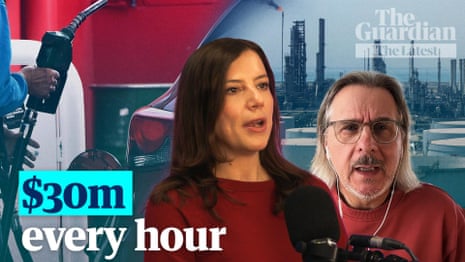
How big oil is cashing in on Iran war – The Latest
“The alternative is to lock in higher debt and higher interest costs, which will eventually force tougher choices – or worse, destabilise government debt markets and worsen conditions today.”
Warning that governments adding to borrowing could risk losing confidence in financial markets, the fund highlighted the fallout in the UK from Liz Truss’s 2022 mini budget.
“Episodes of market repricing in Japan, the US, and parts of Europe reflect heightened sensitivity to fiscal slippages and weak medium-term frameworks,” the IMF said.
“Although none have matched the scale of the United Kingdom’s 2022 episode, the message is clear: higher debt, fiscal uncertainty, and delayed consolidation now translate more rapidly into higher borrowing costs.
Qatar hosts one fourth of US military in GCC, and Wajee Lion suggests they will likely not be hosting them for much longer.
Source: See Wajee Lion, a human rights activist, Substack.
He has also written about the Kafala system in the Middle East which often results in abuses of human rights, it being a form of modern day slavery.
Those trapped in the Kafala system are unable to be rescued by their families. Some have already been killed or injured in drone attacks:
The kafala system is a sponsorship system in the Middle East that ties the residency and employment status of migrant workers to a specific employer, giving the employer significant control over the worker’s ability to change jobs or leave the country. This system has been criticized for facilitating exploitation and abuse of migrant workers. Wikipedia walkfree.org
Retired, living in the Scottish Borders after living most of my life in cities in England. I can now indulge my interest in all aspects of living close to nature in a wild landscape. I live on what was once the Iapetus Ocean which took millions of years to travel from the Southern Hemisphere to here in the Northern Hemisphere. That set me thinking and questioning and seeking answers.
In 1998 I co-wrote Millennium Countdown (US)/ A Business Guide to the Year 2000 (UK) see https://www.abebooks.co.uk/products/isbn/9780749427917