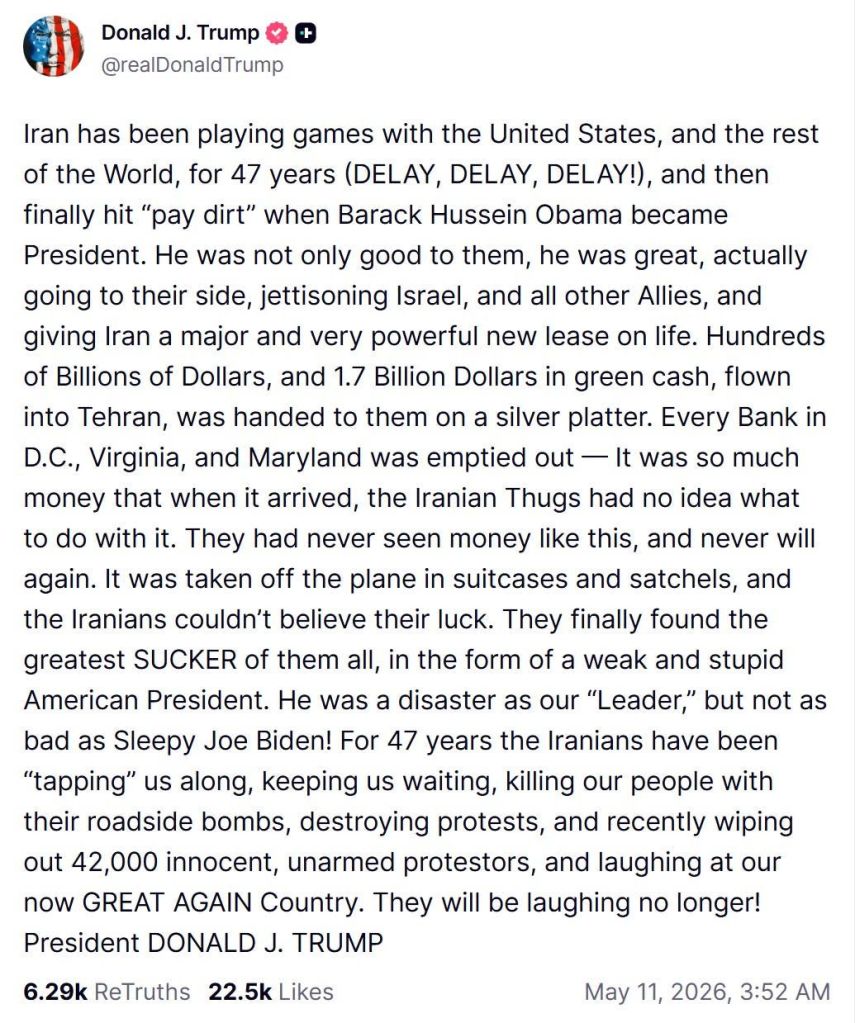
The truth is not to be found on Truth Social. Today Trump’s response to the Iranian proposal is not truly reflecting historical fact about monies refunded to Tehran by Obama. Trump merely repeats a Republican lie regularly promoted since his first term as President.
US payment of $1.7 billion to Iran made entirely in cash
WASHINGTON (AP) — The Obama administration acknowledged late Tuesday that its transfer of $1.7 billion to Iran earlier this year was made entirely in cash, using non-U.S. currency, as Republican critics of the transaction continued to denounce the payments.
Treasury Department spokeswoman Dawn Selak said in a statement the cash payments were necessary because of the “effectiveness of U.S. and international sanctions,” which isolated Iran from the international finance system.
The $1.7 billion was the settlement of a decades-old arbitration claim between the U.S. and Iran. An initial $400 million of euros, Swiss francs and other foreign currency was delivered on pallets Jan. 17, the same day Tehran agreed to release four American prisoners.
The Obama administration had claimed the events were separate, but recently acknowledged the cash was used as leverage until the Americans were allowed to leave Iran. The remaining $1.3 billion represented estimated interest on the Iranian cash the U.S. had held since the 1970s. The administration had previously declined to say if the interest was delivered to Iran in physical cash, as with the principal, or via a more regular banking mechanism.
Earlier Tuesday, officials from the State, Justice and Treasury departments held a closed-door briefing for congressional staff on the payments, according to a Capitol Hill aide familiar with the session. The officials said the $1.3 billion was paid in cash on Jan. 22 and Feb. 5. The aide was not authorized to speak publicly and requested anonymity.
The money came from a little-known fund administered by the Treasury Department for settling litigation claims. The so-called Judgment Fund is taxpayer money Congress has permanently approved in the event it’s needed, allowing the president to bypass direct congressional approval to make a settlement. The U.S. previously paid out $278 million in Iran-related claims by using the fund in 1991.
The Brookings Institute gives an in depth historical account, here is an extract:
Why did the United States pay Iran?
In the 1960s and 1970s, Iran was the largest partner of the U.S. Foreign Military Sales (FMS) Program. As an Obama administration official explained earlier this year, “As part of the FMS Program, a Trust Fund was established with Iranian funds to pay U.S. contractors as work progressed on the various contracts.” In February 1979, days before the culmination of Iran’s revolution, the United States and Iran agreed to a Memorandum of Understanding (MoU) that halted these payments and voided many of the remaining purchases. The MoU also called for Iran’s unexpended FMS funds to be placed in an interest-bearing account.
Later that year, after Iran’s seizure of the U.S. Embassy in Tehran and the detention of the American diplomats, the Carter administration froze all Iranian assets in the United States. The standoff was resolved nearly 15 months later, with an agreement that freed the hostages and established the Iran-U.S. Claims Tribunal to resolve the labyrinth of financial and commercial disputes that had emerged.
In 1982, Iran filed a claim with the Tribunal pertaining to the FMS Trust Fund, which Lisa Grosh, Assistant Legal Advisor at the Department of State, has described as “a multi-billion dollar breach-of-contract dispute covering 1,126 huge military sales contracts.”
Grosh stated that the two sides engaged in some 40 rounds of negotiations “at this level” over several decades. Iran ramped up efforts to adjudicate the claim in 2015, asking the Tribunal to schedule comprehensive hearings on the outstanding FMS claims and requesting a preliminary ruling. The FMS Trust Fund amounted to $600 million until the George H. W. Bush administration returned $200 million to Iran in a partial settlement in 1990.
Who paid who? And how?
The settlement announced in January involved two parts: return of the $400 million principal and payment of $1.3 billion in interest.
To return the principal, the Treasury, working with the Defense Finance and Accounting Service (DFAS) and the Federal Reserve Bank of New York, made a $400 million wire transfer from DFAS to the Swiss National Bank. The $400 million was then converted into Swiss francs and withdrawn in franc banknotes, which were transferred to Geneva. On January 17, the banknotes were disbursed to an official from the Central Bank of Iran.
The interest was paid from the Judgment Fund, which pays “court judgments and Justice Department compromise settlements of actual or imminent lawsuits against the government.” For a payment to be made by the Judgment Fund, Treasury must receive confirmation from the Attorney General that the settlement is in the United States’ best interests. According to Mary McCord, Principal Deputy Assistant Attorney General, National Security Division at the Department of Justice, “[a]ssessment of a settlement payment from the Judgment Fund includes consideration of the exposure that the United States faces from the claim proposed for settlement, … likelihood of an adverse ruling against the United States, the likely size of such an award, the background of the litigation, the tribunal, relevant legal arguments, relevant facts and governing legal doctrines.”
Since the Judgment Fund does not allow the processing of individual claims of amounts over ten digits, the agreed upon interest—$1.3 billion—was split into 13 claims of $99,999,999.99 and one claim of the remaining $10,390,236.28. These amounts were transferred from the Judgment Fund to the Dutch National Bank, where they were converted into euros and withdrawn in euro banknotes. The Dutch bank then disbursed the notes to a representative from the Central Bank of Iran.
Why was interest paid?
The 1979 MoU stipulated that the unexpended funds would be placed in an interest-bearing account. As it turns out, these funds were not based in such an account—no U.S. administration implemented that requirement. The reasons for this are not clear. Former Undersecretary of Defense for Policy Eric Edelman, who testified on this issue before the Senate, noted that the United States “does not let [FMS accounts] accrue interest.”
Still, most if not all other claims before the Iran-U.S. Claims Tribunal have incorporated compensation for accrued interest. This is consistent with the position adopted by the Treasury Department at the outset of the 1979 assets freeze, although in nearly every case the amount of the interest to be paid has been subject to some haggling between Washington and Tehran.
Obama administration officials maintain that a Tribunal decision may have resulted in a much larger judgment on the issue of accrued interest.
Retired, living in the Scottish Borders after living most of my life in cities in England. I can now indulge my interest in all aspects of living close to nature in a wild landscape. I live on what was once the Iapetus Ocean which took millions of years to travel from the Southern Hemisphere to here in the Northern Hemisphere. That set me thinking and questioning and seeking answers.
In 1998 I co-wrote Millennium Countdown (US)/ A Business Guide to the Year 2000 (UK) see https://www.abebooks.co.uk/products/isbn/9780749427917



You must be logged in to post a comment.