After multiple sources previously told the Guardian that Erik Prince – Maga ally and founder of the now defunct mercenary company Blackwater – was looking to work with Ukraine’s invaluable drone sector, recent Securities and Exchange Commission (SEC) documents confirm he now is.
Swarmer, which bills itself as a battle-tested Ukrainian startup specializing in autonomous drone software, filed for an initial public offering and has recruited Prince to help sell the company as non-executive chair.
“Swarmer is a software-first defense technology company focused on collaborative autonomy and intelligent swarming, originating from the cauldron of modern combat in Ukraine,” said Prince in a letter to prospective stockholders in the filing, released earlier this month.
“Since April 2024, Swarmer’s platform has been deployed in Ukraine with more than 100,000 real-world missions in active combat environments, informing the software and machine-learning models that feed into it.”
Defense industry hawks have eyed the battlefield intelligence the Ukrainian military has accrued in over four years of combat with Russia. The war has caused close to 2m casualties, but global military elites, like Prince, are also seeing glimpses of what a future war between world powers might look like and what products the US or its geopolitical rival China will need to buy.
In 2023, Prince was linked to a proposed deal to deploy over 2,000 mercenaries from Colombia, Mexico, and Argentina to North Kivu to secure mining areas and counter the M23 rebel advance. This plan, reportedly brokered by the UAE, did not materialize, and no formal agreement was reached. Similarly, earlier discussions about deploying thousands of contractors to eastern Congo also failed to culminate in a contract. These unfulfilled proposals highlight Prince’s long-standing interest in the DRC’s mineral and security landscape, though they also underscore the challenges of operating in conflict zones like North Kivu, where M23 rebels have consolidated control.
Current Focus: Katanga, Not Kisangani
Prince’s current operations are concentrated in the southern Katanga province, far from the conflict-ridden eastern regions controlled by M23 rebels. The Katanga region, rich in copper and cobalt, is a strategic priority for the DRC government, which seeks to recover lost revenue and strengthen its economic position amid broader U.S.-DRC talks on a minerals-for-security deal. There is no verified evidence that Prince has deployed military troops or advisers in Kisangani, a city approximately 250 miles from M23’s westernmost advance in Walikale. Reports indicate that M23 rebels have not yet reached Kisangani, and Prince’s activities remain geographically and operationally distinct from this region.
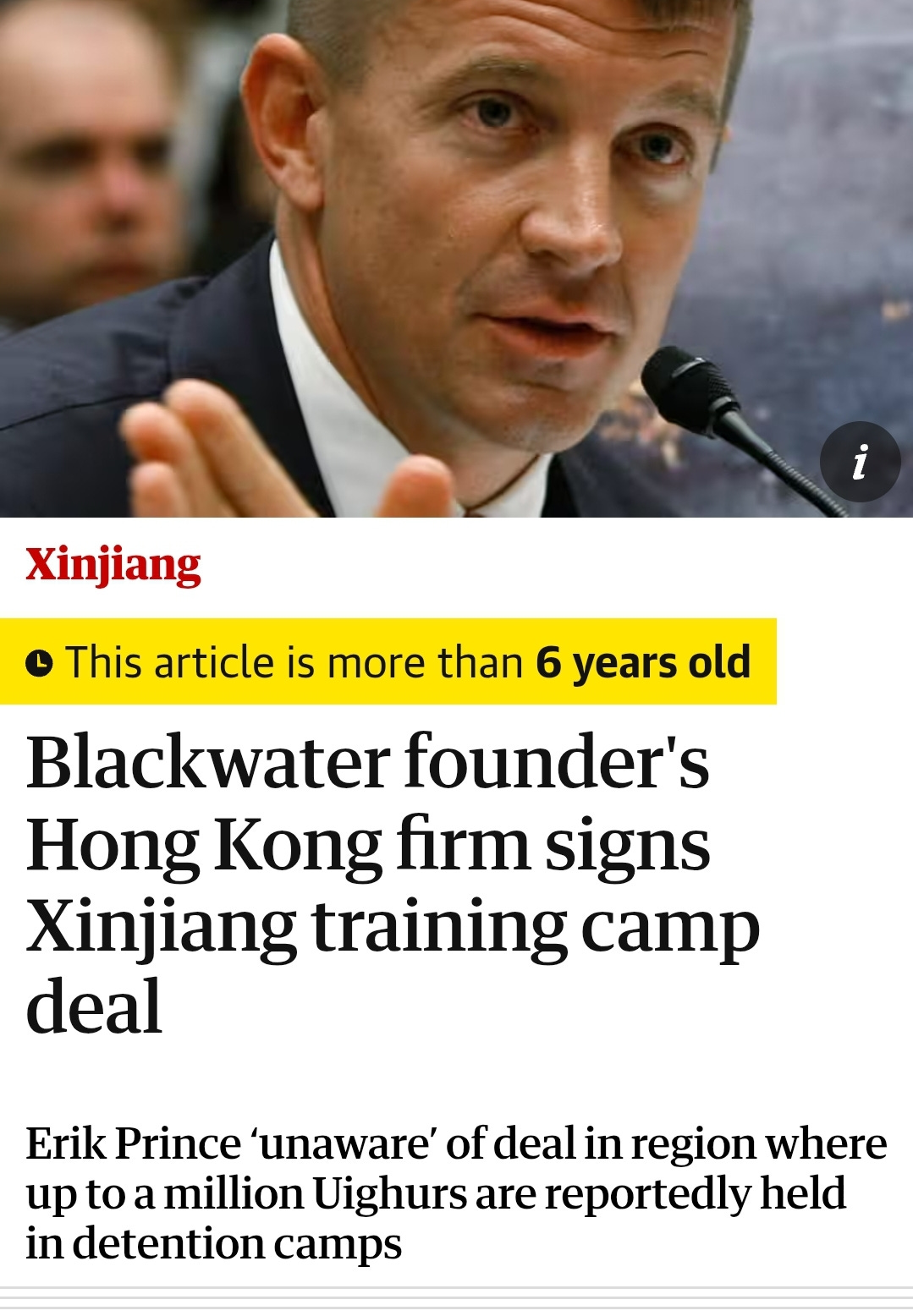
A Hong Kong-listed security firm founded by Erik Prince has signed a preliminary deal with authorities in China to build a training centre in Xinjiang
FSG, which has a Hong Kong headquarters, has built up a wealth of contracts both inside China and for Chinese companies operating overseas, particularly in Africa.
A Hong Kong-listed security firm founded by Erik Prince has signed a preliminary deal with authorities in China to build a training centre in Xinjiang, where Uighur Muslims have experienced a huge security crackdown.
Frontier Services Group, which specialises in providing security and logistics for businesses operating in risky regions, said it had signed a deal to run a training base in the city of Kashgar, according to a statement posted on its Chinese website.
The firm was founded by Erik Prince, a former US Navy Seal and the brother of the US education secretary, Betsy DeVos.
Erik Prince: Fraud Allegations and Blackwater Controversy
Erik Prince, founder of Blackwater, has been at the center of numerous legal battles, including a fraud lawsuit alleging that the company overbilled the U.S. government and submitted fraudulent expens…
Erik Prince, founder of Blackwater, the private military company that became infamous for its operations in conflict zones, remains one of the most controversial figures in the private security industry. His company was involved in numerous operations for the U.S. government, including security services in Iraq and Afghanistan. However, in recent years, Blackwater has faced serious allegations of fraud and misconduct. This article takes a deep dive into the fraud lawsuit that accused Erik Prince and his company of overbilling the U.S. government, including billing for inappropriate expenses. We’ll explore the case’s background, legal proceedings, the broader implications of the lawsuit, and the impact of these revelations on the private military contracting industry.
The Rise of Blackwater: Background on Erik Prince’s Company
The Birth of Blackwater
Blackwater was founded in 1997 by Erik Prince, a former U.S. Navy SEAL. His initial vision was to create a company that would provide professional training for military and law enforcement agencies. Blackwater’s early focus was on providing specialized training for military personnel, but as the company grew, it expanded its operations to offer a wide range of services, including private security for high-profile individuals, corporate clients, and U.S. government agencies.
In the wake of the 9/11 attacks, Blackwater rapidly expanded its services, particularly in Iraq, where the U.S. military sought to outsource security services. By the mid-2000s, Blackwater had become a major player in the world of private military contractors, with billions of dollars in contracts from the U.S. government. Erik Prince, as the CEO, oversaw the company’s operations and ensured its aggressive growth strategy.
Blackwater’s Involvement in the Iraq War
Blackwater gained significant notoriety during the Iraq War, where it provided security services to U.S. government officials, military personnel, and contractors working in the region. One of the most infamous incidents involving Blackwater was the 2004 Nisour Square shooting, in which Blackwater contractors opened fire on civilians, killing 17 people. This event sparked outrage and led to increased scrutiny of Blackwater’s operations.
While Blackwater was contracted to provide security, the company was criticized for its heavy-handed approach, lack of accountability, and the behavior of its employees. The incident further fueled concerns about the ethical and legal standards of private military contractors working in conflict zones.
The Fraud Lawsuit Against Erik Prince and Blackwater
The Whistleblower Allegations
In 2008, former Blackwater employees Brad and Melan Davis filed a federal lawsuit alleging that Blackwater had engaged in fraudulent billing practices. The whistleblower lawsuit claimed that Blackwater had submitted inflated or improper invoices for security services and had billed the U.S. government for expenses that were not directly related to its contracts. These expenses included the use of prostitutes for workers in Afghanistan and strippers in the aftermath of Hurricane Katrina.
The whistleblowers claimed that the company had a pattern of dishonesty, submitting falsified documents to secure payments from the U.S. government. The lawsuit brought attention to the lack of transparency and accountability within Blackwater, raising questions about the company’s business practices and its relationship with the government.
The Nature of the Allegations
The whistleblowers specifically pointed to several areas where they claimed Blackwater had defrauded the government. This included overbilling for services that were never rendered or billed at inflated rates. One of the most shocking claims was that Blackwater had charged for “adult entertainment” during deployments in the Middle East, allegedly seeking reimbursement for the use of prostitutes, which was clearly outside the scope of its contracts.
The allegations also extended to fraudulent billing for logistical support, including the transportation of goods and personnel. According to the whistleblowers, these invoices were either falsified or exaggerated, resulting in the company receiving funds it was not entitled to.
Legal Consequences for Erik Prince and Blackwater
In 2010, Erik Prince was questioned by federal authorities regarding the allegations, and the lawsuit continued to unfold. Although the U.S. government had declined to join the case, suggesting that it did not have enough evidence to pursue criminal charges, the civil lawsuit raised significant concerns about Blackwater’s practices.
Despite these challenges, Blackwater maintained that the allegations were unfounded and defended its actions. The company argued that the whistleblower lawsuit was a result of disgruntled former employees and that the company had always acted within the law. However, the growing public scrutiny and the nature of the allegations continued to damage the company’s reputation.
Government Investigations and Oversight
Federal Investigations into Overbilling Practices
As part of its ongoing investigations into Blackwater’s operations, the U.S. government launched an audit of the company’s billing practices. In 2009, the State Department conducted an audit of Blackwater’s contracts, revealing that the company had submitted invoices for services that were not performed. The audit found that Blackwater had overbilled the government by millions of dollars, which led to further investigations into the company’s financial dealings.
One key finding from the audit was that Blackwater had failed to provide sufficient documentation to support its claims for reimbursement. The State Department audit suggested that Blackwater had submitted invoices for security services that were not delivered in full or at the agreed-upon rates. These findings contributed to growing concerns about the integrity of the company’s operations and its relationship with the government.
Other Investigations and Allegations
In addition to the fraud allegations, Blackwater faced numerous other legal challenges. The company’s contractors were involved in multiple incidents in Iraq and Afghanistan, including allegations of human rights violations and excessive use of force. These incidents led to federal investigations into the company’s activities, particularly regarding its role in military operations and its interactions with the U.S. government.
At the same time, Blackwater was scrutinized for its lack of oversight and its apparent disregard for the laws governing private military contractors. The company was accused of operating in a legal grey area, with limited accountability for its actions in conflict zones.
Blackwater’s Transformation and Erik Prince’s Departure
Rebranding and Moving Forward
In the aftermath of the scandal and the legal challenges it faced, Blackwater rebranded itself as Xe Services and later as Academi. This rebranding was part of an effort to distance the company from its controversial past and to rebuild its reputation. Despite the changes in name and leadership, the company continued to operate in the private security and military contracting industry.
However, the legal challenges and the public scrutiny remained, and Blackwater’s history continued to follow it. The company struggled to regain the trust of both the public and government agencies, and its contracts were increasingly scrutinized for transparency and accountability.
Retired, living in the Scottish Borders after living most of my life in cities in England. I can now indulge my interest in all aspects of living close to nature in a wild landscape. I live on what was once the Iapetus Ocean which took millions of years to travel from the Southern Hemisphere to here in the Northern Hemisphere. That set me thinking and questioning and seeking answers.
In 1998 I co-wrote Millennium Countdown (US)/ A Business Guide to the Year 2000 (UK) see https://www.abebooks.co.uk/products/isbn/9780749427917