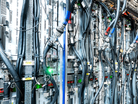
At AWS, the goal is to use just enough liquid to keep servers from overheating, with minimal additional energy (Credit: AWS)
Data centre operators are reducing water waste and energy consumption with closed-loop systems that promise sustainability without sacrificing density
The data centre industry is undergoing a fundamental shift in how it approaches thermal management, driven by the dual pressures of AI-driven density requirements and mounting concerns over resource consumption.
Closed-loop cooling systems, once considered a specialised solution, are rapidly becoming the standard architecture for operators seeking to balance performance with environmental responsibility.
At the heart of this transformation is a simple principle: circulating coolant through sealed systems that eliminate the need for constant water replenishment.
Unlike traditional evaporative cooling, which loses millions of gallons annually through tower operations, closed-loop architectures recirculate fluid continuously, removing dependency on freshwater resources whilst simultaneously enabling far higher rack densities.
The waterless target for data centres
Edged US has positioned waterless cooling at the centre of its expansion strategy. In 2025, the company broke ground on its second Aurora, Illinois facility, a high-density AI data centre designed to save more than 277 million gallons of water annually compared to conventional evaporative approaches. The site has been designed to deploy closed-loop, waterless cooling capable of supporting densities up to 200kW per rack using its ThermalWorks liquid-to-chip system.
air to remove heat indirectly, these architectures capture heat closer to the processor itself, improving thermal transfer efficiency while reducing dependence on high-power airflow systems. Lenovo’s Neptune liquid cooling architecture demonstrates how higher-temperature water loops can support dense AI workloads while reducing overall facility energy consumption. (Source: Lenovo Neptune Liquid Cooling Architecture)
…………
Beyond efficiency, heat itself is starting to gain infrastructure value. Some hyperscale and HPC environments are exploring ways to redirect recovered thermal energy into district heating systems, campus thermal loops, and nearby industrial processes rather than rejecting it entirely
Wind turbines may serve another purpose in modern-day society other than generating power.
As the green energy transition gains momentum around the world, the wind power subsector has seen tremendous growth. However, the recent innovations in wind turbine technology have seen some companies aiming to develop a new purpose for the wind-powered industry.
How has the wind energy sector influenced your life?
How wind power has blown through modern-day society
As the wind energy sector gained traction over the past few decades, the impact it has had on our society has been profound.
Modern offshore wind turbines have become huge structures that are taller than most iconic landmarks. Some wind turbines now reach as high as 918 ft, which is almost as tall as the Eiffel Tower.
The components of wind turbines are getting bigger, too.
The latest wind turbines have blades that can be longer than a football field. And we now know that a single rotation from these massive blades can produce enough energy to power a family of three for a whole week.
But one recent innovation has seen wind turbines performing another crucial purpose as our tech becomes more complex.
The economic and social impact of the renewable energy market is substantial
The vast majority of nations have committed to a clean energy transition away from fossil fuel-based energy production towards a more climate-friendly sector.
The wind power market has become a significant global employer. Recent data has revealed that at the current rate of progression, the wind power sector alone could support roughly 4 million jobs across the world.
But, as we know, the ever-volatile energy market is influenced by a wide range of factors, and the latest impact has come from the need to cool the many AI data centers that big tech companies are building across the world.
So, how can the wind energy subsector play a role in the AI-driven progression currently taking place across the big tech ecosystem? An emblematic tech company has given us a surprising answer to this question.
The AI market will be transformed thanks to Aikido Technologies
Aikido Technologies has recently outlined its plan to construct a floating offshore AI data center that is entirely powered by wind turbines.
This innovative development aims to address the significant issues around the land needed for AI data centers, as well as how to power and cool these remarkably huge and hot data collection centers popping up around the world.
But this innovation aims to harness the energy from wind to power and, more importantly, cool the AI data centers that have become a necessity in the modern world.
How will this new wind turbine impact the AI market
Each system combines a 15-18 MW wind turbine with a standard battery storage system, as well as a 10-12 MW computing system specifically designed to serve the AI sector in one single unit.
The data center makes use of a passive cooling system that transfers the heat generated into the seawater around it. Aikido Technologies has identified several offshore sites that could use the innovation. The first proof-of-concept unit is already working in Norway.
Retired, living in the Scottish Borders after living most of my life in cities in England. I can now indulge my interest in all aspects of living close to nature in a wild landscape. I live on what was once the Iapetus Ocean which took millions of years to travel from the Southern Hemisphere to here in the Northern Hemisphere. That set me thinking and questioning and seeking answers.
In 1998 I co-wrote Millennium Countdown (US)/ A Business Guide to the Year 2000 (UK) see https://www.abebooks.co.uk/products/isbn/9780749427917