Extract from Wajeeh Lion analysis on Substack pertaining to the West Bank:
Data compiled by the Israeli human rights organization Yesh Din reveals that the 2026 Iran War provided cover for a massive surge in extremist settler violence. In just the first 30 days of the conflict (overlapping with the March and April Passover holiday), 305 separate incidents of settler violence were documented. This violence was not random; it occurred across 139 different Palestinian villages and towns, demonstrating wide-scale organizational coordination rather than isolated friction. The tactics used included the systematic uprooting of olive trees in Sha’ab al Butum, the destruction of vital water infrastructure, physical assaults on herders using sticks and stones, armed home invasions, and the firing of live ammunition in the presence of Israel Defense Forces (IDF) soldiers, as witnessed in Qaryut. Amnesty International and Human Rights Watch have labeled this violence a state-sanctioned ethnic cleansing campaign aimed at forcing the displacement of Bedouin and herding communities in Area C, specifically in villages like Zanuta and Masafer Yatta.
This violence operates alongside bureaucratic mechanisms. Approximately 41,000 dunams (roughly 10,000 acres) of privately titled Palestinian land were frozen and declared “state land.” The legal reality in the West Bank facilitates this: settlers are subject to Israeli civil law, while Palestinians live under military law. Consequently, there is a staggering 94% impunity rate for police-recorded cases of settler violence over a 20-year period, meaning the vast majority of perpetrators never face trial. B’Tselem reports corroborate this, stating IDF personnel systematically fail to protect Palestinians and frequently provide armed escorts for the perpetrators.
Strategically, this unchecked expansion and state-backed violence are highly counterproductive for Israel. It alienates essential European allies, provides diplomatic ammunition to adversaries at the UN Security Council, and forces U.S. diplomats to expend finite political capital defending West Bank policies rather than focusing on the primary threat from Tehran.
Media coverage:
Israel’s Smotrich declares ‘revolution’ in West Bank settlement expansion
Story by Al Jazeera Staff
• 1d
Israel’s Finance Minister Bezalel Smotrich speaks to reporters about settlements expansion that would split East Jerusalem from the occupied West Bank [File: Ronen Zvulun/Reuters]
Israeli Finance Minister Bezalel Smotrich has declared that Israel has launched a “revolution in settlement” expansion, which he says will see illegal outposts extended beyond the occupied West Bank into the Negev and Galilee.
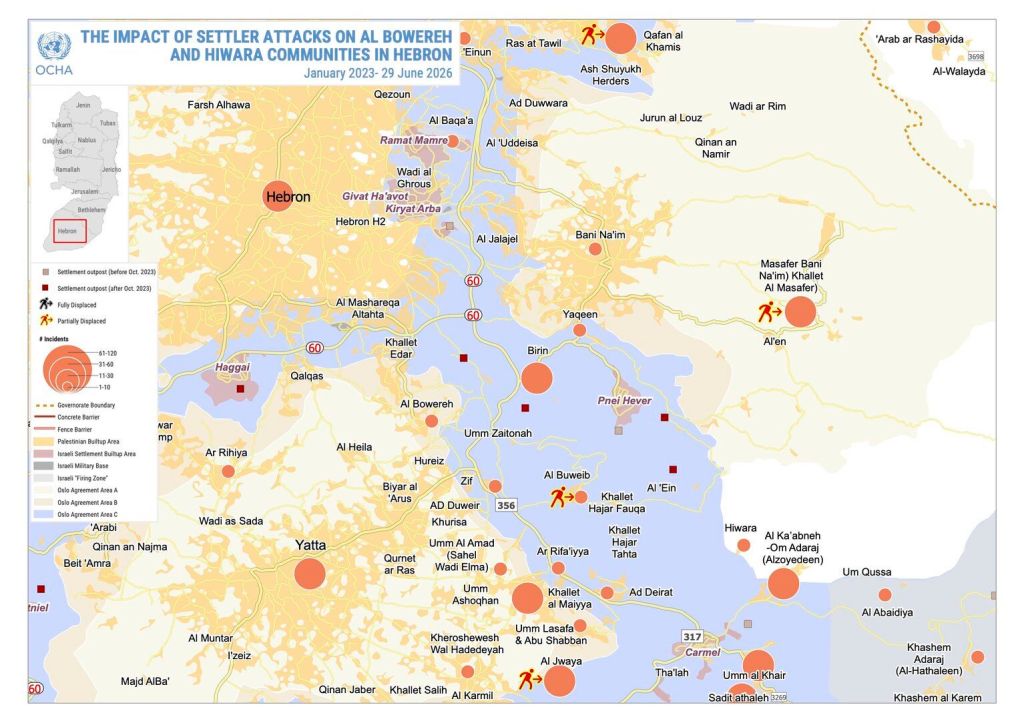
Since the establishment of outposts, at least six settler attacks affecting Al Bowereh and 11 affecting Hiwara, resulting in casualties, property damage or both, were documented compared with two attacks in Al Bowereh and no attacks in Hiwara recorded between 2020 and the establishment of the outposts. In both communities, residents reported increasing limitations on access to agricultural land and grazing areas, repeated damage to homes and livelihood assets, obstruction of the only access routes, and greater difficulties in accessing emergency medical care.
The assessments highlighted mounting protection concerns, particularly for children and women. Community members reported that repeated exposure to violence, intimidation and insecurity has contributed to heightened fear, anxiety and psychosocial distress among children, who also face unsafe journeys to school and limited access to recreational and child-focused services. Families also reported increasing difficulties in accessing emergency health care during settler attacks due to movement restrictions that have delayed ambulance access, while limited legal assistance and barriers to seeking accountability have compounded protection risks.
Humanitarian partners continue to respond by providing mental health and psychosocial support, child-friendly activities, shelter rehabilitation, hygiene and WASH assistance, including water trucking and household water storage, fodder assistance and other support to herding and agricultural livelihoods, as well as support for women’s livelihoods. Partners also continue to support an elementary school in Hiwara to improve children’s access to education. However, they report mounting operational difficulties in reaching both communities due to recurrent settler attacks and movement restrictions, limiting the delivery of assistance and essential services.
The deterioration in the humanitarian situation has also undermined livelihoods and access to basic services. In Al Bowereh, farmers reported significant losses following repeated damage to vineyards, trees and other agricultural assets, while additional agricultural land has been affected by the widening of Road 60. In Hiwara, herding families reported shrinking grazing areas, repeated attacks on livestock and increasing pressure on traditional livelihoods. Both communities also face chronic water shortages and rely on water trucking during the summer months, further compounding humanitarian needs.
Retired, living in the Scottish Borders after living most of my life in cities in England. I can now indulge my interest in all aspects of living close to nature in a wild landscape. I live on what was once the Iapetus Ocean which took millions of years to travel from the Southern Hemisphere to here in the Northern Hemisphere. That set me thinking and questioning and seeking answers.
In 1998 I co-wrote Millennium Countdown (US)/ A Business Guide to the Year 2000 (UK) see https://www.abebooks.co.uk/products/isbn/9780749427917

![Israel's Finance Minister Bezalel Smotrich speaks to reporters about settlements expansion that would split East Jerusalem from the occupied West Bank [File: Ronen Zvulun/Reuters]](https://img-s-msn-com.akamaized.net/tenant/amp/entityid/AA27k047.img?w=768&h=512&m=6&x=445&y=128&s=220&d=220 "Israel's Finance Minister Bezalel Smotrich speaks to reporters about settlements expansion that would split East Jerusalem from the occupied West Bank [File: Ronen Zvulun/Reuters]")


You must be logged in to post a comment.