Previously unreported emails – first identified by Tax Policy Associates – show Peter Mandelson discussing with his “chief life adviser”, Jeffrey Epstein, a tax avoidance structure for the purchase of a £2m1 Rio apartment, involving a Panama company.
Mr Mandelson told us that he has no recollection of the proposal, or knowledge as to the authenticity of the documents. He added that neither he nor his husband have ever owned property in Brazil, and that he has no association with any company in Panama, and holds no funds offshore.
After receiving that response, we identified a company, incorporated in Rio de Janeiro for the purpose of holding real estate, of which Mr Mandelson and his husband were the directors. Mr Mandelson has denied to us that he held Brazilian property through the company.
The emails
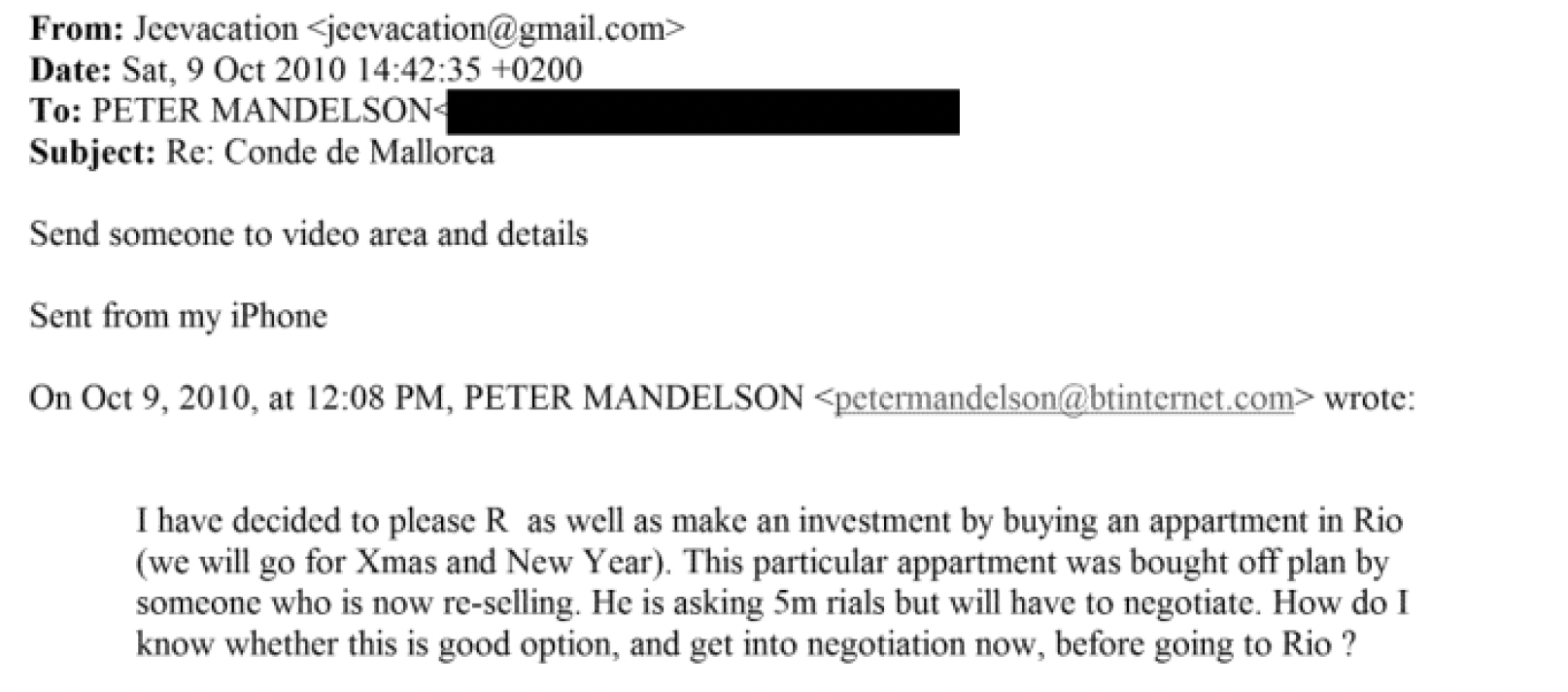
The email chain starts in October 2010, with Peter Mandelson deciding to buy an apartment in Rio, and sending emails asking for advice from his “chief life adviser”, Jeffrey Epstein:
About three weeks later, the documents show Mr Mandelson receiving approval from HSBC Private Bank for a loan of £1.68m to acquire the Rio apartment, secured on Mr Mandelson’s £2.4m London home.
Things progressed slowly, which is not unusual in Brazilian property transactions. In March 2011, Mr Mandelson wrote to Mr Epstein describing a highly unusual tax structure:
The dispute over the canal is just the latest chapter of Trump drama in Panama.
Before and throughout his first term in the White House, a high-profile Trump hotel project in the country was a seemingly unending source of scandal and financial problems, ranging from a partner’s bankruptcy to money-laundering allegations to long-running legal battles.
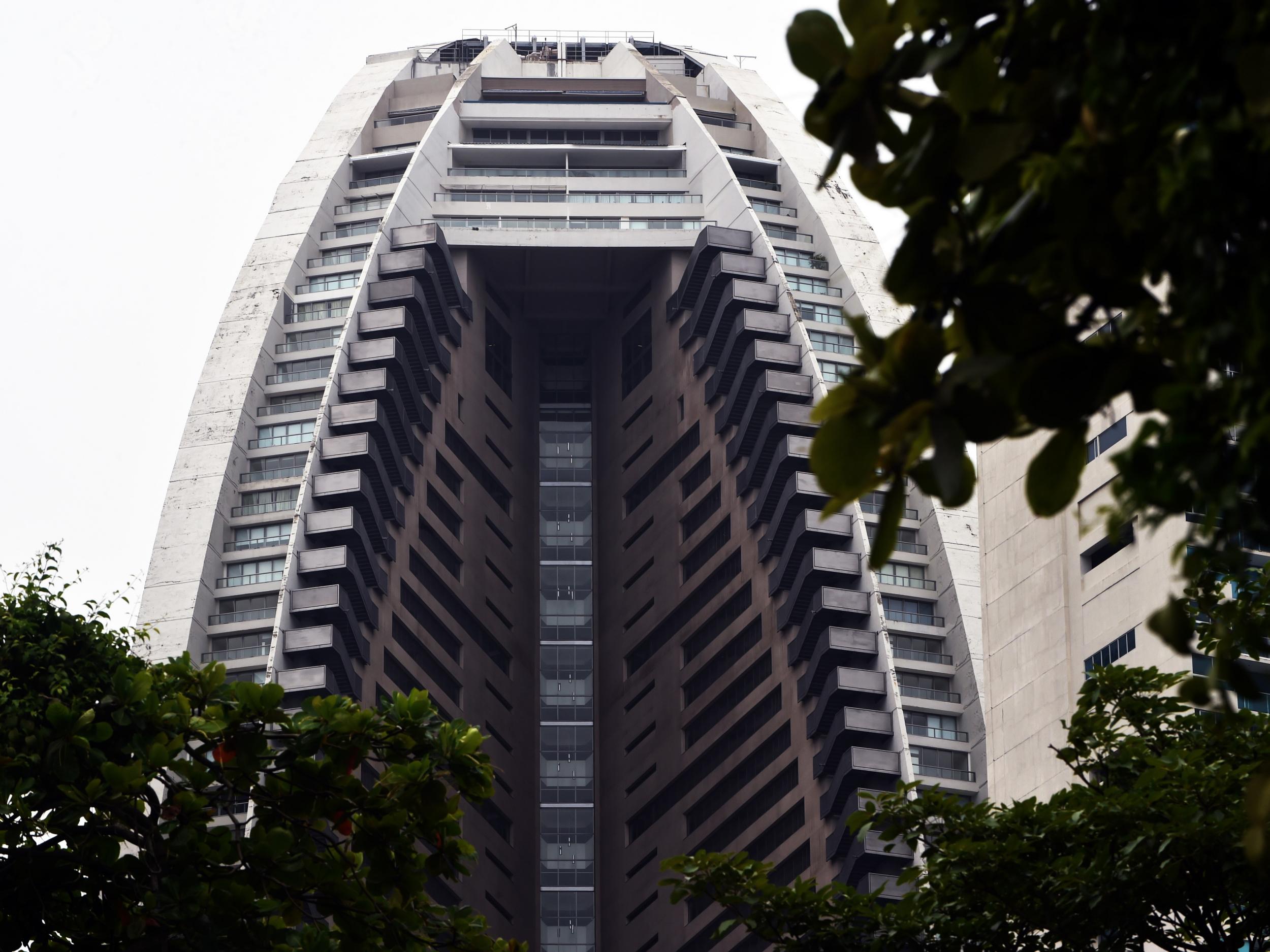
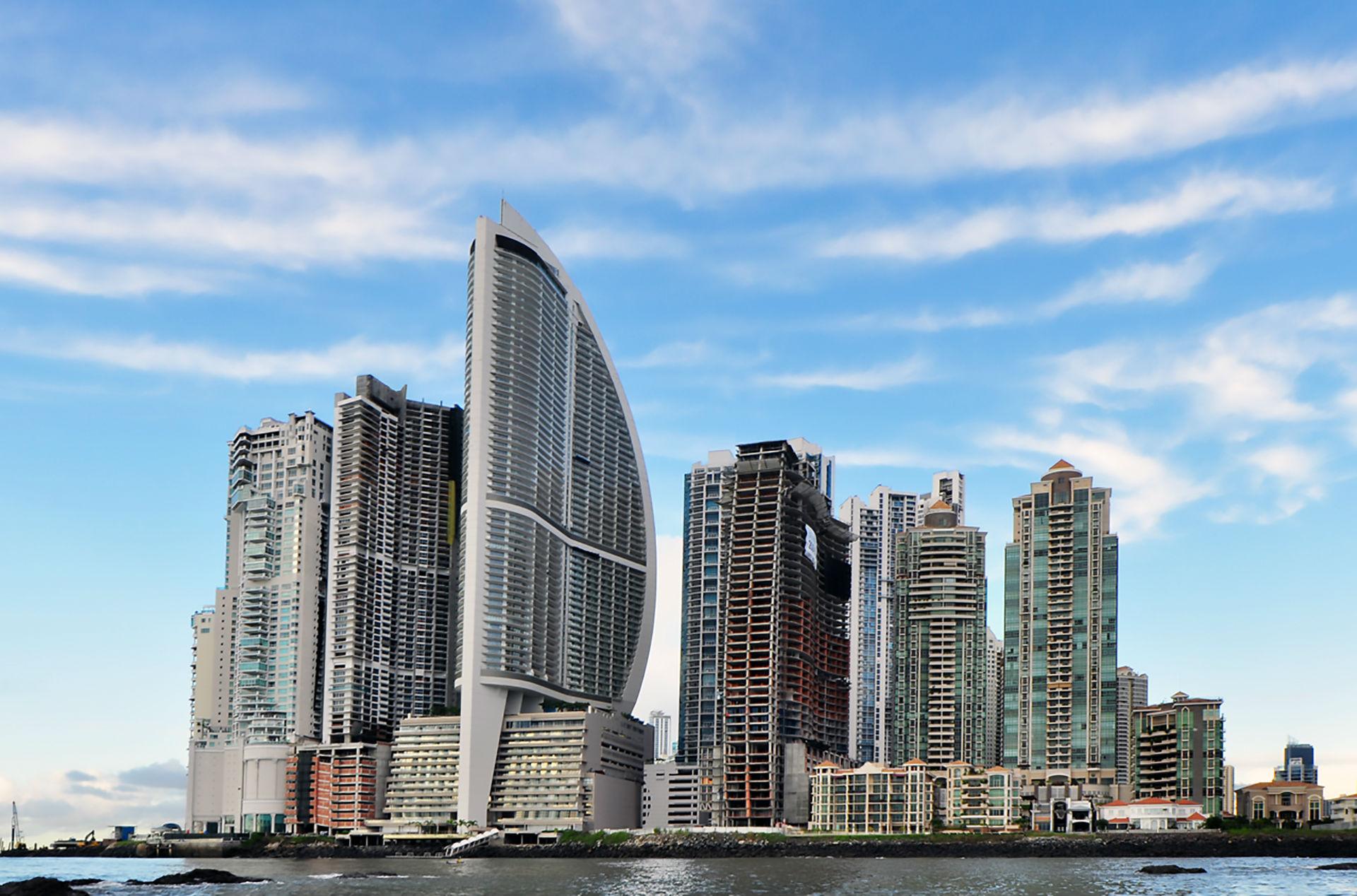
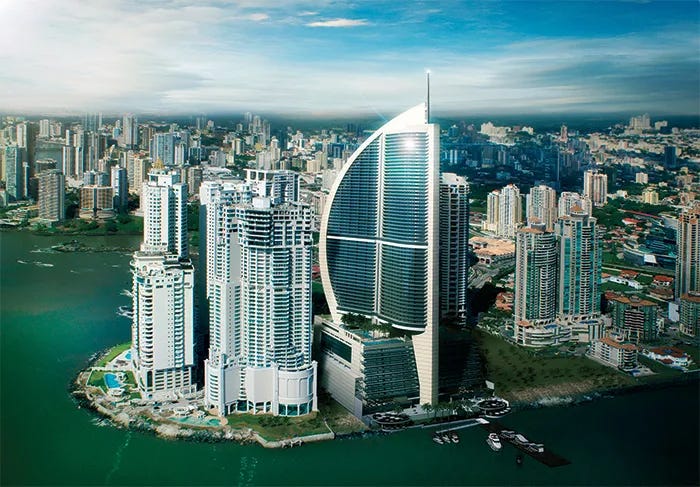
In 2011, Trump and his business partners cut the ribbon on the Trump Ocean Club International Hotel and Tower, a 70-story, sail-shaped skyscraper that loomed large over Panama City and the Trump Organization itself.
The tower, which was first conceived way back in 2005, was Trump’s first international hotel venture and one of the tallest buildings in Latin America.
Trump capital didn’t go towards building the development itself, but the tower used the Trump name for branding, and companies controlled by the Trump Organization would manage the property, which contained a casino, hotel rooms and condos.
Even in the early days, the project seemed doomed, with one of Trump’s partners defaulting on debts soon after the tower opened and later filing for bankruptcy.
Trump opened his first international hotel venture in 2011 in Panama City with the Trump Ocean Club International Hotel and Tower (AFP/Getty)
Subsequent investigations from news outlets alleged that one of the main brokers who sold units in the tower, Alexandre Ventura Nogueira, met repeatedly with Ivanka Trump while working on the project and did business with organized crime figures who may have used the properties for money-laundering, earning the tower the nickname “Narco-a-Lago,” a play on Trump’s Mar-a-Lago estate in Florida.
“The Trump Organization was not the owner, developer or seller of the Trump Ocean Club Panama project,” the Trump Organization said after the money-laundering allegations. “Because of its limited role, the company was not responsible for the financing of the project and had no involvement in the sale of units or the retention of any real estate brokers.”
The company told Reuters it “never had any contractual relationship or significant dealings” with Nogueira.
Trump later fought for control of the Panama City tower with a developer who bought out the majority of units (Wikipedia)
Nogueira fled Panama on bail while awaiting trial on unrelated fraud charges, and spoke to reporters as a fugitive in disguise in Europe.
At one point, as Ocean Club condo owners objected to the Trump team’s management practices and sought to fire the company, accusing them of overspending and taking excessive bonuses. Trump responded by suing, demanding $75m for wrongful termination.
A key broker on the Trump Panama project may have sold units to organized crime figures who used properties as vehicles for money-laundering (Getty)
The litigation was settled in 2016 – the same year Trump was elected president – but the drama around the tower didn’t end there.
“President Trump removed himself from his multi-billion-dollar real estate empire to run for office and forewent his government salary, becoming the first President to actually lose net worth while serving in the White House,” Karoline Leavitt, a spokesperson for the Trump-Vance transition team, told The Independent in a statement. “Unlike most politicians, President Trump didn’t get into politics for profit – he’s fighting because he loves the people of this country and wants to make America great again.”
In 2017, businessman Orestes Fintiklis bought hundreds of units inside the hotel-condo portion of the building for between $20m and $25m from one of the tower’s bankrupt developers, making him the controlling owner. He helped lead owners of units in the building in calls to sever their relationship with the Trump companies managing the development.
The Trump Organization accused Fintiklis of violating the terms of his original acquisition deals for the units, saying he agreed not to interfere in the Trump team’s management of the hotel.
By the following year, as Fintiklis sought to assume what he argued was majority ownership of the tower, shoving matches broke out between his employees and remaining Trump Organization staff. In one incident, the Trump team allegedly barred the new owners from entering a room with computer servers and CCTV monitors, prompting the owners group to allegedly shut off power to the room.
Fintiklis accused the Trump companies of shredding documents and hastily building walls to lock the new owners out of certain areas, while the Trump Organization accused the Fintiklis group of “thug-like, mob-style tactics.”
In a 2018 suit filed in New York federal court and amended multiple times since, Fintiklis and his company Ithaca Capital Partners accused Trump companies managing the Panama tower of “intentionally evading taxes” related to their role overseeing the development, allegedly saddling the new owners with millions in liability when an alleged 2018 audit uncovered the shortfall, the suit claimed.
Later filings accused the Trump managers of understating employee salaries to reduce potential social security tax payments and painting the building’s finances in a “false light” before Fintiklis was bought in, which the company denied and called “completely false.”
“To the extent any taxes were to be withheld,” the Trump Organization told The New York Times in 2019, they were the responsibility of the new owners, the company said. The Trump Organization added it “did not evade any taxes.”
A tower built on dirty money: Trump’s sail-shaped tower in Panama laundered countless millions until it went belly up after being caught up in the finances of kleptocracy.
When the sail-shaped Trump Ocean Club first took its place in Panama City’s skyline, the building(later renamed the Trump International Hotel and Tower Panama and, still later, renamed again the JW Marriott Panama) was presented as the last word in international luxury. But by the time it opened in 2011 as the Trump Organization’s first overseas hotel, the cognoscenti realized it had become something entirely different. Instead of functioning as a glamorous oasis for the rich and powerful, it had become a high-speed laundromat that washed enormous amounts of tainted capital. At the heart of the operation was a sales team that expertly courted wealthy foreigners—many of whom were Russian or Soviet émigrés—and leveraged the Trump brand to command inflated prices and launder money.
Like most of the projects he started after his crippling bankruptcies in Atlantic City, the Panama tower was not built by or financed by Donald Trump. After all, most banks wouldn’t touch him. Moreover, Trump had become party to a scheme by which he licensed his name and provided management services so that he could shift all the risk that went along with financing and development to local partners while he benefitted from a lucrative payday. Better yet, the arrangement continued to generate millions in management fees and royalties for Trump that amounted to nearly $14 million, even though the project itself faltered and buyers were left exposed
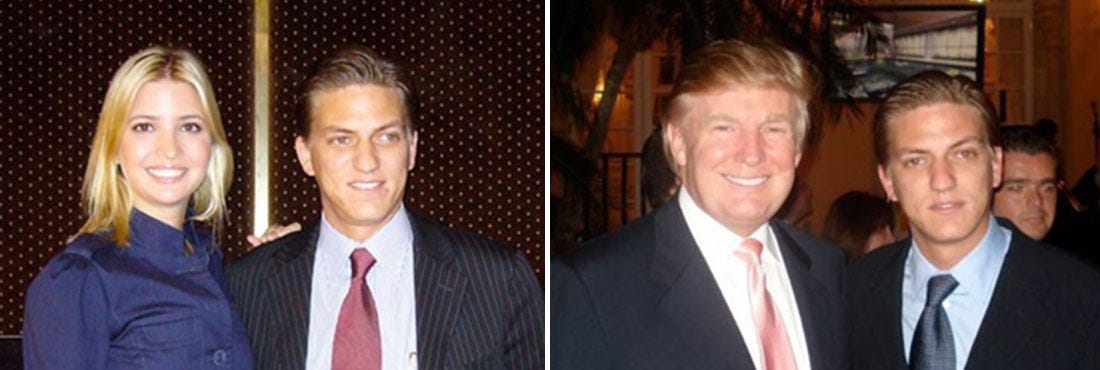
WHO HE? Both the Trump Organization and the Trump Family denied knowing Alexandre Ventura Nogueira, the chief broker for the Trump Ocean Club. Nogueira is pictured at left with Ivanka Trump and at right with Donald Trump
Trump fostered similar relationships all over the world. In 2003, Trump had whetted Latin American interest in the Trump brand by staging the Miss Universe pageant in Panama City, Panama. Three years later, he struck a deal in Panama to develop the Trump Ocean Club International Hotel and Tower, a sail-shaped seventy-story waterfront complex that included residential apartments and a casino. According to an investigation by Global Witness, an anticorruption watchdog, Trump was entitled to a licensing fee, 1 percent of any financing he secured, and a cut of every unit sold—all of which would add up to more than $75 million. Many of the problems behind the project led to a man named Alexandre Ventura Nogueira, the tower’s primary broker. According to a report by Reuters, Nogueira, who, with his partners, sold more than half the apartments in the project, marketed the condos largely to Russians because, a colleague said, “Russians like to show off. For them, Trump was the Bentley” of real estate brands.
According to conversations secretly recorded by a former business partner, in 2013 Ventura Nogueira said he had laundered tens of millions of dollars through real estate. “More important than the money from real estate was being able to launder the drug money—there were much larger amounts involved,” he said in the recording. “When I was in Panama I was regularly laundering money for more than a dozen companies.”
Nogueira told Reuters that he became the leading broker for the project thanks in part to the support of Trump’s daughter Ivanka, who appeared in a promotional video with him. The Trump Organization went into overdrive with the new model. Why not? Since Trump did none of the financing and almost none of the development, its risks were minimal and the upside was high. The Trump Organization’s role in the Panama project “was at all times limited to licensing its brand and providing management services,” said Alan Garten, the company’s chief legal officer. “As the company was not the owner or developer, it had no involvement in the sale of any units at the property . . . No one at the Trump Organization, including the Trump family, has any recollection of ever meeting or speaking with this individual [Nogueira].”
Retired, living in the Scottish Borders after living most of my life in cities in England. I can now indulge my interest in all aspects of living close to nature in a wild landscape. I live on what was once the Iapetus Ocean which took millions of years to travel from the Southern Hemisphere to here in the Northern Hemisphere. That set me thinking and questioning and seeking answers.
In 1998 I co-wrote Millennium Countdown (US)/ A Business Guide to the Year 2000 (UK) see https://www.abebooks.co.uk/products/isbn/9780749427917

![To: jeevacation@gmail com[eevacation@gmail com]
From: Peter Mandelson
Sem: Sun 11/7/2010 2 34 57 PM
Subyect: Fwd Rio apartment
Seat to mys bank manager Gratetul tor helpful thoughts trom my chief lite adviser
Sent from ims iPad
Bevin torwarded messave
From: Peter Mander iS
Date: 7 November 2010 [4 29 12 GMI
Subject: Rio apartment
P| ag awe dpeecussed Pan consdernne a purchase of an apartmentin Rion Ttisain](https://taxpolicy.org.uk/wp-content/uploads/2026/01/Screenshot-2026-01-31-at-21.27.15.png)
![To: jeevacationg@gmail comieevacation@gmail com]
From: Peter Mandelson
Sen: Sun 11/7/2010 2 34 57 PM
Subject: Fwd Rio apartment
Sent to my bank manager Gratetul for helpful thoughts from my chiet ite adviser
Sent from ms 1Pad
Beuin tonvarded message
From: Peter Mandelson Po :
Date: 7 November 2010 14 29 12 GMI
Subject: Rio apartment
as we discussed, | am considering a purchase of an apartment in Rio It isin
a block under construction in [panema [tis being re-sold off plan bs the onginal
purchaser Asking price ts § 350 000 nals | am told that this value will rise on
construction and will follow Rio property prices up in coming sears
Tcan forward property details to vou m nest few dass but | would be grateful for advice
trom sou on how HSBCPB in Rio can assist in helping me take the decision on
this particular property and ina purchase [also need some advice on tas
mplications in Brazil and UK
Lam minded to place ownership, once secured. in Reinaldo’s name and advice on this
would also be welcome
Please let me know whether and how sou can help on this
Best regards from Beying
Peter
Sent from my iPad](https://taxpolicy.org.uk/wp-content/uploads/2026/01/upload_73f957b3-5d51-4d36-9449-a9bef95c2947.jpg)
![To: jeevacation@@gmail com[jeevacationgggmail.com]
From: PETER MANDELSON
Sent: Wed 12/1/2010 10:07:26 PM
Subject: Fw: Re: Rio apartment
I cannot tell you how nervous this makes me. Going to bed now
On 24 Nov 2010, at 16:34, EE wrote:
Peter,
| am pleased to confirm that | now have approval to provide you with a loan on the following headiine
terms:-
Borrower You
Amount £1.68m
Purpose Assistance with purchase of holiday home in Rio
Term 5 years
Repayment £24,000 per quarter
Security Mortgage over 4 Park Village West
Valuaton The property wall be valued by one of the bank's panel valuers, at your cost.
We require a minirnum valuation of £2.4m
Interest 2.25% over 3m LIBOR - 1. approx. 3% p.a. at the present time. This 16 a
discount to our revised standard pricing of 2.5% margin, and unfortunately | am unable to reduce tt
further
Fee 0.75% (£12,600)
Other For the duration of the facilty, it1s a conditon that you maintain a maumum credit
balance with us of £100.000
Please advise iffhow you wish to proceed. As you may recall, from the end of this week | will be on
holiday untd 13th December, but Sam will be able to take matters forward in my absence.
Regards
HSBC Private Bank
ASSOCIATE DIRECTOR | Media & Entertainment
HSBC Private Bank (UK) Limited, 78 St. James's Street, London. SW1A 1JB](https://taxpolicy.org.uk/wp-content/uploads/2026/01/upload_f224aa92-4eca-4653-bdd8-1e8a40477fab.jpg)
![To: jeevacation@gmail.comfjeevacation@gmail.com]: Jeffrey Epsteinfjjeevacation€@gmail.com}
From: Peter Mandelson
Sent: Wed 3/30/2011 3:41:59 PM
Subject: on
A lawyer in Rio has pointed out two problems in Reinaldo purchasing the Rio flat by means of a
cash transfer from me: we would be liable to taxes in both UK and Brazil, and the purchase itself
would be liable for two forms of property taxation in Brazil, 4° and 6°o respectively of the full
purchase price. This would be prohibitively expensive.
The lawyer suggests the following scheme which he has operated for others. He would
buy‘create an offshore company in Panama and this company would open an account with
HSBCPB in London. We would also create a Brazilian company which would have the
Panamanian company as a partner (shares held by Reinaldo and me). The Brazilian company,
managed by Reinaldo, would purchase the flat. The flat purchase would be financed by means of a
loan from the Panamanian company's account in London to justify the offshore (non-taxable)
ongin of the moncy.
The lawyer proposes that | invest US$S0,000 to buy the shares of the Brazilian company (making
a residence permit in Brazil also possible).
The company would be liable for tax at 20 on the property purchase (rather than 4% and 6°o).
The company would have a Brazilian bank account (Safra or HSBC 7). The lawyer would have
power of attorncy to sign legal documents etc.
As directors of the Brazilian company, Reinaldo and | would have joint control over the property.](https://taxpolicy.org.uk/wp-content/uploads/2026/01/image-4.png)