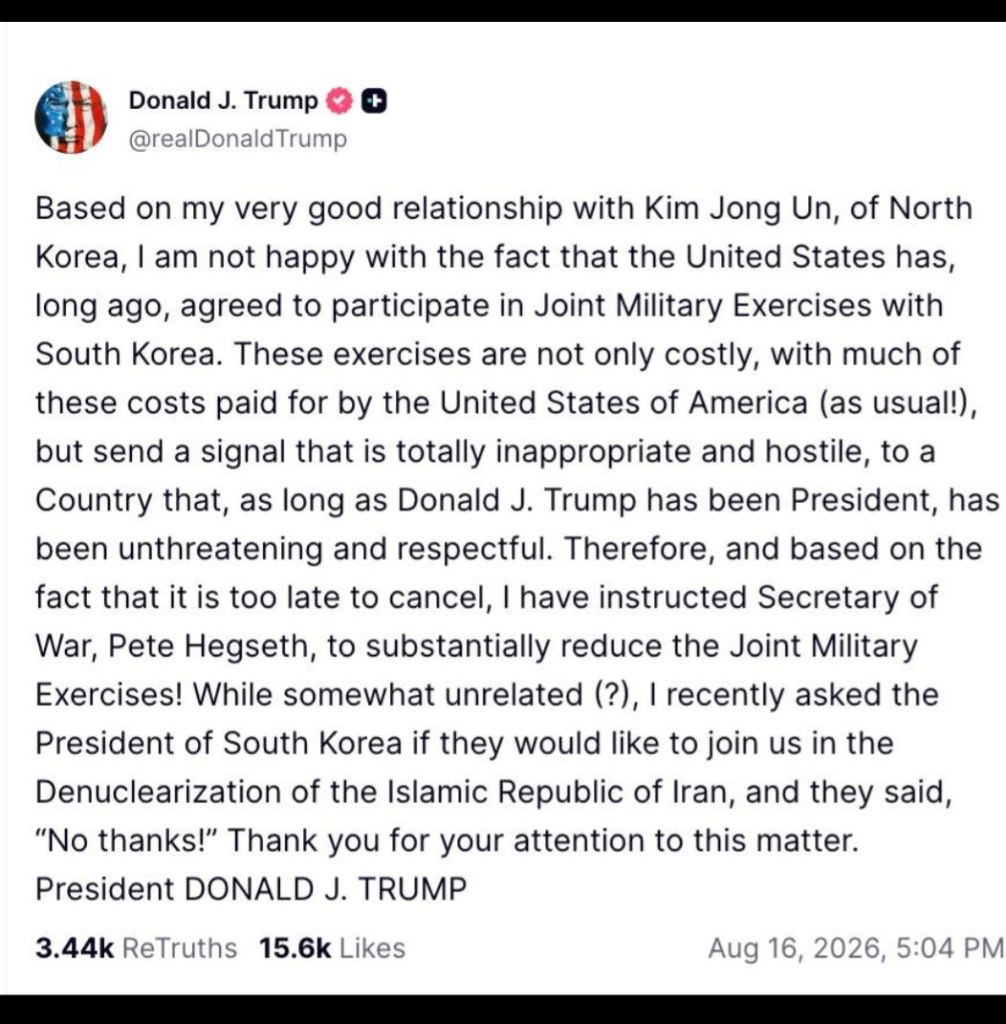
Trump Cites Kim Jong Un Ties in Calling for Reduced Korea Exercises
Published
Aug 16, 2026 at 06:06 PM EDT
………..
Trump also referenced a recent conversation with South Korean President Lee Jae Myung, claiming he had asked Lee whether South Korea wished to participate in efforts related to the denuclearization of Iran. Trump said Lee replied, “No thanks.”
It was not immediately clear whether the Pentagon plans to alter the upcoming Ulchi Freedom Shield exercises in response to Trump’s comments.
Standing at the edge of the Demilitarized Zone (DMZ), you can sense the history that runs deep through the rugged hills and rusted barbed wire. The Korean Peninsula is a place where the tension between past and present is palpable, and where readiness is not just a concept—but a daily reality. For decades, the Korean Peninsula has hosted numerous US and South Korean military exercises. These exercises aim to deter conflict, ensure readiness, and bolster their strategic alliance on the Korean Peninsula. Each exercise—some massive, some specialized—carries the legacy of a war that never technically ended and underscores a continuing commitment to peace, stability, and defense.
In this blog post, we’ll journey through the major US and South Korean military exercises, weaving together how they began, what they aim to accomplish, and how they’ve evolved over the years. This isn’t just a list of drills; it’s the story of an alliance tested by history and shaped by hope for a more secure future.
Team Spirit (1976–1993): Where It All Began
Back in the 1970s, the United States and South Korea recognized the need for large-scale, multi-domain training. The Cold War was at its height, and North Korea stood just across the border with its own military might. The solution? Team Spirit, launched in 1976.
Scope and Scale: At its zenith, Team Spirit was among the biggest field training exercises in the world. Imagine hundreds of tanks rolling across dusty terrain, battalions of soldiers moving in lockstep, and fighter jets streaking overhead. Each drill tested the ability of American and South Korean forces to work as a single unit, from planning to execution.
Purpose: While the exercise was defensive by design, it also served as a visible assurance of the US commitment to the ROK’s security. North Korea watched closely, often condemning it as a dress rehearsal for invasion. Yet to the US and ROK, it demonstrated that if conflict arose, they would respond as partners—swiftly and decisively.
Legacy: Team Spirit ended in 1993, partly in an effort to reduce tensions and encourage dialogue with North Korea. But it left behind a blueprint for future US and South Korean military exercises: intense combined training across all branches of the military, working in synchronized fashion.
Recent commentary downplaying the U.S. Army’s role in the Indo-Pacific misrepresents the complex security landscape and landpower’s essential place within it.
Assertions that the Army is on a “dead-end ride to Asia” are short-sighted, overlooking how deterrence must function across sea, air, land, space, and cyber domains as was just witnessed in the Middle East with the extraordinary strike in Iran. Likewise, remarks by Air Force Chief of Staff General David Allvin and his so-called strategist—that one service must grow “at the expense of others,” namely the Army—undermine the foundations of the joint force.
In today’s gray-zone competition and looming threat of large-scale war in the Indo-Pacific, adversaries probe seams relentlessly. Such shallow and parochial views are unhelpful, further exposing divisions. Alternatively, a fully joint and integrated force—anchored by land power with transformative capabilities—can hold those seams together. This is because land power underwrites joint operations and binds the region’s security architecture in ways that no other form of power can.
Deterrence in the Indo-Pacific cannot be achieved with exquisite maritime or air systems alone. During my recent testimony to the House Select Committee on the Chinese Communist Party, I emphasized how we have invested heavily in sea and air campaigns, while leaving ourselves exposed where conflicts are decided: on land.
The CCP’s primary instrument for coercion is the People’s Liberation Army, relying on its land force—the PLA Army—to achieve a future cross-Strait invasion of Taiwan. The PLA Navy, Rocket Force, and other branches will play important roles in a cross-strait invasion scenario. But if the PLA Army cannot land, cannot maneuver, cannot hold terrain, and cannot subdue the population, then the CCP cannot prevail
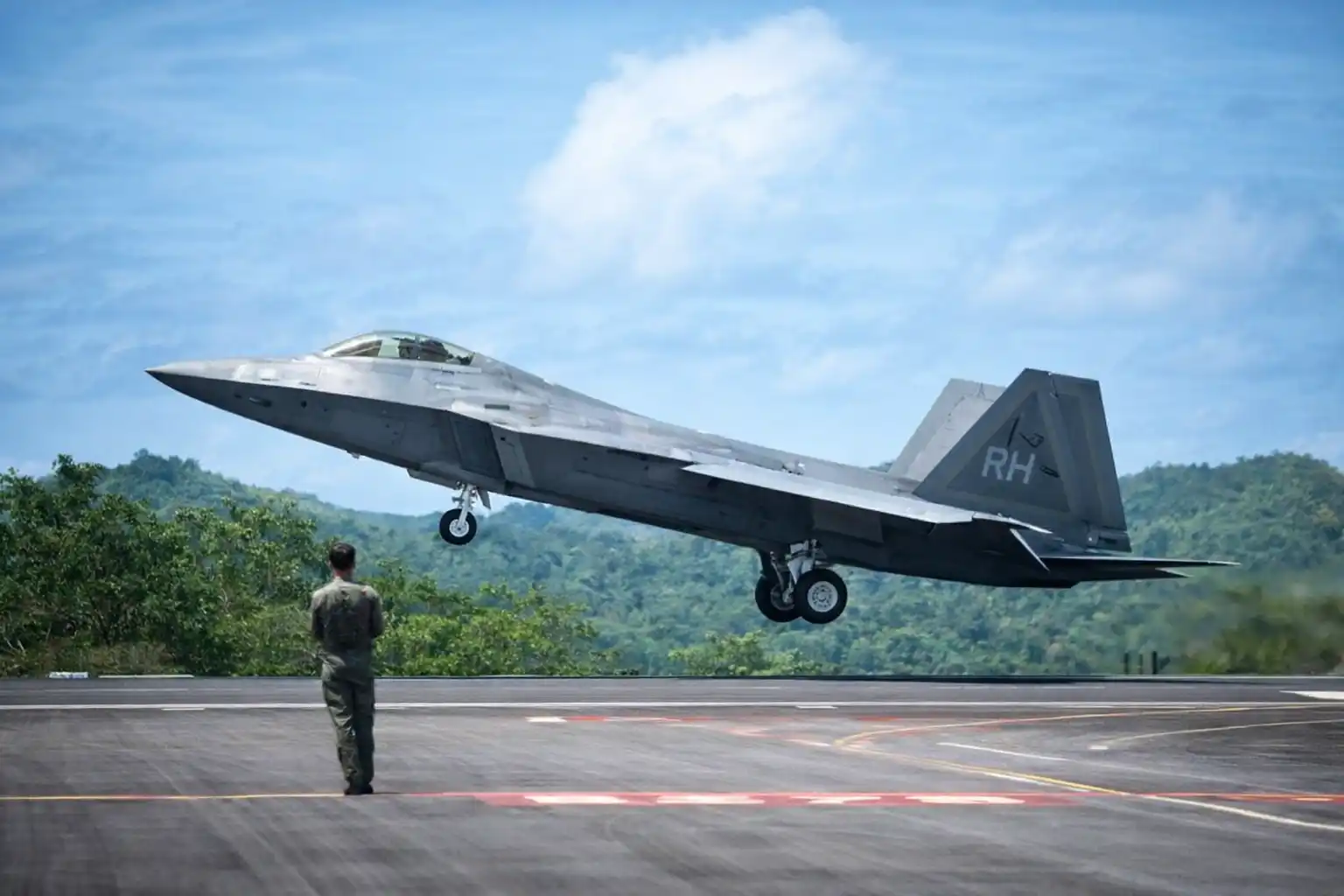
The Pacific is not just an oceanic expanse; it is the central arena of modern great-power competition. Stretching from the western shores of the Americas to the First Island Chain and beyond, this region is where airpower, logistics, deterrence, and alliance credibility intersect. The United States maintains a carefully layered network of air bases across the Pacific that allows it to project force, reassure allies, and respond rapidly to crises. These bases are not interchangeable runways; each one has a distinct operational logic tied to geography, politics, and strategy.
Taken together, the seven most important U.S. military air basing locations in the Pacific form a living system rather than a static footprint. Some host permanently stationed fighter wings, others rely on rotational deployments, and several function as surge platforms designed to absorb pressure in wartime. Their value lies not only in the aircraft they host, but in how they enable command and control, sustainment, intelligence, and interoperability across thousands of miles.
Understanding these bases reveals how U.S. Pacific strategy actually works on the ground and in the air.
The United States is currently reviewing its nuclear strategy, Elbridge Colby, Under-Secretary of Defense at the Pentagon, told journalists at a briefing on Thursday.
According to the transcript, Colby spoke of “a relatively narrow review” relating more to a specific, potential use of nuclear weapons. “Obviously, the goal here, I stress, is to maintain deterrence and stability.”
Colby also emphasized that the US military had previously been organized in such a way that it could carry out “regime-change operations”. It is now, however, being geared towards a “defensive function of prevention” with a focus on defending the territorial integrity of allies, he said.
North Korea grows stronger as South Korea reckons with fading US support
Published: August 17, 2026 4.02pm BST
According to Ukraine’s president, Volodymyr Zelensky, North Korea is preparing to send as many as 50,000 fresh troops to support Russia’s military campaign in Ukraine. While the South Korean Ministry of Foreign Affairs has been unable to verify Zelensky’s claim, it has not fallen on deaf ears in Seoul.
When questioned on August 10, an unnamed foreign-ministry spokesperson stated:
North Korea-Russia military cooperation is a matter directly related to our security and an act that violates UN Security Council resolutions … the government’s position is that such cooperation must be suspended immediately, and we are closely monitoring related developments.
Retired, living in the Scottish Borders after living most of my life in cities in England. I can now indulge my interest in all aspects of living close to nature in a wild landscape. I live on what was once the Iapetus Ocean which took millions of years to travel from the Southern Hemisphere to here in the Northern Hemisphere. That set me thinking and questioning and seeking answers.
In 1998 I co-wrote Millennium Countdown (US)/ A Business Guide to the Year 2000 (UK) see https://www.abebooks.co.uk/products/isbn/9780749427917



You must be logged in to post a comment.