
In the late 19th and early 20th century, pistachios were popularised in the US by migrants from the Middle East. By the 1930s, pistachio orchards were established in California. The warm, dry climate of California provided ideal conditions for pistachio trees, so much so that the US has now overtaken Iran and Turkey as the world’s largest producer of pistachio
But when the climate heats up and drought occurs, pistachio production is crippled.
As with many crops requiring irrigation during drought conditions, future proofing for water supply for crops has to be put in place:
The larger concern from a sustainability standpoint, however, is the amount of water used in pistachio production, especially as pistachios are predominantly grown in areas susceptible to drought. Pistachios require over 7,600 litres of irrigated water per kg according to one study published in 2020. That is more than almost any other food source. Only beef and lamb are more water intensive, but they generally consume mostly rainwater, which doesn’t deplete as much groundwater as irrigation typically does.
Source: The Conversation
Highlights
- •A ‘Water, Efficiency, Resilience, Drought’ framework and model was developed.
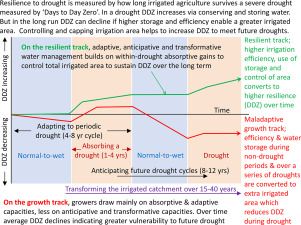
- •Days to Day Zero (DDZ) measures the resilience of irrigated agriculture to drought.
- •Absorptive, adaptive, anticipative and transformative capacities can change DDZ.
- •Improved irrigation efficiency and water storage can increase resilience and DDZ.
- •But resilience and DDZ decline if efficiency and storage expand irrigated areas.
4.3. On storage as a resilience factor
As a result of running various scenarios in WERD-M, we draw the following insights on how water storage mediates resilience:
- •The presence of the large water storage bodies provides an important safeguard against drought impacts (McCartney and Smakhtin, 2010) and if governed well, helps build resilience (Matthews and McCartney, 2018). For example, in our modelled GLC, a refilled storage of 230 MCM can provide 402 days of protective watering for 28,000 ha of irrigated crops. Furthermore, dams and groundwater provide water security for supplying priority non-agricultural sectors.
- •The presence of storage allows inter-drought water to be captured and stored which supports drought resilience. The larger the potential drought store (PDS) the greater the chance of this being refilled by high flow events leading to DDZ being sustained or increased (although this phenomenon was not fully modelled by WERD-M).
- •The presence of storage underpins the ability of irrigators to conserve water and retain that conserved water in storage for release later in the drought to meet protective irrigation needs. Put another way, it is large volumes of water storage which enable the relative gains in DDZ and DPI to occur when water conservation is undertaken. Two corollaries follow – both of which can be demonstrated by adjusting variables in WERD-M. First, if access to storage is switched off so that farmers draw only on low UDF streamflows during a drought, their water conservation attempts would have a much smaller effect on boosting DDZ. Second, if farmers are given access to much larger UDF streamflows during a drought, their reliance on storage for retaining conserved water diminishes.
- •In the long-term, the presence of high-capacity storage, combined with efficiency gains, allows irrigated area to increase by providing a buffer to drought. (A contrasting explanation is that with no or little storage, irrigation would be constrained by a lack of water during drought which would throttle long-term growth). This combined effect supports observations by Di Baldassarre et al. (2018) that higher water demand can offset the initial benefits of reservoirs.
Thus, similar to the previous section’s discussion about efficiency, and as WERD-M demonstrates, the capacity of water storage and size of streamflows accessible by irrigation during a drought variously combine to mediate DDZ resilience. These interactions are further revealed and amplified when irrigated areas are controlled and capped in the longer-term.
https://www.sciencedirect.com/science/article/pii/S0048969722073636
After 5 successive heatwaves this year in the UK, farming has become near impossible due to drought. The UK government is now future proofing UK farming:
Funding Available for On-Farm Reservoirs Following Government Drought Support Package
By Alister Smith, Head of Planning and Design
We all know it has been a very dry summer and, whilst the weather has been celebrated by some, for many farmers it has caused notable hardship and will continue to do so over the coming months.
Whilst it is clearly too late to improve water storage for this summer, action can be taken now to put things in place for future years. The warning from the Met Office of an even hotter 2027 may also be a sign of things to come.
On 14 August 2026, the Government announced a £65 million drought support package for English farmers, including:
- Up to £15 million specifically for on-farm reservoirs.
- The reopening of the Water Management Grant in autumn 2026.
The recently published National Planning Policy Framework (NPPF) also directs councils to look favourably upon infrastructure projects that help address climate and drought risks, including on-farm reservoirs and water storage projects.


You must be logged in to post a comment.