All of us who are white skinned know of historical abuses committed during colonisation of non-white nations. But we continue to abuse non-white people who live within our communities, even though the majority contribute massive benefits to our way of life as our fellow human beings.
I just learned of historic atrocities committed within the United States as a white supremacy backlash against the growing success and prosperity of black communities.
Drowned Towns: The Black Communities Erased by Water
Mar 27, 2025
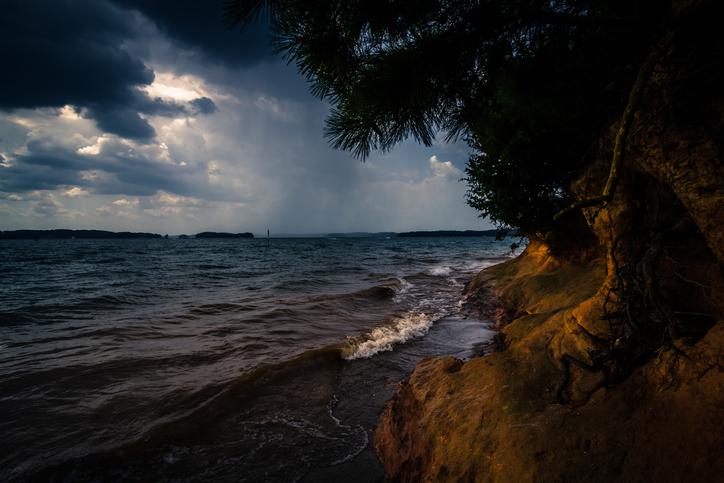
Throughout history, Black communities in America have built thriving towns—only to have them stolen, destroyed, and erased. In five such cases—Oscarville, GA; Ferguson, SC; Little Egypt, NC; Vanport, OR; and Kowaliga, AL—entire Black towns were forcibly emptied and submerged under water, often under the guise of “progress” or public works projects. What were once bustling communities filled with homes, businesses, schools, and churches now lie buried beneath lakes, their histories nearly forgotten.
These were not accidents. Whether through violent racial expulsions, unfair eminent domain seizures, or deliberate neglect, the residents of these towns were forced from their land with little to no compensation. Their loss meant more than just the destruction of homes—it was the theft of generational wealth and culture.
Today, these lakes serve as recreational spots, their dark past hidden beneath the surface. But the stories of the families who lived, worked, and built their lives in these places must not be lost. This is their history.
Oscarville, GA → Lake Lanier
Oscarville, Georgia, was a thriving Black community in Forsyth County, home to farmers, shopkeepers, and skilled laborers. However, in 1912, white mobs terrorized the town after a white woman named Mae Crow was allegedly assaulted. Two Black men, Ernest Knox and Oscar Daniel, were lynched, and white residents launched a campaign of racial violence.
The Black residents were driven out at gunpoint, their homes burned, and their land stolen. Many were forced to flee in the middle of the night, leaving behind farms, churches, and schools.
Decades later, the U.S. Army Corps of Engineers flooded the land in the 1950s to create Lake Lanier, erasing the remnants of Oscarville. Families who had owned property for generations received little or no compensation, and the descendants of those displaced still struggle to reclaim their stolen land.
Survivor Account:
One survivor’s descendant, George Rucker, recounted the fear his grandmother felt as a child when her family had to leave Oscarville. “She remembered the night the men came to their home, torches in hand, telling them they had to go or they’d be killed. They left with just the clothes on their backs.”
Lake Lanier has a notorious reputation for unexplained drownings and accidents, which some believe are tied to the violent history of Oscarville.
All of the human race originated in Africa. We are one people – each has equal value. Our ancient ancestors did not strive to survive in order to destroy one another over artificially created belief systems, motivated by greed and desire for power over one another.
There’s a city buried under Lake Lanier (Georgia’s biggest lake), and submerged with it is a secret: An American horror story filled with terror, death, genocide, and ghosts.
If you spend any time in or around Atlanta, you’ve heard tales of Lake Lanier. There are eerie accounts of fishermen seeing ghostly kayaks floating on the water, or women with no hands roaming the Jerry D. Jackson Bridge. Every so often, someone loses their life at the lake and leaves behind stories of good swimmers being snatched under the water, unexplainable boating accidents, or vehicles crashing into the lake without cause.
Many folks who live close by will tell you straight up, “Don’t go to Lake Lanier.” And its death toll certainly validates their point. There have been well over 500 deaths since the lake’s inception and more than 200 since 1994. Whether the lake is cursed or not is entirely up to you. But, one thing’s for certain, its horrifying past adds a much-needed perspective to understanding its haunting present.
Long before Central Park became New York City’s most iconic green space, its land was home to a thriving, self-sufficient settlement known as Seneca Village. Founded in 1825 by free African Americans, the community represented one of the first significant concentrations of Black property ownership in Manhattan. At its height, it was home to about 225 residents, multiple churches, schools, and cemeteries. But by 1857, the entire village was destroyed through eminent domain to make way for Central Park. For more than a century, Seneca Village was all but erased from history.
Seneca Village was established on land purchased from John Whitehead, a white farmer who began selling off lots in 1825. The first recorded African American buyer was Andrew Williams, a 25-year-old shoeshiner who purchased three lots for $125. That same week, trustee Epiphany Davis of the African Methodist Episcopal Zion Church acquired twelve lots, and soon after, the church itself purchased additional land. These early acquisitions laid the foundation for a settlement where Black New Yorkers could own property, vote, and escape the intense racial hostility of downtown Manhattan.
Following the abolition of slavery in New York State in 1827, more African Americans moved to Seneca Village. By the 1830s, displaced residents from nearby areas, also joined the community. Later, waves of Irish and German immigrants, many fleeing famine and economic hardship, settled alongside Black residents, creating a rare example of a racially and ethnically mixed community in the mid-19th century.
By 1855, Seneca Village had 52 houses, with some built on stone foundations. Archaeological evidence suggests that the homes were well-built and stable, contradicting claims that the area was a “shantytown.” Many residents grew vegetables in gardens, raised livestock, and relied on natural resources like Tanner’s Spring for fresh water and the Hudson River for fishing.
Retired, living in the Scottish Borders after living most of my life in cities in England. I can now indulge my interest in all aspects of living close to nature in a wild landscape. I live on what was once the Iapetus Ocean which took millions of years to travel from the Southern Hemisphere to here in the Northern Hemisphere. That set me thinking and questioning and seeking answers.
In 1998 I co-wrote Millennium Countdown (US)/ A Business Guide to the Year 2000 (UK) see https://www.abebooks.co.uk/products/isbn/9780749427917



You must be logged in to post a comment.