Back in March of this year this was reported, but I missed it. Seems it has been under reported:
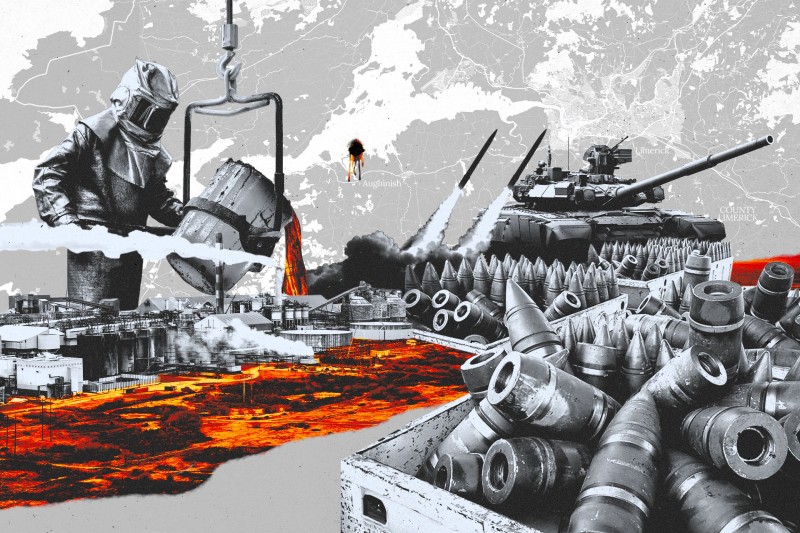
Inside the Supply Chain Funneling Irish Alumina to Russian Rockets
Investigation
Leaked transaction data reveals how a major refinery in Ireland feeds into the aluminum supply chain of Russian weapons manufacturers arming Putin’s forces as they attack Ukraine.
Key Findings
Europe’s largest refinery of alumina — the main raw material used to make aluminum — has been sending the majority of its exports to Russian smelters that feed into the supply chain of EU-sanctioned arms manufacturers.
The Ireland-based plant, Aughinish Alumina, has increased its exports to Russian smelters since Moscow’s full-scale invasion of Ukraine in 2022.
Once in Russia, the alumina is processed into aluminum and sold to clients that include a Moscow-based trader which has supplied hundreds of millions of dollars’ worth of aluminum to Russian arms manufacturers, leaked transaction data shows.
These arms manufacturers include more than 40 firms that have been sanctioned by the EU, and whose weapons have killed thousands of civilians and caused widespread damage in Ukraine.
Despite the EU’s calls for member states to stockpile alumina due to its importance in industry and defense, the bloc has not placed restrictions on the raw material’s export to Russia.
Along a rugged, wind-swept shore in western Ireland stands Aughinish Alumina, the hulking industrial complex that is Europe’s largest alumina refinery.
Inside the sprawling plant, heat and pressure are harnessed to transform bauxite — a reddish rock mined oceans away — into alumina, the main raw material needed to produce aluminum.
Strong and resistant to corrosion, aluminum is vital for manufacturing military hardware like missiles, drones, and aircraft. That’s one reason why the European Commission has called on member states to stockpile alumina as a defense against hostile powers.
Yet rather than remaining in the European Union, the majority of the Aughinish factory’s exports are shipped to Russia’s largest aluminum smelters. Those smelters, in turn, feed into a supply chain of sanctioned defense contractors whose weapons have killed thousands of civilians in Ukraine, a new investigation by OCCRP and partners has found.
Reporters could not track the final destination of a specific batch of Aughinish’s alumina, as the powdery substance is typically mixed together with alumina from other sources in the smelting process.
However, customs and trade data show that since 2023, more than half the Ireland-based refinery’s alumina exports have gone to smelters in Russia owned by the plant’s Russian parent company, United Company Rusal.
After processing the alumina into aluminum, the smelters have sold more than $650 million worth of the metal to a Moscow-based trader, Aluminium Sales Company (ASK), which supplies aluminum to clients that include dozens of EU-sanctioned Russian weapons manufacturers, according to leaked transaction data. (The data does not detail the volume of aluminum sold.)
Weapons made by these firms have leveled entire city blocks in Mariupol, struck a children’s hospital in Kyiv, and blown open an apartment building in western Ukraine, according to EU sanctions listings, Ukraine’s military intelligence, and the London-based Royal United Services Institute (RUSI).
When reached for comment, Aughinish told OCCRP that it operates “in strict compliance with all applicable European Union laws, including sanctions, export control measures and trade regulations.” The company said it had implemented “robust sanctions compliance and due diligence framework covering its entire supply chain,” though it did not respond to specific questions about whether its products might be used to build Russian weapons.
The firm emphasized that alumina and aluminum are basic commodities serving “broad general purpose societal needs…vital for countless civilian industries.”
Alex Prezanti, a U.K. barrister and sanctions specialist, said the lack of restrictions on the alumina trade reflects the tightrope the EU must walk as it tries to stem the flow of money and materials to Russia without compromising the bloc’s own economic interests.
“EU policymakers have to draw a balance between potential impact of sanctions on Russia and potential impact of sanctions on their domestic economies,” said Prezanti, a co-founder of the State Capture Accountability Project non-profit.
No further action was taken on alumina “either because the EU didn’t think that it would have sufficient impact, or because one or more member states decided that this ban was not in their national interests.”
The European Commission did not respond to requests to comment.
Ireland’s Department of Foreign Affairs and Trade stressed that alumina is “not a sanctioned good” and “therefore its export to other countries, including Russia, is not restricted.”
A lack of data makes it “difficult to ascertain where Russia is sourcing its tools and weapons from,” a spokesperson said, adding that “Ireland remains unequivocal in its continuing support for Ukraine in light of Russia’s unjustified invasion.”
Yet Oleksandr V. Danylyuk, a former Ukraine defense official who is now a fellow at the think-tank RUSI, sees a concerning contradiction. In his view, supplying Russia with EU-made alumina “could undermine NATO’s stated goals of supporting Ukraine and deterring Russia.”
Pavlo Shkurenko, a Sanctions Research Fellow at Kyiv School of Economics Institute, also warns that Europe’s “entanglement” with Russia’s metallurgical sector carries serious risks for the continent.
It enables “not only direct daily attacks on Ukrainian civilians, but also potential confrontation with Europe itself, as the development of Russian military industry suggests.”
Retired, living in the Scottish Borders after living most of my life in cities in England. I can now indulge my interest in all aspects of living close to nature in a wild landscape. I live on what was once the Iapetus Ocean which took millions of years to travel from the Southern Hemisphere to here in the Northern Hemisphere. That set me thinking and questioning and seeking answers.
In 1998 I co-wrote Millennium Countdown (US)/ A Business Guide to the Year 2000 (UK) see https://www.abebooks.co.uk/products/isbn/9780749427917