
Russia has a ‘refining problem,’ the biggest question is ‘where are they going to get the diesel from?’
written by Mark Harrison LLB Political Reporter10th Oct 26 1:58 pm
Ukraine intends to continue striking Russian oil refineries despite Donald Trump’s efforts to secure increased diesel supplies from Moscow, exposing a sharp divergence between Washington’s energy priorities and Kyiv’s strategy of degrading the infrastructure sustaining Russia’s war economy.
The Times: EU increases Russian gas purchases despite promises to abandon it
Europe paid €7.88 billion for Russian LNG in the first nine months of the year alone. The bulk of the supplies are under long-term contracts that are still allowed
Oct 17, 2026 20:42
“South Korea’s Russian LNG Imports Hit Nearly Five-Year High in September”
byKwon Haeyoung
Published 16 Oct.2026 20:56(KST)
Russian TASS Report
Imports Rise Amid Disruptions to Qatar’s LNG SupplySouth Korea’s imports of Russian liquefied natural gas (LNG) in September reached their highest level in about five years.
On the 16th (local time), Russia’s state-run TASS news agency reported that an analysis of Korea Customs Service data showed South Korea imported a total of 3.56 million metric tons of LNG last month, worth approximately $3 billion.
Australia was the largest supplier, with 1.33 million metric tons, followed by the United States with 436,000 metric tons and Canada with 426,000 metric tons. South Korea imported 326,000 metric tons of Russian LNG, worth approximately $250 million, the agency reported. This was the largest volume of Russian LNG imports since November 2021.
The agency cited disruptions to Qatar’s supply as the reason for the increase in South Korea’s imports of Russian LNG. Qatar, one of South Korea’s major LNG suppliers, halted LNG production in early March following Iranian airstrikes. State-owned QatarEnergy subsequently declared force majeure on its LNG supply contracts, leaving supplies to South Korea suspended, the agency explained.
Meanwhile, the European Union (EU) and the United Kingdom plan to completely ban the provision of services related to the transport and insurance of Russian LNG starting in January 2027, as part of sanctions against Russia. However, Russian LNG imported by South Korea and Japan under existing long-term supply contracts will be exempt from the sanctions until March 2028.
https://www.asiae.co.kr/en/article/2026101620560700026
Air fuel:
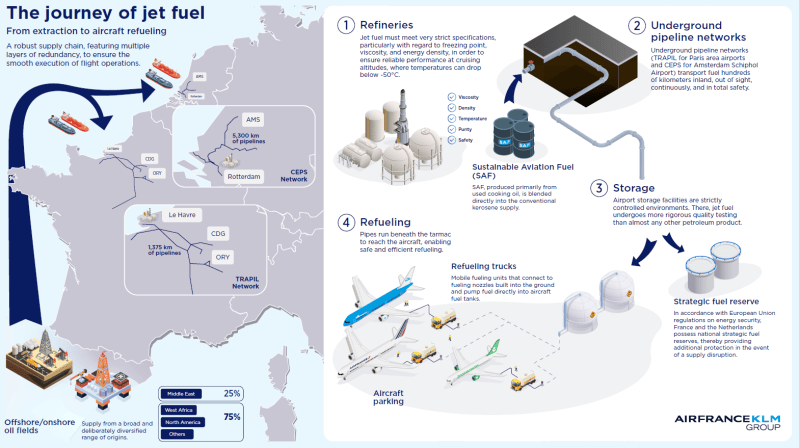
Crude oil and refining: where jet fuel begins
Jet fuel starts as crude oil, extracted from oilfields around the world. Unlike road fuels, Jet A-1 is produced to exceptionally tight specifications: it must meet strict requirements on flash point*, freezing point, viscosity, and energy density to perform reliably at cruising altitudes where temperatures can drop below -50°C.
European airports draw their supply from a broad and deliberately diversified range of origins. Domestic European refineries, including major facilities in France and the Netherlands, provide a significant share of the continent’s needs, supported by imports. Before the crisis, around 25% of jet fuel consumption in Europe was imported from the Middle East. New logistics routes, namely from North America and West Africa, are now in place to increase supply from these regions to Europe.
While recent tensions in the Middle East have put upward pressure on prices, the multitude of supply routes and the depth of storage infrastructure in Europe strengthen the resilience of Air France-KLM’s supply chain in the face of any regional disruptions.


You must be logged in to post a comment.