Details: Sybiha said there is almost no food left in Oleshky, and reports indicate that some civilians are being forced to survive by eating grass and weeds.
Medicines, clean water, electricity and medical care are also becoming increasingly difficult to access. Children are among those living in these conditions.
But the Trump regime sides with Russia and ignores their plight.
Blockade of Oleshky
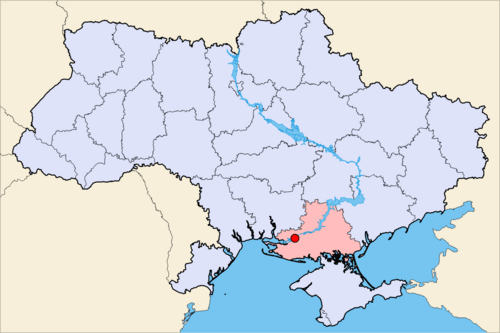
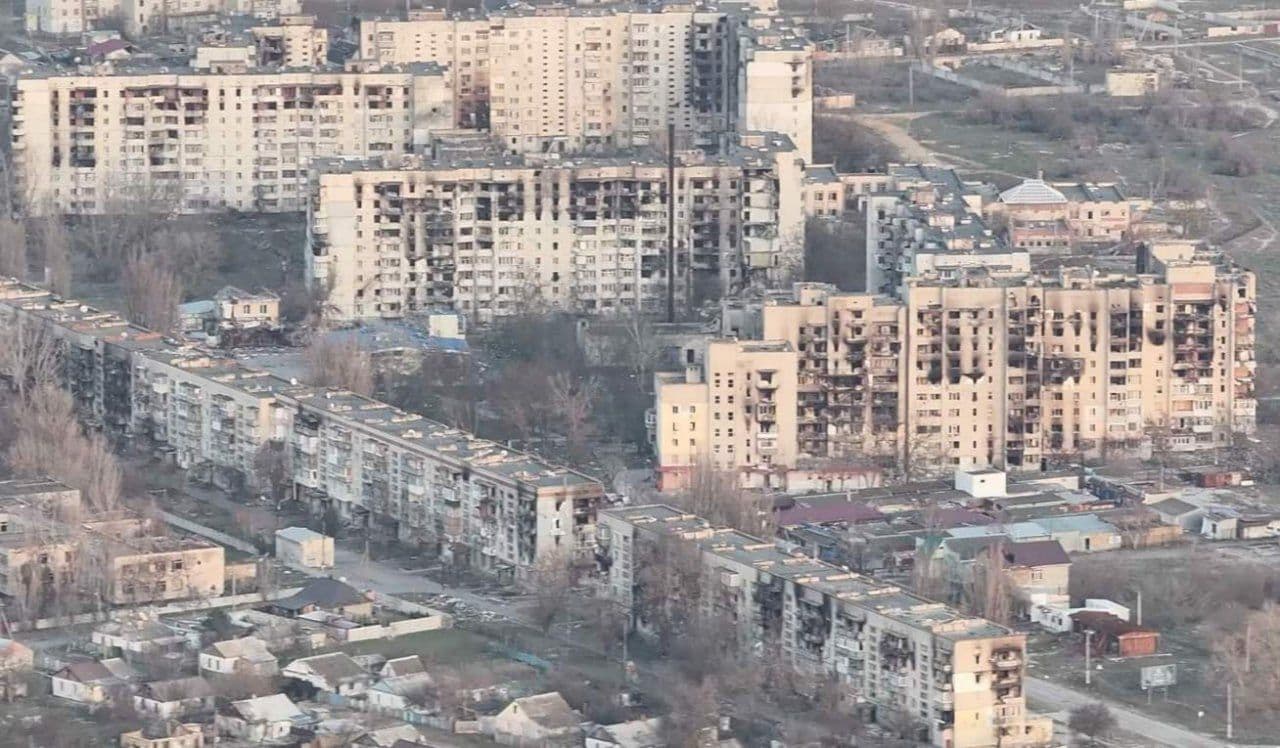
Following the Russian invasion of Ukraine, the city of Oleshky, located in the Russian-occupied part of Kherson Oblast in Ukraine, has been experiencing a worsening food crisis, as placement of land mines and drone attacks have disrupted supplies of food and medicine. The situation has been exacerbated by the fact, that only people who agreed to receive Russian citizenship have reportedly been qualified as eligible to receive aid from the occupying authorities. As a result, the city’s population has decreased from approximately 25,000 before the invasion to only 2,000 as of 2026.[1][2] Ukrainian officials have described the situation in the city and surrounding settlements as a humanitarian blockade, with witnesses making parallels with the Holodomor.[3][4]Location map of Oleshky in Ukraine
The aerial view of Oleshky, a Russian-occupied town in Kherson Oblast, Ukraine in a photo published on Sept.16, 2026. (Dmytro Lubinets / Telegram)
An investigation by Ukrainian media outlet Slidstvo.info published on Oct. 23 has uncovered the identities of Russian officers involved in the blockade of the city of Oleshky in Kherson Oblast.
The Russian-occupied city, located just across the Dnipro River from Kherson, has been effectively blockaded by Russian forces in the area, who prevent humanitarian aid from entering. Civilians attempting to flee via the only roads in and out of the city are frequently targeted by drones.
Building on a previous investigation published in late September that identified the commanders of the Russian 126th Coast Guard Brigade of the Black Sea Fleet and the 331st Guards Airborne Regiment as operating in the area, Slidstvo.info established the presence of the 217th Guards Airborne Regiment and its commander, Georgy Yanchev.
According to the Oct. 23 investigation, the 217th Regiment previously took part in the Battle of Kyiv at the outset of Russia’s full-scale invasion and later fought in Chasiv Yar, one of the main hotspots of fighting in Donetsk Oblast
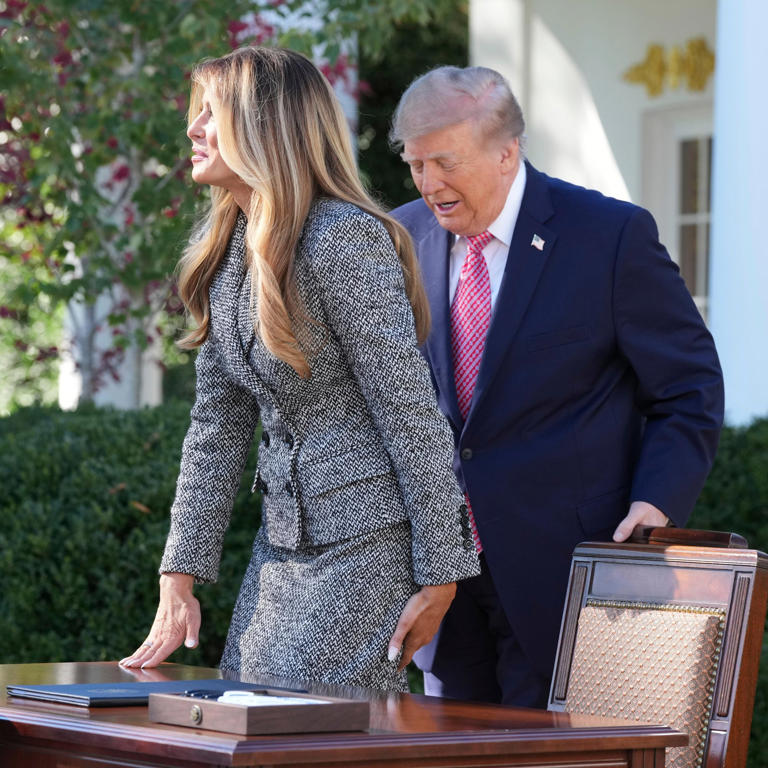
First lady Melania Trump’s office on Friday said she — not President Trump or another top official — has secured a temporary ceasefire between Russia and Ukraine for the Russian-occupied Ukrainian city of Oleshky for humanitarian reasons.
In an unusual announcement for a first lady’s office, it said both nations agreed to temporarily halt all military action in the southern Ukrainian city “to allow for humanitarian aid to enter and to prepare a civilian evacuation through a designated safe passageway.” The localized ceasefire will begin Thursday, Oct. 29.
Russia and Ukraine have not commented on the first lady’s announcement. But Ukrainian officials indicated that there has been a tentative agreement in the Russian-occupied territory in southern Ukraine.
The first lady’s office says she worked “directly with Russian and Ukrainian leadership to define the terms of the localized ceasefire.”
The intervention, presented as a humanitarian request by Melania to Putin, will only place the future of these citizens into a removal by Russians in order that fighting with Ukraine can continue unabated.
Just pointing out, some nearer truth:
On Ukraine war: Pope Francis the prophetic disruptor, Pope Leo the institutional pragmatist
Pope Leo called Vladimir Putin from Rome’s Gemelli Hospital on Friday, Oct. 16, to ask for a humanitarian ceasefire that would allow medical and food assistance to enter the frontline Ukrainian city of Oleshky and for its citizens to safely and voluntarily evacuate. The Kremlin said Mr. Putin “supported the Vatican’s intention” for aid to be delivered and said “cooperation in this regard was agreed upon,” without committing to a ceasefire. On Monday—perhaps due to the absence of visible progress—Leo called Volodymyr Zelensky with the same proposal.
At issue is the livelihood of some 2,000 Ukrainians, including 40 children, who are facing hunger and dropping temperatures as the infrastructure around them has been destroyed. While Mr. Putin agreed on Wednesday to trilateral peace negotiations with Ukraine and the United States to be held sometime in November, the fate of Oleshky hangs in the balance, and it is too early to tell whether Leo’s appeal will have the desired result.
Still, the phone call was remarkable, both considering Leo’s hospitalization—which surely brought an added gravitas to his appeal—as well as the fact that, after Russia’s invasion of Ukraine, Pope Francis was never able to speak to Mr. Putin again. The two had enjoyed a fairly cordial relationship up until the February 2022 invasion, with Mr. Putin calling to wish Francis a happy birthday in December 2021.
…………
“sacriligeous” and denouncing Russian Orthodox Patriarch Kirill’s endorsement of the war, saying Kirill should not become “Putin’s altar boy.”
At the same time, Francis often faced criticism for not going as far as some would have liked in his denunciations (following Vatican protocol, he never named Russia) and for, at times, seemingly playing into Russian talking points, as when he suggested NATO may have provoked the war by “barking at the gates” of Russia or when he spoke about Ukraine needing to have the “courage of the white flag,” which the Vatican later clarified referred to negotiation rather than surrender. Francis’ intention was to keep dialogue open with Russia and Ukraine, but his personal interventions and improvised comments may have made Mr. Putin wary of a top-level bilateral conversation, even as diplomatic work continued between the Holy See and Russia.
Pope Leo XIV, on the other hand, has taken a much more calculated, institutional approach, one that reflects his status as a Vatican “insider” in contrast with Pope Francis, who never held a Vatican role before his election. Leo, from the beginning of his pontificate, has demonstrated trust in the Vatican Secretariat of State—keeping in place the same team Francis had in that department—while initially saying he faced a “huge learning curve” when it came to assuming his role as a world leader, implying he would be leaning more on his team of diplomats for advice.
That institutional approach has led to more measured, specific and scripted appeals for peace: Leo’s strongest words are often reserved for more general denunciations of war, the arms race and the resulting increases in hatred and suffering, while his personal interventions—like the ones we saw this week—have often come with calculated, almost surgical requests. In his first conversation with Mr. Putin, for example, Leo reportedly asked for a concrete gesture of peace and brought up humanitarian assistance and prisoner exchanges—key areas in which Vatican diplomats have already been able to make a difference during this war. Likewise, his request to Mr. Putin and Mr. Zelensky this week called for a humanitarian ceasefire, the delivery of aid and medicine and, vitally, the “safe and voluntary” evacuation of Oleshky.
Retired, living in the Scottish Borders after living most of my life in cities in England. I can now indulge my interest in all aspects of living close to nature in a wild landscape. I live on what was once the Iapetus Ocean which took millions of years to travel from the Southern Hemisphere to here in the Northern Hemisphere. That set me thinking and questioning and seeking answers.
In 1998 I co-wrote Millennium Countdown (US)/ A Business Guide to the Year 2000 (UK) see https://www.abebooks.co.uk/products/isbn/9780749427917



You must be logged in to post a comment.