The Israeli prime minister faced opposition from Lt Gen Eyal Zamir, Israel’s military chief, who believed an attack could prompt Tehran to retaliate, three Israeli defence officials told the New York Times.
After nearly two decades in office, the Israel’s longest-serving prime minister is facing one of the biggest political challenges of his career on Tuesday.
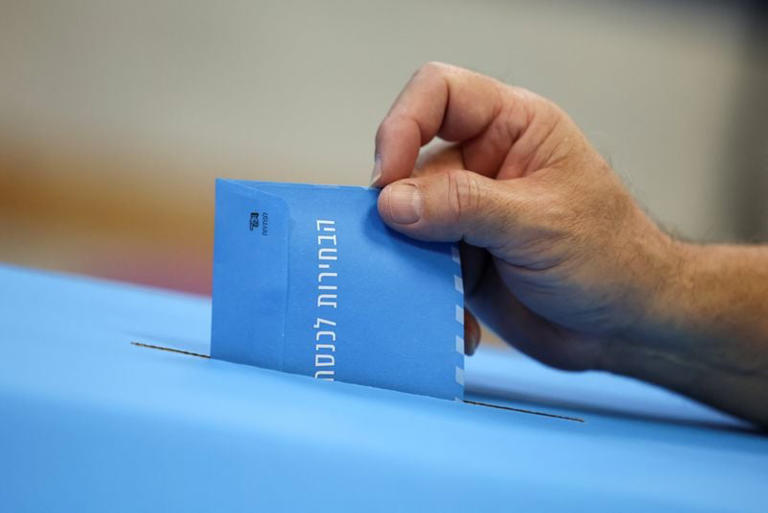
The national elections are the first since the Oct 7, 2023 attacks by Hamas, and Mr Netanyahu, who is behind in the polls, has tied his re-election to the survival of Israel.
Although Lt Gen Zamir was not opposed to an attack on Iran per se, he reportedly objected to the timing coinciding with the elections and said there was no immediate need to restart the conflict, the officials said.
He and Maj Gen Omer Tischler, the commander of the Israeli air force, apparently cited “political sensitivities”, The New York Times reported.
Lt Gen Eyal Zamir, the Israeli military chief, was opposed to the timing of the strike Credit: Reuters/Amir Cohen
Mr Netanyahu has not said publicly why he was pushing for renewed strikes on Iran but a return to war could have delayed the election.
Reports in Israeli media claimed that he would dismiss Lt Gen Zamir if he received a mandate to form the next government.
In his final interview before the election, the Israeli prime minister admitted that his Likud party could face defeat, telling Channel 14 that “it’s not in our pocket and it’s not a lost cause”.
Arab parties:
Ra’am: Mansour Abbas’s pragmatic approach
Ra’am, or the United Arab List, is an Islamist-conservative party led by Mansour Abbas. It advocates better public services and economic opportunities for Arab communities, alongside recognition of Arab citizens’ collective rights.
Its priorities include tackling organised crime, improving housing and infrastructure, narrowing educational inequalities and securing greater resources for Arab municipalities. The party also supports Palestinian statehood, an end to the occupation and the dismantling of Israeli settlements.
Abbas has pursued a pragmatic approach to coalition politics, arguing that Arab lawmakers can secure tangible benefits by negotiating with Israeli governments rather than remaining permanently outside them. In 2021, Ra’am became the first independent Arab party to join an Israeli governing coalition, supporting the government led by Naftali Bennett and Yair Lapid.
For this election, Ra’am’s strategy has centred on presenting itself as a potential negotiating partner. Its list also includes former Israeli deputy public security minister Yoav Segalovitz, a Jewish politician who previously belonged to the centrist Yesh Atid party
Who are Israel’s Arab parties, what they want, why they matter
Story by Raunaq Lekhi
• 10h
Who are Israel’s Arab parties, what they want, why they matter
New Delhi: Israel’s Arab parties could emerge as pivotal players in the country’s first general election since the Hamas-led 7 October 2023 attack. Exit polls released on 28 October project that Palestinian parties could win as many as 19 seats in the 120-member Knesset. Neither the bloc led by Prime Minister Benjamin Netanyahu nor the opposition grouping led by Gadi Eisenkot is projected to secure the 61 seats required for a majority. The official results are still awaited.
The result could give Arab lawmakers greater leverage in negotiations over the next government. But Israel’s Arab parties are not a unified political force. While they share concerns about discrimination, crime and the treatment of Palestinians, they differ over ideology and how far they should cooperate with predominantly Jewish parties to influence government policy.
‘Go home, Ben-Gvir’; Arab bloc celebrates record turnout in Israel elections
Current Time 0:09
/
Duration 0:43
Who are Israel’s Arab parties?
Arab citizens make up roughly a fifth of Israel’s population. They can vote in national elections and elect representatives to the Knesset, although they have long faced inequalities in areas such as housing, public services and municipal funding.
The main Arab political forces contesting the 2026 election are Mansour Abbas’s Ra’am and the Joint List, an alliance comprising Hadash, Ta’al and Balad. The two are pursuing different approaches to political influence.
Ra’am, or the United Arab List, is an Islamist-conservative party led by Mansour Abbas. It advocates better public services and economic opportunities for Arab communities, alongside recognition of Arab citizens’ collective rights.
Its priorities include tackling organised crime, improving housing and infrastructure, narrowing educational inequalities and securing greater resources for Arab municipalities. The party also supports Palestinian statehood, an end to the occupation and the dismantling of Israeli settlements.
Abbas has pursued a pragmatic approach to coalition politics, arguing that Arab lawmakers can secure tangible benefits by negotiating with Israeli governments rather than remaining permanently outside them. In 2021, Ra’am became the first independent Arab party to join an Israeli governing coalition, supporting the government led by Naftali Bennett and Yair Lapid.
For this election, Ra’am’s strategy has centred on presenting itself as a potential negotiating partner. Its list also includes former Israeli deputy public security minister Yoav Segalovitz, a Jewish politician who previously belonged to the centrist Yesh Atid party.
The Joint List: Hadash, Ta’al and Balad
The Joint List brings together three parties with different political traditions.
Hadash, associated with the Jewish-Arab left, emphasises equality, social justice, workers’ rights and cooperation between Jewish and Arab citizens. Ofer Cassif is among its prominent representatives.
Ta’al, founded by Ahmad Tibi, combines Palestinian national advocacy with participation in Israeli parliamentary politics. Tibi is one of the most recognisable Arab lawmakers in Israel.
Balad, led by Sami Abu Shehadeh, advances an Arab-nationalist and democratic vision, calling for Israel to become a state of all its citizens rather than one that privileges Jewish national identity. Abu Shehadeh withdrew from the Joint List’s candidate slate in October, although he remains Balad’s chairman.
Yousef Jabareen and Ahmad Tibi head the Joint List’s filed electoral slate. The alliance supports Palestinian statehood, opposition to the occupation, civil equality and stronger protections for minority rights.
Retired, living in the Scottish Borders after living most of my life in cities in England. I can now indulge my interest in all aspects of living close to nature in a wild landscape. I live on what was once the Iapetus Ocean which took millions of years to travel from the Southern Hemisphere to here in the Northern Hemisphere. That set me thinking and questioning and seeking answers.
In 1998 I co-wrote Millennium Countdown (US)/ A Business Guide to the Year 2000 (UK) see https://www.abebooks.co.uk/products/isbn/9780749427917