World leaders will fly in to Asia for back-to-back high-level summits this week against the backdrop of the tussle for influence between the superpowers China and the US.
Beijing will have the home advantage when it welcomes Donald Trump to its southern technology hub of Shenzhen for the Asia-Pacific Economic Cooperation (Apec) leaders’ meeting. It starts two weeks after the US leader lost midterm elections.
Apec represents more than 60% of global GDP and has primarily promoted free trade and multilateralism. This year’s meeting could be defined, however, by theconfirmed trilateral meeting between Trump, the Chinese president, Xi Jinping, and Vladimir Putin of Russia.
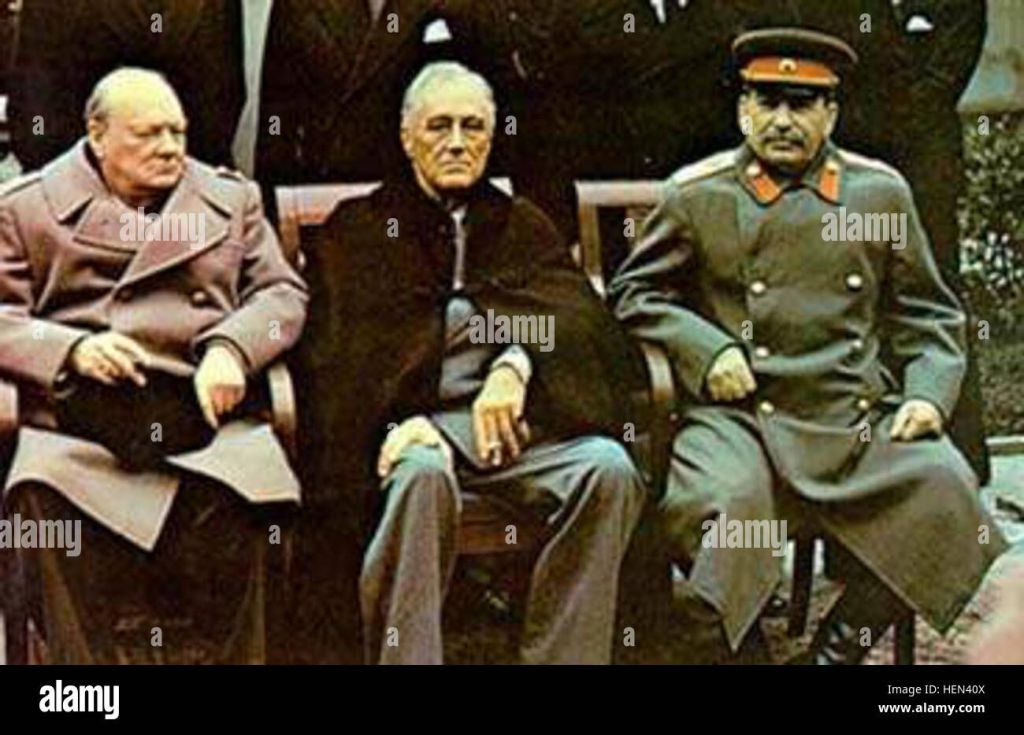
The three-way meeting has been likened to a modern-day Yalta, when in 1945 then US president, Franklin D Roosevelt, Britain’s Winston Churchill and the Soviet leader Joseph Stalin met in Crimea to carve up Europe after the second world war. However, analysts say a “Yalta 2.0” that issues edicts on Ukraine and Taiwan without their involvement is unlikely.
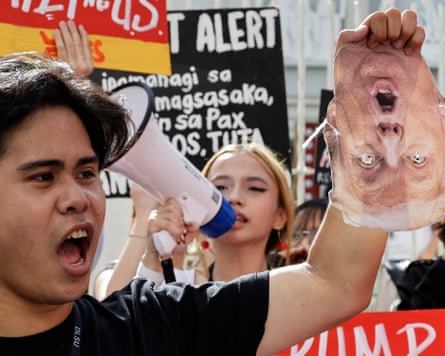
Protesters in Manila on Friday object to Donald Trump’s participation in the Asean summit. Photograph: Rolex dela Peña/EPA
Stalin, Churchill, and Roosevelt first met together at the Tehran Conference, held from November 28 to December 1, 1943. They met again at Yalta in February 1945.
PROTOCOL OF PROCEEDINGS OF CRIMEA CONFERENCE
The Crimea Conference of the heads of the Governments of the United States of America, the United Kingdom, and the Union of Soviet Socialist Republics, which took place from Feb. 4 to 11, came to the following conclusions:
I. WORLD ORGANIZATION
It was decided:
1. That a United Nations conference on the proposed world organization should be summoned for Wednesday, 25 April, 1945, and should be held in the United States of America.
2. The nations to be invited to this conference should be:
(a) the United Nations as they existed on 8 Feb., 1945; and
(b) Such of the Associated Nations as have declared war on the common enemy by 1 March, 1945. (For this purpose, by the term “Associated Nations” was meant the eight Associated Nations and Turkey.) When the conference on world organization is held, the delegates of the United Kingdom and United State of America will support a proposal to admit to original membership two Soviet Socialist Republics, i.e., the Ukraine and White Russia.
3. That the United States Government, on behalf of the three powers, should consult the Government of China and the French Provisional Government in regard to decisions taken at the present conference concerning the proposed world organization.
4. That the text of the invitation to be issued to all the nations which would take part in the United Nations conference should be as follows:
“The Government of the United States of America, on behalf of itself and of the Governments of the United Kingdom, the Union of Soviet Socialistic Republics and the Republic of China and of the Provisional Government of the French Republic invite the Government of ——– to send representatives to a conference to be held on 25 April, 1945, or soon thereafter , at San Francisco, in the United States of America, to prepare a charter for a general international organization for the maintenance of international peace and security.
“The above-named Governments suggest that the conference consider as affording a basis for such a Charter the proposals for the establishment of a general international organization which were made public last October as a result of the Dumbarton Oaks conference and which have now been supplemented by the following provisions for Section C of Chapter VI:
C. Voting
“1. Each member of the Security Council should have one vote.
“2. Decisions of the Security Council on procedural matters should be made by an affirmative vote of seven members.
“3. Decisions of the Security Council on all matters should be made by an affirmative vote of seven members, including the concurring votes of the permanent members; provided that, in decisions under Chapter VIII, Section A and under the second sentence of Paragraph 1 of Chapter VIII, Section C, a party to a dispute should abstain from voting.’
“Further information as to arrangements will be transmitted subsequently.
“In the event that the Government of ——– desires in advance of the conference to present views or comments concerning the proposals, the Government of the United States of America will be pleased to transmit such views and comments to the other participating Governments.”
Retired, living in the Scottish Borders after living most of my life in cities in England. I can now indulge my interest in all aspects of living close to nature in a wild landscape. I live on what was once the Iapetus Ocean which took millions of years to travel from the Southern Hemisphere to here in the Northern Hemisphere. That set me thinking and questioning and seeking answers.
In 1998 I co-wrote Millennium Countdown (US)/ A Business Guide to the Year 2000 (UK) see https://www.abebooks.co.uk/products/isbn/9780749427917



You must be logged in to post a comment.