At least 45 MQ-9 Reaper drones have been shot down or crashed, which accounts for about 25% of the U.S. military’s fleet during the ongoing conflict with Iran. The Independent migflug.com
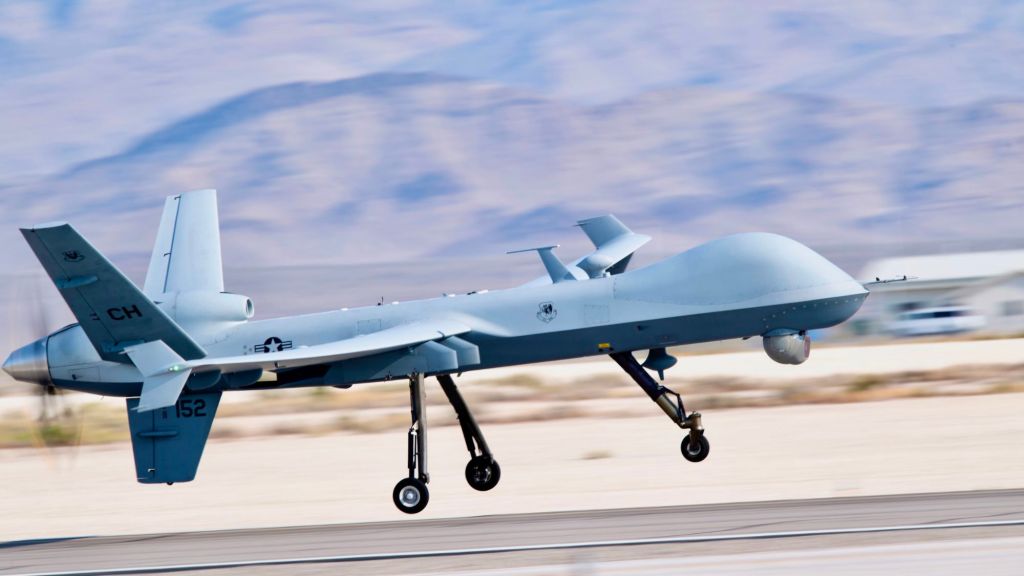
The MQ-9A “Reaper” was developed by General Atomics Aeronautical. The design was that of the earlier battle-proven MQ-1 Predator (Predator RPA), albeit larger and far deadlier, and saw first flight in 2001. The main purpose behind its design was to execute time-sensitive targets.
This was to be done with persistence and precision in the aim of destroying or disabling those very targets. It also serves as an intelligence gathering reconnaissance aircraft that is able to coordinate strikes or itself strike the very thing it is observing.
You’ll find that MQ-9 Reaper acquisition costs vary considerably based on configuration—basic airframes run $14.5-33 million, while complete systems average $33 million in 2024 dollars. However, fully-equipped operational packages routinely exceed $100 million per aircraft when you account for mission systems (56% of unit cost), ground control stations ($3.17 million each), advanced sensor suites, weapons integration, and support infrastructure. Foreign military sales demonstrate this reality: Italy’s six-aircraft package totaled $738 million, while Qatar’s eight MQ-9B systems reached $1.96 billion. The following analysis breaks down these complex cost drivers and lifecycle expenses.
Breaking Down the MQ-9 Reaper Unit Acquisition Price
When evaluating the MQ-9 Reaper‘s acquisition price, you’ll find the airframe itself represents the dominant cost driver at $14.5 million per unit based on the Air Force’s 29-aircraft procurement plan totaling $420 million. However, your acquisition strategy must account for the complete system cost, which averages $33 million per unit in 2024 dollars—significantly higher than the bare airframe price. This budget allocation includes essential components beyond the aircraft structure. The ground control stations add $3.17 million each, with 10 units totaling $31.7 million. Program management requires $60.5 million, while satellite communications equipment demands $3 million. The Reaper’s integration of advanced sensors enables its dual-purpose capability for both surveillance and precision strike missions across diverse operational theaters. These systems can function similarly to drone motherships by coordinating with other aerial platforms and transmitting critical mission data to ground control stations. The widespread adoption of Reaper systems reflects the broader trend toward low-cost, high-impact operations that have become central to contemporary military strategy. This cost-effectiveness aligns with the integration of loitering munitions and other economical platforms that modernize defense capabilities. All Reaper aircraft over 250 grams must comply with Remote ID regulations to maintain operational standards and airspace integration requirements. When you examine bundled configurations, you’ll see complete four-aircraft packages—including sensors, ground stations, and satellite links—priced at $56.5 million, demonstrating the system’s integrated complexity. Procurement spending, which encompasses aircraft purchases, ground control stations, modifications, repairs, and spare parts, received $884.8 million in allocation, representing 79% of the total Reaper budget.
(VIDEO) Houthis Down 21st U.S. MQ-9 Reaper, Delivering US$735 Million Blow to America’s Aerial Dominance
(Video) “With this 21st MQ-9 Reaper drone downed, the U.S. military is estimated to have incurred losses amounting to US$735 million (RM3.2 billion) due to these drone incidents,” according to a military observer.
Iran has unveiled footage of what it describes as a new air defence system, claiming its forces have shot down dozens of American military drones amid the ongoing US-Iran conflict. The Islamic Revolutionary Guard Corps claims Iranian forces have destroyed 56 US MQ-9 Reaper drones and 16 MQ-1 drones, taking the claimed total to 72. Newly released nighttime footage reportedly shows the air defence system tracking and striking aerial targets. The MQ-9 Reaper is one of the US military’s most advanced unmanned aircraft, used for intelligence gathering, surveillance and precision strikes. Iran has also reported discovering the wreckage of an advanced Orbiter 4 reconnaissance drone in western Iran, claiming it was shot down during the 40-day US-Israeli war
In mid-October it was confirmed that at least 81 American military aircraft had been lost or damaged during the U.S.-led war effort against Iran since February 28, including at least 45 MQ-9 Reaper drones. This count did not account for the reported destruction of eight newly produced and unassembled MQ-9s during an Iranian missile strike on King Faisal Air Base in Jordan in late July. Reports of unassembled MQ-9 drones being present at air bases in the Middle East corroborated with reports from U.S. sources that a number of airframes stored by the type’s primary producer, General Atomics, could be purchased by the Air Force to replenish wartime losses. The U.S. Air Force cannot place orders for additional MQ-9A Reapers due to the suspension of production, as while limited production of the MQ-9 continues, only the very different MQ-9B SeaGuardian, which has a redesigned airframe that has different systems and logistics requirements, is being produced.
Retired, living in the Scottish Borders after living most of my life in cities in England. I can now indulge my interest in all aspects of living close to nature in a wild landscape. I live on what was once the Iapetus Ocean which took millions of years to travel from the Southern Hemisphere to here in the Northern Hemisphere. That set me thinking and questioning and seeking answers.
In 1998 I co-wrote Millennium Countdown (US)/ A Business Guide to the Year 2000 (UK) see https://www.abebooks.co.uk/products/isbn/9780749427917



You must be logged in to post a comment.