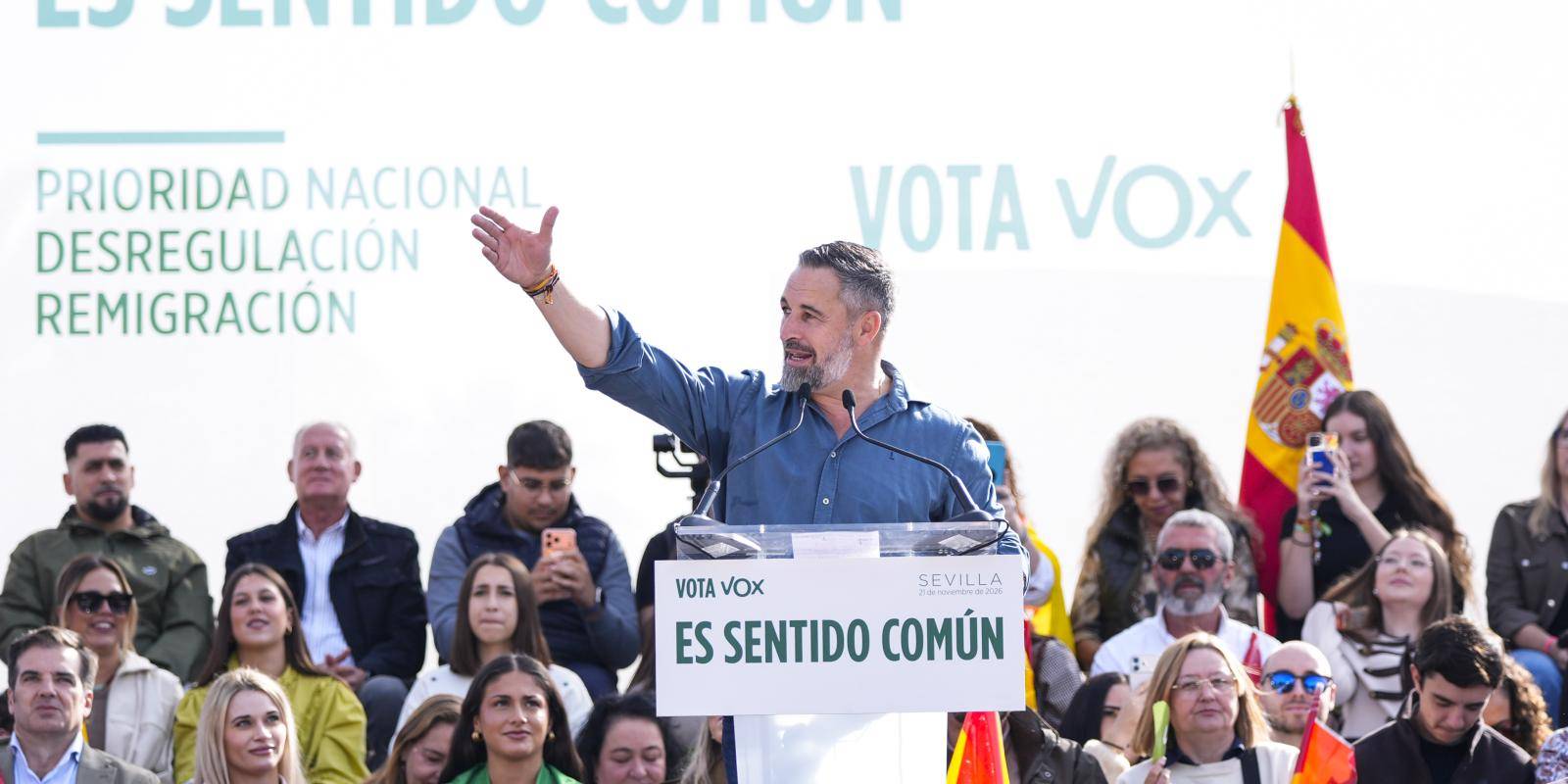
Spain’s election could see Europe’s far-right ‘firewall’ begin to fall apart
Polls suggest the Spanish election could produce a coalition of the conservative Partido Popular (PP) and the far-right Vox party, with consequences far beyond Madrid.
Spain votes on Sunday 29 November in a snap general election called by Prime Minister Pedro Sánchez. Most polls suggest the conservative opposition Partido Popular (PP), led by Alberto Feijóo, will be the largest party but fall short of a majority itself. They also suggest that together with the far-right Vox, led by Santiago Abascal, the right-wing bloc would have a combined majority in the 350-seat parliament.
As of 22 November, Convergent Opinion’s MRP poll put the two parties on a combined 186 seats, 10 above the 176 needed.
It is illegal in Spain to publish polls in the week leading up to the election, which is when data suggests that voters typically decide who to vote for, leaving poll watchers in the dark during the final straight. This may aid the left-wing bloc as voters consider how best to tactical vote against the right.
Sánchez has been clear that the only route to victory for the left is high mobilization – with the prime minister targeting a turnout of 75 per cent. Although the Socialists have gained ground in the campaign, the gap between blocs may be too large to overturn without such extraordinary high turnout.
If Vox is brought into government, Spain will become the test case for what happens when Europe’s centre right drops its barrier to the far right.
A PP-Vox coalition government seems the most likely outcome. In this instance, Vox would not just lend its votes from outside government. On current polling it would win between 55 and 69 seats, close to a third of the right-wing bloc. This would be enough to claim ministries and shape policy.
However, it remains to be seen whether Vox choses to pursue its objectives from within government or to exert pressure on a minority Feijoo government. Until now, the PP and Vox have governed together only in regional and local government. A national coalition would give Vox a say in Spain’s foreign policy for the first time. It would also be the first time the far right has been in government in Spain since it became a democratic country.
Elsewhere in Europe, Finland, Sweden and the Netherlands have all brought the far right into government or into formal support arrangements. But Spain is the eurozone’s fourth-largest economy and, under Sánchez, has been the most outspoken progressive government among the EU’s large states.
If Vox is brought into government, Spain will become the test case for what happens when Europe’s centre right drops its barrier to the far right at the national level – referred to as the ‘firewall’ in Germany. It will have direct consequences for Spain’s foreign policy and wider European politics.
Divided over Europe
The deepest divide between the two potential coalition parties is over Europe itself. The PP belongs to the European People’s Party, the group that leads the EU institutions. In 2024, Vox left the European Conservatives and Reformists group and joined the Patriots for Europe, the far more Eurosceptic group that was founded by Viktor Orbán.
On trade, Vox calls the EU-Mercosur trade agreement a ‘betrayal’ of Spanish farmers and attacks the PP for supporting it. If a coalition is formed, Feijóo will need to decide if he will defend a deal in Brussels that his coalition partner back home has virulently rejected.
On Ukraine, Feijóo’s PP supports Kyiv in line with the mainstream European centre right position. However, when US President Trump clashed with Ukraine’s President Zelenskyy in the White House in 2025, Abascal took Trump’s side and attacked the European leaders backing Kyiv. Vox denies being pro-Russian, but Abascal has previously sought to blame Europe for financing the war in Ukraine and his party has repeatedly abstained on resolutions in the European Parliament.
Morocco, migration and Gibraltar
Vox’s manifesto makes ‘remigration’ a central promise, borrowing the term from Germany’s AfD. Yet Spain cannot easily control migration without Morocco’s cooperation. The PP’s Feijóo had pledged to make Morocco his first foreign visit as prime minister, but his tone has hardened since the Ceuta border crisis in the summer. In last week’s televised debate, he called the crisis an ‘invasion’, taking a far more hostile line towards Rabat than Sánchez. Vox, for its part, has vowed to militarize the border – something unlikely to please Rabat.
Retired, living in the Scottish Borders after living most of my life in cities in England. I can now indulge my interest in all aspects of living close to nature in a wild landscape. I live on what was once the Iapetus Ocean which took millions of years to travel from the Southern Hemisphere to here in the Northern Hemisphere. That set me thinking and questioning and seeking answers.
In 1998 I co-wrote Millennium Countdown (US)/ A Business Guide to the Year 2000 (UK) see https://www.abebooks.co.uk/products/isbn/9780749427917